#DollarIndexBreaksBelow99
The Historic Breakdown
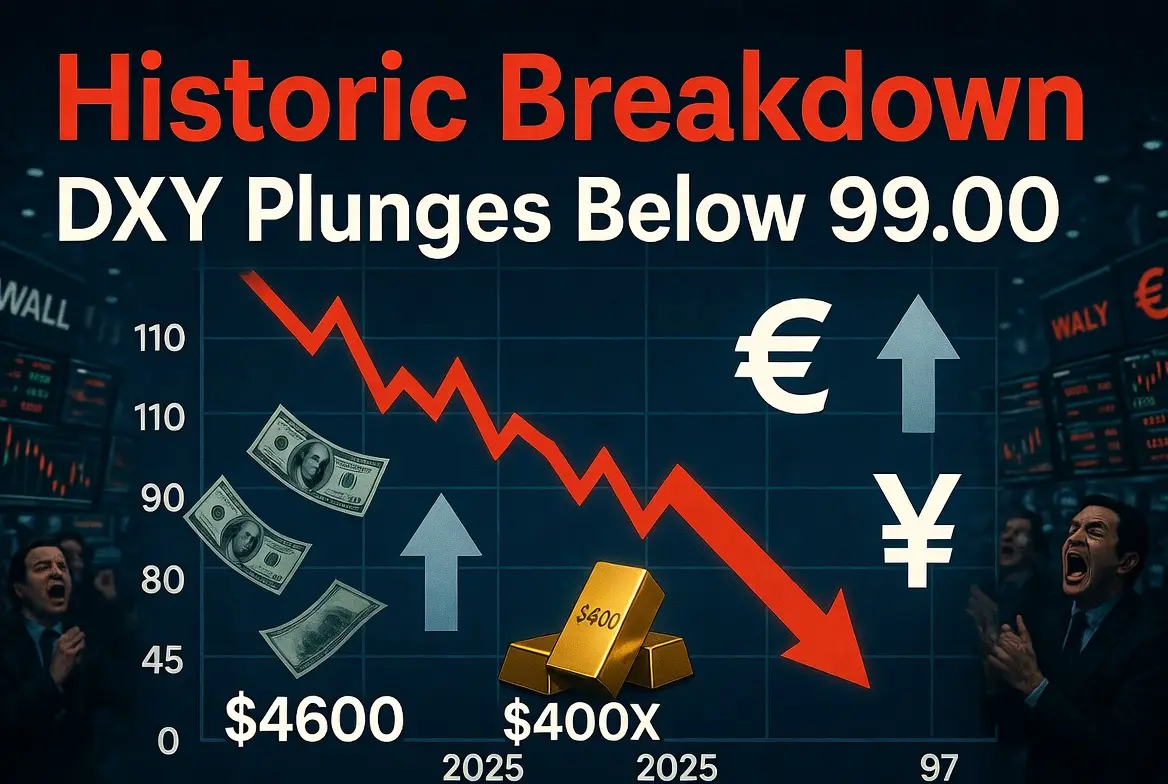
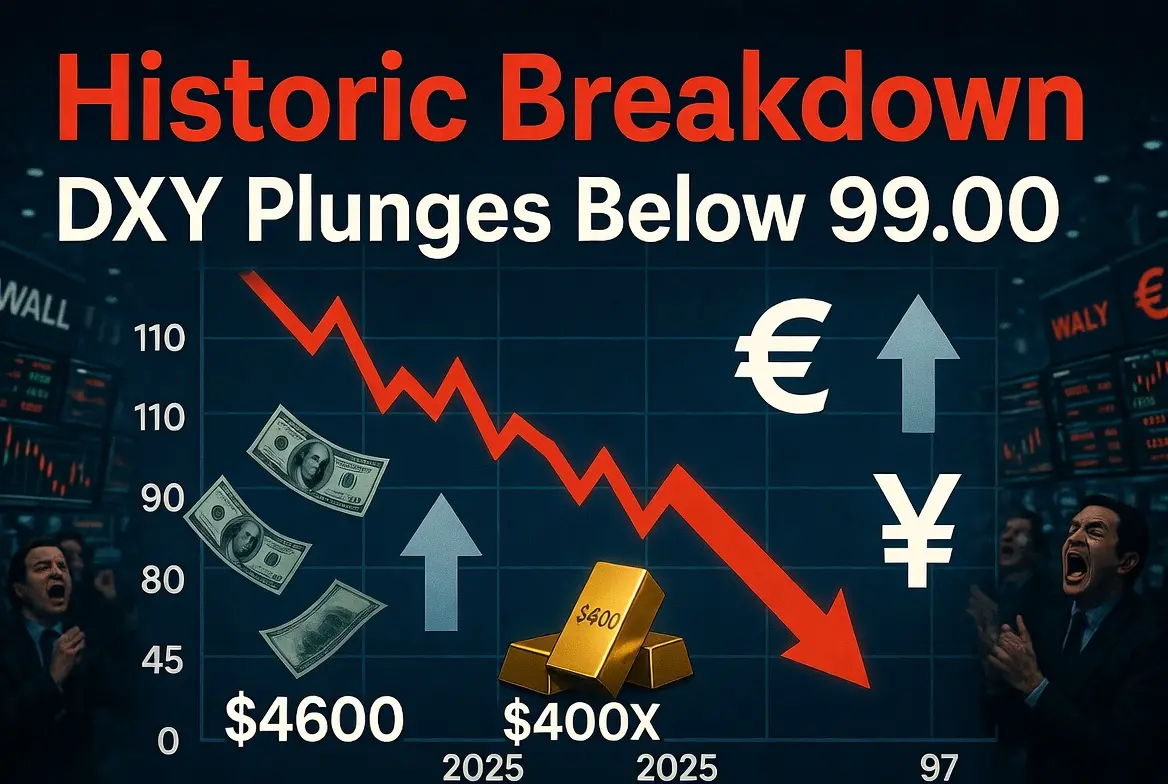
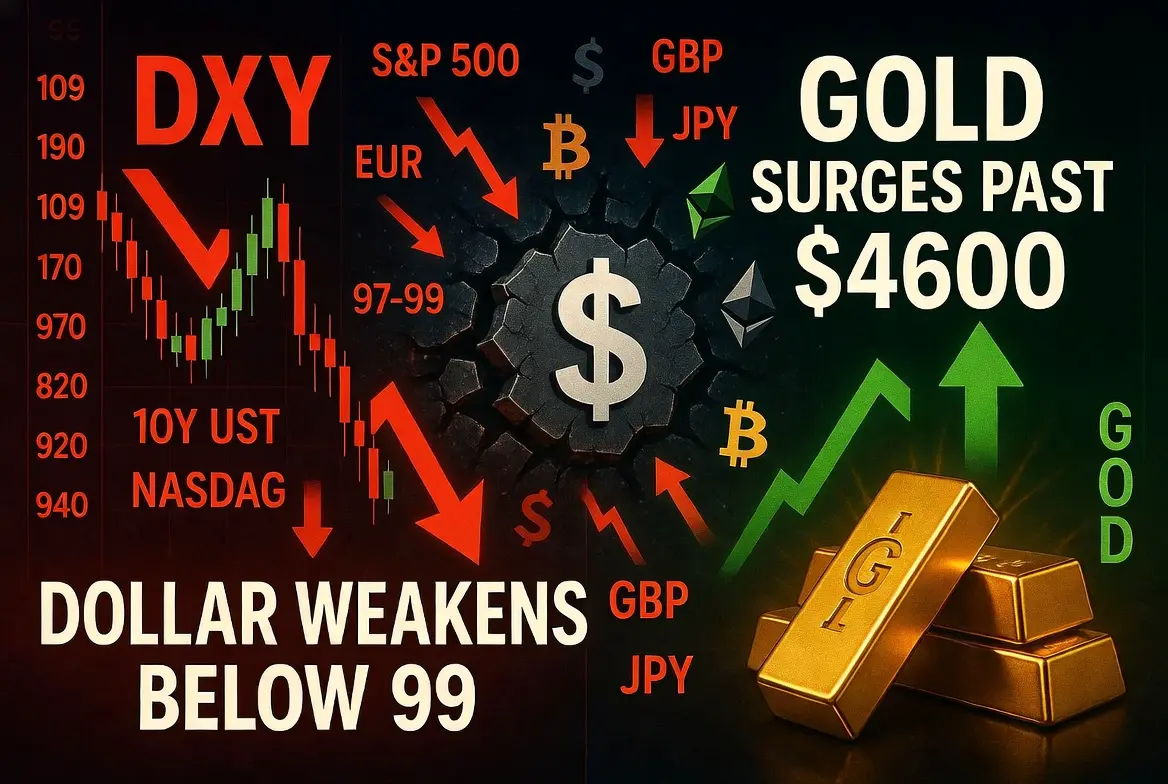
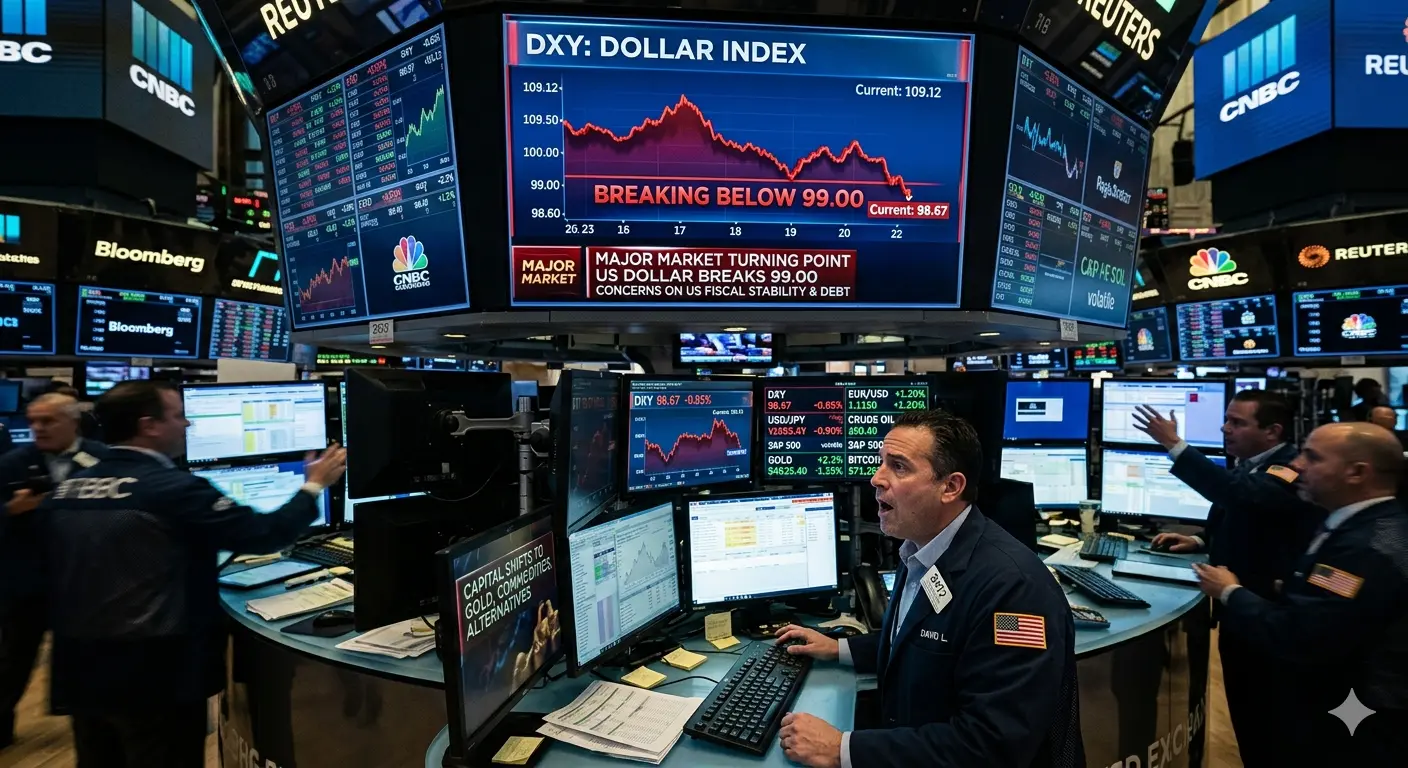
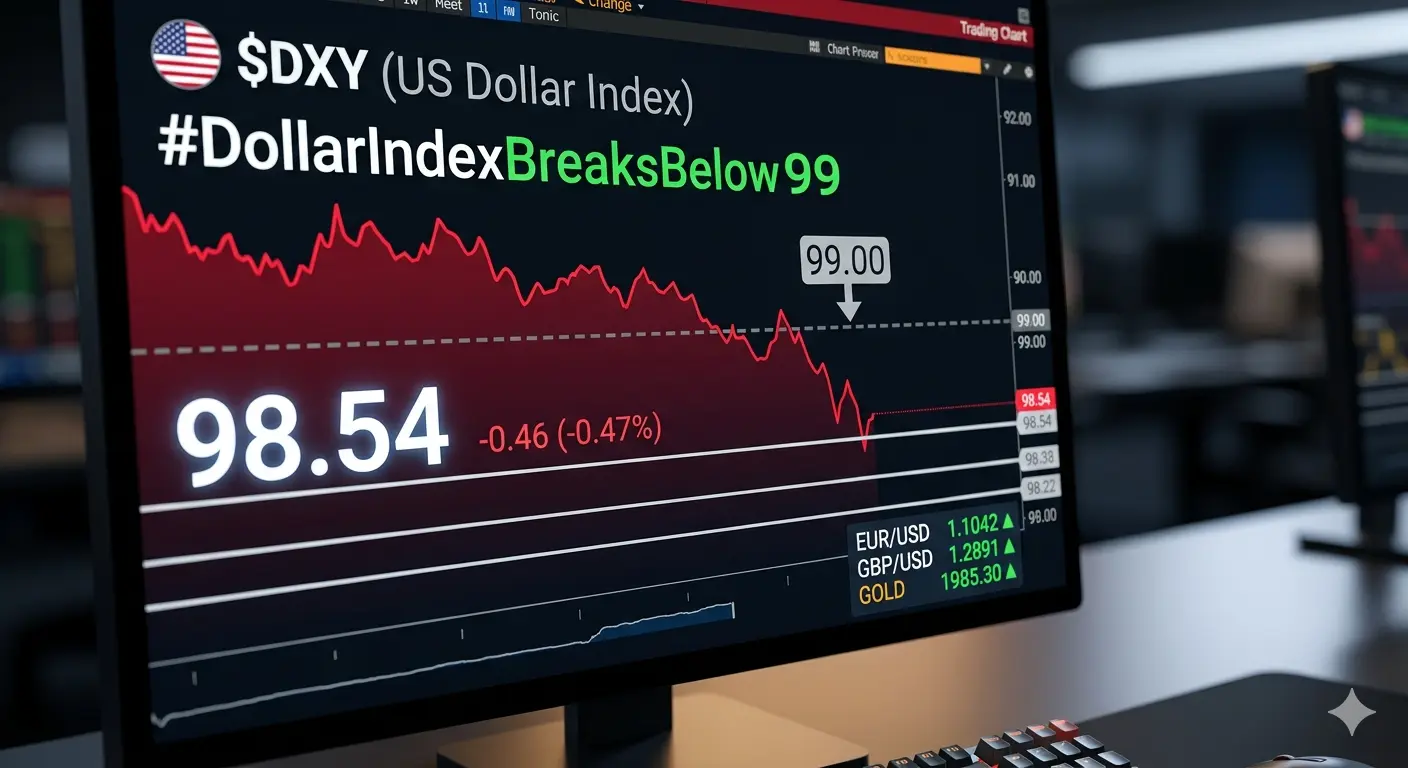
The United States Dollar Index (DXY) has broken below the psychologically critical 99.00 level, marking one of the most significant currency breakdowns seen in global financial markets during the modern floating exchange-rate era, and this historic decline is being viewed by institutional investors, central banks, hedge funds, commodity traders, and multinational corporations as far more than a temporary correction because it reflects a broader shift in confidence regarding the long-term stability of U.S. fiscal policy, monetary credibility, debt sustainability, and America’s role at the center of the global financial system.
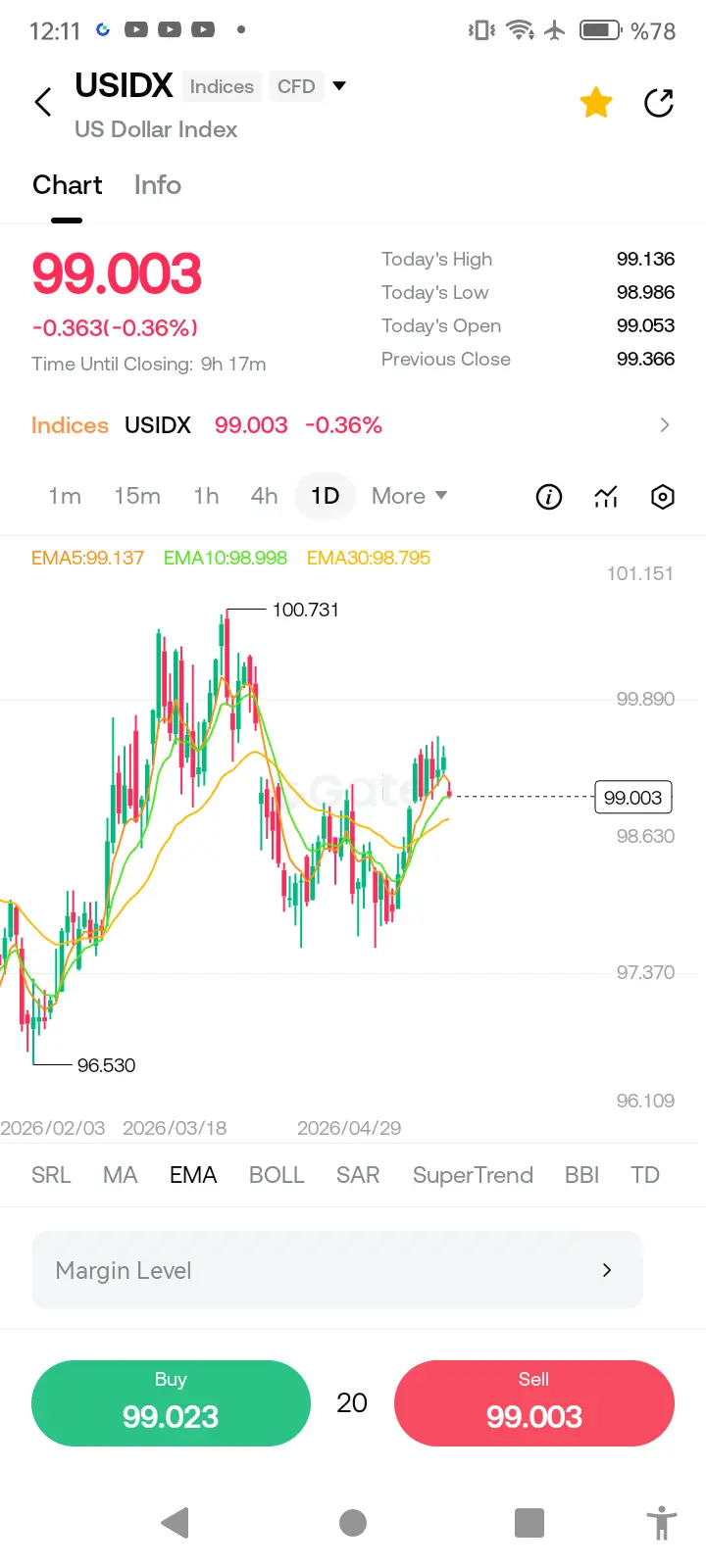
The collapse below 99.00 carries major technical and psychological importance because this zone had repeatedly acted as a strong institutional support region during previous periods of market stress, and once such a long-standing support structure fails under heavy volume and sustained selling pressure, markets often interpret the move as confirmation that a deeper long-term trend reversal is underway rather than a short-term fluctuation driven by temporary headlines or speculative positioning.
Currency strategists across major banks now believe that the dollar may be entering a prolonged structural downtrend similar to major historical periods of dollar weakness seen after the Bretton Woods collapse in 1973, the Plaza Accord era of the mid-1980s, and the gradual depreciation cycle that unfolded during the early 2000s, although the current situation is considered more dangerous because fiscal concerns, trade uncertainty, geopolitical fragmentation, and declining institutional confidence are all occurring simultaneously.
The Magnitude of the Decline: By The Numbers
The scale of the dollar’s decline throughout 2025 has been extraordinary by historical standards because the U.S. Dollar Index has fallen nearly 10.1% year-to-date, making it the steepest annual decline in roughly three decades and the weakest first-half performance for the dollar in more than fifty years, while intraday volatility has surged to levels rarely seen in reserve currencies as traders witnessed multiple trading sessions where the DXY moved between 1.0% and 1.5% within hours.
The index collapsed from highs near 109.80 reached during the strong-dollar rally phase into lows around 97.70 during early July trading before staging a limited rebound toward the 98.80–99.20 region, but despite these temporary recoveries the broader structure remains deeply bearish because the dollar continues trading below major moving averages including the 100-day and 200-day trend indicators that many institutional traders use to define long-term momentum direction.
Relative to historical averages, the DXY now trades approximately 5.7% below its 2022–2025 average, slightly above the 2015–2020 average, yet still significantly stronger than the extremely weak-dollar environment experienced between 2007 and 2014 when the index traded near 78–88 for extended periods, which means that although the current collapse appears severe, some analysts argue that additional downside toward 95.00 or even 92.00 cannot be ruled out if macroeconomic conditions continue deteriorating.
Understanding the Dollar Index Composition
The U.S. Dollar Index measures the value of the dollar against a basket of six major global currencies, including the euro with a dominant weighting of 57.6%, followed by the Japanese yen at 13.6%, British pound at 11.9%, Canadian dollar at 9.1%, Swedish krona at 4.2%, and Swiss franc at 3.6%, which means that movements in EUR/USD have the single largest influence on the overall direction of the DXY.
Because of the euro’s overwhelming weighting within the index, the recent DXY collapse has largely reflected aggressive euro appreciation as EUR/USD surged from the 1.04–1.05 range toward 1.16–1.18, while USD/JPY simultaneously dropped from highs above 161 toward 146–148 due to strong yen buying and Bank of Japan policy normalization expectations.
The index was originally established in 1973 after the collapse of the Bretton Woods fixed exchange-rate system, and since then it has become one of the most closely watched macroeconomic benchmarks in global finance because movements in the dollar influence commodity pricing, international trade flows, debt servicing costs, inflation dynamics, capital allocation, and central-bank reserve management worldwide.
Root Causes: Why the Dollar Is Falling
Trade Policy Shock and "Liberation Day"
The April 2, 2025 tariff announcement, widely referred to by markets as “Liberation Day,” became the single most important catalyst behind the dollar’s collapse because the administration introduced sweeping tariffs covering imports from nearly 180 countries, creating immediate fears of slowing global trade, weakening corporate earnings, rising inflationary pressure, and recession risks across both developed and emerging economies.
Instead of strengthening the dollar as traditional economic models would normally predict, the tariffs triggered aggressive foreign selling of U.S. assets because international investors feared that escalating trade tensions could damage long-term U.S. growth prospects, disrupt global supply chains, and reduce the attractiveness of American financial markets, leading to more than $5 trillion being erased from the S&P 500 within just three trading sessions while Treasury yields spiked sharply due to heavy bond-market liquidation.
Federal Reserve Independence Concerns
Financial markets also became increasingly concerned about political pressure on Federal Reserve Chair Jerome Powell because repeated demands for immediate rate cuts created fears that the Fed’s independence could weaken, and institutional investors historically consider central-bank credibility one of the most important pillars supporting reserve-currency stability.
Interest-rate futures now price in multiple Federal Reserve cuts before year-end, with expectations that benchmark rates could fall from the 5.25%–5.50% region toward 4.25%–4.50%, and lower interest rates naturally reduce the yield advantage that previously supported dollar strength during 2022 and 2023 when aggressive tightening pushed Treasury yields above 5%.
Fiscal Sustainability Worries
Concerns surrounding U.S. debt sustainability have intensified dramatically because projected federal debt levels continue climbing toward $40 trillion while the debt-to-GDP ratio remains near historically extreme levels above 120%, and investors fear that persistent deficit expansion combined with slower economic growth could eventually undermine confidence in long-term Treasury stability.
Moody’s decision in May 2025 to downgrade U.S. sovereign credit added further pressure because the downgrade reinforced market fears that America’s fiscal trajectory is becoming increasingly difficult to stabilize without either substantial spending cuts, stronger growth, or significantly higher taxation in future years.
Safe-Haven Status Erosion
Perhaps the most important structural development is the gradual erosion of the dollar’s traditional safe-haven status because during previous geopolitical crises investors almost automatically rushed into dollars and Treasuries, whereas the current environment has seen gold rally above $4,600 per ounce while the dollar simultaneously weakened despite elevated geopolitical uncertainty across the Middle East, Eastern Europe, and Asia.
This unusual divergence signals that many investors are increasingly viewing gold, select commodities, and alternative reserve assets as safer stores of value than dollar-denominated instruments during periods of global instability.
Global Impact and Market Reactions
Commodity Price Surge
The decline in the dollar has triggered powerful rallies across commodity markets because dollar-denominated assets become cheaper for holders of foreign currencies whenever the greenback weakens, resulting in gold surging above $4,600, silver climbing toward $58, copper moving above $6.20 per pound, and Brent crude fluctuating between $96 and $112 depending on geopolitical developments and demand expectations.
Central banks across Asia and the Middle East have accelerated gold purchases at record pace while reducing portions of their Treasury holdings, contributing further to the precious-metals rally and reinforcing broader de-dollarization narratives developing within global reserve-management strategies.
Emerging Market Currency Strength
Emerging-market currencies including the Brazilian real, Mexican peso, Indian rupee, and several Southeast Asian currencies have strengthened considerably against the dollar, improving purchasing power and reducing imported inflation pressures, although stronger local currencies may create challenges for export competitiveness if appreciation continues too rapidly.
Cryptocurrency Market Response
Cryptocurrency markets have responded in a more complex manner because although weaker fiat conditions traditionally support alternative assets such as Bitcoin and Ethereum, digital assets are increasingly influenced by ETF inflows, institutional leverage positioning, liquidity cycles, and macro risk appetite rather than simple dollar weakness alone.
Bitcoin traded between $92,000 and $118,000 during the broader DXY collapse while Ethereum fluctuated between $4,800 and $6,900, showing that crypto markets remain volatile despite favorable long-term monetary conditions.
Technical Analysis: What Breaking Below 99 Means
From a technical perspective, the break below 99.00 confirms a major bearish continuation pattern because former support has now transformed into resistance, meaning future rallies toward 99.00–100.00 may attract renewed institutional selling pressure unless macroeconomic conditions improve significantly.
The next downside support zones are clustered near 98.50–98.20 followed by the psychologically important 97.50 region, while a sustained breakdown below 97.50 could expose deeper targets around 96.00 and potentially 94.80 over the medium term.
Momentum indicators including weekly RSI, MACD, and trend-volume analysis continue signaling strong downside momentum, while elevated trading volume during declines confirms that the move reflects genuine institutional repositioning rather than temporary speculative volatility.
Conclusion: A Watershed Moment
The Dollar Index breaking below 99 represents one of the most important macroeconomic developments of the decade because it reflects a combination of fiscal concerns, monetary-policy uncertainty, trade instability, and changing global reserve preferences that collectively challenge the assumption of permanent dollar dominance within the international financial system.
Although the dollar remains the world’s primary reserve currency and still dominates global trade settlement, cross-border lending, commodity pricing, and foreign-exchange reserves, the speed and scale of the recent decline suggest that global investors are becoming increasingly willing to diversify away from exclusive dependence on U.S. assets whenever confidence in American policy management weakens.
If policymakers fail to restore fiscal discipline, maintain Federal Reserve credibility, and stabilize long-term growth expectations, the dollar could face extended structural weakness over the coming years with potential downside targets toward 95.00–92.00, while gold, commodities, emerging markets, and alternative reserve assets may continue benefiting from the broader transition toward a more fragmented and multipolar financial system.@Gate_Square @Gate广场_Official #DailyPolymarketHotspot #TradfiTradingChallenge
The Historic Breakdown
The United States Dollar Index (DXY) has broken below the psychologically critical 99.00 level, marking one of the most significant currency breakdowns seen in global financial markets during the modern floating exchange-rate era, and this historic decline is being viewed by institutional investors, central banks, hedge funds, commodity traders, and multinational corporations as far more than a temporary correction because it reflects a broader shift in confidence regarding the long-term stability of U.S. fiscal policy, monetary credibility, debt sustainability, and America’s role at the center of the global financial system.
The collapse below 99.00 carries major technical and psychological importance because this zone had repeatedly acted as a strong institutional support region during previous periods of market stress, and once such a long-standing support structure fails under heavy volume and sustained selling pressure, markets often interpret the move as confirmation that a deeper long-term trend reversal is underway rather than a short-term fluctuation driven by temporary headlines or speculative positioning.
Currency strategists across major banks now believe that the dollar may be entering a prolonged structural downtrend similar to major historical periods of dollar weakness seen after the Bretton Woods collapse in 1973, the Plaza Accord era of the mid-1980s, and the gradual depreciation cycle that unfolded during the early 2000s, although the current situation is considered more dangerous because fiscal concerns, trade uncertainty, geopolitical fragmentation, and declining institutional confidence are all occurring simultaneously.
The Magnitude of the Decline: By The Numbers
The scale of the dollar’s decline throughout 2025 has been extraordinary by historical standards because the U.S. Dollar Index has fallen nearly 10.1% year-to-date, making it the steepest annual decline in roughly three decades and the weakest first-half performance for the dollar in more than fifty years, while intraday volatility has surged to levels rarely seen in reserve currencies as traders witnessed multiple trading sessions where the DXY moved between 1.0% and 1.5% within hours.
The index collapsed from highs near 109.80 reached during the strong-dollar rally phase into lows around 97.70 during early July trading before staging a limited rebound toward the 98.80–99.20 region, but despite these temporary recoveries the broader structure remains deeply bearish because the dollar continues trading below major moving averages including the 100-day and 200-day trend indicators that many institutional traders use to define long-term momentum direction.
Relative to historical averages, the DXY now trades approximately 5.7% below its 2022–2025 average, slightly above the 2015–2020 average, yet still significantly stronger than the extremely weak-dollar environment experienced between 2007 and 2014 when the index traded near 78–88 for extended periods, which means that although the current collapse appears severe, some analysts argue that additional downside toward 95.00 or even 92.00 cannot be ruled out if macroeconomic conditions continue deteriorating.
Understanding the Dollar Index Composition
The U.S. Dollar Index measures the value of the dollar against a basket of six major global currencies, including the euro with a dominant weighting of 57.6%, followed by the Japanese yen at 13.6%, British pound at 11.9%, Canadian dollar at 9.1%, Swedish krona at 4.2%, and Swiss franc at 3.6%, which means that movements in EUR/USD have the single largest influence on the overall direction of the DXY.
Because of the euro’s overwhelming weighting within the index, the recent DXY collapse has largely reflected aggressive euro appreciation as EUR/USD surged from the 1.04–1.05 range toward 1.16–1.18, while USD/JPY simultaneously dropped from highs above 161 toward 146–148 due to strong yen buying and Bank of Japan policy normalization expectations.
The index was originally established in 1973 after the collapse of the Bretton Woods fixed exchange-rate system, and since then it has become one of the most closely watched macroeconomic benchmarks in global finance because movements in the dollar influence commodity pricing, international trade flows, debt servicing costs, inflation dynamics, capital allocation, and central-bank reserve management worldwide.
Root Causes: Why the Dollar Is Falling
Trade Policy Shock and "Liberation Day"
The April 2, 2025 tariff announcement, widely referred to by markets as “Liberation Day,” became the single most important catalyst behind the dollar’s collapse because the administration introduced sweeping tariffs covering imports from nearly 180 countries, creating immediate fears of slowing global trade, weakening corporate earnings, rising inflationary pressure, and recession risks across both developed and emerging economies.
Instead of strengthening the dollar as traditional economic models would normally predict, the tariffs triggered aggressive foreign selling of U.S. assets because international investors feared that escalating trade tensions could damage long-term U.S. growth prospects, disrupt global supply chains, and reduce the attractiveness of American financial markets, leading to more than $5 trillion being erased from the S&P 500 within just three trading sessions while Treasury yields spiked sharply due to heavy bond-market liquidation.
Federal Reserve Independence Concerns
Financial markets also became increasingly concerned about political pressure on Federal Reserve Chair Jerome Powell because repeated demands for immediate rate cuts created fears that the Fed’s independence could weaken, and institutional investors historically consider central-bank credibility one of the most important pillars supporting reserve-currency stability.
Interest-rate futures now price in multiple Federal Reserve cuts before year-end, with expectations that benchmark rates could fall from the 5.25%–5.50% region toward 4.25%–4.50%, and lower interest rates naturally reduce the yield advantage that previously supported dollar strength during 2022 and 2023 when aggressive tightening pushed Treasury yields above 5%.
Fiscal Sustainability Worries
Concerns surrounding U.S. debt sustainability have intensified dramatically because projected federal debt levels continue climbing toward $40 trillion while the debt-to-GDP ratio remains near historically extreme levels above 120%, and investors fear that persistent deficit expansion combined with slower economic growth could eventually undermine confidence in long-term Treasury stability.
Moody’s decision in May 2025 to downgrade U.S. sovereign credit added further pressure because the downgrade reinforced market fears that America’s fiscal trajectory is becoming increasingly difficult to stabilize without either substantial spending cuts, stronger growth, or significantly higher taxation in future years.
Safe-Haven Status Erosion
Perhaps the most important structural development is the gradual erosion of the dollar’s traditional safe-haven status because during previous geopolitical crises investors almost automatically rushed into dollars and Treasuries, whereas the current environment has seen gold rally above $4,600 per ounce while the dollar simultaneously weakened despite elevated geopolitical uncertainty across the Middle East, Eastern Europe, and Asia.
This unusual divergence signals that many investors are increasingly viewing gold, select commodities, and alternative reserve assets as safer stores of value than dollar-denominated instruments during periods of global instability.
Global Impact and Market Reactions
Commodity Price Surge
The decline in the dollar has triggered powerful rallies across commodity markets because dollar-denominated assets become cheaper for holders of foreign currencies whenever the greenback weakens, resulting in gold surging above $4,600, silver climbing toward $58, copper moving above $6.20 per pound, and Brent crude fluctuating between $96 and $112 depending on geopolitical developments and demand expectations.
Central banks across Asia and the Middle East have accelerated gold purchases at record pace while reducing portions of their Treasury holdings, contributing further to the precious-metals rally and reinforcing broader de-dollarization narratives developing within global reserve-management strategies.
Emerging Market Currency Strength
Emerging-market currencies including the Brazilian real, Mexican peso, Indian rupee, and several Southeast Asian currencies have strengthened considerably against the dollar, improving purchasing power and reducing imported inflation pressures, although stronger local currencies may create challenges for export competitiveness if appreciation continues too rapidly.
Cryptocurrency Market Response
Cryptocurrency markets have responded in a more complex manner because although weaker fiat conditions traditionally support alternative assets such as Bitcoin and Ethereum, digital assets are increasingly influenced by ETF inflows, institutional leverage positioning, liquidity cycles, and macro risk appetite rather than simple dollar weakness alone.
Bitcoin traded between $92,000 and $118,000 during the broader DXY collapse while Ethereum fluctuated between $4,800 and $6,900, showing that crypto markets remain volatile despite favorable long-term monetary conditions.
Technical Analysis: What Breaking Below 99 Means
From a technical perspective, the break below 99.00 confirms a major bearish continuation pattern because former support has now transformed into resistance, meaning future rallies toward 99.00–100.00 may attract renewed institutional selling pressure unless macroeconomic conditions improve significantly.
The next downside support zones are clustered near 98.50–98.20 followed by the psychologically important 97.50 region, while a sustained breakdown below 97.50 could expose deeper targets around 96.00 and potentially 94.80 over the medium term.
Momentum indicators including weekly RSI, MACD, and trend-volume analysis continue signaling strong downside momentum, while elevated trading volume during declines confirms that the move reflects genuine institutional repositioning rather than temporary speculative volatility.
Conclusion: A Watershed Moment
The Dollar Index breaking below 99 represents one of the most important macroeconomic developments of the decade because it reflects a combination of fiscal concerns, monetary-policy uncertainty, trade instability, and changing global reserve preferences that collectively challenge the assumption of permanent dollar dominance within the international financial system.
Although the dollar remains the world’s primary reserve currency and still dominates global trade settlement, cross-border lending, commodity pricing, and foreign-exchange reserves, the speed and scale of the recent decline suggest that global investors are becoming increasingly willing to diversify away from exclusive dependence on U.S. assets whenever confidence in American policy management weakens.
If policymakers fail to restore fiscal discipline, maintain Federal Reserve credibility, and stabilize long-term growth expectations, the dollar could face extended structural weakness over the coming years with potential downside targets toward 95.00–92.00, while gold, commodities, emerging markets, and alternative reserve assets may continue benefiting from the broader transition toward a more fragmented and multipolar financial system.@Gate_Square @Gate广场_Official #DailyPolymarketHotspot #TradfiTradingChallenge