#EthereumUpdate
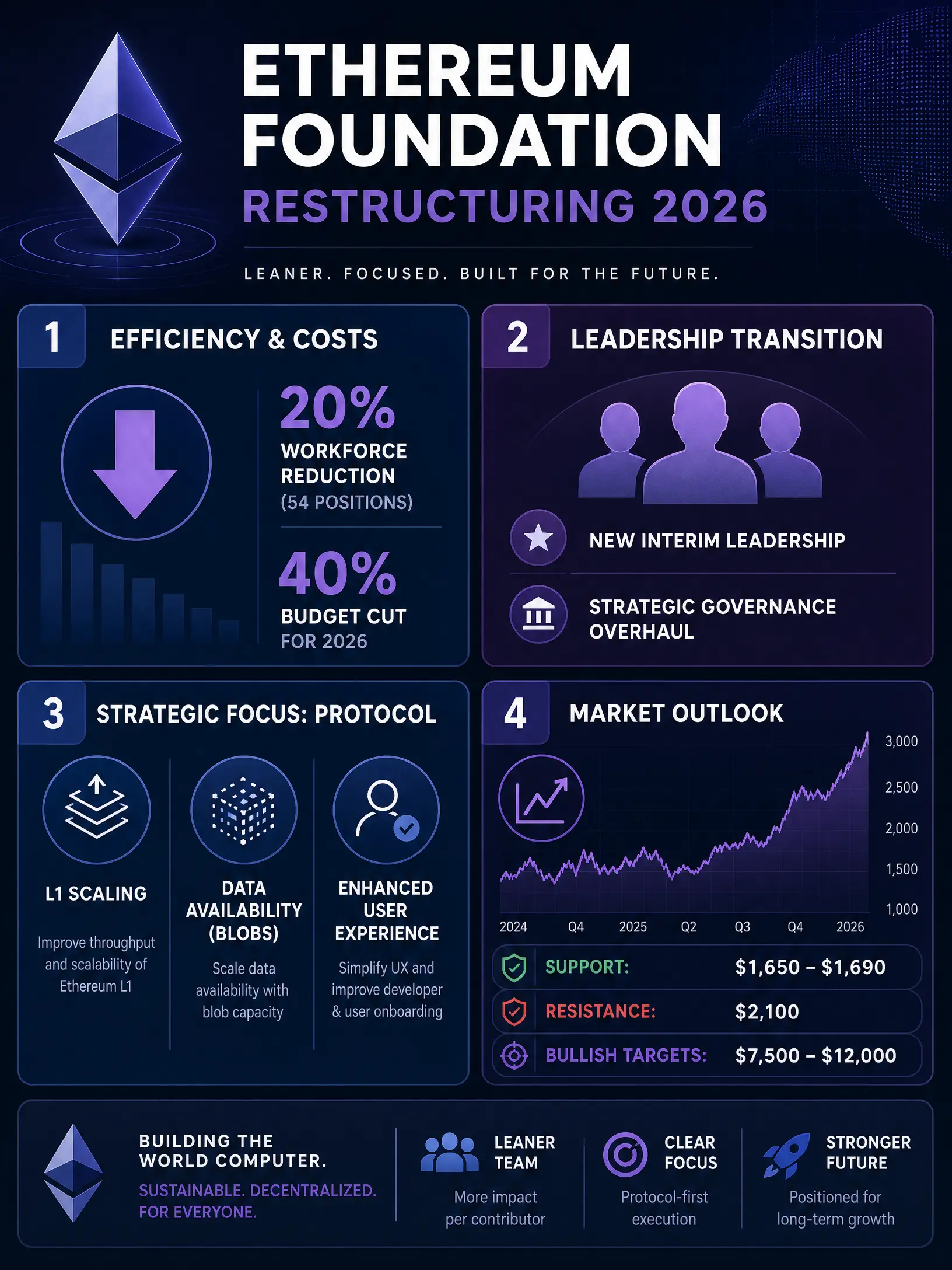
The Ethereum Foundation has recently completed a significant organizational restructuring, laying off approximately 54 employees which represents about 20% of its total workforce. This move comes alongside substantial changes to their treasury management policies, marking one of the most transformative periods in the foundation's recent history.
Understanding the Organizational Restructuring
The Ethereum Foundation's decision to reduce its workforce by roughly 20% signals a strategic pivot toward operational efficiency and cost optimization. This restructuring is not merely about cutting expenses but represents a deliberate effort to streamline operations and focus resources on critical protocol development initiatives. The foundation has reorganized into five distinct divisions, each with clearly defined responsibilities aimed at accelerating Ethereum's technological advancement.
The workforce reduction aligns with the foundation's newly implemented Mandate and Treasury Management Policy. By maintaining a leaner organizational structure, the foundation aims to ensure long-term sustainability while maintaining its commitment to Ethereum's core development. The remaining team members are now focused on what the foundation describes as its most important responsibilities, particularly surrounding the upcoming Glamsterdam upgrade and other protocol improvements.
Treasury Management Policy Changes
The Ethereum Foundation has introduced comprehensive reforms to its treasury management approach. Under the new policy, the foundation will manage its substantial ETH reserves with greater deliberation, seeking to balance short-term operational needs with long-term strategic objectives. The policy establishes specific parameters for capital deployment, with targets set at 15% of treasury allocated for annual operational expenses and a 2.5-year runway for sustainability.
The foundation has committed to stepping up its support for the Ethereum ecosystem during critical periods and market downturns. This approach reflects a more thoughtful reserve depletion strategy, ensuring that the organization can maintain its stewardship role while pursuing acceptable returns on treasury assets. The foundation explicitly stated that 2025-2026 will be pivotal years for the ecosystem, warranting enhanced focus on critical deliverables.
Current Market Position and Price Analysis
As of June 2026, Ethereum is trading in a challenging price environment. The cryptocurrency has experienced significant pressure, with prices hovering around $1,760 to $1,778 range. This represents a substantial decline from the all-time high of $4,946 reached in August 2025, with ETH currently down approximately 57% from its peak valuation.
The recent price action has been particularly concerning for market participants. Ethereum opened 2026 near $3,100 but experienced a dramatic decline to a low of $1,743 in February 2026, marking its lowest level since early 2023. Since then, the price has been grinding sideways, primarily trading between $2,000 and $2,400, though recent weakness has pushed prices below the psychologically important $2,000 support level.
Technical Analysis and Key Levels
From a technical perspective, Ethereum is currently testing critical support zones. The immediate support level sits around $1,700, with a major support zone extending from $1,500 to $1,700. A break below $1,700 could trigger accelerated selling pressure, potentially pushing prices toward the $1,500 liquidation cluster where significant stop-loss orders are clustered.
On the resistance side, Ethereum faces multiple hurdles before any meaningful recovery can occur. The first major resistance level is positioned at $2,000, which has now flipped from support to resistance following the recent breakdown. Above that, additional resistance levels are identified at $2,350, $2,600, and $2,800. The path back to $4,000 would require ETH to nearly double from current levels, representing a significant technical challenge.
The Relative Strength Index (RSI) has reached extremely oversold territory, with readings near 18 on the daily timeframe. This extreme oversold condition, while potentially signaling a bounce, also indicates strong bearish momentum that should not be ignored. The MACD and Bollinger Bands have simultaneously entered extreme oversold territory, creating a rare triple-oversold alignment that has historically preceded significant price movements.
Market Impact of Foundation Restructuring
The immediate market reaction to the Ethereum Foundation's restructuring has been mixed. In the short term, some investors have interpreted the layoffs as a negative signal, contributing to the bearish sentiment surrounding ETH. The reduction in workforce could be perceived as a sign of financial stress or reduced commitment to development, though the foundation has emphasized this is a strategic realignment rather than a crisis response.
However, the long-term implications may prove more positive. By reducing operational expenses and implementing more efficient treasury management, the foundation is positioning itself for greater sustainability. The leaner structure could enable faster decision-making and more focused resource allocation toward critical protocol upgrades. If the restructuring succeeds in improving operational efficiency without compromising development quality, it could ultimately strengthen Ethereum's competitive position.
Price Forecasts and Analyst Predictions
Market analysts maintain divergent views on Ethereum's price trajectory. Standard Chartered, which had previously been bullish on Ethereum, recently reduced its 2026 price target to $4,000, citing sustained ETF outflows and bearish market sentiment. This revision represents a significant downgrade from earlier, more optimistic projections.
Conservative forecasts suggest Ethereum could trade in a range of $1,750 to $2,050 through July 2026, with a potential recovery toward $2,000 if buying pressure materializes. More optimistic scenarios envision Ethereum reclaiming $3,000 in the third quarter of 2026 and potentially testing $4,000 by year-end, assuming favorable market conditions and successful protocol upgrades.
Bullish long-term predictions remain ambitious, with some analysts forecasting Ethereum reaching $7,000 to $10,000 by 2026, driven by ETF accumulation exceeding $100 billion in assets under management, Layer 2 total value locked expansion, and restaking yield opportunities. Extreme bullish scenarios project prices as high as $15,000 to $25,000 over the next several years, contingent upon widespread institutional adoption and successful network scaling.
Trading Strategy and Risk Management
For traders and investors considering Ethereum positions, current market conditions demand careful risk management. The breakdown below $2,000 has established a bearish technical structure that favors caution. Any long positions should be sized appropriately with strict stop-loss orders placed below the $1,500 support zone to protect against further downside.
Short-term traders might consider waiting for a confirmed reclaim of the $2,000 level before establishing new long positions. A successful breakout above $2,088 with strong volume could signal the beginning of a recovery phase, targeting initial resistance at $2,350. However, failure to reclaim $2,000 could see prices testing lower support levels.
Long-term investors may view current prices as an accumulation opportunity, particularly given the extreme oversold technical conditions. Dollar-cost averaging into positions over time could mitigate timing risk while positioning for potential recovery. The key consideration is whether the Ethereum Foundation's restructuring will ultimately strengthen the ecosystem or raise concerns about development continuity.
Future Outlook and Catalysts
Several factors could catalyze an Ethereum price recovery in the coming months. The Glamsterdam upgrade represents a significant technical milestone that could improve network efficiency and reduce transaction costs by approximately 78.6%, potentially increasing throughput to 10,000 transactions per second. This upgrade could serve as a major catalyst for price appreciation if successfully implemented.
Institutional adoption through spot ETFs continues to evolve, with sustained inflows potentially providing price support. Additionally, the acceleration of long-term holder accumulation at current levels, combined with exchange reserves reaching all-time lows, suggests underlying demand remains robust despite recent price weakness.
The Ethereum Foundation's commitment to enhanced focus during this pivotal period could result in accelerated development and improved ecosystem support. If the restructuring enables more efficient resource allocation and faster protocol improvements, the long-term fundamentals of Ethereum could strengthen considerably.
Conclusion
The Ethereum Foundation's organizational restructuring and treasury policy changes represent a significant inflection point for the ecosystem. While the immediate market reaction has been cautious, the long-term implications could prove positive if the leaner structure enables more efficient operations and focused development.
Current price levels present both risk and opportunity. With ETH trading near multi-year lows and technical indicators showing extreme oversold conditions, the potential for a meaningful recovery exists. However, traders should remain vigilant regarding key support and resistance levels, implementing appropriate risk management strategies.
The path forward for Ethereum depends on multiple factors including successful protocol upgrades, institutional adoption trends, and the effectiveness of the foundation's new organizational structure. Investors should monitor developments closely while maintaining a balanced perspective on both the risks and opportunities present in current market conditions.
#EthereumFoundationRestructuresForEfficiency #MyGateTradeStory #TradFiCFDGoldMasters
The Ethereum Foundation has recently completed a significant organizational restructuring, laying off approximately 54 employees which represents about 20% of its total workforce. This move comes alongside substantial changes to their treasury management policies, marking one of the most transformative periods in the foundation's recent history.
Understanding the Organizational Restructuring
The Ethereum Foundation's decision to reduce its workforce by roughly 20% signals a strategic pivot toward operational efficiency and cost optimization. This restructuring is not merely about cutting expenses but represents a deliberate effort to streamline operations and focus resources on critical protocol development initiatives. The foundation has reorganized into five distinct divisions, each with clearly defined responsibilities aimed at accelerating Ethereum's technological advancement.
The workforce reduction aligns with the foundation's newly implemented Mandate and Treasury Management Policy. By maintaining a leaner organizational structure, the foundation aims to ensure long-term sustainability while maintaining its commitment to Ethereum's core development. The remaining team members are now focused on what the foundation describes as its most important responsibilities, particularly surrounding the upcoming Glamsterdam upgrade and other protocol improvements.
Treasury Management Policy Changes
The Ethereum Foundation has introduced comprehensive reforms to its treasury management approach. Under the new policy, the foundation will manage its substantial ETH reserves with greater deliberation, seeking to balance short-term operational needs with long-term strategic objectives. The policy establishes specific parameters for capital deployment, with targets set at 15% of treasury allocated for annual operational expenses and a 2.5-year runway for sustainability.
The foundation has committed to stepping up its support for the Ethereum ecosystem during critical periods and market downturns. This approach reflects a more thoughtful reserve depletion strategy, ensuring that the organization can maintain its stewardship role while pursuing acceptable returns on treasury assets. The foundation explicitly stated that 2025-2026 will be pivotal years for the ecosystem, warranting enhanced focus on critical deliverables.
Current Market Position and Price Analysis
As of June 2026, Ethereum is trading in a challenging price environment. The cryptocurrency has experienced significant pressure, with prices hovering around $1,760 to $1,778 range. This represents a substantial decline from the all-time high of $4,946 reached in August 2025, with ETH currently down approximately 57% from its peak valuation.
The recent price action has been particularly concerning for market participants. Ethereum opened 2026 near $3,100 but experienced a dramatic decline to a low of $1,743 in February 2026, marking its lowest level since early 2023. Since then, the price has been grinding sideways, primarily trading between $2,000 and $2,400, though recent weakness has pushed prices below the psychologically important $2,000 support level.
Technical Analysis and Key Levels
From a technical perspective, Ethereum is currently testing critical support zones. The immediate support level sits around $1,700, with a major support zone extending from $1,500 to $1,700. A break below $1,700 could trigger accelerated selling pressure, potentially pushing prices toward the $1,500 liquidation cluster where significant stop-loss orders are clustered.
On the resistance side, Ethereum faces multiple hurdles before any meaningful recovery can occur. The first major resistance level is positioned at $2,000, which has now flipped from support to resistance following the recent breakdown. Above that, additional resistance levels are identified at $2,350, $2,600, and $2,800. The path back to $4,000 would require ETH to nearly double from current levels, representing a significant technical challenge.
The Relative Strength Index (RSI) has reached extremely oversold territory, with readings near 18 on the daily timeframe. This extreme oversold condition, while potentially signaling a bounce, also indicates strong bearish momentum that should not be ignored. The MACD and Bollinger Bands have simultaneously entered extreme oversold territory, creating a rare triple-oversold alignment that has historically preceded significant price movements.
Market Impact of Foundation Restructuring
The immediate market reaction to the Ethereum Foundation's restructuring has been mixed. In the short term, some investors have interpreted the layoffs as a negative signal, contributing to the bearish sentiment surrounding ETH. The reduction in workforce could be perceived as a sign of financial stress or reduced commitment to development, though the foundation has emphasized this is a strategic realignment rather than a crisis response.
However, the long-term implications may prove more positive. By reducing operational expenses and implementing more efficient treasury management, the foundation is positioning itself for greater sustainability. The leaner structure could enable faster decision-making and more focused resource allocation toward critical protocol upgrades. If the restructuring succeeds in improving operational efficiency without compromising development quality, it could ultimately strengthen Ethereum's competitive position.
Price Forecasts and Analyst Predictions
Market analysts maintain divergent views on Ethereum's price trajectory. Standard Chartered, which had previously been bullish on Ethereum, recently reduced its 2026 price target to $4,000, citing sustained ETF outflows and bearish market sentiment. This revision represents a significant downgrade from earlier, more optimistic projections.
Conservative forecasts suggest Ethereum could trade in a range of $1,750 to $2,050 through July 2026, with a potential recovery toward $2,000 if buying pressure materializes. More optimistic scenarios envision Ethereum reclaiming $3,000 in the third quarter of 2026 and potentially testing $4,000 by year-end, assuming favorable market conditions and successful protocol upgrades.
Bullish long-term predictions remain ambitious, with some analysts forecasting Ethereum reaching $7,000 to $10,000 by 2026, driven by ETF accumulation exceeding $100 billion in assets under management, Layer 2 total value locked expansion, and restaking yield opportunities. Extreme bullish scenarios project prices as high as $15,000 to $25,000 over the next several years, contingent upon widespread institutional adoption and successful network scaling.
Trading Strategy and Risk Management
For traders and investors considering Ethereum positions, current market conditions demand careful risk management. The breakdown below $2,000 has established a bearish technical structure that favors caution. Any long positions should be sized appropriately with strict stop-loss orders placed below the $1,500 support zone to protect against further downside.
Short-term traders might consider waiting for a confirmed reclaim of the $2,000 level before establishing new long positions. A successful breakout above $2,088 with strong volume could signal the beginning of a recovery phase, targeting initial resistance at $2,350. However, failure to reclaim $2,000 could see prices testing lower support levels.
Long-term investors may view current prices as an accumulation opportunity, particularly given the extreme oversold technical conditions. Dollar-cost averaging into positions over time could mitigate timing risk while positioning for potential recovery. The key consideration is whether the Ethereum Foundation's restructuring will ultimately strengthen the ecosystem or raise concerns about development continuity.
Future Outlook and Catalysts
Several factors could catalyze an Ethereum price recovery in the coming months. The Glamsterdam upgrade represents a significant technical milestone that could improve network efficiency and reduce transaction costs by approximately 78.6%, potentially increasing throughput to 10,000 transactions per second. This upgrade could serve as a major catalyst for price appreciation if successfully implemented.
Institutional adoption through spot ETFs continues to evolve, with sustained inflows potentially providing price support. Additionally, the acceleration of long-term holder accumulation at current levels, combined with exchange reserves reaching all-time lows, suggests underlying demand remains robust despite recent price weakness.
The Ethereum Foundation's commitment to enhanced focus during this pivotal period could result in accelerated development and improved ecosystem support. If the restructuring enables more efficient resource allocation and faster protocol improvements, the long-term fundamentals of Ethereum could strengthen considerably.
Conclusion
The Ethereum Foundation's organizational restructuring and treasury policy changes represent a significant inflection point for the ecosystem. While the immediate market reaction has been cautious, the long-term implications could prove positive if the leaner structure enables more efficient operations and focused development.
Current price levels present both risk and opportunity. With ETH trading near multi-year lows and technical indicators showing extreme oversold conditions, the potential for a meaningful recovery exists. However, traders should remain vigilant regarding key support and resistance levels, implementing appropriate risk management strategies.
The path forward for Ethereum depends on multiple factors including successful protocol upgrades, institutional adoption trends, and the effectiveness of the foundation's new organizational structure. Investors should monitor developments closely while maintaining a balanced perspective on both the risks and opportunities present in current market conditions.
#EthereumFoundationRestructuresForEfficiency #MyGateTradeStory #TradFiCFDGoldMasters