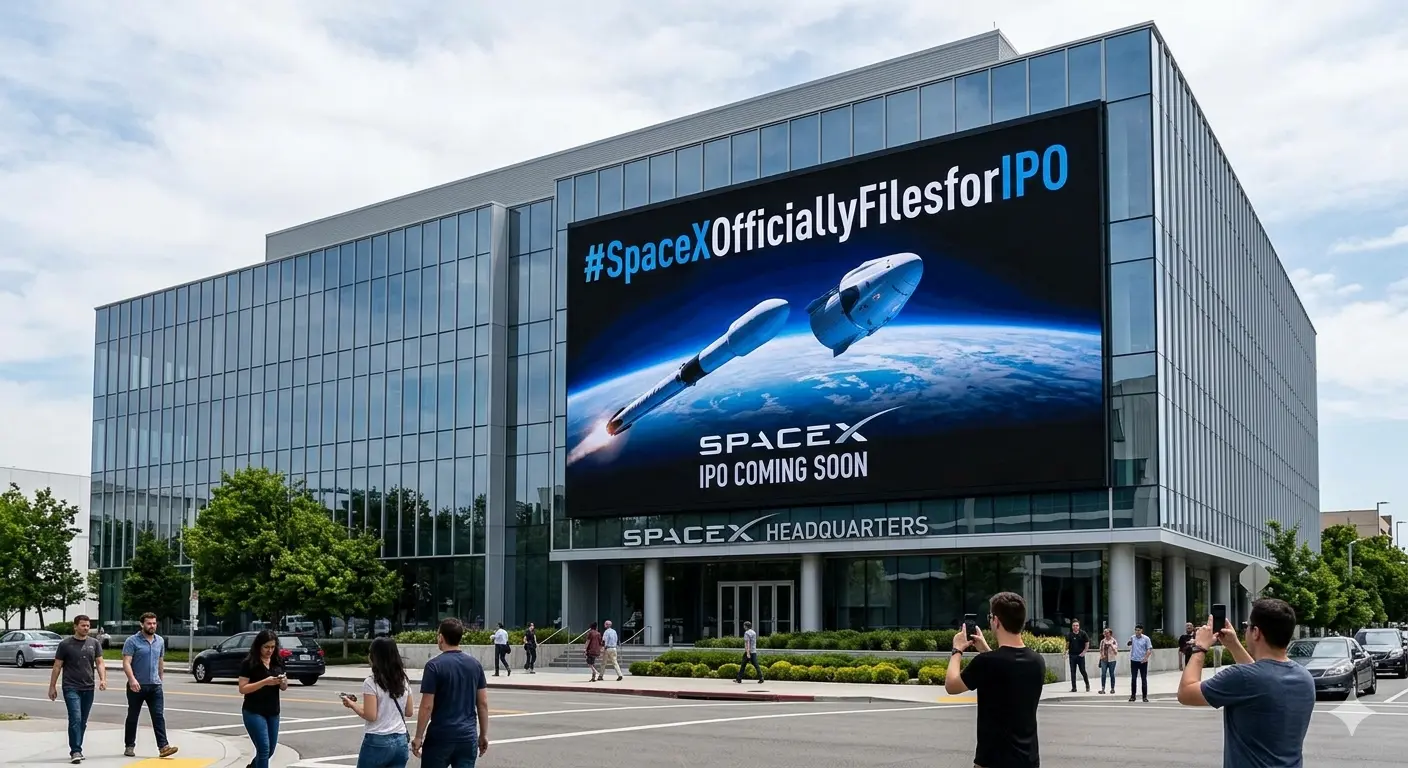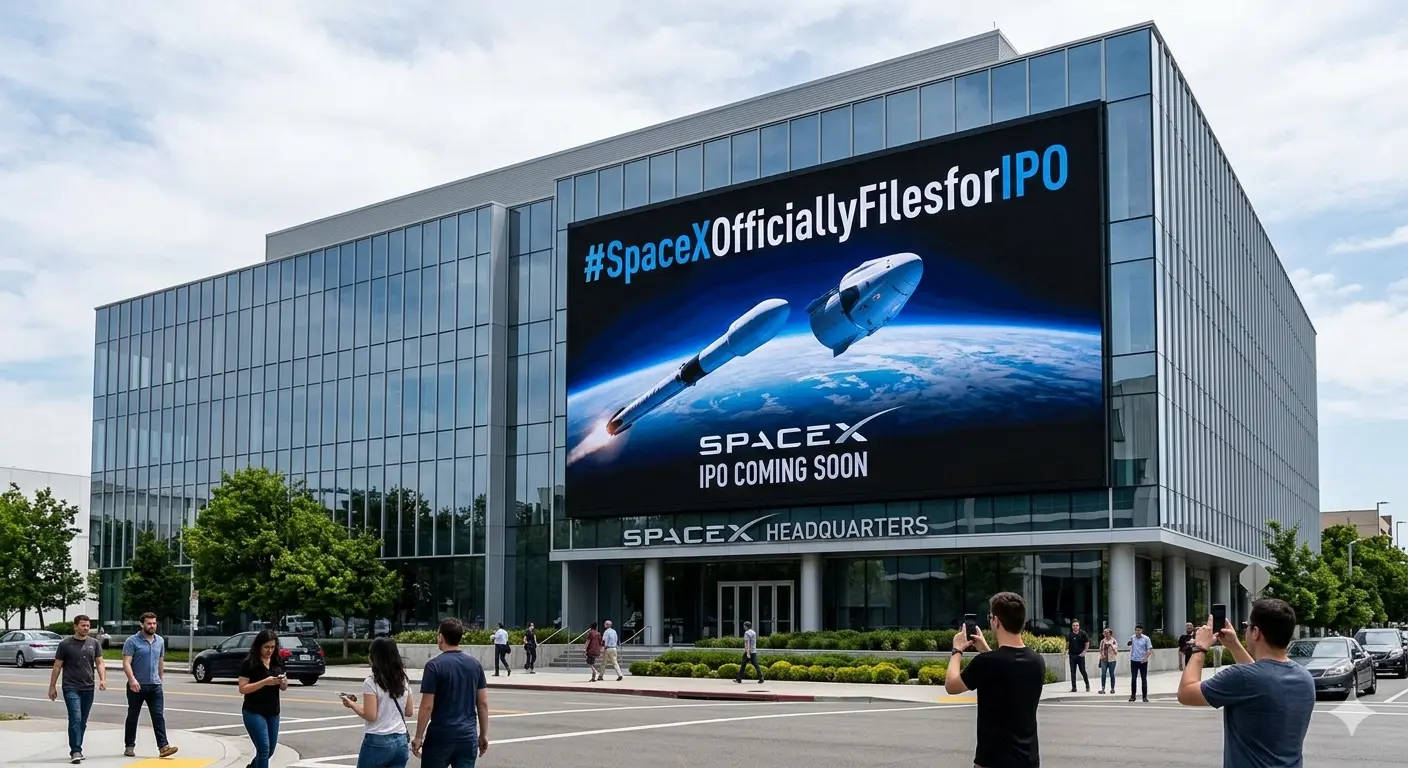
#SpaceXOfficiallyFilesforIPO
Why SpaceX's IPO Filing Could Change Tech & Space Investing Forever
The Largest IPO in History Just Became Reality
SpaceX officially filed its S-1 IPO prospectus on May 20, 2026, confirming what markets anticipated for years. The company plans to list on Nasdaq under ticker "SPCX" with pricing expected June 11 and trading debut June 12. At a targeted valuation of $1.75 trillion (potentially reaching $2 trillion), this will be the largest public offering ever—raising up to $75 billion and instantly placing SpaceX among the world's most valuable companies.
Starlink: The Golden Goose Driving Value
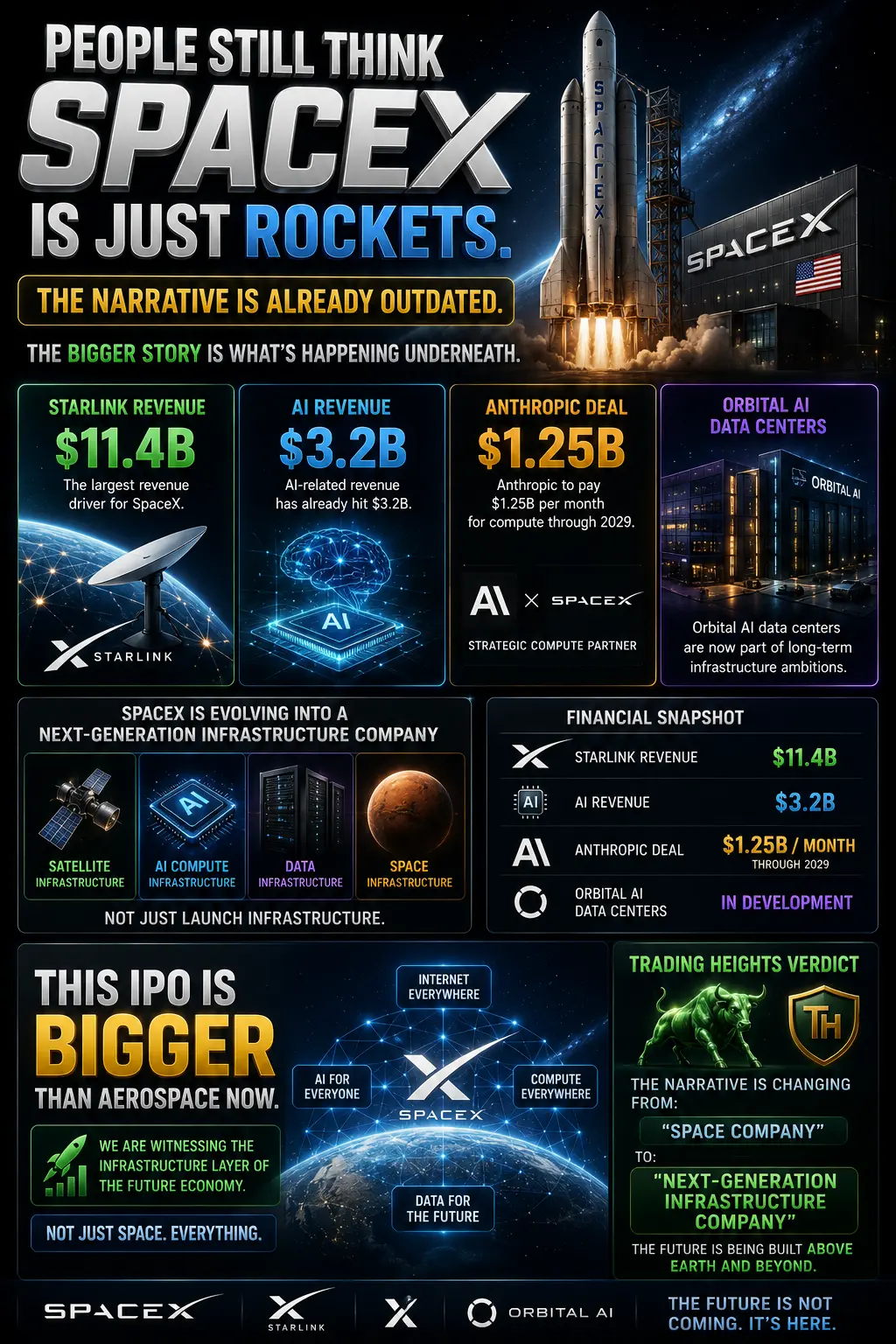
The filing reveals Starlink as SpaceX's primary revenue engine, generating $11.4 billion in 2025—approximately 61-70% of total company revenue. With over 10 million subscribers globally, Starlink has evolved from experimental satellite internet into a cash-flow positive connectivity business. The company projects a $1.6 trillion addressable market for broadband alone, with satellite services now competing directly with traditional telecom infrastructure.
The AI Factor: $28.5 Trillion Market Opportunity
SpaceX is positioning itself as more than aerospace—it's becoming a technology conglomerate. The February 2026 xAI merger (valued at $250 billion) integrates artificial intelligence into the orbital infrastructure strategy. The S-1 outlines ambitions for "space-based AI data centers" and projects a staggering $26.5 trillion future revenue opportunity from corporate AI applications. This transforms SpaceX from a rocket company into an AI infrastructure play with orbital computing capabilities.
Financial Reality Check
The numbers tell a complex story: $18.6 billion revenue in 2025 (+33% YoY growth) alongside a $4.9 billion net loss. The company has burned $37 billion since inception to achieve its current position. Q1 2026 shows revenue of $4.7 billion with continued losses, reflecting the capital-intensive nature of space infrastructure. However, adjusted EBITDA turned positive at $6.6 billion in 2025, suggesting the underlying business model is reaching profitability.
Historical Precedent & Market Impact
Previous mega-IPOs show mixed results—Meta fell 47% from post-IPO peaks, Alibaba 26%, Saudi Aramco 22%. Nearly 64% of IPOs underperform broader markets by 10+ percentage points over three years. However, SpaceX differs fundamentally: it combines monopoly-like launch dominance, recurring Starlink subscription revenue, and the xAI growth optionality. The S&P 500 trading at 23x forward earnings versus historical 16-18x suggests market positioning matters—SpaceX enters as a generational infrastructure asset.
What This Means for Tech & Crypto Investors
The SpaceX IPO creates a publicly-traded proxy for space economy exposure—something previously inaccessible to retail investors. For crypto and tech enthusiasts, the filing validates institutional appetite for frontier technology investments. The $28.5 trillion total addressable market projection signals where smart capital is flowing: AI infrastructure, orbital computing, and global connectivity. SpaceX's success or failure will likely determine whether other space-tech unicorns follow to public markets.
Risk Factors to Monitor
The S-1 discloses significant risks: regulatory uncertainty around satellite spectrum, competition from Amazon's Project Kuiper and China's space programs, Starship development delays, and Elon Musk's divided attention across multiple companies. The $1.75 trillion valuation leaves limited upside room if execution misses targets. Historical mega-IPO underperformance suggests patience rather than FOMO may reward long-term investors.
The Bottom Line
SpaceX's IPO filing represents more than a stock listing—it's the moment private space exploration becomes investable infrastructure. With Starlink proving the business model and xAI adding growth optionality, SPCX offers exposure to two of this century's largest technological transformations simultaneously. Whether you're a tech investor seeking AI infrastructure plays or a space enthusiast betting on humanity's expansion beyond Earth, this IPO changes the game.
Why SpaceX's IPO Filing Could Change Tech & Space Investing Forever
The Largest IPO in History Just Became Reality
SpaceX officially filed its S-1 IPO prospectus on May 20, 2026, confirming what markets anticipated for years. The company plans to list on Nasdaq under ticker "SPCX" with pricing expected June 11 and trading debut June 12. At a targeted valuation of $1.75 trillion (potentially reaching $2 trillion), this will be the largest public offering ever—raising up to $75 billion and instantly placing SpaceX among the world's most valuable companies.
Starlink: The Golden Goose Driving Value
The filing reveals Starlink as SpaceX's primary revenue engine, generating $11.4 billion in 2025—approximately 61-70% of total company revenue. With over 10 million subscribers globally, Starlink has evolved from experimental satellite internet into a cash-flow positive connectivity business. The company projects a $1.6 trillion addressable market for broadband alone, with satellite services now competing directly with traditional telecom infrastructure.
The AI Factor: $28.5 Trillion Market Opportunity
SpaceX is positioning itself as more than aerospace—it's becoming a technology conglomerate. The February 2026 xAI merger (valued at $250 billion) integrates artificial intelligence into the orbital infrastructure strategy. The S-1 outlines ambitions for "space-based AI data centers" and projects a staggering $26.5 trillion future revenue opportunity from corporate AI applications. This transforms SpaceX from a rocket company into an AI infrastructure play with orbital computing capabilities.
Financial Reality Check
The numbers tell a complex story: $18.6 billion revenue in 2025 (+33% YoY growth) alongside a $4.9 billion net loss. The company has burned $37 billion since inception to achieve its current position. Q1 2026 shows revenue of $4.7 billion with continued losses, reflecting the capital-intensive nature of space infrastructure. However, adjusted EBITDA turned positive at $6.6 billion in 2025, suggesting the underlying business model is reaching profitability.
Historical Precedent & Market Impact
Previous mega-IPOs show mixed results—Meta fell 47% from post-IPO peaks, Alibaba 26%, Saudi Aramco 22%. Nearly 64% of IPOs underperform broader markets by 10+ percentage points over three years. However, SpaceX differs fundamentally: it combines monopoly-like launch dominance, recurring Starlink subscription revenue, and the xAI growth optionality. The S&P 500 trading at 23x forward earnings versus historical 16-18x suggests market positioning matters—SpaceX enters as a generational infrastructure asset.
What This Means for Tech & Crypto Investors
The SpaceX IPO creates a publicly-traded proxy for space economy exposure—something previously inaccessible to retail investors. For crypto and tech enthusiasts, the filing validates institutional appetite for frontier technology investments. The $28.5 trillion total addressable market projection signals where smart capital is flowing: AI infrastructure, orbital computing, and global connectivity. SpaceX's success or failure will likely determine whether other space-tech unicorns follow to public markets.
Risk Factors to Monitor
The S-1 discloses significant risks: regulatory uncertainty around satellite spectrum, competition from Amazon's Project Kuiper and China's space programs, Starship development delays, and Elon Musk's divided attention across multiple companies. The $1.75 trillion valuation leaves limited upside room if execution misses targets. Historical mega-IPO underperformance suggests patience rather than FOMO may reward long-term investors.
The Bottom Line
SpaceX's IPO filing represents more than a stock listing—it's the moment private space exploration becomes investable infrastructure. With Starlink proving the business model and xAI adding growth optionality, SPCX offers exposure to two of this century's largest technological transformations simultaneously. Whether you're a tech investor seeking AI infrastructure plays or a space enthusiast betting on humanity's expansion beyond Earth, this IPO changes the game.