#YenHits40YearLow
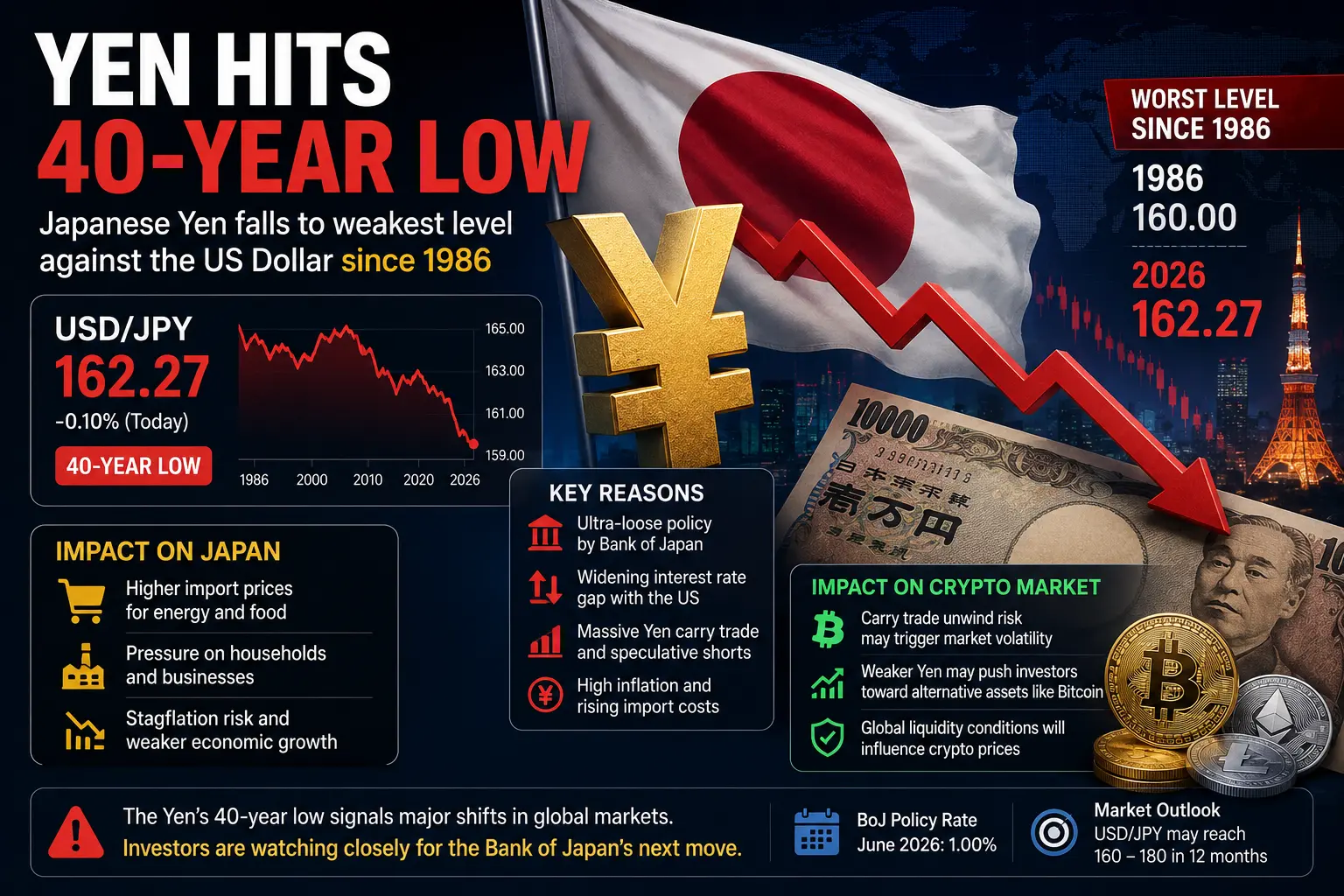
The Japanese yen has reached its weakest level against the United States dollar since 1986, marking a historic milestone that has sent significant ripples through global financial markets. As of late June 2026, the yen has depreciated to approximately 162.27 per dollar, representing a year-to-date decline of 12.51 percent. This unprecedented weakness in one of the world's major reserve currencies demands careful examination of its causes, implications, and particularly its effects on the cryptocurrency market.
Current Exchange Rate Position and Historical Context
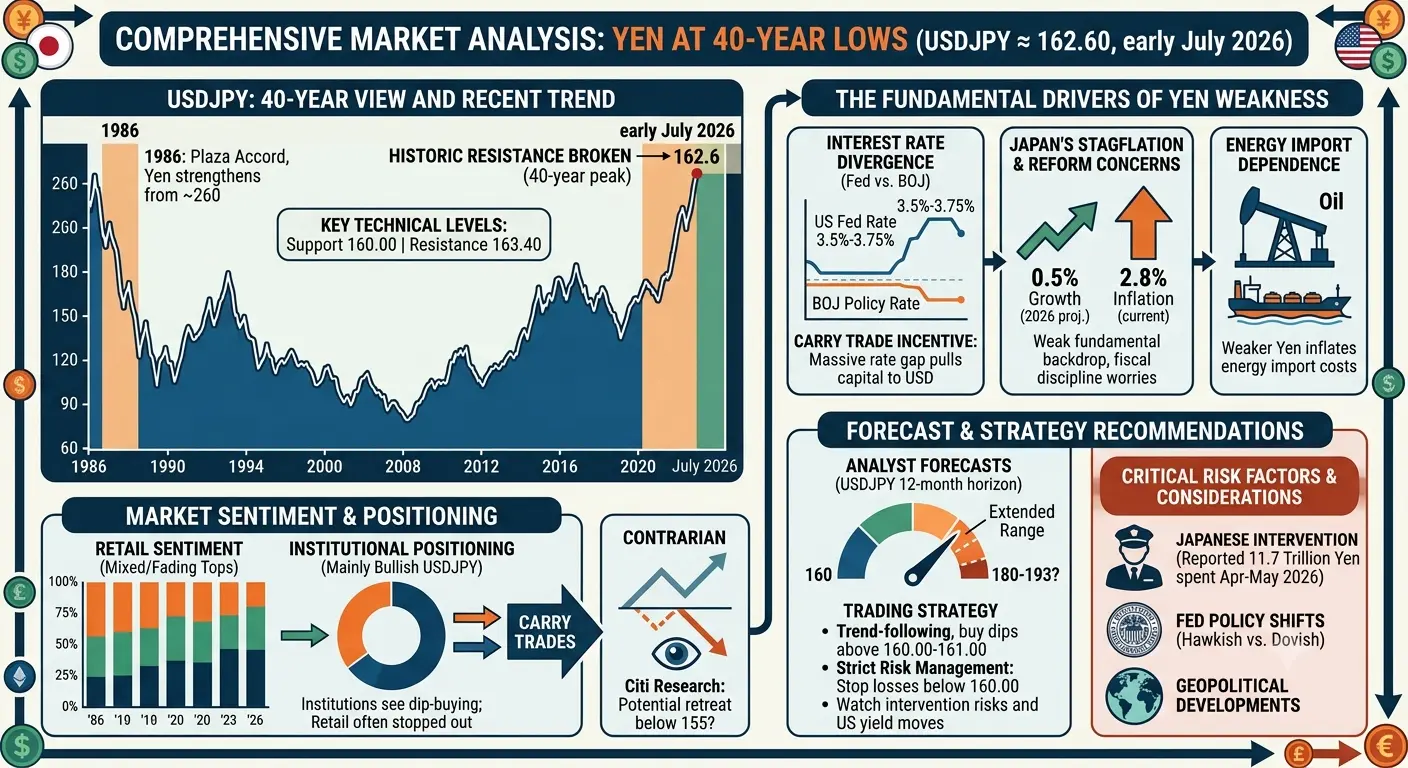
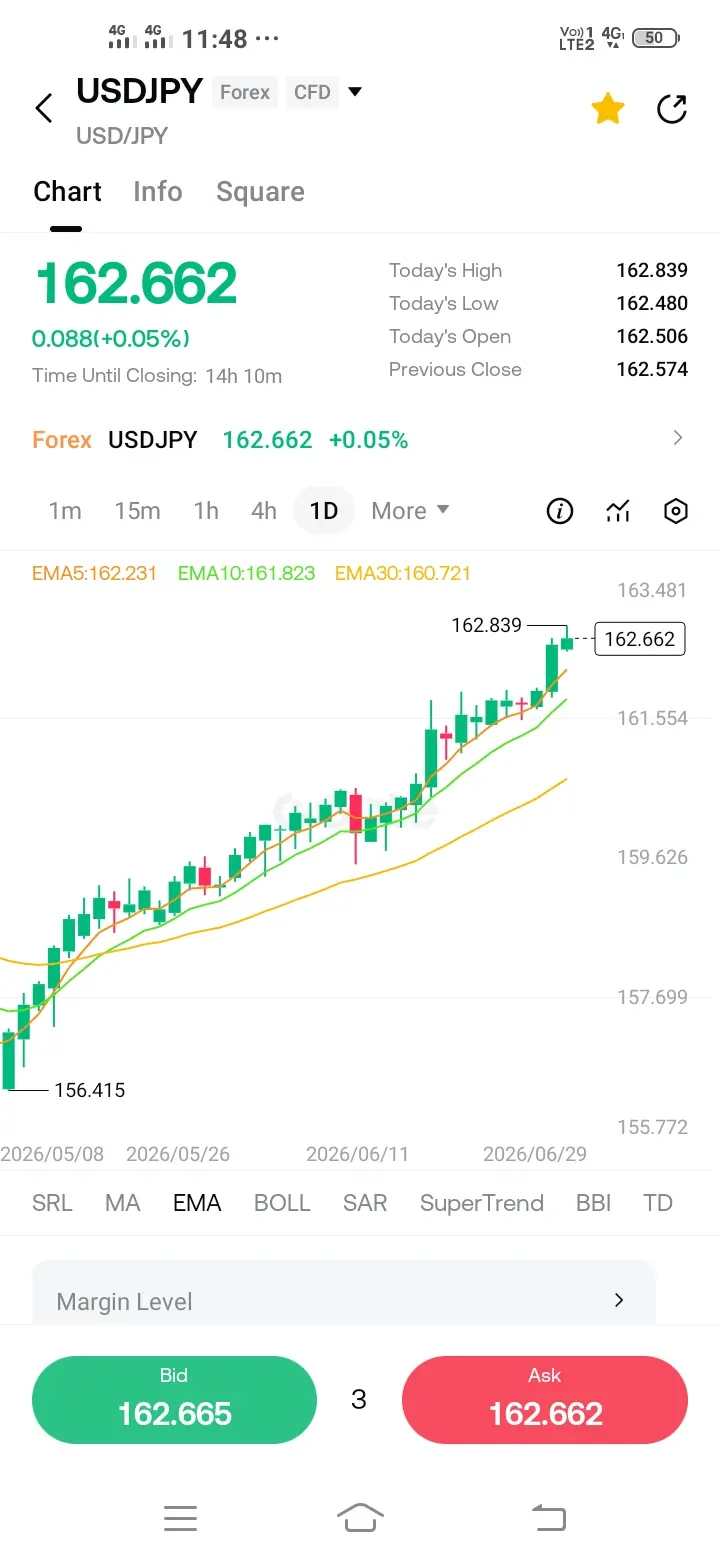
The USD/JPY currency pair is currently trading in the range of 161.80 to 162.27, with the yen having breached the critical psychological barrier of 160 per dollar multiple times throughout 2026. To put this into historical perspective, the last time the yen traded at these levels was during the Plaza Accord era of the mid-1980s. The currency has depreciated by approximately 0.1 percent to touch 161.96 versus the greenback, breaching the 161.95 mark touched in July 2024 during Japan's previous intervention campaign. A move beyond 161.96 against the dollar would leave the yen at its weakest since 1986, a level last seen when Japan was reeling from the aftereffects of the Plaza Accord.
The foreign exchange market for USD/JPY maintains substantial liquidity, with average daily turnover reaching unprecedented levels. According to the Bank for International Settlements Triennial Survey conducted in April 2025, global foreign exchange trading hit $9.6 trillion per day, representing a 28 percent increase from 2022. FX swaps remained the most traded instrument with average daily turnover rising to $4 trillion. This massive liquidity underscores the significance of yen movements for global financial stability.
Root Causes of Yen Depreciation
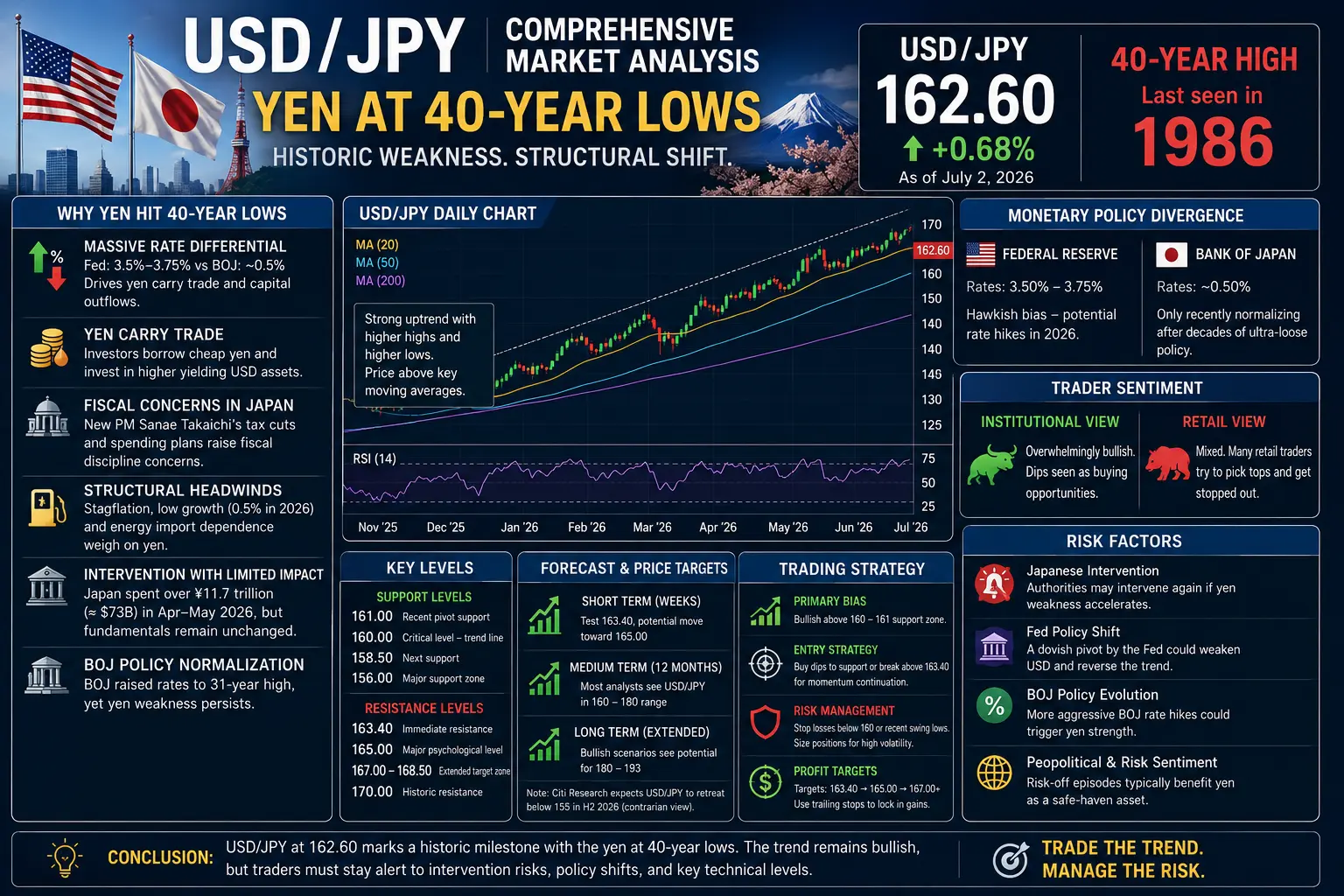
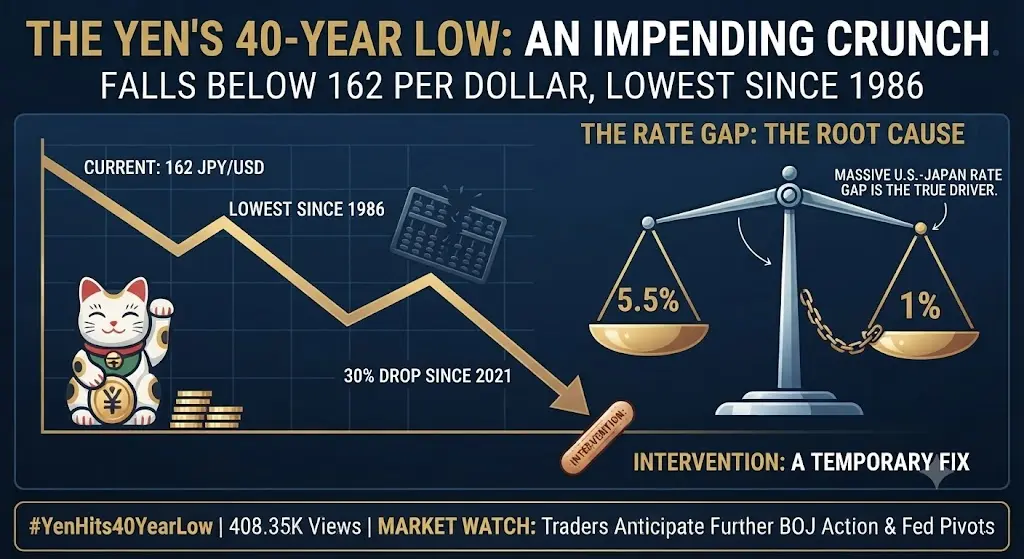
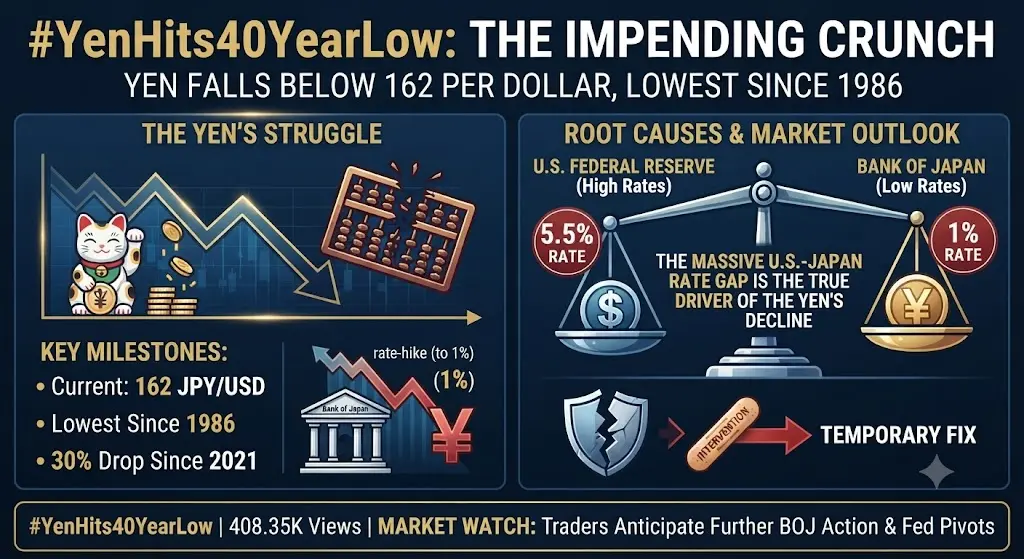
The dramatic decline in yen value stems from multiple interconnected factors. First and foremost is the substantial interest rate differential between Japan and the United States. The Bank of Japan has maintained an ultra-loose monetary policy for decades, with rates near zero percent for extended periods. While the BOJ raised rates to 0.75 percent in December 2025 and subsequently to 1 percent in June 2026, this remains significantly below the Federal Reserve's policy rate. This wide gap between Japanese and American borrowing costs has created powerful incentives for the yen carry trade.
The yen carry trade represents one of the most significant drivers of currency weakness. This strategy involves borrowing cheap yen at low Japanese interest rates, converting them into dollars or other currencies, and investing in higher-yielding assets abroad. Morgan Stanley estimates that approximately $500 billion in outstanding yen carry positions remain active in global markets. Hedge funds have reportedly built one of their biggest bearish bets against the Japanese yen in years, accumulating around 85,000 net short contracts as pressure on the currency intensifies.
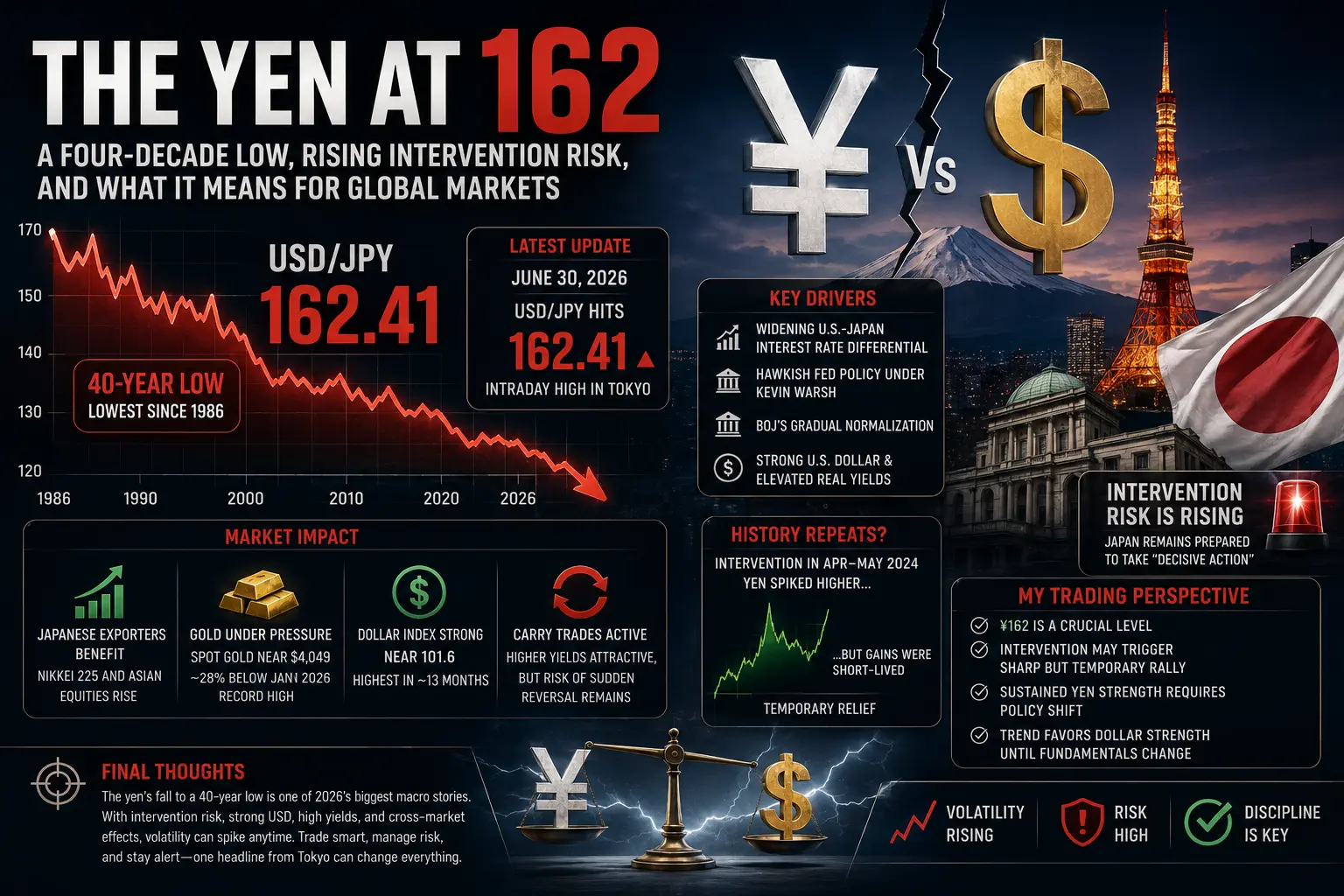
Japanese authorities have attempted to counter this depreciation through massive foreign exchange interventions. The Finance Ministry deployed over 11.7 trillion yen, equivalent to approximately $72.8 to $73.5 billion, in intervention operations from April to May 2026. Despite this staggering expenditure, the yen has drifted back toward the 160-per-dollar level, essentially erasing the temporary bounce that intervention provided.
Inflation dynamics have also played a crucial role. Japan's core inflation eased to 1.4 percent in April 2026, its lowest level since March 2022, with headline inflation also at 1.4 percent, representing the fourth consecutive month below the central bank's 2 percent target. This persistent undershooting of inflation targets has reinforced the case for continued monetary accommodation, even as other major economies have tightened policy.
Impact on Japan's Domestic Economy
The weak yen has created significant challenges for Japanese households and businesses. Import prices for energy and food have risen substantially, creating real pain for consumers as the weaker currency pushes up costs for essential goods. Japan's dependence on energy imports has made this particularly acute, with nearly 95 percent of crude oil coming from the Gulf region including 40 percent from Saudi Arabia and 43 percent from the United Arab Emirates.
Japanese exporters have theoretically benefited from yen weakness, as their products become more competitively priced in international markets. Japan's exports in May grew at their fastest pace since November 2022, rising 17 percent year on year, beating expectations. Imports rose 12.5 percent year on year in May, the highest level since January 2025. However, the benefits have been unevenly distributed, with large multinational corporations gaining advantages while smaller domestic-oriented businesses face higher input costs.
The economy is currently experiencing stagflation conditions, with the Bank of Japan expecting only 0.5 percent growth in 2026, barely a fifth of its 2.8 percent internal inflation rate. Real wages have fallen for four consecutive years, with a 1.3 percent decline in 2025. Nominal wages did rise at the fastest pace in nearly three decades in December 2025, supporting the Bank of Japan's rate hike decision, but this has not translated into improved purchasing power for households.
Effects on Global Financial Markets and Cryptocurrency Sector
The yen's historic weakness has profound implications for cryptocurrency markets through several transmission mechanisms. The most significant is the carry trade unwind risk. When traders unwind carry trades, they do not merely sell yen; they raise cash everywhere to close positions, potentially triggering broad market volatility. Bitcoin and other digital assets are likely to be among the hardest-hit assets during such unwinding episodes.
Arthur Hayes has argued that Japan's weak yen could paradoxically ignite a crypto rally that sends Bitcoin to new heights, as Japanese investors seek alternative stores of value. The logic suggests that as traditional safe-haven assets like the yen lose their appeal, capital may flow into Bitcoin and other cryptocurrencies as alternative hedges against currency depreciation.
However, the more immediate risk lies in the potential for rapid carry-trade unwinding. If the Bank of Japan signals more aggressive tightening, the large build-up of speculative short positions in the yen raises the risk of a sharp short squeeze. Such an event could trigger a rise in the yen and force the liquidation of yen-funded positions across global markets, including cryptocurrency holdings.
The correlation between yen weakness and cryptocurrency performance has become increasingly apparent. During periods of yen stability, crypto markets have shown greater resilience, while yen volatility has coincided with increased crypto market turbulence. This relationship reflects the broader risk-on and risk-off dynamics that govern global financial markets, where the yen often serves as a funding currency for leveraged positions across asset classes.
Bank of Japan Policy Response and Future Outlook
The Bank of Japan finds itself in a difficult position, balancing the need to support the currency against the risks of choking off economic recovery. The central bank raised its policy rate to 1 percent in June 2026, the highest level in over three decades, accelerating the policy normalization that began in 2024. Governor Kazuo Ueda has left the door open to additional rate hikes, though the pace of normalization remains uncertain.
Market expectations suggest the USD/JPY pair could trade in the 160 to 180 range over the coming twelve months, with some projections indicating potential movement toward 180 to 193 over the extended horizon. However, these projections assume continued divergence between Japanese and American monetary policies, which may narrow if the Federal Reserve begins cutting rates while the BOJ continues hiking.
Japanese Finance Minister Satsuki Katayama has vowed that authorities are prepared to respond appropriately to currency moves at any time, including taking decisive action as confirmed between Japan and the United States. Nomura's North Asia chief investment officer Julia Wang has indicated that Japan could intervene in the foreign exchange market after the yen slid to fresh multi-decade lows, though any impact on broader markets may be short-lived.
Implications for Global Financial Stability
The yen's weakness has implications extending beyond Japan and cryptocurrency markets. The currency's role as a major funding currency means that its depreciation affects global liquidity conditions. When the yen weakens, it effectively increases the supply of cheap funding available for leveraged trades across global markets. Conversely, any sudden yen appreciation could trigger forced liquidations and contagion effects.
The situation has drawn parallels to the August 2024 market panic, when a surprise Bank of Japan rate hike triggered a 12 percent single-day crash in the Nikkei 225 and significant volatility across global markets. While the June 2026 rate hike was telegraphed and therefore less disruptive, the underlying vulnerabilities remain.
For cryptocurrency investors, monitoring Bank of Japan rate decisions, Japanese intervention data, and the dollar-yen exchange rate has become essential. The interconnectedness of global financial markets means that developments in Tokyo can have immediate and significant effects on digital asset prices, liquidity conditions, and trading volumes.
Conclusion
The Japanese yen's decline to 40-year lows represents one of the most significant currency movements in recent financial history. With the USD/JPY exchange rate hovering near 162 and showing little sign of substantial recovery despite massive intervention and rate hikes, the situation remains fluid and potentially volatile. The causes are deeply rooted in monetary policy divergence, carry trade dynamics, and structural economic factors that will take time to resolve.
For cryptocurrency markets, the implications are mixed but significant. While yen weakness has historically correlated with increased risk appetite and potential capital flows into alternative assets, the attendant risks of carry trade unwinding and global liquidity shocks present substantial downside scenarios. Investors would be wise to monitor developments in Japanese monetary policy closely, as decisions made in Tokyo will continue to reverberate through global markets and digital asset valuations in the months ahead.
The current environment presents both opportunities and risks for cryptocurrency market participants. Understanding the complex interplay between yen dynamics, central bank policy, and global liquidity conditions will be essential for navigating the evolving landscape of digital asset investment in the coming period.@Gate_Square
The Japanese yen has reached its weakest level against the United States dollar since 1986, marking a historic milestone that has sent significant ripples through global financial markets. As of late June 2026, the yen has depreciated to approximately 162.27 per dollar, representing a year-to-date decline of 12.51 percent. This unprecedented weakness in one of the world's major reserve currencies demands careful examination of its causes, implications, and particularly its effects on the cryptocurrency market.
Current Exchange Rate Position and Historical Context
The USD/JPY currency pair is currently trading in the range of 161.80 to 162.27, with the yen having breached the critical psychological barrier of 160 per dollar multiple times throughout 2026. To put this into historical perspective, the last time the yen traded at these levels was during the Plaza Accord era of the mid-1980s. The currency has depreciated by approximately 0.1 percent to touch 161.96 versus the greenback, breaching the 161.95 mark touched in July 2024 during Japan's previous intervention campaign. A move beyond 161.96 against the dollar would leave the yen at its weakest since 1986, a level last seen when Japan was reeling from the aftereffects of the Plaza Accord.
The foreign exchange market for USD/JPY maintains substantial liquidity, with average daily turnover reaching unprecedented levels. According to the Bank for International Settlements Triennial Survey conducted in April 2025, global foreign exchange trading hit $9.6 trillion per day, representing a 28 percent increase from 2022. FX swaps remained the most traded instrument with average daily turnover rising to $4 trillion. This massive liquidity underscores the significance of yen movements for global financial stability.
Root Causes of Yen Depreciation
The dramatic decline in yen value stems from multiple interconnected factors. First and foremost is the substantial interest rate differential between Japan and the United States. The Bank of Japan has maintained an ultra-loose monetary policy for decades, with rates near zero percent for extended periods. While the BOJ raised rates to 0.75 percent in December 2025 and subsequently to 1 percent in June 2026, this remains significantly below the Federal Reserve's policy rate. This wide gap between Japanese and American borrowing costs has created powerful incentives for the yen carry trade.
The yen carry trade represents one of the most significant drivers of currency weakness. This strategy involves borrowing cheap yen at low Japanese interest rates, converting them into dollars or other currencies, and investing in higher-yielding assets abroad. Morgan Stanley estimates that approximately $500 billion in outstanding yen carry positions remain active in global markets. Hedge funds have reportedly built one of their biggest bearish bets against the Japanese yen in years, accumulating around 85,000 net short contracts as pressure on the currency intensifies.
Japanese authorities have attempted to counter this depreciation through massive foreign exchange interventions. The Finance Ministry deployed over 11.7 trillion yen, equivalent to approximately $72.8 to $73.5 billion, in intervention operations from April to May 2026. Despite this staggering expenditure, the yen has drifted back toward the 160-per-dollar level, essentially erasing the temporary bounce that intervention provided.
Inflation dynamics have also played a crucial role. Japan's core inflation eased to 1.4 percent in April 2026, its lowest level since March 2022, with headline inflation also at 1.4 percent, representing the fourth consecutive month below the central bank's 2 percent target. This persistent undershooting of inflation targets has reinforced the case for continued monetary accommodation, even as other major economies have tightened policy.
Impact on Japan's Domestic Economy
The weak yen has created significant challenges for Japanese households and businesses. Import prices for energy and food have risen substantially, creating real pain for consumers as the weaker currency pushes up costs for essential goods. Japan's dependence on energy imports has made this particularly acute, with nearly 95 percent of crude oil coming from the Gulf region including 40 percent from Saudi Arabia and 43 percent from the United Arab Emirates.
Japanese exporters have theoretically benefited from yen weakness, as their products become more competitively priced in international markets. Japan's exports in May grew at their fastest pace since November 2022, rising 17 percent year on year, beating expectations. Imports rose 12.5 percent year on year in May, the highest level since January 2025. However, the benefits have been unevenly distributed, with large multinational corporations gaining advantages while smaller domestic-oriented businesses face higher input costs.
The economy is currently experiencing stagflation conditions, with the Bank of Japan expecting only 0.5 percent growth in 2026, barely a fifth of its 2.8 percent internal inflation rate. Real wages have fallen for four consecutive years, with a 1.3 percent decline in 2025. Nominal wages did rise at the fastest pace in nearly three decades in December 2025, supporting the Bank of Japan's rate hike decision, but this has not translated into improved purchasing power for households.
Effects on Global Financial Markets and Cryptocurrency Sector
The yen's historic weakness has profound implications for cryptocurrency markets through several transmission mechanisms. The most significant is the carry trade unwind risk. When traders unwind carry trades, they do not merely sell yen; they raise cash everywhere to close positions, potentially triggering broad market volatility. Bitcoin and other digital assets are likely to be among the hardest-hit assets during such unwinding episodes.
Arthur Hayes has argued that Japan's weak yen could paradoxically ignite a crypto rally that sends Bitcoin to new heights, as Japanese investors seek alternative stores of value. The logic suggests that as traditional safe-haven assets like the yen lose their appeal, capital may flow into Bitcoin and other cryptocurrencies as alternative hedges against currency depreciation.
However, the more immediate risk lies in the potential for rapid carry-trade unwinding. If the Bank of Japan signals more aggressive tightening, the large build-up of speculative short positions in the yen raises the risk of a sharp short squeeze. Such an event could trigger a rise in the yen and force the liquidation of yen-funded positions across global markets, including cryptocurrency holdings.
The correlation between yen weakness and cryptocurrency performance has become increasingly apparent. During periods of yen stability, crypto markets have shown greater resilience, while yen volatility has coincided with increased crypto market turbulence. This relationship reflects the broader risk-on and risk-off dynamics that govern global financial markets, where the yen often serves as a funding currency for leveraged positions across asset classes.
Bank of Japan Policy Response and Future Outlook
The Bank of Japan finds itself in a difficult position, balancing the need to support the currency against the risks of choking off economic recovery. The central bank raised its policy rate to 1 percent in June 2026, the highest level in over three decades, accelerating the policy normalization that began in 2024. Governor Kazuo Ueda has left the door open to additional rate hikes, though the pace of normalization remains uncertain.
Market expectations suggest the USD/JPY pair could trade in the 160 to 180 range over the coming twelve months, with some projections indicating potential movement toward 180 to 193 over the extended horizon. However, these projections assume continued divergence between Japanese and American monetary policies, which may narrow if the Federal Reserve begins cutting rates while the BOJ continues hiking.
Japanese Finance Minister Satsuki Katayama has vowed that authorities are prepared to respond appropriately to currency moves at any time, including taking decisive action as confirmed between Japan and the United States. Nomura's North Asia chief investment officer Julia Wang has indicated that Japan could intervene in the foreign exchange market after the yen slid to fresh multi-decade lows, though any impact on broader markets may be short-lived.
Implications for Global Financial Stability
The yen's weakness has implications extending beyond Japan and cryptocurrency markets. The currency's role as a major funding currency means that its depreciation affects global liquidity conditions. When the yen weakens, it effectively increases the supply of cheap funding available for leveraged trades across global markets. Conversely, any sudden yen appreciation could trigger forced liquidations and contagion effects.
The situation has drawn parallels to the August 2024 market panic, when a surprise Bank of Japan rate hike triggered a 12 percent single-day crash in the Nikkei 225 and significant volatility across global markets. While the June 2026 rate hike was telegraphed and therefore less disruptive, the underlying vulnerabilities remain.
For cryptocurrency investors, monitoring Bank of Japan rate decisions, Japanese intervention data, and the dollar-yen exchange rate has become essential. The interconnectedness of global financial markets means that developments in Tokyo can have immediate and significant effects on digital asset prices, liquidity conditions, and trading volumes.
Conclusion
The Japanese yen's decline to 40-year lows represents one of the most significant currency movements in recent financial history. With the USD/JPY exchange rate hovering near 162 and showing little sign of substantial recovery despite massive intervention and rate hikes, the situation remains fluid and potentially volatile. The causes are deeply rooted in monetary policy divergence, carry trade dynamics, and structural economic factors that will take time to resolve.
For cryptocurrency markets, the implications are mixed but significant. While yen weakness has historically correlated with increased risk appetite and potential capital flows into alternative assets, the attendant risks of carry trade unwinding and global liquidity shocks present substantial downside scenarios. Investors would be wise to monitor developments in Japanese monetary policy closely, as decisions made in Tokyo will continue to reverberate through global markets and digital asset valuations in the months ahead.
The current environment presents both opportunities and risks for cryptocurrency market participants. Understanding the complex interplay between yen dynamics, central bank policy, and global liquidity conditions will be essential for navigating the evolving landscape of digital asset investment in the coming period.@Gate_Square