Report Summary
-
AI is reshaping work across every industry, while the crypto sector faces the combined pressures of a bear market and AI-driven transformation. Yet, the sectors that generate real value continue to grow.
-
The market rewards skill stacks: professionals who combine AI expertise with deep knowledge of a specific industry are becoming the rarest—and most highly valued—talent.
-
This is not an industry recruitment report—it's a practical guide for individuals, designed to help every professional find their place in the AI era.
In Q1 2026, the crypto industry is navigating a bear market coupled with structural shifts driven by AI. Together, these forces have created a talent market unseen in the past decade.
Key takeaway: AI's impact has already reached the crypto sector: Faster than most expected.
-
Crypto.com has cut 12% of its workforce, explicitly citing AI. Gemini has reduced headcount by 30%, while crypto job postings have plunged 80% year over year. This is no longer "someone else's problem."
-
That said, most layoffs in crypto are less about AI replacing jobs and more about entire sectors losing momentum. Sectors like restaking, DePIN, and undifferentiated L2s are seeing broad pullbacks, pushing projects into survival mode and aggressive cost-cutting. In some companies, AI is genuinely driving organizational change. In many others, it serves primarily as a narrative to rationalize layoffs. Getting this distinction right is critical to making sound talent decisions.
-
Stablecoins remain the only crypto use case with proven, large-scale adoption, and they are currently the most reliable source of talent demand. Their market cap has surpassed $300 billion, with annual transaction volume reaching $33 trillion, while regulatory frameworks are taking shape globally. Roles across compliance, payments, and banking integrations within the stablecoin ecosystem are among the few that remain resilient, with limited exposure to market cycles.
-
"Layoffs followed by rehiring" is becoming increasingly common. 32% of companies that reduced headcount due to AI have already rehired more than a quarter of the roles they cut. AI is replacing tasks, not entire roles. Companies that understand this distinction are far less likely to make costly missteps.
-
At the individual level, AI readiness is now the defining divide. Only 16% of professionals currently demonstrate a high level of AI readiness. Early adopters of AI tools are not guaranteed to win, but those who fail to adopt them are far more likely to fall behind.
I. Introduction: Key Drivers of the Global Job Market in Q1 2026
From December 2025 through March 2026, the global job market was hit by a wave of disruption at a scale rarely seen in recent years.
The AI Model Race Intensifies
From the second half of 2025 through Q1 2026, leading large language models underwent a broad leap forward. Across both proprietary models and the open-source ecosystem, significant progress was made in reasoning, multimodal capabilities, and agentic systems. The following provides an overview of the current landscape of leading models as of March 2026:
Latest Models Released in the Past 6 Months | 🟢 = Open Source
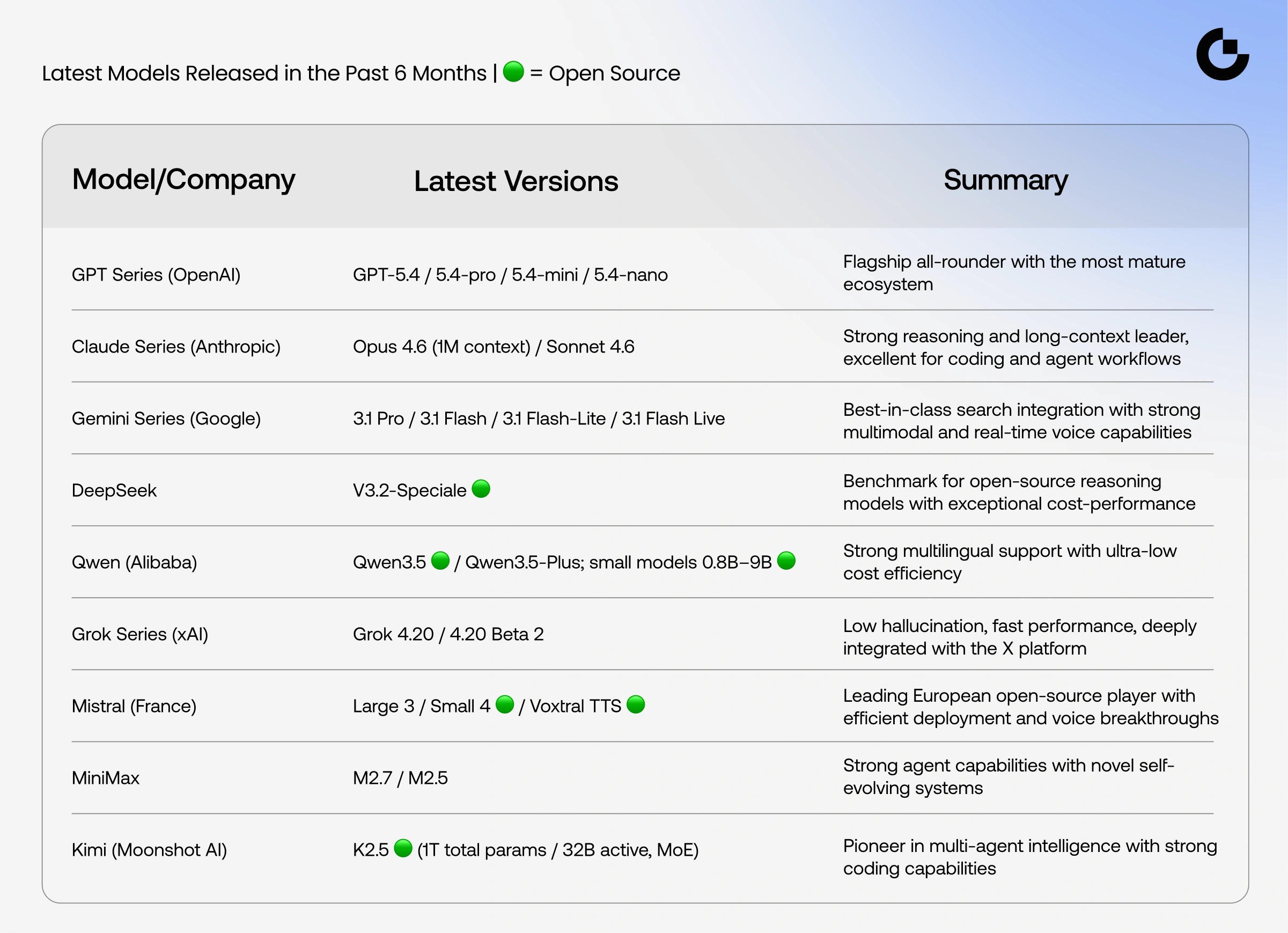
Sources: OpenAI (Aug 2025); Anthropic (Feb 2026); Google AI (2026); DeepSeek GitHub (2025); Alibaba Cloud (Feb 2026); Meta AI (Apr 2025); xAI (Feb 2026); Mistral AI (Dec 2025).
AI Agents Move from Concept to Real-World Deployment
The race to scale models may look like an arms race, but the real inflection point lies in agentic systems. This is where AI starts to materially change how work is done.
-
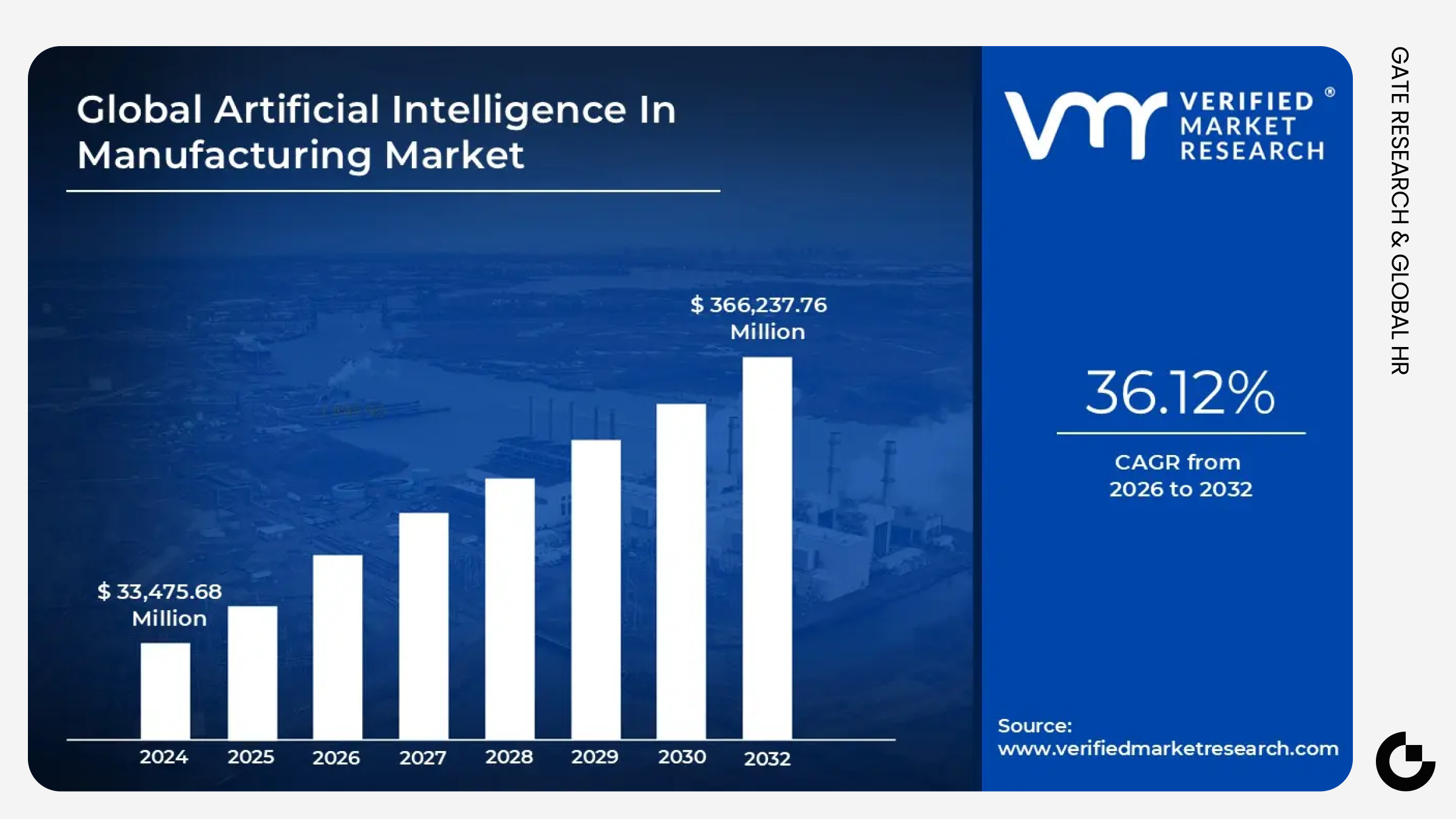
According to Gartner, by the end of 2026, 40% of enterprise applications are expected to incorporate task-specific AI agents, up from less than 5% today. Meanwhile, enterprise demand for multi-agent systems has surged by 1,445% over the past year.
-
GitHub Copilot's agent mode can now autonomously complete the full development workflow—from writing code to submitting pull requests. Meanwhile, Cursor has surpassed 2 million users.
-
Amazon Q Developer is using agent-based systems to modernize thousands of legacy Java systems at scale.
-
Bill McDermott, CEO of ServiceNow, has warned that entry-level unemployment could rise above 30% in the coming years, as AI agents automate a growing share of early-career roles.
Sources: Gartner (Jan 2026); Fortune (Mar 17, 2026). https://fortune.com/2026/03/17/servicenow-ceo-bill-mcdermott-gen-z-graduates-face-30-unemployment-next-couple-of-years-ai-takes-over/
Layoffs Across Tech and One-Way Talent Flows
As AI platforms scale, companies are beginning to rethink how they structure their workforce. On February 26, Block said it would reduce headcount by 40%, eliminating around 4,000 roles. This is one of the clearest examples to date of layoffs tied directly to AI. The timing stands out: Block's Q4 gross profit was up 24% year over year, suggesting this was a strategic decision made from a position of strength rather than a response to pressure. Investors reacted swiftly, sending the stock up 24% on the day. (Sources: CNBC; Block Q4 earnings)
Layoffs didn't stay isolated, they quickly spread across the sector. Amazon cut 16,000 roles, Atlassian reduced its workforce by 10%, and HSBC is weighing plans to eliminate up to 20,000 middle- and back-office positions over the next three to five years. By the end of March, the tech industry had already shed roughly 59,000 jobs in 2026 alone. Early signals suggest the trend may accelerate: an anonymous survey of CFOs indicates AI-driven layoffs this year could reach up to nine times last year's level.
(Sources: NBER; Duke CFO Survey; Fortune.)
The other side of the story paints a different picture. ByteDance is launching what may be its largest-ever intern hiring program, targeting the class of 2027 with over 7,000 positions. More than 4,800 offers are for engineering roles, with conversion rates exceeding 50%. While traditional companies are pulling back, AI-native firms are expanding, driving a one-way shift in talent flows. Source: Sina Tech (Mar 6, 2026). https://finance.sina.com.cn/tech/discovery/2026-03-06/doc-inhpzvnr2495717.shtml
What makes these developments significant is that they are fundamentally redefining the role of human labor within organizations. If you're discussing employment trends without considering what's happened over the past three months, you're essentially talking about a world that no longer exists.
Crypto Enters a New Phase Amid Macro Shocks and Capital Repricing
From Q4 2025 to Q1 2026, the crypto industry faced a more complex and mature external environment than in the previous cycle. On one hand, global markets continued to price in expectations of rate cuts, with the Federal Reserve lowering the target range for the federal funds rate to 3.50%–3.75%, providing marginally improved liquidity that supported risk asset valuations. On the other hand, regional tensions drove volatility in safe-haven assets such as energy and gold. In March 2026, Brent crude surged roughly 9% in a single day due to Middle East conflicts and continued climbing past $110 per barrel, underscoring how geopolitical risks have once again become a key variable in global capital allocation.
(Sources: Federal Reserve FOMC Statement, March 18, 2026; CNBC Report on Brent Crude, March 1, 2026)
In this context, traditional financial institutions are no longer engaging with crypto only at the trading level. Their participation now extends to ETFs, custody, stablecoin payments, and on-chain financial infrastructure. As a result, the crypto ecosystem is moving beyond a purely price-driven phase to one shaped by emerging narratives like AI, stablecoins, and prediction markets.
II. Transmission Path: From Tech Restructuring to Structural Shocks in Crypto
At the beginning of the year, many crypto professionals still thought "these stories" were just a Web2 issue. March data proved otherwise. (All data below are sourced from publicly available information.)
Layoffs within the crypto industry have begun. On March 19, Crypto.com cut 12% of its workforce (around 180 employees). CEO Kris Marszalek made his stance clear on X: "Companies that don't adopt AI immediately risk being put out of business." The cuts were targeted at growth and CRM teams, exactly the roles most easily automated by AI tools. Gemini was even more aggressive, reducing headcount by 30% since the start of the year, from roughly 630 to 445 employees, telling shareholders: "Working without AI is like showing up with a typewriter." During the same period, Algorand Foundation reduced staff by 25%, OP Labs (Optimism) by 20%, and Messari, after three rounds of layoffs, shrank from an intended 1,000 employees to around 140. (Source: CoinDesk, March 21, 2026)
The real drivers behind crypto layoffs are far more complex than "AI replacement." Dan Eskow, founder of crypto recruiting firm Up Top, provides a more nuanced view: most layoffs have little to do with AI. Once talent-heavy sectors like Restaking, DePIN, and L2s have largely vanished, and companies are cutting costs simply to extend their runway. Algorand's reductions focused on community management and business development roles—positions not easily automated by AI. Recruitment data reinforces this point: in January 2026, major crypto hiring platforms added only about 6.5 new positions per day, down 80% year over year. (Source: Dan Eskow / FinanceFeeds; CoinDesk interview)
In practice, two forces are at play simultaneously: a market downturn is shrinking overall opportunities (cyclical), while AI is accelerating structural changes within organizations (structural). For hiring managers, understanding whether a role is disappearing due to sector contraction or being redefined by AI determines whether to pause hiring or revise the job description. For job seekers, knowing the difference tells you whether to wait for the market to rebound or to make a proactive career shift.
The talent drain is accelerating. Top technical talent is migrating from crypto to AI-native companies. Firms like OpenAI, Anthropic, and DeepSeek are offering compensation, cutting-edge tech exposure, and career growth opportunities that currently far outpace the crypto industry average. The reverse flow—from AI back to crypto—is extremely rare. The crypto sector's once-strong appeal, built on token incentives and a remote-first culture, is being eroded as AI companies increasingly embrace global remote hiring and highly competitive pay packages.
A confidential survey of 750 U.S. corporate CFOs, conducted with support from the National Bureau of Economic Research (NBER), projects that AI-attributed layoffs in 2026 could reach roughly 502,000—nine times the previous year's figure of around 55,000. In Q1 alone, 23% of layoffs explicitly cited AI automation as the driving factor. (Sources: Fortune, 2026.03.24; CFO Dive, 2026.03)
The overall industry data is even more striking: crypto job openings have plunged 80% year-over-year, averaging just around 6.5 new positions per day. Entire sectors are fading away—once-hot areas like Restaking, DePIN, and undifferentiated L2s have all but disappeared. (Sources: InCrypted, 2026; Crypto.news)
The Talent Drain Is Accelerating
Top technical talent is migrating from crypto to AI-native companies. Firms like OpenAI, Anthropic, and DeepSeek are offering compensation, cutting-edge tech exposure, and career growth opportunities that currently far outpace the crypto industry average. The reverse flow—from AI back to crypto—is extremely rare. The crypto sector's once-strong appeal, built on token incentives and a remote-first culture, is being eroded as AI companies increasingly embrace global remote hiring and highly competitive pay packages.
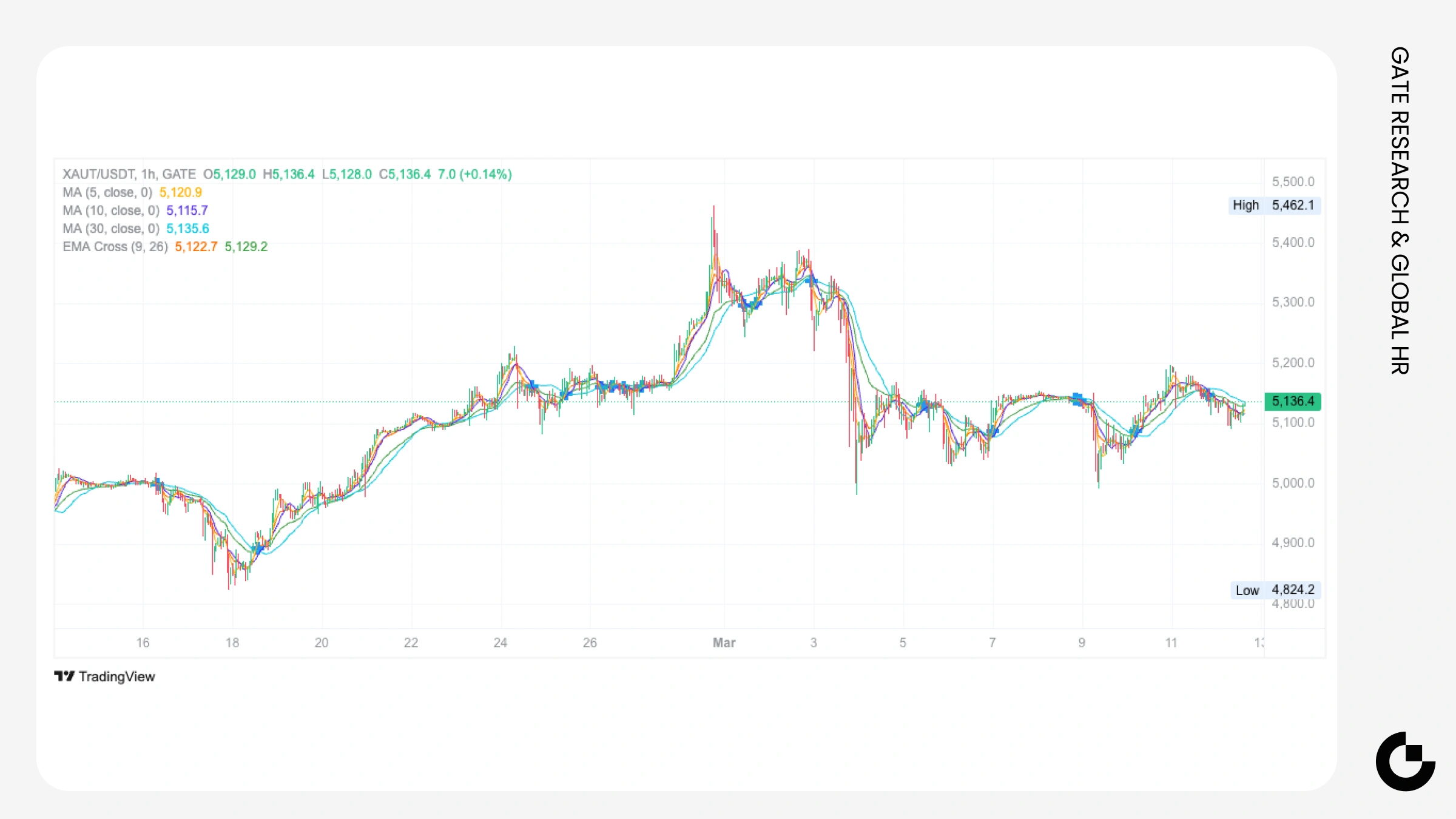
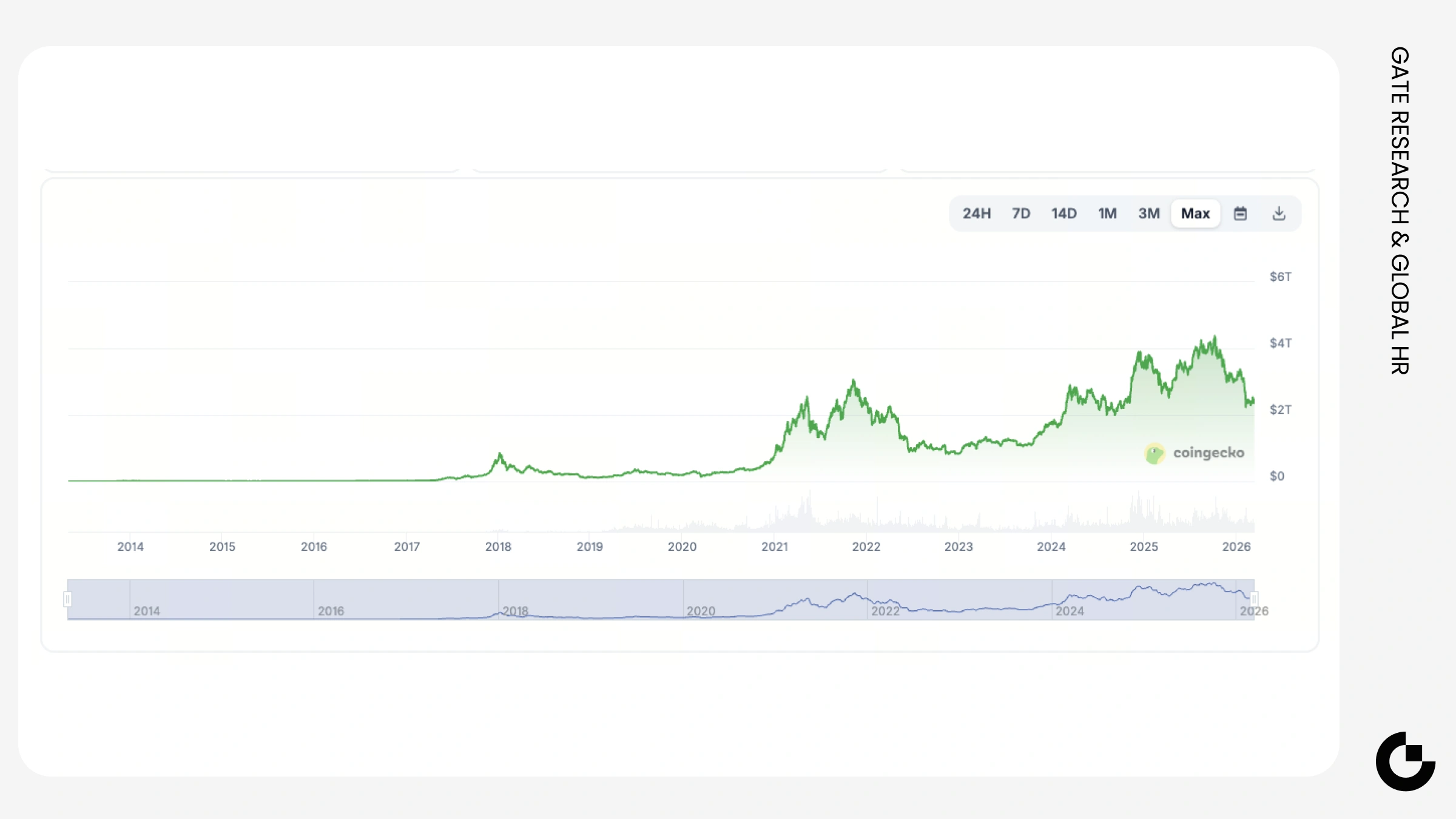
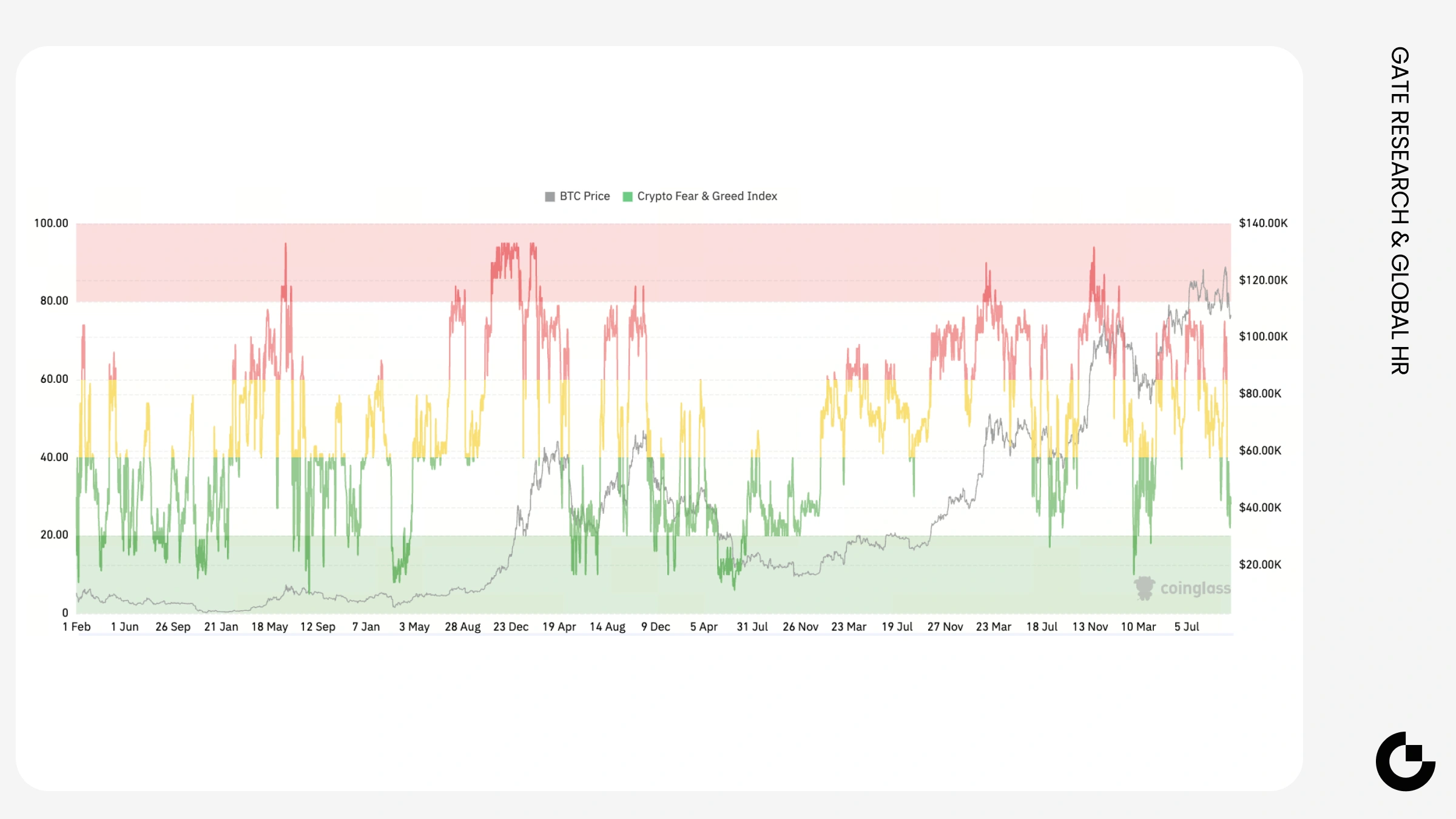
Crypto Market Update: Pullback from the Highs Signals a Phase of Bearish Conditions
Following a strong rally, crypto markets recently reached short-term highs before pulling back sharply. Prices have retreated from their peaks, volatility has picked up, and risk appetite has cooled, suggesting that the industry has likely entered a temporary bear phase. In this environment, companies generally slow their expansion, and hiring shifts from growth-focused roles to positions critical for efficiency and core operations. Source: CoinGecko public market data
III. Who's Hiring: Employer Profiles and Recruitment Priorities Across Four Key Sectors
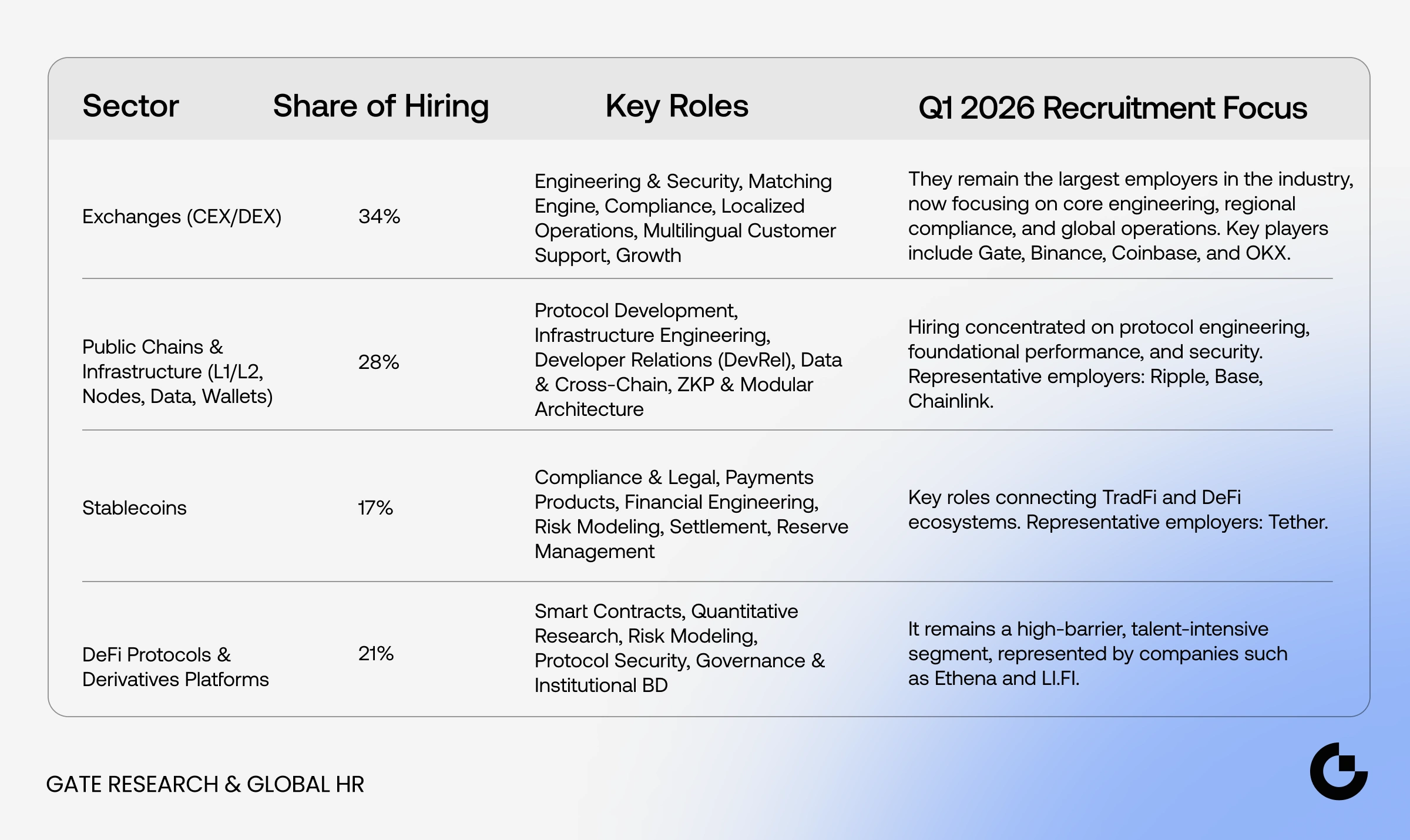
The industry is cooling, but not all segments are shrinking. The key distinction right now is between tracks that are fading away and those where real demand is emerging. Looking at the market by major employer types, crypto hiring in Q1 2026 centers around four sectors: exchanges, public chains and infrastructure, stablecoins, and DeFi & derivatives.
Shifts in Talent Demand: The Market Is Becoming Role-Specific
In Q1, new hiring remained cautious and slowed, but this does not signal a drop in overall demand. The rise of AI and the increasing clarity of regulatory frameworks are reshaping role expectations: low-barrier, execution-focused, process-driven positions are being streamlined, while the bar continues to rise for critical roles in engineering, security, compliance, product, and commercialization.
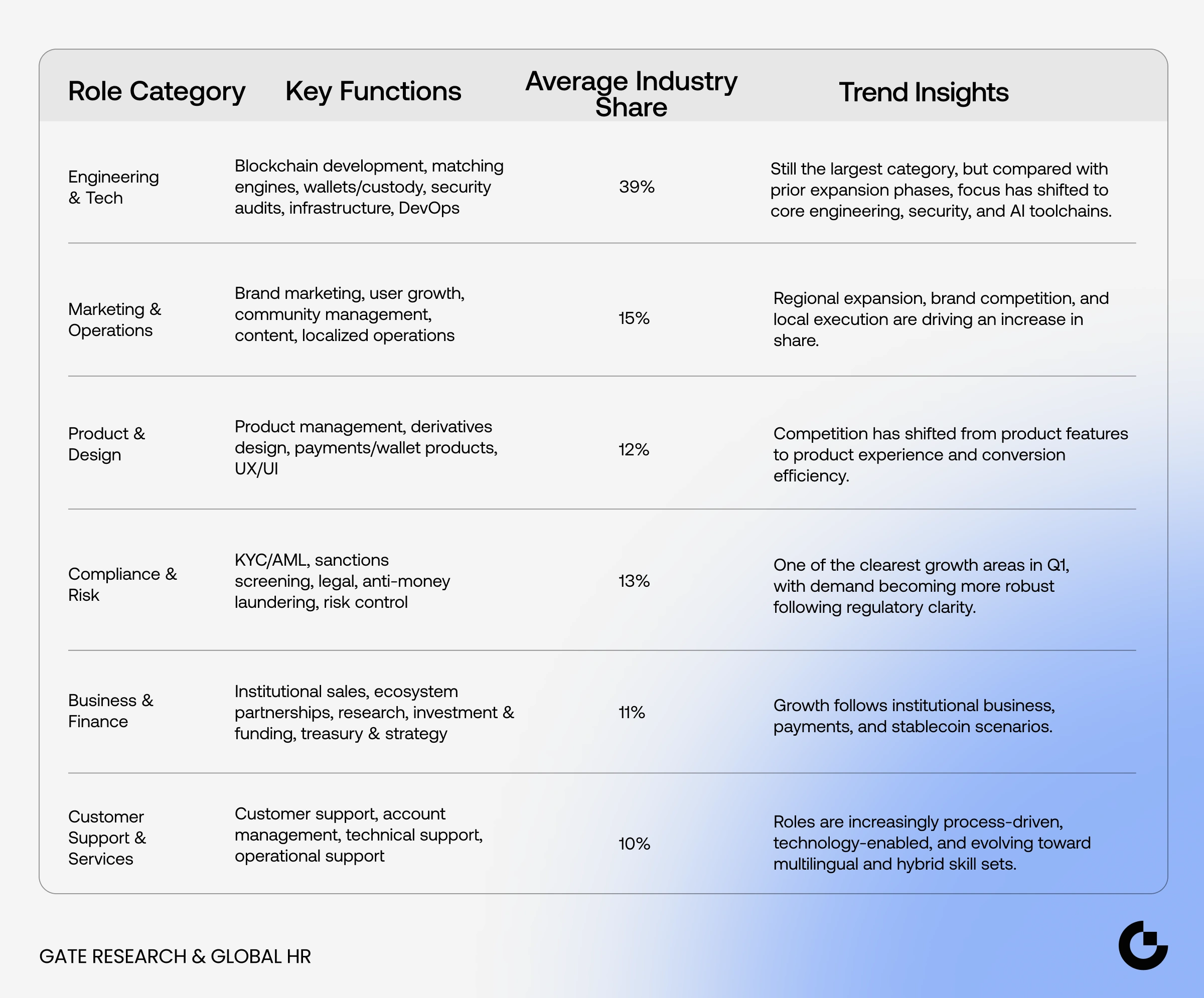
(Source: Web3.Career Intelligence Report 2025; Edgen.tech; Crypto Jobs List)
Q1 2026 New Hiring Data
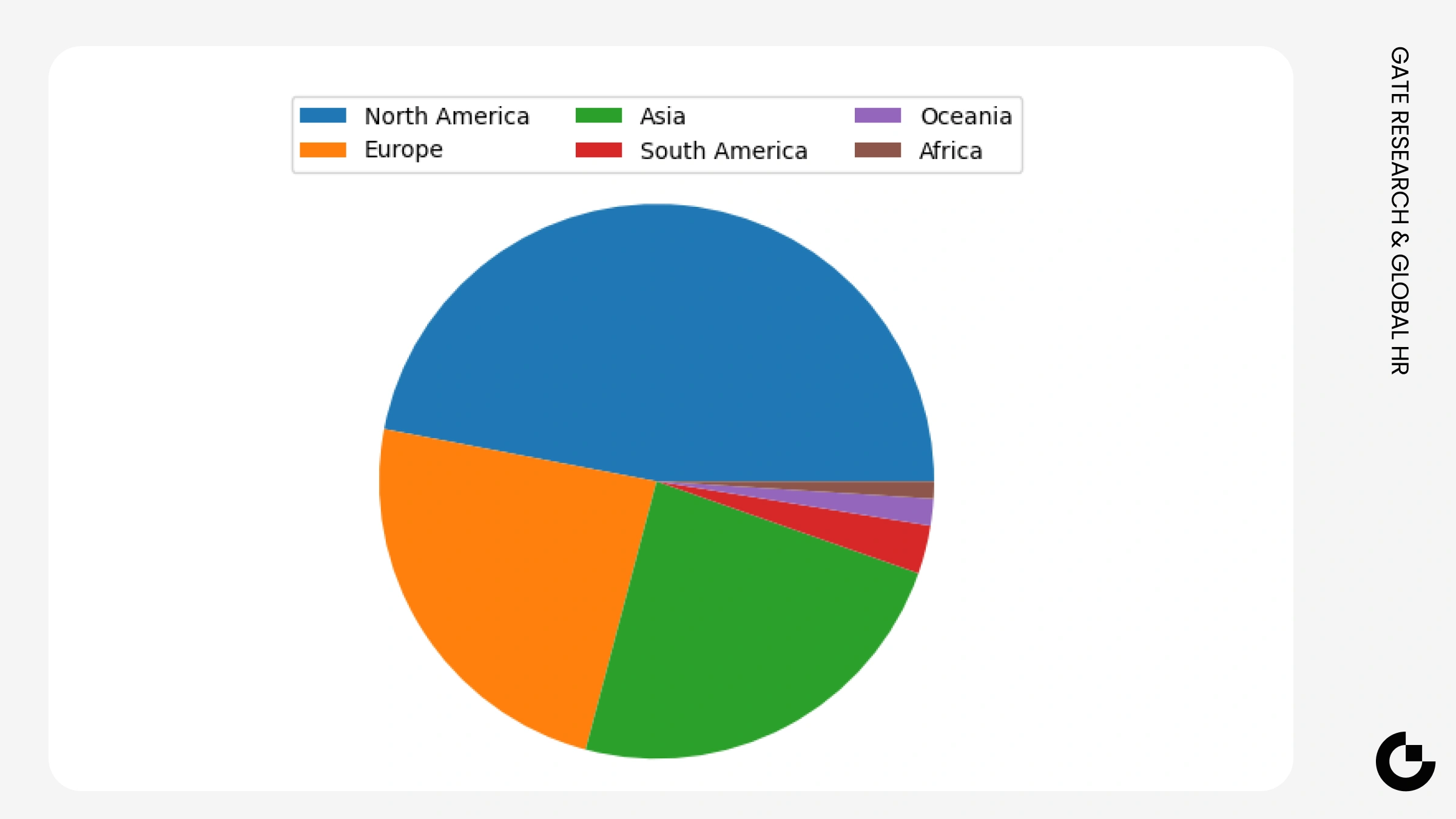
In Q1 2026, approximately 2,167 new Web3 and crypto-related positions were added, including around 328 new Web3 Developer roles. North America led significantly with 25,000 positions, while Europe and Asia each had about 12,000. South America, Oceania, and Africa combined accounted for fewer than 3,000 roles. Remote crypto positions reached 15,000. (Source: Web3.Career)
At Present, Candidates with Combined Skill Sets Hold the Greatest Advantage
The crypto industry has never truly been short on people who can write Solidity. What's scarce are hybrid talents who understand financial product logic, can code, and grasp compliance frameworks. In the AI era, there's an added baseline: being able to leverage AI tools to amplify output. This isn't a bonus—it's a minimum requirement.
Technical roles still make up over 50% of the crypto job market, with blockchain developers, security auditors, and smart contract engineers representing core demand. ZKP engineers and Rollup designers are emerging as scarce, high-paying positions. However, the definition of "technical roles" is evolving rapidly—Gemini framed it as AI turning "10x engineers" into "100x engineers." The implication: pure execution-focused coding roles are shrinking fast, while architecture skills, systems thinking, and the ability to solve ambiguous problems are the real hard currency. (Source: Web3 Jobs; CoinDesk 2026.03.21)
Non-technical roles are increasingly diverging. Compliance positions continue to expand as global regulations tighten, while product managers and ecosystem operators still find opportunities in emerging markets such as Southeast Asia and the Middle East. Meanwhile, Crypto.com's recent layoffs focused on growth and CRM teams—roles like core operations, customer support, and data entry, which are most exposed to AI-driven automation.
For job seekers from other industries: you don't need a "crypto-native" background.
Over the past year, more than half of new entrants into the crypto industry have come from Web2, AI, finance, and related fields. What matters is whether you can bring your existing expertise and quickly get up to speed on crypto fundamentals. For instance, an engineer experienced in traditional payment systems moving into stablecoins, or a lawyer familiar with securities law transitioning into RWA compliance—these cross-industry paths often offer a stronger competitive edge than a purely crypto background.
AI × Crypto Talent Migration 2.0
Top exchanges like Binance, OKX, Coinbase, and Gate are moving beyond simply adding AI tools—they are fully transforming their operations with AI. Binance has deployed 25,000 AI agents, OKX has launched OnchainOS with an integrated AI layer for developers, and Gate now offers natural language trading. The industry is reshaping its core infrastructure.
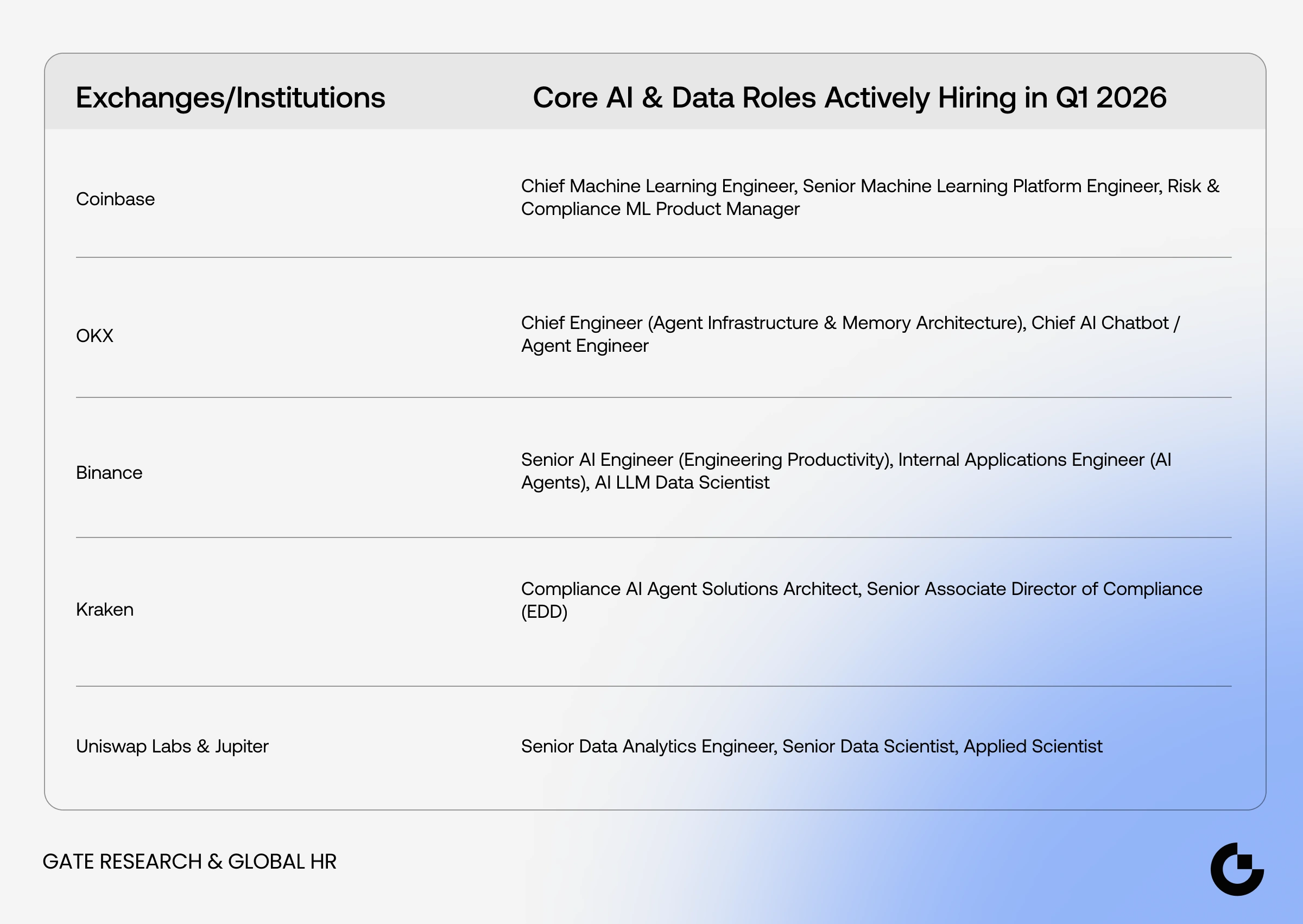
Data reveals that global demand for AI talent is now 3.2x the available supply. Roles requiring AI skills command a 67% salary premium over traditional positions. Currently, 14% of all Web3 job descriptions explicitly require proficiency in AI workflows.
IV. Compensation & Incentives: The Unfiltered Reality
While the global average crypto salary rose by approximately 18% in 2025, this figure masks a significant internal divide. Technical and compliance roles remain at the top of the pay scale, while basic operations and customer support face downward wage pressure from both AI replacement and global remote competition. (Sources: Web3.Career; Edgen.tech; Crypto Jobs List)
Salary Tiers for High-Competition Roles
Tier 1: AI-Native Quant & Algorithms
AI-native quant researchers and algorithmic traders have displaced traditional quants at the absolute top of the crypto salary pyramid. With fewer than 3,000 professionals globally possessing elite "Finance × AI" backgrounds—and a supply-demand ratio of 1:50—these candidates enjoy a 40%–60% salary premium.
Tier 2: Compliance, Legal, & Risk Management
As major global markets establish firm regulatory frameworks, the strategic value of Chief Compliance Officers (CCOs), AML experts, and crypto-specialized lawyers has skyrocketed. In North America, senior compliance officers with top-tier institutional backgrounds now see annual compensation ranges that rival or even exceed those of quant traders.
Tier 3: Security & Smart Contracts
Smart contract auditors and core blockchain developers form the fastest-growing talent cluster with the highest barriers to entry. Top auditors often supplement their base salary with Bug Bounties, providing massive upside potential in their total annual income.
Token Incentives & Remote Culture
Token compensation remains the primary differentiator in crypto pay packages. Over 70% of projects offer token options, which can yield returns several times higher than a base salary during a bull market. However, many project tokens go to zero during bear cycles. When evaluating a crypto offer, do not just look at the "paper total package." You must assess: does the project generate real revenue (rather than relying solely on token issuance)? What are the token vesting schedules and lock-up conditions? Does the team have enough treasury reserves to survive a full market cycle? (Sources: Web3 Career; Web3 Jobs)
Remote work is in the DNA of the crypto industry, with remote roles accounting for 36% of all positions in 2025. For instance, Gate has nearly 3,000 employees distributed globally, operating almost entirely as a remote workforce. While this breaks down geographic barriers, it also means you are competing against both global talent and global AI tools for every seat.
V. Action Guide: Finding Your Place in the AI-Driven Crypto Industry
For HR & Managers
-
Audit Existing JDs: Review every role to identify which specific responsibilities can be assisted or replaced by AI. Make "AI Collaboration Skills" a standard requirement in your job postings.
-
Build Pipelines in Key Sectors: Proactively build talent pipelines in Stablecoins, Compliance, and Security Audits. These sectors are "weather-proof" and remain in demand regardless of market cycles. A bear market is actually the best time to cultivate relationships with top-tier candidates.
-
Reassess Token Incentive Realism: Evaluate the current market appeal of your token incentive packages. If a project's token has dropped 70% from its peak, using it as a major percentage of the total compensation package to attract talent will likely backfire.
-
Task-Based Impact Analysis: Before approving any "AI-driven" layoffs, perform a task-level breakdown. Which tasks are truly automatable? What is the AI system's error rate? Most importantly: What is the fallback plan if the AI fails?
For Current Industry Professionals
-
Master AI Tooling Immediately: Whether you are in a technical or non-technical role, proficiency in at least 2–3 AI productivity tools (such as Claude, Cursor, or GitHub Copilot) has become a basic survival requirement.
-
Assess Sector Momentum: Evaluate the structural health of your current niche. If you are working in Restaking, DePIN, or an L2 project with no real revenue, do not wait for the doors to close before exploring new opportunities.
-
Pivot Toward Growth: Focus on expanding sectors: Stablecoins (where regulatory frameworks are creating a surge in professional roles), Compliance & Risk Management (a non-negotiable demand as global regulation tightens), and the AI × Crypto cross-section.
For Cross-Industry Applicants
-
Identify Practical Entry Points: The most realistic paths into the industry are through Stablecoin Compliance, Technical Security, and Product Management. These sectors value your cross-industry expertise more than pure "crypto enthusiasm."
-
The Myth of the "Crypto-Native": You don't need a pure crypto background. In the past year, over half of the new entrants have come from Web2, AI, and traditional finance.
-
Focus on the "Non-Automatable": Instead of panicking about "AI replacing my job," identify which specific tasks in your role will be taken over by AI and which will not. Invest your time in strengthening the latter.
The AI Readiness Index (AIQ) indicates that only about 16% of the workforce has reached a high level of AI proficiency. This represents a massive window of opportunity for early adopters—but that window will not stay open forever. (Sources: Forrester AI Readiness Index 2025)
Conclusion
Reflecting on this past cycle, the crypto industry has navigated an extraordinary journey through macroeconomic volatility and capital restructuring. As the market retraced from its highs and corporate hiring shifted from aggressive expansion to a more conservative stance, the industry entered a new phase of "restructured growth." However, beneath this surface-level contraction, bigger structural changes are taking root: the accelerated convergence of AI and crypto, the deepening of global compliance, and the continued emergence of real-world use cases. These forces are collectively redefining the industry's boundaries and its future.
Throughout this profound structural transformation, Gate has remained at the forefront of the industry. We have leaned deeply into the AI wave, actively integrating AI tools and intelligent capabilities across our product suites, risk management systems, research departments, and daily operations. Simultaneously, through our global remote-work model, we continue to attract multifaceted talent that possesses "Blockchain Logic × Cutting-edge AI Skills × A Global Vision." We are firm in our belief: the future of the crypto ecosystem will be built by versatile professionals who can navigate the underlying logic of the blockchain, harness the power of AI, and pair a global perspective with a deep commitment to local markets.

Appendix
Key Terms Explained (for Non-Crypto Readers)
-
AI Agent: An AI system capable of autonomously planning and executing multi-step tasks.
-
SaaSpocalypse: The massive collapse of SaaS software stocks in early 2026, triggered by the rise of AI Agents.
-
GENIUS Act: The first U.S. law regulating stablecoins.
-
ZKP (Zero-Knowledge Proof): A cryptographic method that allows a prover to prove that something is true without revealing any additional information.
-
RWA (Real-World Assets): Traditional financial assets tokenized via blockchain technology.
-
DeFi (Decentralized Finance): On-chain financial services such as lending and trading, powered by smart contracts.
-
TVL (Total Value Locked): The total value of crypto assets locked in a DeFi protocol.
-
Vesting: A mechanism for the phased release of token incentives, typically over 1–4 years.
-
Bug Bounty: A reward offered by a project to researchers who identify security vulnerabilities.
-
Hyperliquid: A decentralized perpetual futures exchange that rose to prominence in 2025, with zero external funding and purely driven by product strength.