This comprehensive guide evaluates EMYC as an investment opportunity by analyzing E-money Network's compliance-focused blockchain infrastructure for real-world asset tokenization. The article examines EMYC's price trajectory from a January 2025 launch at $0.11 to current levels around $0.007, highlighting a 90.33% annual decline despite 6 global banking licenses and MiCA compliance positioning. Key investment factors include controlled token supply (400M max), institutional adoption potential, and the expanding RWA tokenization market, balanced against significant risks including extreme volatility, limited liquidity (single exchange listing), and regulatory uncertainty. The guide presents multi-scenario forecasts through 2031 ranging from $0.007 to $0.0137, tailored investment strategies for conservative to professional investors, and essential risk management protocols. Ideal for investors seeking exposure to compliant blockchain infrastructure while managing concentration risk through dollar-cost averaging
Introduction: E Money (EMYC)'s Investment Position and Market Outlook
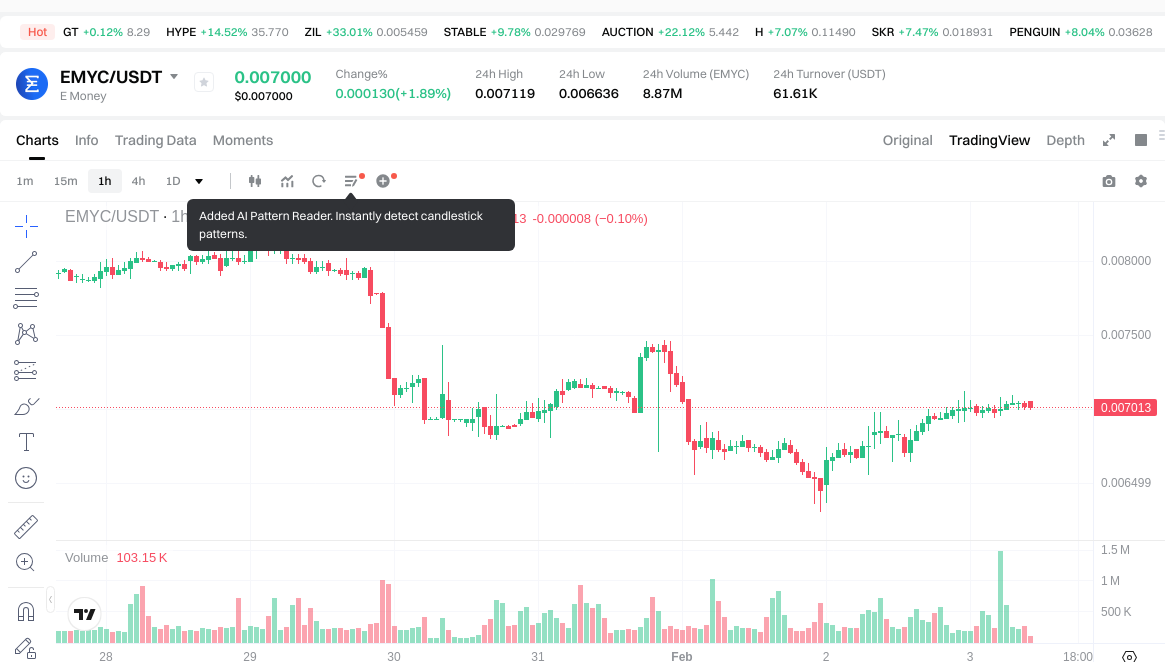
EMYC is a notable asset in the cryptocurrency field. E-money Network represents a public permissioned blockchain network supporting on-chain KYC and AML capabilities, enabling retail users and institutions to tokenize real-world assets (RWAs) on-chain through MiCA-compliant infrastructure with bank-grade security. As of February 03, 2026, EMYC has a market capitalization of approximately $1,132,444.87, with a circulating supply of around 161,777,838.66 tokens. The current price stands at approximately $0.007. With its positioning in the compliance-focused blockchain and real-world asset tokenization space, EMYC has become a subject of discussion when investors consider "Is E Money (EMYC) a good investment?" This article provides a comprehensive analysis of EMYC's investment value, historical trends, future price projections, and investment risks to serve as a reference for investors.
I. E Money (EMYC) Price History Review and Current Investment Value
- January 2025: Token launch at $0.11 → Price experienced significant volatility in early trading
- January 23, 2025: Market milestone → EMYC price reached $0.31049 during initial market activity
- February 2026: Market adjustment → Price declined from early 2025 levels to $0.006301
Current EMYC Investment Market Status (February 2026)
- EMYC current price: $0.007
- Market sentiment (Fear & Greed Index): Data not available in provided materials
- 24-hour trading volume: $61,463.83
- Institutional investor holdings: 2,242 holders recorded
Click to view real-time EMYC market price
II. Core Factors Affecting Whether EMYC Is a Good Investment
Supply Mechanism and Scarcity (EMYC Investment Scarcity)
- Total Supply Cap: EMYC has a maximum supply of 400 million tokens, creating a defined upper limit that establishes potential scarcity dynamics in the long term.
- Current Circulation: As of February 2026, approximately 161.78 million EMYC tokens are in circulation, representing about 40.44% of the total supply, indicating substantial locked or unvested tokens that may enter the market gradually.
- Investment Implications: The controlled supply structure may support price stability over time, though investors should monitor token release schedules and vesting periods that could affect future market dynamics.
Institutional Investment and Mainstream Adoption (Institutional Investment in EMYC)
- Holder Base: The token currently has 2,242 holders as of early 2026, reflecting a relatively concentrated holder distribution that may indicate early-stage adoption.
- Compliance Infrastructure: E-money Network has obtained 6 global banking licenses, positioning itself as a MiCA-compliant infrastructure provider, which may attract institutional participants seeking regulatory clarity.
- Regulatory Positioning: The network's focus on on-chain KYC and AML compliance distinguishes it in the tokenization space, potentially appealing to institutions prioritizing regulatory alignment in their blockchain investments.
Macroeconomic Environment's Impact on EMYC Investment
- Real-World Asset (RWA) Tokenization Trend: E-money Network operates in the expanding RWA tokenization sector, where macroeconomic factors such as interest rate environments and institutional demand for regulated digital assets may influence adoption rates.
- Market Volatility Context: EMYC has experienced significant price fluctuations, with a one-year decline of 90.33% as of February 2026, reflecting sensitivity to broader cryptocurrency market conditions and risk sentiment.
- Regulatory Environment: The project's emphasis on MiCA compliance may position it favorably in jurisdictions implementing stricter cryptocurrency regulations, though regulatory developments remain a key variable for investment considerations.
Technology and Ecosystem Development (Technology & Ecosystem for EMYC Investment)
- Public Permissioned Blockchain Architecture: E-money Network operates as a public permissioned blockchain, combining accessibility with compliance controls through integrated KYC and AML processes at the protocol level.
- RWA Tokenization Infrastructure: The platform provides bank-grade security infrastructure for tokenizing real-world assets, targeting both retail users and institutional participants in regulated digital asset markets.
- Ecosystem Maturity: Trading activity shows 24-hour volume of approximately $61,463.83 with availability on one exchange as of February 2026, suggesting an emerging ecosystem that may require further development and liquidity expansion to support broader investment participation.
III. EMYC Future Investment Forecast and Price Outlook (Is E Money(EMYC) worth investing in 2026-2031)
Short-term Investment Forecast (2026, short-term EMYC investment outlook)
- Conservative Forecast: $0.00553 - $0.007
- Neutral Forecast: $0.007 - $0.0080
- Optimistic Forecast: $0.0080 - $0.0091
Mid-term Investment Outlook (2027-2029, mid-term E Money(EMYC) investment forecast)
-
Market Stage Expectation: E Money Network may experience gradual growth as its public permissioned blockchain infrastructure and compliance framework continue to mature. The project's focus on on-chain KYC and AML compliance, along with MiCA-compliant infrastructure, could attract institutional interest in real-world asset tokenization.
-
Investment Return Forecast:
- 2027: $0.0057155 - $0.0095795
- 2028: $0.00599403 - $0.0096080775
- 2029: $0.00847450065 - $0.011606381325
-
Key Catalysts: Expansion of banking licenses beyond current six jurisdictions, increased adoption of compliant RWA tokenization solutions, potential partnerships with financial institutions, and broader market acceptance of regulated blockchain infrastructure.
Long-term Investment Outlook (Is E Money a good long-term investment?)
- Base Scenario: $0.00700310626323 - $0.0120743211435 (assuming steady development of compliance infrastructure and moderate growth in RWA tokenization market)
- Optimistic Scenario: $0.0120743211435 - $0.0137397447495 (assuming accelerated institutional adoption and favorable regulatory environment for compliant blockchain solutions)
- Risk Scenario: Below $0.006301 (under adverse market conditions or significant competitive pressure from alternative compliance-focused blockchain platforms)
Click to view EMYC long-term investment and price forecast: Price Prediction
2026-02-03 - 2031 Long-term Outlook
- Base Scenario: $0.007 - $0.0104088975375 (corresponding to steady progress and gradual mainstream application adoption)
- Optimistic Scenario: $0.0104088975375 - $0.0137397447495 (corresponding to large-scale adoption and favorable market environment)
- Transformative Scenario: Above $0.0137397447495 (in case of breakthrough ecosystem developments and mainstream penetration)
- 2031-12-31 Forecast High: $0.0137397447495 (based on optimistic development assumptions)
Disclaimer: This forecast is based on available data and predictive models. Cryptocurrency markets are highly volatile and subject to various risks. Past performance does not guarantee future results. This information should not be construed as investment advice. Investors should conduct their own research and consult with financial professionals before making investment decisions.
| Year |
Predicted High Price |
Predicted Average Price |
Predicted Low Price |
Price Change |
| 2026 |
0.0091 |
0.007 |
0.00553 |
0 |
| 2027 |
0.0095795 |
0.00805 |
0.0057155 |
15 |
| 2028 |
0.0096080775 |
0.00881475 |
0.00599403 |
25 |
| 2029 |
0.011606381325 |
0.00921141375 |
0.00847450065 |
31 |
| 2030 |
0.0137397447495 |
0.0104088975375 |
0.009888452660625 |
48 |
| 2031 |
0.012919523623545 |
0.0120743211435 |
0.00700310626323 |
72 |
IV. EMYC Investment Strategy and Risk Management (How to invest in E Money)
Investment Methodology (EMYC investment strategy)
-
Long-term Holding (HODL EMYC): Suitable for conservative investors
Long-term holding strategies focus on accumulating EMYC tokens over an extended period, capitalizing on the potential growth of the E-money Network's infrastructure for real-world asset tokenization. This approach minimizes the impact of short-term price fluctuations and aligns with the project's vision of establishing compliant, bank-grade blockchain infrastructure.
-
Active Trading: Relies on technical analysis and swing trading
Active traders may leverage price volatility to execute short-term trades. Given EMYC's 24-hour price change of 2.33% and fluctuations between $0.006636 and $0.007119, technical analysis tools such as support/resistance levels, volume indicators, and momentum oscillators can inform entry and exit points. However, traders should remain cautious of liquidity constraints, as the token is currently listed on a limited number of exchanges.
Risk Management (Risk management for EMYC investment)
-
Asset Allocation Ratios: Conservative / Aggressive / Professional investors
- Conservative investors: Allocate 1-3% of total portfolio to EMYC, prioritizing capital preservation while gaining exposure to RWA tokenization trends.
- Aggressive investors: May allocate 5-10% of portfolio, accepting higher volatility in pursuit of growth opportunities.
- Professional investors: Could consider strategic allocations of 10-15%, combined with active risk monitoring and hedging strategies.
-
Risk Hedging Solutions: Multi-asset portfolio + hedging tools
Investors can mitigate EMYC-specific risks by diversifying across multiple blockchain projects, stablecoins, and traditional assets. Derivatives such as options or futures (where available) may provide additional downside protection. Portfolio rebalancing on a quarterly basis helps maintain desired risk exposure levels.
-
Secure Storage: Hot/cold wallets + hardware wallet recommendations
Given EMYC's deployment on the Binance Smart Chain (BSC) with contract address 0xe3f53c0d48360de764ddc2a1a82c3e6db5d4624d, investors should utilize BEP20-compatible wallets. For long-term holdings, hardware wallets such as Ledger or Trezor offer enhanced security through offline storage. For active trading, reputable hot wallets with multi-signature authentication and two-factor verification provide necessary accessibility while maintaining security standards.
V. EMYC Investment Risks and Challenges (Risks of investing in E Money)
-
Market Risks: High volatility, price manipulation
EMYC has demonstrated substantial price volatility, with a 7-day decline of 11.17%, 30-day decline of 34.76%, and 1-year decline of 90.33%. The token's current price of $0.007 represents a significant decrease from its historical high of $0.31049 on January 23, 2025. With a circulating supply of approximately 161.78 million tokens (40.44% of max supply) and 24-hour trading volume of $61,463.83, liquidity concerns may amplify price swings. The relatively small market capitalization of approximately $1.13 million and limited exchange availability (currently listed on 1 exchange) increase susceptibility to volatility and potential market manipulation.
-
Regulatory Risks: Policy uncertainty across different jurisdictions
While E-money Network positions itself as compliant with MiCA (Markets in Crypto-Assets) standards and claims to have acquired 6 global banking licenses, the evolving regulatory landscape for crypto assets and RWA tokenization presents ongoing uncertainty. Different jurisdictions maintain varying approaches to digital asset regulation, KYC/AML requirements, and securities classification. Changes in regulatory frameworks could impact the project's operational model, token utility, or market access across different regions.
-
Technical Risks: Network security vulnerabilities, upgrade failures
As a blockchain network supporting on-chain KYC and AML functions, E-money Network faces technical challenges related to security architecture, smart contract vulnerabilities, and system scalability. The integration of permissioned access controls with public blockchain infrastructure introduces complexity that may create potential attack vectors. Additionally, future protocol upgrades or modifications to compliance mechanisms carry execution risks that could temporarily affect network functionality or token utility.
VI. Conclusion: Is E Money a Good Investment?
-
Investment Value Summary: EMYC presents exposure to the emerging RWA tokenization sector through a compliance-focused infrastructure approach, though the token has experienced considerable price declines over recent periods.
-
Investor Recommendations:
✅ Beginners: Consider dollar-cost averaging strategies combined with secure wallet storage to mitigate timing risks and maintain asset security.
✅ Experienced Investors: May explore swing trading opportunities during volatility periods while maintaining diversified portfolio allocation to manage concentration risk.
✅ Institutional Investors: Could evaluate strategic long-term positioning based on the project's regulatory compliance framework and RWA tokenization infrastructure development.
⚠️ Disclaimer: Cryptocurrency investments carry substantial risk. This content is provided for informational purposes only and does not constitute investment advice. Conduct thorough due diligence and consider consulting qualified financial advisors before making investment decisions.
VII. FAQ
Q1: What is E Money (EMYC) and what makes it different from other cryptocurrencies?
E Money (EMYC) is the native token of E-money Network, a public permissioned blockchain designed for real-world asset (RWA) tokenization with built-in compliance features. What distinguishes EMYC from other cryptocurrencies is its focus on regulatory compliance through on-chain KYC and AML capabilities, MiCA-compliant infrastructure, and bank-grade security. The project has acquired 6 global banking licenses and operates within a framework that enables both retail users and institutions to tokenize real-world assets while maintaining regulatory standards. This compliance-first approach positions EMYC uniquely in the blockchain space, targeting users who prioritize regulatory alignment over complete decentralization.
Q2: How has EMYC performed historically as an investment?
EMYC has experienced significant volatility since its launch in January 2025. The token initially launched at $0.11 and reached a historical high of $0.31049 on January 23, 2025. However, as of February 2026, the price has declined substantially to approximately $0.007, representing a 1-year decline of 90.33%. Recent performance shows a 7-day decline of 11.17% and a 30-day decline of 34.76%. With a current market capitalization of approximately $1.13 million and 24-hour trading volume of $61,463.83, the token has demonstrated considerable price instability characteristic of early-stage cryptocurrency projects in emerging market segments.
Q3: What is the investment outlook for EMYC in 2026-2031?
Investment forecasts for EMYC vary across timeframes and scenarios. For 2026, conservative estimates range from $0.00553 to $0.007, while optimistic forecasts suggest potential growth to $0.0080-$0.0091. Mid-term projections (2027-2029) indicate gradual appreciation, with 2029 estimates ranging from $0.00847 to $0.0116, assuming continued development of the RWA tokenization market and institutional adoption. Long-term forecasts through 2031 present a base scenario of $0.007 to $0.0104 and an optimistic scenario reaching $0.0137. These projections depend on factors including regulatory developments, institutional adoption rates, expansion of banking licenses, and broader market acceptance of compliant blockchain infrastructure. However, given the high volatility and early-stage nature of the project, these forecasts carry substantial uncertainty.
Q4: What are the main risks associated with investing in EMYC?
Investing in EMYC involves multiple risk categories. Market risks include extreme volatility, limited liquidity (currently listed on only 1 exchange), and potential price manipulation due to the relatively small market cap of $1.13 million and concentrated holder base of 2,242 addresses. Regulatory risks stem from evolving policies across jurisdictions, despite the project's MiCA compliance positioning. Technical risks encompass potential security vulnerabilities in the permissioned blockchain architecture, smart contract risks, and execution challenges during protocol upgrades. Additionally, approximately 59.56% of the total token supply remains unvested or locked, presenting dilution risks as these tokens enter circulation. The 90.33% price decline over one year highlights the substantial downside risk inherent in this investment.
Q5: What investment strategy should different types of investors consider for EMYC?
Investment strategies for EMYC should align with investor profiles and risk tolerance levels. Conservative investors may consider allocating 1-3% of their portfolio to EMYC through dollar-cost averaging strategies, utilizing hardware wallets (Ledger or Trezor) for secure storage, and maintaining long-term holding positions focused on the RWA tokenization thesis. Aggressive investors might allocate 5-10% while employing active trading strategies to capitalize on volatility, using technical analysis tools to identify entry and exit points within the typical daily range ($0.006636-$0.007119). Professional investors could consider 10-15% strategic allocations combined with hedging instruments and quarterly rebalancing. Regardless of approach, all investors should maintain diversified portfolios, use BEP20-compatible wallets for the BSC-deployed token, and implement proper security measures including multi-signature authentication and two-factor verification.
Q6: How does the supply mechanism affect EMYC's investment potential?
EMYC has a maximum supply of 400 million tokens, with approximately 161.78 million (40.44%) currently in circulation as of February 2026. This controlled supply structure creates defined scarcity dynamics that could support long-term price stability, particularly if demand increases through institutional adoption and RWA tokenization growth. However, the substantial portion of locked or unvested tokens (approximately 238.22 million, or 59.56% of total supply) represents potential selling pressure as tokens are released into circulation according to vesting schedules. Investors should monitor token unlock events and distribution timelines, as these scheduled releases may create downward price pressure regardless of fundamental developments. The supply mechanism's impact on investment value depends heavily on the rate of demand growth relative to the pace of token distribution.
Q7: Is EMYC suitable for long-term holding (HODL) strategy?
EMYC's suitability for long-term holding depends on individual investment goals and risk tolerance. The project's positioning in the emerging RWA tokenization sector, combined with its compliance-focused infrastructure and 6 global banking licenses, suggests potential long-term value if regulatory frameworks favor compliant blockchain solutions and institutional adoption accelerates. Price forecasts through 2031 indicate potential appreciation from current levels ($0.007) to estimated ranges of $0.0104-$0.0137 under favorable scenarios. However, several factors complicate long-term holding strategies: the token's 90.33% decline since launch, limited liquidity across exchanges, ongoing token unlocks that may dilute value, and intense competition in the blockchain infrastructure space. Conservative investors interested in long-term exposure should limit allocation to 1-3% of portfolio, employ dollar-cost averaging to mitigate timing risks, and maintain realistic expectations given the project's early-stage development and significant historical volatility.
Q8: Where can investors purchase and securely store EMYC tokens?
EMYC is currently available for trading on a limited number of exchanges, with the primary option being Gate.com as indicated in the reference materials. The token operates on the Binance Smart Chain (BSC) with contract address 0xe3f53c0d48360de764ddc2a1a82c3e6db5d4624d, requiring BEP20-compatible wallets for storage. For secure storage, investors have several options depending on their needs: hardware wallets such as Ledger Nano S/X or Trezor provide maximum security for long-term holdings through offline cold storage; software hot wallets like MetaMask or Trust Wallet offer convenience for active trading while maintaining reasonable security through features like multi-signature authentication and two-factor verification. Investors should never store significant holdings on exchanges due to custodial risks. When setting up wallets, ensure proper backup of recovery phrases, enable all available security features, and verify the correct BSC network configuration before transferring tokens. The limited exchange availability currently presents liquidity constraints that investors should consider when planning entry and exit strategies.
* The information is not intended to be and does not constitute financial advice or any other recommendation of any sort offered or endorsed by Gate.