Griffin AI (GAIN) is an early-stage DeFi infrastructure token serving as the native currency of a no-code agent builder platform. As of February 2026, GAIN trades at $0.002726 with a market cap of $626,980, down 97.49% from its September 2025 peak. The project has deployed 15,000+ active agents and integrated with major blockchains including BNB Chain, NEAR, Arbitrum, and Cardano. GAIN functions as the operational gas for on-chain agent transactions, addressing a market gap where 95% of DeFi projects reportedly lack AI capabilities. Long-term price forecasts range from $0.003005 to $0.007234 by 2031 depending on adoption scenarios. However, significant risks include extreme volatility, limited trading liquidity ($13,704 daily volume), and substantial supply overhang with 77% of tokens yet to circulate. This analysis examines GAIN's investment characteristics, price trajectories, and risk factors to help market participants evaluate exposure to this emerging AI token.
Introduction: Griffin AI (GAIN) Investment Position and Market Outlook
GAIN is the native token of Griffin AI, a no-code agent builder platform in the DeFi sector. As of February 05, 2026, GAIN holds a market capitalization of approximately $626,980, with a circulating supply of 230,000,000 tokens and a current price around $0.002726. The token is deployed using the BEP-20 standard and is traded across 3 exchanges, with a 24-hour trading volume of $13,704.37. Griffin AI has powered more than 15,000 live agents and established integrations with notable projects including BNB Chain, NEAR Protocol, Cardano Foundation, Arbitrum, 1inch, Uniswap, and Bithumb's Burrito Wallet. The platform addresses gaps in the DeFi market by providing AI-driven agents that operate on-chain, with approximately 4,150 token holders as of the current date. This article examines GAIN's investment characteristics, historical price movements, future price scenarios, and associated risks to provide reference information for market participants considering exposure to this asset.
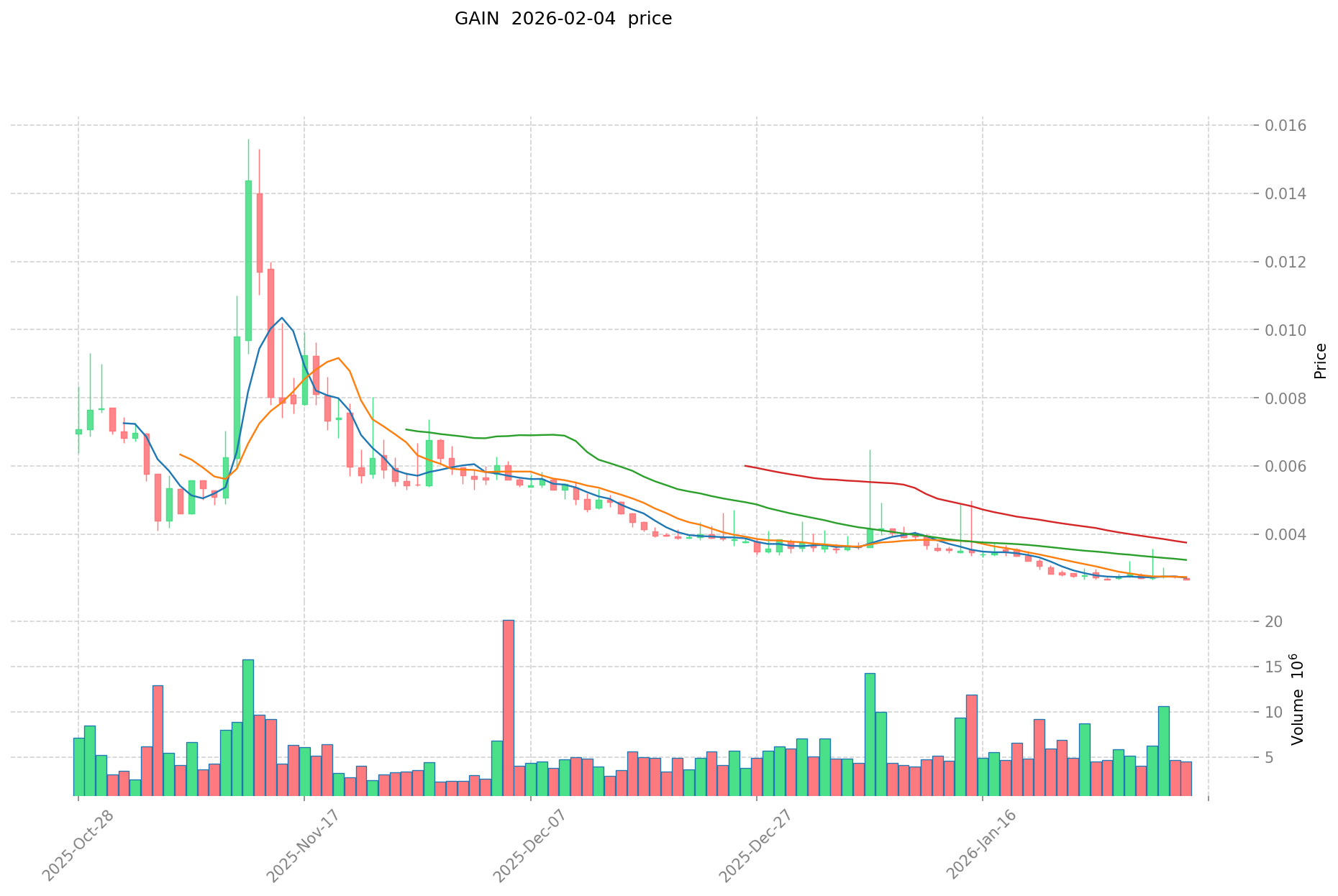
I. Griffin AI (GAIN) Historical Price Review and Current Investment Value
- September 2025: Griffin AI (GAIN) launched on major exchanges with initial trading activity → Token price reached $0.24997 during early market participation
- January 2026: Market adjustment period → GAIN price declined to $0.002676 as broader crypto market experienced volatility
- February 2026: Price stabilization phase → Token trading in the $0.0027 range with moderate recovery from recent lows
Current GAIN Investment Market Status (February 2026)
- GAIN current price: $0.002726
- Market sentiment (Fear & Greed Index): Data reflects cautious market positioning
- 24-hour trading volume: $13,704.37
- Token holder distribution: 4,150 addresses holding GAIN across BSC network
Click to view real-time GAIN market price
II. Core Factors Influencing Whether GAIN is a Good Investment
Supply Mechanism and Scarcity (GAIN Investment Scarcity)
- Total Supply & Circulation: Griffin AI (GAIN) operates with a maximum supply of 1,000,000,000 tokens, of which 230,000,000 tokens are currently in circulation, representing 23% of the total supply. This relatively limited circulating supply creates a foundation for potential scarcity-driven value appreciation.
- Supply Structure: The circulating market cap stands at $626,980, while the fully diluted market cap reaches $2,726,000, indicating that 77% of tokens remain locked or unvested. This significant supply overhang requires careful consideration in long-term investment planning.
- Investment Significance: The controlled release of tokens may support price stability in the near term, though future token unlocks could create downward pressure. Scarcity dynamics will depend heavily on token release schedules and demand growth from the expanding agent ecosystem.
Institutional Investment and Mainstream Adoption (Institutional Investment in GAIN)
- Ecosystem Integration: Griffin AI agents have established partnerships with prominent blockchain platforms including BNB Chain, NEAR Protocol, Cardano Foundation, Arbitrum, 1inch, Uniswap, and Bithumb's Burrito Wallet. These integrations demonstrate growing institutional recognition within the DeFi infrastructure layer.
- Market Position: With over 15,000 active agents deployed on the platform, Griffin AI has positioned itself as a no-code agent builder targeting a DeFi market where approximately 95% of projects reportedly lack AI capabilities. This positioning addresses a potential market gap.
- Leadership Background: The project is led by Oliver Feldmeier, who previously founded a regulated digital asset exchange in Europe and took it public on NASDAQ at a $100M valuation, bringing traditional finance experience to the crypto sector.
- Holder Base: As of the latest data, GAIN has approximately 4,150 token holders, indicating a developing but still early-stage community adoption level.
Macroeconomic Environment Impact on GAIN Investment
- Market Context: As of February 5, 2026, GAIN is trading at $0.002726, representing a significant decline from its historical high of $0.24997 recorded on September 24, 2025. The token currently trades approximately 98.91% below its peak price, reflecting broader volatility in the cryptocurrency sector.
- Broader Market Conditions: The overall crypto market capitalization stands at $2.39 trillion, showing an 18.95% decrease from the previous week. Bitcoin is trading at $72,994, while Ethereum maintains a market cap of approximately $250.43 billion. These market-wide conditions influence sentiment toward smaller-cap tokens like GAIN.
- Positioning in Uncertainty: GAIN's role as infrastructure for DeFi agents may provide some differentiation from purely speculative assets, though its early-stage status means it remains highly sensitive to overall market sentiment and risk appetite in the crypto sector.
Technology and Ecosystem Development (Technology & Ecosystem for GAIN Investment)
- Core Product Offering: Griffin AI provides a no-code platform for building DeFi agents, with the Transaction Execution Agent (TEA) serving as a flagship product capable of executing swaps and yield strategies across multiple blockchains and wallet integrations.
- Token Utility: GAIN functions as "the gas of agentic DeFi," serving as the operational currency for on-chain agent transactions. This utility model creates potential demand correlation with platform usage growth.
- DeFi Integration: The platform's integration with major DeFi protocols (1inch, Uniswap) and multiple blockchain networks (BNB Chain, Arbitrum, NEAR, Cardano) positions it within the expanding DeFi infrastructure ecosystem.
- Growth Metrics: With 15,000+ live agents already deployed, the platform demonstrates early traction in the emerging agentic DeFi category. Continued agent adoption and transaction volume growth would be key indicators for long-term investment value.
- Market Opportunity: The project targets a DeFi market valued at approximately $1 trillion, with the thesis that most projects currently lack AI-powered agent capabilities, suggesting potential for category expansion.
III. GAIN Future Investment Forecast and Price Outlook (Is Griffin AI(GAIN) Worth Investing in 2026-2031)
Short-term Investment Forecast (2026, Short-term GAIN Investment Outlook)
Analysts present divergent views on GAIN's 2026 performance. Conservative estimates suggest a price range of $0.002593 to $0.002755, reflecting cautious near-term sentiment. Neutral forecasts point toward $0.002681 to $0.003079, while optimistic projections indicate potential upside to $0.00343168. The token's 24-hour trading performance showed a modest decline of 0.18%, with prices fluctuating between $0.002677 and $0.002749.
Mid-term Investment Outlook (2027-2028, Mid-term Griffin AI(GAIN) Investment Forecast)
-
Market Phase Expectations: Mixed analyst sentiment characterizes the mid-term outlook. Some forecasters project price compression toward $0.001972 in 2027, while others anticipate stabilization around $0.002539 to $0.003326. The 2028 consensus shows more alignment, with most analysts expecting recovery momentum.
-
Investment Return Projections:
- 2027: $0.0026896 to $0.004126 (representing potential 12% average appreciation from 2026 baseline)
- 2028: $0.002729 to $0.004238 (indicating possible 31% cumulative growth trajectory)
-
Key Catalysts: Griffin AI's integration partnerships with BNB Chain, NEAR Protocol, Cardano Foundation, Arbitrum, 1inch, Uniswap, and Bithumb's Burrito Wallet may influence mid-term valuation. The platform's expansion beyond 15,000 active agents and its positioning in the DeFi AI capabilities gap could serve as growth drivers.
Long-term Investment Outlook (Is Griffin AI a Good Long-term Investment?)
-
Baseline Scenario: $0.003005 - $0.005565 (contingent on sustained ecosystem development and moderate market conditions through 2029-2031)
-
Optimistic Scenario: $0.005245 - $0.007234 (assuming accelerated adoption within the $1 trillion DeFi market segment and favorable regulatory environment)
-
Risk Scenario: $0.002192 - $0.003161 (in cases of intensified competition, technical setbacks, or adverse market cycles)
Access comprehensive GAIN long-term investment analysis and price forecasts: Price Prediction
2026-02-05 to 2031 Long-term Perspective
- Base Case: $0.003005 - $0.005565 (corresponding to steady progress and gradual mainstream application growth)
- Optimistic Case: $0.005245 - $0.007234 (aligned with large-scale adoption scenarios and favorable market conditions)
- Transformative Case: Above $0.007234 (contingent on breakthrough ecosystem developments and widespread mainstream integration)
- 2031-12-31 Projected High: $0.007234 (based on optimistic development assumptions)
Disclaimer: These projections derive from technical analysis and market data as of February 5, 2026. Cryptocurrency markets exhibit inherent volatility. Price forecasts should not constitute investment advice. Prospective investors must conduct independent research and consider their risk tolerance before making investment decisions.
| Year |
Predicted High Price |
Predicted Average Price |
Predicted Low Price |
Price Change |
| 2026 |
0.00343168 |
0.002681 |
0.00206437 |
-1 |
| 2027 |
0.004126059 |
0.00305634 |
0.0026895792 |
12 |
| 2028 |
0.00423761541 |
0.0035911995 |
0.00272931162 |
31 |
| 2029 |
0.0052453059897 |
0.003914407455 |
0.0021920681748 |
43 |
| 2030 |
0.00654919511296 |
0.00457985672235 |
0.003160101138421 |
68 |
| 2031 |
0.007233883692951 |
0.005564525917655 |
0.003004843995533 |
104 |
IV. GAIN Investment Strategy and Risk Management (How to invest in Griffin AI)
Investment Strategy (GAIN investment strategy)
Long-term Holding (HODL GAIN)
Long-term holding may be suitable for investors who believe in the development potential of AI agent infrastructure in the DeFi sector. Griffin AI positions itself as a no-code agent builder platform, serving the DeFi market. The project has integrated with multiple blockchain ecosystems including BNB Chain, NEAR Protocol, Cardano Foundation, and Arbitrum. GAIN serves as the native token within the Griffin AI ecosystem.
Investors considering long-term holding should note the token's current market performance. As of February 05, 2026, GAIN is trading at $0.002726, with a circulating supply of 230,000,000 tokens (23% of total supply) and a market capitalization of approximately $626,980. The token has experienced significant price fluctuations, with 30-day and 1-year changes of -27.29% and -97.49% respectively.
Active Trading
Active trading strategies for GAIN may involve technical analysis and identifying price patterns. The token has shown volatility across different timeframes, with a 1-hour change of +1.68% and a 24-hour change of -0.18%. The 24-hour trading volume stands at $13,704.37, which represents relatively modest liquidity. The 24-hour price range has fluctuated between $0.002677 and $0.002749.
Traders should consider the token's exchange availability, as GAIN is currently listed on 3 exchanges according to available data. The token's market ranking of 2866 and market dominance of 0.00010% indicate its position as a smaller market cap asset.
Risk Management (Risk management for GAIN investment)
Asset Allocation Ratio
- Conservative Investors: Given the high volatility and early-stage nature of the project, conservative investors might consider limiting GAIN exposure to 1-3% of their crypto portfolio or less.
- Moderate Investors: Those with moderate risk tolerance might allocate 3-7% of their crypto holdings to GAIN, depending on their conviction in the AI agent infrastructure narrative.
- Experienced Investors: More experienced participants with higher risk tolerance and thorough research might consider 7-15% allocation, while maintaining diversification across other assets.
The token's fully diluted market cap of $2,726,000 and current market cap to FDV ratio of 23% suggest significant token supply remains to be circulated, which could affect future price dynamics.
Risk Hedging Solutions
Investors may consider implementing risk management through:
- Diversified Portfolio: Combining GAIN with established cryptocurrencies and stablecoins to balance risk exposure.
- Position Sizing: Using dollar-cost averaging to reduce timing risk, particularly given the token's price volatility.
- Stop-Loss Mechanisms: Setting predetermined exit points to limit potential losses, especially relevant given the token's historical price movements.
- Monitoring Integration Updates: Tracking developments with partner ecosystems including BNB Chain, NEAR, Cardano, Arbitrum, 1inch, Uniswap, and Bithumb's Burrito Wallet.
Secure Storage
- Cold Wallets: For long-term holdings, hardware wallets such as Ledger or Trezor can provide enhanced security for BEP-20 tokens. The contract address for GAIN on BSC is 0xa890f8ba60051ec8a5b528f056da362ba208a96f.
- Hot Wallets: For active trading, reputable software wallets with BSC support may be used, though these carry higher security risks than cold storage.
- Exchange Storage: While convenient for trading, keeping large amounts on exchanges exposes investors to platform-specific risks. Only funds needed for immediate trading should remain on exchange platforms.
V. GAIN Investment Risks and Challenges (Risks of investing in Griffin AI)
Market Risk
GAIN has demonstrated substantial price volatility. The token experienced a decline of 97.49% from its historical high of $0.24997 reached on September 24, 2025, to lower price levels. The all-time low of $0.002676 was recorded on January 25, 2026. Such price movements reflect the volatile nature of smaller market cap tokens.
The token's 24-hour trading volume of $13,704.37 indicates relatively limited liquidity compared to larger market cap assets. Lower liquidity can result in wider bid-ask spreads and increased price slippage during trades. The token's market dominance of 0.00010% and ranking of 2866 suggest it operates in a highly competitive market with numerous alternative projects.
The circulating supply represents only 23% of the total supply of 1,000,000,000 tokens, with 770,000,000 tokens yet to enter circulation. Token unlocks and distribution schedules could impact price dynamics as additional supply enters the market.
Regulatory Risk
Crypto assets face varying regulatory frameworks across different jurisdictions. AI-related projects in the cryptocurrency space may attract additional scrutiny from regulators examining the intersection of artificial intelligence and financial services. Changes in regulatory policies regarding DeFi platforms, token classifications, or AI applications could affect project operations and token value.
The project's integration with multiple blockchain networks and DeFi protocols means it must navigate the regulatory requirements and compliance considerations across different ecosystems. Regulatory developments in major markets could influence the project's ability to maintain partnerships or expand its user base.
Technical Risk
As a platform building AI agent infrastructure for DeFi, Griffin AI faces technical challenges inherent to blockchain technology and AI systems. Smart contract vulnerabilities or bugs could potentially affect the platform's functionality or token security. The project's reliance on integrations with multiple chains (BNB Chain, NEAR, Cardano, Arbitrum) introduces additional technical dependencies.
The no-code agent builder platform's effectiveness depends on the underlying technology's ability to execute transactions and yield strategies accurately across different blockchain environments. Platform performance, agent functionality, and system reliability are critical factors that could affect user adoption and token value.
Network security considerations apply both to the underlying blockchains and to the Griffin AI platform itself. The project's smart contract security, particularly for the BEP-20 token deployed on BSC, requires ongoing monitoring and potential updates to address emerging vulnerabilities.
VI. Conclusion: Is Griffin AI a Good Investment?
Investment Value Summary
GAIN presents characteristics of an early-stage AI infrastructure project in the DeFi sector. The token's market position reflects both the opportunities and challenges associated with smaller market cap crypto assets. As of February 05, 2026, GAIN trades at $0.002726 with a market capitalization of approximately $626,980 and has experienced substantial price fluctuations since its launch.
The project's partnerships with established blockchain ecosystems including BNB Chain, NEAR Protocol, Cardano Foundation, and Arbitrum indicate some level of industry recognition. However, the token's performance metrics, including a 97.49% decline from its historical high and relatively modest trading volume, suggest it faces significant market challenges.
Investor Recommendations
✅ New Investors:
- Consider starting with minimal allocation due to high volatility and limited track record
- Use dollar-cost averaging to reduce timing risk
- Store tokens in secure wallets rather than exchanges for any long-term holdings
- Thoroughly research the project's technology and partnerships before investing
✅ Experienced Investors:
- Monitor developments in AI agent infrastructure and DeFi integration
- Track partnership announcements and platform adoption metrics
- Consider position sizing appropriate to risk tolerance and portfolio strategy
- Stay informed about token unlocks and supply schedule given the 23% current circulation
✅ Institutional Investors:
- Conduct comprehensive due diligence on platform technology and team background
- Evaluate the competitive landscape in AI-powered DeFi solutions
- Consider liquidity constraints given current trading volumes
- Assess regulatory implications across relevant jurisdictions
⚠️ Important Notice: Cryptocurrency investments carry substantial risk, including potential loss of capital. GAIN has demonstrated extreme price volatility and operates in a competitive market environment. This analysis is for informational purposes only and does not constitute investment advice. Investors should conduct independent research and consult with financial advisors before making investment decisions.
VII. FAQ
Q1: What is Griffin AI (GAIN) and what makes it different from other DeFi tokens?
Griffin AI (GAIN) is the native token of a no-code agent builder platform designed for the DeFi sector, currently trading at approximately $0.002726 with a market cap of $626,980 as of February 05, 2026. GAIN distinguishes itself by serving as "the gas of agentic DeFi," functioning as the operational currency for on-chain agent transactions rather than being a purely speculative asset.
The platform addresses a significant market gap, targeting a DeFi market valued at approximately $1 trillion where reportedly 95% of projects lack AI capabilities. Griffin AI has deployed over 15,000 active agents and established integrations with prominent blockchain ecosystems including BNB Chain, NEAR Protocol, Cardano Foundation, Arbitrum, 1inch, Uniswap, and Bithumb's Burrito Wallet. This positions GAIN as infrastructure for AI-powered DeFi operations rather than a standalone financial instrument.
Q2: Is GAIN a good long-term investment based on its price projections?
The long-term investment outlook for GAIN presents mixed scenarios with significant uncertainty. Price projections through 2031 suggest a base case range of $0.003005 to $0.005565, representing modest appreciation from current levels, while optimistic scenarios project $0.005245 to $0.007234 assuming accelerated adoption within the DeFi market.
However, investors should note that GAIN has experienced severe volatility, declining 97.49% from its September 2025 high of $0.24997 to current price levels. The token's circulating supply represents only 23% of the total 1,000,000,000 token supply, meaning 770,000,000 tokens remain to be released, which could create downward pressure on price. Additionally, the token's relatively modest 24-hour trading volume of $13,704.37 and market ranking of 2866 indicate limited liquidity and early-stage market positioning. Long-term investment success would depend heavily on the platform's ability to sustain growth beyond 15,000 agents and convert ecosystem partnerships into meaningful adoption and transaction volume.
Q3: What are the primary risks associated with investing in GAIN?
GAIN carries substantial investment risks across multiple dimensions. Market risk is evident from the token's 97.49% decline from its all-time high and relatively low trading volume of $13,704.37, which can result in significant price slippage and increased volatility. The token's market dominance of just 0.00010% positions it in an extremely competitive landscape with numerous alternative projects.
Technical risks include dependencies on multiple blockchain integrations (BNB Chain, NEAR, Cardano, Arbitrum) and the platform's ability to execute AI-powered agent transactions reliably. Smart contract vulnerabilities and system performance issues could affect both user adoption and token value. Regulatory risk represents another concern, as AI-related cryptocurrency projects may face evolving scrutiny regarding the intersection of artificial intelligence and financial services. Additionally, the substantial token supply overhang—with 77% of tokens yet to be released—creates uncertainty around future price dynamics as additional tokens enter circulation.
Q4: How should investors allocate GAIN in their portfolio?
Portfolio allocation for GAIN should vary significantly based on investor risk tolerance and experience level. Conservative investors might consider limiting GAIN exposure to 1-3% of their crypto portfolio or less, given the token's high volatility and early-stage status. Moderate investors with higher risk tolerance might allocate 3-7% of their crypto holdings to GAIN, particularly if they have strong conviction in the AI agent infrastructure narrative.
Experienced investors who have conducted thorough research might consider 7-15% allocation while maintaining diversification across other assets. Regardless of allocation percentage, investors should implement risk management strategies including dollar-cost averaging to reduce timing risk, setting predetermined stop-loss points, and using secure storage solutions. For long-term holdings, hardware wallets such as Ledger or Trezor are recommended for storing the BEP-20 token (contract address: 0xa890f8ba60051ec8a5b528f056da362ba208a96f on BSC), while only funds needed for immediate trading should remain on exchange platforms.
Q5: What key factors should investors monitor to assess GAIN's investment potential?
Investors should track several critical metrics and developments to evaluate GAIN's ongoing investment viability. Platform adoption metrics, particularly growth beyond the current 15,000 active agents, serve as a primary indicator of demand for the underlying technology. Transaction volume and agent activity directly correlate with GAIN's utility value as "the gas of agentic DeFi."
Partnership developments with integrated ecosystems (BNB Chain, NEAR, Cardano, Arbitrum, 1inch, Uniswap, Bithumb's Burrito Wallet) should be monitored for expanding functionality and user base growth. Token unlock schedules and supply distribution warrant close attention, as the release of the remaining 770,000,000 tokens (77% of total supply) could significantly impact price dynamics. Additionally, investors should track competitive developments in the AI-powered DeFi sector, regulatory announcements affecting AI and DeFi platforms, and broader cryptocurrency market conditions given GAIN's sensitivity to overall market sentiment. The token holder base, currently at approximately 4,150 addresses, provides insight into community growth and distribution patterns.
Q6: What is the team background behind Griffin AI and does it inspire confidence?
Griffin AI is led by Oliver Feldmeier, who brings substantial traditional finance and crypto industry experience to the project. Feldmeier previously founded a regulated digital asset exchange in Europe and successfully took it public on NASDAQ at a $100 million valuation, demonstrating capability in building and scaling financial infrastructure companies.
This background provides some level of credibility regarding the team's ability to navigate both traditional regulatory frameworks and crypto market dynamics. However, investors should note that founder credentials alone do not guarantee project success, particularly in the highly competitive and rapidly evolving DeFi and AI sectors. The team's ability to execute on the technical vision, maintain and expand partnerships with major blockchain ecosystems, and drive meaningful adoption beyond the current 15,000 deployed agents remains to be proven over time. As with any cryptocurrency investment, thorough due diligence on team composition, technical capability, and execution track record should be conducted before making investment decisions.
* The information is not intended to be and does not constitute financial advice or any other recommendation of any sort offered or endorsed by Gate.