WRT vs VET: Understanding the Key Differences Between Warrant and Veterinary Education Certifications

Introduction: WRT vs VET Investment Comparison
In the cryptocurrency market, the comparison between WRT and VET has consistently been a topic that investors cannot bypass. The two differ significantly in market cap rankings, application scenarios, and price performance, representing distinct positioning within the crypto asset landscape. WRT (WingRiders): Launched in 2017, WRT has gained market recognition through its positioning as an AMM-based decentralized exchange ecosystem built on the Cardano network. The platform aims to enable users to exchange native Cardano tokens in a truly decentralized manner without intermediaries or single points of failure. VET (VeChain): Since its founding in 2015, VET has been positioned as a blockchain solution for supply chain transparency and anti-counterfeiting. Through partnerships with organizations such as DNV, Walmart, and BCG, VeChain has validated its real-world use cases and expanded its global reach. As part of its Renaissance roadmap, VeChain is rolling out Ethereum-compatible infrastructure, dPoS consensus, dynamic VTHO tokenomics, and enhanced interoperability. This article will provide a comprehensive analysis of the WRT vs VET investment value comparison, focusing on historical price trends, supply mechanisms, institutional adoption, technical ecosystems, and future outlooks, attempting to address the question that concerns investors most:
"Which is the better buy right now?"
I. Historical Price Comparison and Current Market Status
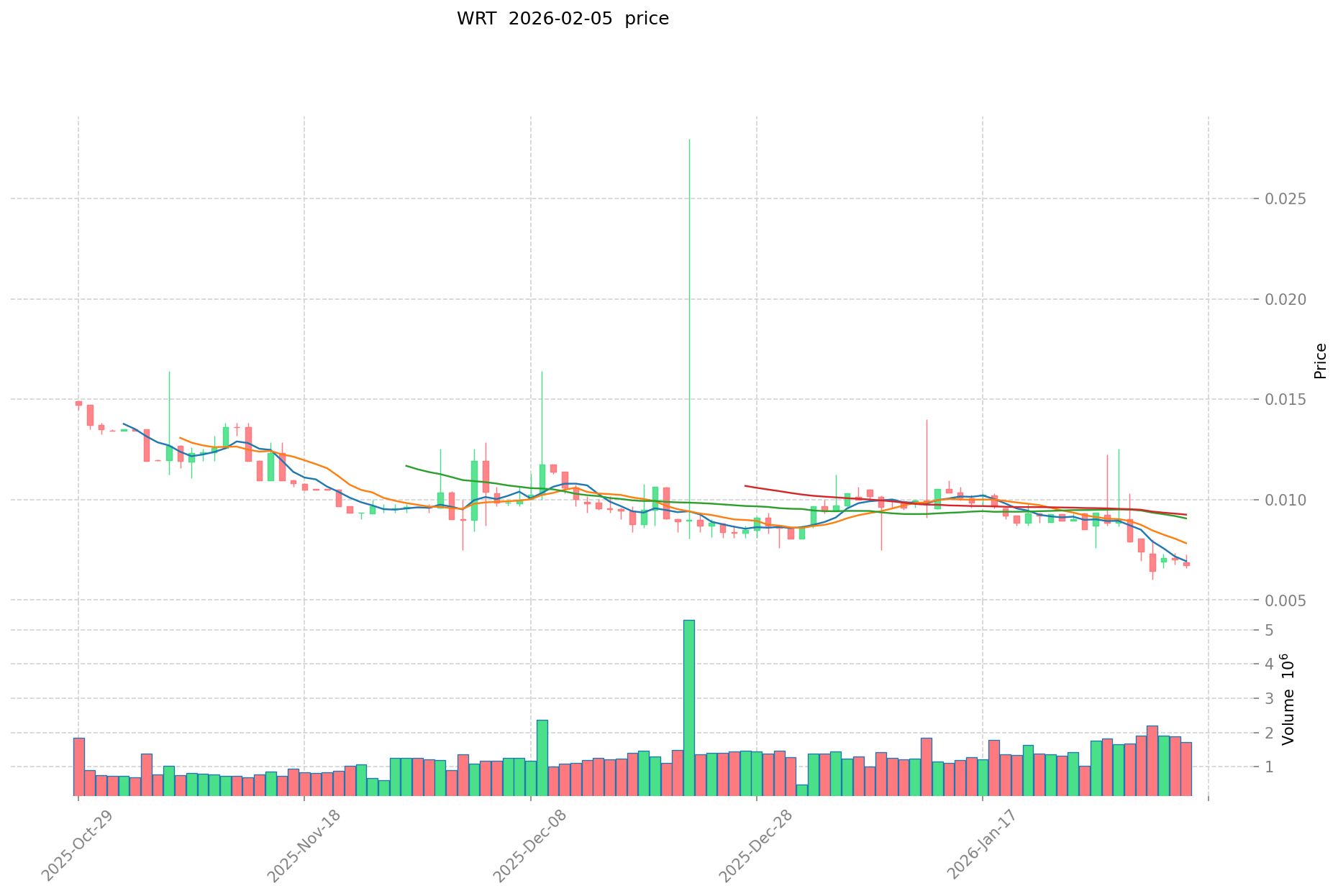
Historical Price Trends of WRT (Coin A) and VET (Coin B)
- 2022: WRT recorded its all-time high at $0.949834 on July 14, representing a significant price peak during the period.
- 2024: WRT reached its all-time low at $0.00583306 on April 16, reflecting notable downward pressure in market conditions.
- 2021: VET achieved its all-time high at $0.280991 on April 19, marking a period of elevated market interest.
- 2020: VET registered its all-time low at $0.00191713 on March 13, coinciding with broader market volatility.
- Comparative Analysis: During recent market cycles, WRT experienced a decline from $0.949834 to $0.00583306, while VET demonstrated a similar pattern, moving from $0.280991 to $0.00191713. Both assets have shown substantial price reductions from their respective peaks.
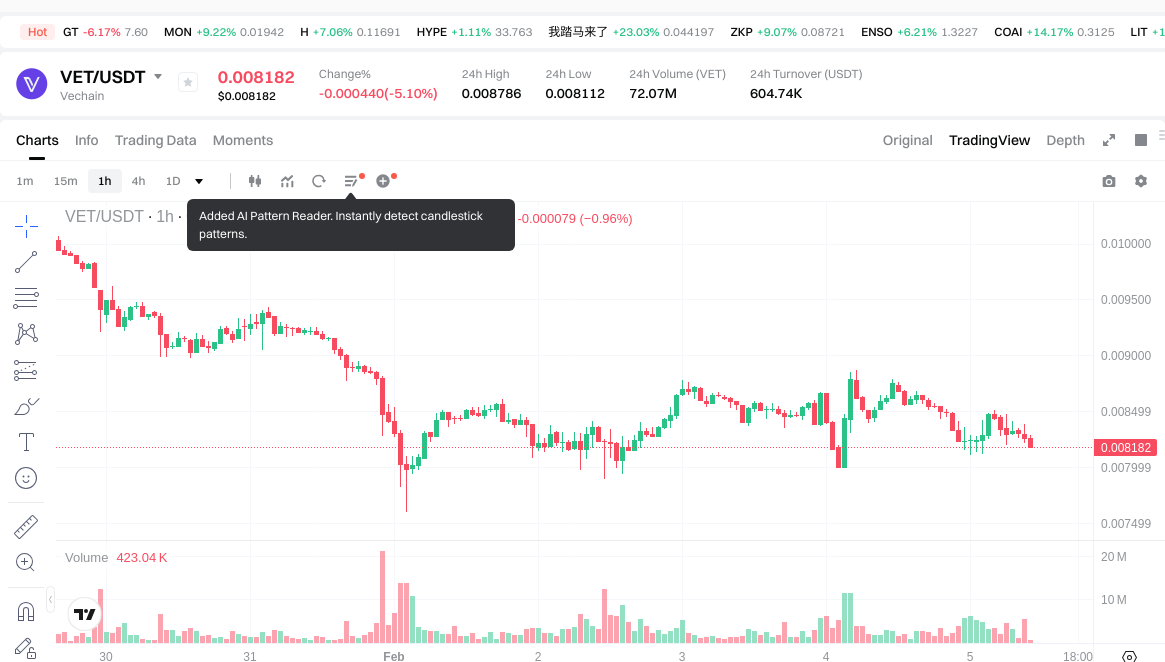
Current Market Status (February 05, 2026)
- WRT current price: $0.0067
- VET current price: $0.008264
- 24-hour trading volume: WRT $11,982.66 vs VET $611,829.01
- Market Sentiment Index (Fear & Greed Index): 12 (Extreme Fear)
View real-time prices:
- Check WRT current price Market Price
- Check VET current price Market Price
II. Core Factors Influencing WRT vs VET Investment Value
Tokenomics Comparison
- WRT: Supply mechanism details are not available in the provided materials.
- VET: Supply mechanism details are not available in the provided materials.
- 📌 Historical Pattern: Supply mechanisms can influence price cycles through scarcity dynamics and inflation control.
Institutional Adoption and Market Applications
- Institutional Holdings: Information regarding institutional preference between WRT and VET is not available in the provided materials.
- Enterprise Adoption: Comparative data on WRT/VET applications in cross-border payments, settlements, and investment portfolios is not available in the provided materials.
- National Policies: Information on regulatory attitudes toward these assets across different jurisdictions is not available in the provided materials.
Technological Development and Ecosystem Building
- WRT Technical Upgrades: Details on technological advancements and their potential impact are not available in the provided materials.
- VET Technical Development: Details on technological progress and potential implications are not available in the provided materials.
- Ecosystem Comparison: Information on DeFi, NFT, payment solutions, and smart contract implementations for both assets is not available in the provided materials.
Macroeconomic Factors and Market Cycles
- Performance in Inflationary Environments: Comparative analysis of anti-inflation properties is not available in the provided materials.
- Macroeconomic Monetary Policy: Information on how interest rates and dollar index movements affect both assets is not available in the provided materials.
- Geopolitical Factors: Data on cross-border transaction demand and international developments impacting these assets is not available in the provided materials.
III. 2026-2031 Price Prediction: WRT vs VET
Short-term Forecast (2026)
- WRT: Conservative $0.0063-$0.0068 | Optimistic $0.0078-$0.0081
- VET: Conservative $0.0057-$0.0082 | Optimistic $0.0115-$0.0121
Mid-term Forecast (2028-2029)
- WRT may enter a gradual growth phase, with projected price range of $0.0050-$0.0110 in 2028, expanding to $0.0083-$0.0125 in 2029
- VET may enter an accelerated expansion phase, with projected price range of $0.0064-$0.0177 in 2028, expanding to $0.0113-$0.0205 in 2029
- Key drivers: institutional capital inflows, ETF developments, ecosystem growth
Long-term Forecast (2030-2031)
- WRT: Baseline scenario $0.0082-$0.0134 (2030), $0.0130-$0.0191 (2031) | Optimistic scenario reaching $0.0160 (2030), $0.0191 (2031)
- VET: Baseline scenario $0.0142-$0.0178 (2030), $0.0100-$0.0189 (2031) | Optimistic scenario reaching $0.0201 (2030), $0.0250 (2031)
Disclaimer: Price predictions are for reference only and should not be considered investment advice. Cryptocurrency markets are highly volatile and subject to various risk factors.
WRT:
| Year | Predicted High Price | Predicted Average Price | Predicted Low Price | Price Change |
|---|---|---|---|---|
| 2026 | 0.00807891 | 0.006789 | 0.00631377 | 1 |
| 2027 | 0.0078799923 | 0.007433955 | 0.00393999615 | 10 |
| 2028 | 0.011026042056 | 0.00765697365 | 0.0049770328725 | 14 |
| 2029 | 0.01251762052302 | 0.009341507853 | 0.00831394198917 | 39 |
| 2030 | 0.015957163714494 | 0.01092956418801 | 0.008197173141007 | 63 |
| 2031 | 0.019089576810778 | 0.013443363951252 | 0.013040063032714 | 100 |
VET:
| Year | Predicted High Price | Predicted Average Price | Predicted Low Price | Price Change |
|---|---|---|---|---|
| 2026 | 0.01205547 | 0.008201 | 0.0057407 | 0 |
| 2027 | 0.0147872231 | 0.010128235 | 0.0066846351 | 22 |
| 2028 | 0.017689975251 | 0.01245772905 | 0.0063534418155 | 50 |
| 2029 | 0.02050043892468 | 0.0150738521505 | 0.011305389112875 | 82 |
| 2030 | 0.020099474457476 | 0.01778714553759 | 0.014229716430072 | 115 |
| 2031 | 0.025005169196744 | 0.018943309997533 | 0.010039954298692 | 129 |
IV. Investment Strategy Comparison: WRT vs VET
Long-term vs Short-term Investment Strategies
- WRT: May appeal to investors focused on DeFi ecosystem participation and decentralized exchange infrastructure within the Cardano network, with a longer-term perspective on protocol development
- VET: May suit investors interested in enterprise blockchain adoption and supply chain transparency applications, particularly those seeking exposure to real-world business use cases
Risk Management and Asset Allocation
- Conservative Investors: WRT 30% vs VET 70% - emphasizing established enterprise partnerships and broader market recognition
- Aggressive Investors: WRT 50% vs VET 50% - balancing emerging DeFi potential with supply chain infrastructure exposure
- Hedging Tools: Stablecoin allocation for liquidity management, diversified portfolio across multiple crypto assets, periodic rebalancing strategies
V. Potential Risk Comparison
Market Risk
- WRT: Trading volume of $11,982.66 indicates lower liquidity, which may result in higher price volatility and potential difficulty in executing large transactions
- VET: Trading volume of $611,829.01 reflects relatively higher market activity, though still subject to broader cryptocurrency market sentiment and current Extreme Fear conditions (Fear & Greed Index: 12)
Technical Risk
- WRT: Dependency on Cardano network infrastructure and AMM protocol functionality, with considerations around network scalability and user adoption
- VET: Technical development trajectory includes Ethereum compatibility integration and dPoS consensus implementation, with associated transition considerations
Regulatory Risk
- Both assets operate in evolving regulatory environments that may affect cross-border operations, enterprise adoption patterns, and investor accessibility across different jurisdictions
VI. Conclusion: Which Is the Better Buy?
📌 Investment Value Summary:
- WRT Characteristics: Positioning within Cardano DeFi ecosystem, AMM-based decentralized exchange infrastructure, early-stage development phase
- VET Characteristics: Established enterprise partnerships with organizations including DNV, Walmart, and BCG; supply chain transparency focus; ongoing technical infrastructure development through Renaissance roadmap
✅ Investment Considerations:
- Beginning Investors: Consider starting with smaller allocations, prioritizing understanding of fundamental differences between DeFi protocols and enterprise blockchain applications, maintaining adequate risk management practices
- Experienced Investors: May evaluate portfolio positioning based on conviction in either DeFi infrastructure growth or enterprise blockchain adoption trends, considering correlation with broader market cycles
- Institutional Investors: Assessment may focus on regulatory clarity, liquidity depth, enterprise use case validation, and alignment with institutional risk parameters
⚠️ Risk Disclosure: Cryptocurrency markets exhibit high volatility. This analysis does not constitute investment advice. Market conditions, regulatory developments, and technical factors can significantly impact asset performance.
VII. FAQ
Q1: What are the main differences between WRT and VET in terms of their blockchain ecosystems?
WRT operates as an AMM-based decentralized exchange within the Cardano network, while VET functions as an enterprise blockchain solution focused on supply chain transparency. WRT's ecosystem centers around DeFi infrastructure and decentralized token exchanges without intermediaries, positioning itself within Cardano's smart contract environment. VET, on the other hand, has established partnerships with major enterprises including DNV, Walmart, and BCG, focusing on real-world supply chain applications and anti-counterfeiting solutions. VET's Renaissance roadmap includes Ethereum compatibility, dPoS consensus, and enhanced interoperability features, indicating a broader enterprise-focused blockchain infrastructure approach.
Q2: Which asset shows higher liquidity and trading activity?
VET demonstrates significantly higher liquidity with a 24-hour trading volume of $611,829.01 compared to WRT's $11,982.66. This 50x difference in trading volume indicates that VET has substantially greater market activity and depth. Higher liquidity typically translates to easier trade execution, tighter bid-ask spreads, and lower slippage for investors. For investors planning larger transactions or requiring quick entry and exit positions, VET's higher trading volume presents a more favorable liquidity profile.
Q3: How do the price prediction trajectories compare for 2026-2031?
Both assets show potential growth trajectories, but with different patterns. For 2026, WRT's conservative forecast ranges from $0.0063-$0.0068, while VET ranges from $0.0057-$0.0082. By 2031, WRT's optimistic scenario reaches $0.0191, representing approximately 185% growth from current levels, while VET's optimistic scenario reaches $0.0250, representing roughly 202% growth. VET's baseline scenario for 2031 ($0.0100-$0.0189) shows a wider range than WRT's ($0.0130-$0.0191), suggesting potentially greater volatility but also higher growth ceiling in optimistic market conditions.
Q4: What risk factors should investors consider when choosing between WRT and VET?
Investors should evaluate three primary risk categories. Market risk: WRT's lower trading volume ($11,982.66) creates higher exposure to liquidity constraints and price volatility, while VET's higher volume ($611,829.01) offers better liquidity but both remain subject to current Extreme Fear market sentiment (Fear & Greed Index: 12). Technical risk: WRT depends on Cardano network infrastructure and AMM protocol adoption, while VET faces transition considerations with its Ethereum compatibility integration and dPoS consensus implementation. Regulatory risk: Both assets operate in evolving regulatory environments that may affect cross-border operations and enterprise adoption patterns differently, with VET's enterprise partnerships potentially facing more direct regulatory scrutiny.
Q5: Which asset is more suitable for different investor profiles?
Investment suitability varies by investor experience and objectives. Beginning investors may consider starting with VET due to its higher liquidity, established enterprise partnerships, and clearer real-world use cases, which provide more tangible evaluation metrics. Experienced investors might evaluate portfolio positioning based on conviction in either DeFi infrastructure growth (favoring WRT) or enterprise blockchain adoption trends (favoring VET). Institutional investors typically assess factors such as regulatory clarity, liquidity depth, and enterprise use case validation, where VET's partnerships with DNV, Walmart, and BCG provide stronger reference points. Conservative allocation models suggest 30% WRT vs 70% VET, while aggressive strategies may balance at 50-50, depending on risk tolerance and market outlook.
Q6: How do current market conditions affect the investment thesis for each asset?
The current Extreme Fear market sentiment (Fear & Greed Index: 12) creates a challenging environment for both assets, but with different implications. WRT's current price of $0.0067 represents a significant decline from its 2022 all-time high of $0.949834, suggesting substantial downward price adjustment has occurred. VET's current price of $0.008264 similarly reflects major correction from its 2021 peak of $0.280991. However, VET's higher trading volume and established enterprise partnerships may provide more stability during fearful market conditions. Both assets require careful timing consideration, as extreme fear conditions historically present both heightened risk and potential accumulation opportunities for long-term investors.
Q7: What are the key technological developments that could impact future valuations?
WRT's valuation trajectory depends primarily on Cardano network adoption, AMM protocol enhancements, and DeFi ecosystem growth within the Cardano infrastructure. Success factors include user adoption of decentralized exchange functionality and expansion of native Cardano token trading activity. VET's future valuation links to its Renaissance roadmap execution, including Ethereum-compatible infrastructure deployment, dPoS consensus implementation, dynamic VTHO tokenomics optimization, and enhanced interoperability features. Additionally, VET's ability to expand enterprise partnerships beyond DNV, Walmart, and BCG, and successfully demonstrate supply chain transparency use cases at scale will significantly influence institutional adoption and long-term price performance.
Share
Content
Introduction: WRT vs VET Investment Comparison
I. Historical Price Comparison and Current Market Status
II. Core Factors Influencing WRT vs VET Investment Value
III. 2026-2031 Price Prediction: WRT vs VET
IV. Investment Strategy Comparison: WRT vs VET
V. Potential Risk Comparison
VI. Conclusion: Which Is the Better Buy?
VII. FAQ
How to Buy Cryptocurrency


Trending Cryptocurrencies



What will be the market capitalization of USDC in 2025? Analysis of the stablecoin market landscape.

How is DeFi different from Bitcoin?

What is DeFi: Understanding Decentralized Finance in 2025

USDC stablecoin 2025 Latest Analysis: Principles, Advantages, and Web3 Eco-Applications

Development of Decentralized Finance Ecosystem in 2025: Integration of Decentralized Finance Applications with Web3

2025 USDT USD Complete Guide: A Must-Read for Newbie Investors

Comprehensive Guide to the Metaverse and IQ Protocol

DRAC vs CHZ: A Comprehensive Comparison of Two Leading Blockchain Gaming Tokens

SKYA vs DOT: A Comprehensive Comparison of Two Leading Blockchain Platforms

DIN vs HBAR: A Comprehensive Comparison of Two Rising Blockchain Cryptocurrencies

TRVL vs APT: A Comprehensive Comparison of Two Leading Travel Technology Platforms