What is POLK: A Comprehensive Guide to Understanding this Innovative Technology Platform

Polkamarkets' Positioning and Significance
In 2021, the Polkamarkets team launched Polkamarkets (POLK), aiming to address inefficiencies in decentralized prediction markets and limited cross-chain interoperability. As a DeFi-powered prediction market platform, Polkamarkets plays a key role in decentralized finance and blockchain-based forecasting.
As of 2026, Polkamarkets has established itself as a notable player in the prediction market niche, with 8,814 holders and an active community of users engaging with real-world event forecasting. This article will provide an in-depth analysis of its technical architecture, market performance, and future potential.
Origin and Development History
Birth Background
Polkamarkets was created by its founding team in 2021, aiming to solve the lack of decentralized, interoperable platforms for prediction markets and the barriers to cross-chain information exchange. It emerged during the DeFi boom and growing interest in Polkadot-based ecosystems, with the goal of enabling users to take positions on real-world event outcomes through a decentralized and transparent platform. The launch of Polkamarkets brought new possibilities to DeFi enthusiasts and prediction market participants.
Key Milestones
- 2021: Platform launch on February 24, with initial price at $3.074, introducing decentralized prediction market functionality built on Ethereum.
- 2021: Reached all-time high of $4.18 on March 16, demonstrating strong initial market interest.
- 2026: Continues to operate with 100 million POLK tokens in circulation, representing 100% of total supply, maintaining its position in the prediction market sector.
With support from the Polkamarkets community and development team, the platform continues to refine its technology, security measures, and real-world applications.
How Polkamarkets Works?
No Central Control
Polkamarkets operates on a decentralized network infrastructure, removing dependence on centralized institutions. The platform leverages distributed nodes to validate transactions and market outcomes, ensuring transparency and resistance to manipulation, giving users greater autonomy and enhancing network resilience.
Blockchain Foundation
Polkamarkets utilizes blockchain technology as a public, immutable digital ledger to record all market activities and transactions. Transactions are grouped into blocks and linked through cryptographic hashes to form a secure chain. Anyone can view the records, establishing trust without intermediaries. The platform's architecture is designed to facilitate cross-chain information exchange and interoperability, particularly within the Polkadot ecosystem.
Ensuring Fairness
Polkamarkets implements decentralized consensus mechanisms to validate market outcomes and prevent fraudulent activities. Participants maintain network security through platform engagement and market creation, contributing to the integrity of prediction results. The platform's innovation includes leveraging Polkadot's interoperability features for enhanced cross-chain functionality.
Secure Transactions
Polkamarkets uses public-private key cryptography to protect transactions:
- Private keys (similar to secret passwords) are used to sign transactions
- Public keys (similar to account numbers) are used to verify ownership
This mechanism ensures fund security while maintaining pseudonymous transaction privacy. The platform deploys its token on Ethereum (contract address: 0xd478161c952357f05f0292b56012cd8457f1cfbf), leveraging established blockchain security standards.
Polkamarkets (POLK) Market Performance
Circulation Overview
As of February 6, 2026, Polkamarkets (POLK) has a circulating supply of 100,000,000 tokens, with a total supply of 100,000,000 tokens, indicating a fully circulated fixed supply model. The token maintains a complete circulation rate of 100%, with all tokens already in market circulation, eliminating concerns about future supply inflation.
Price Fluctuations
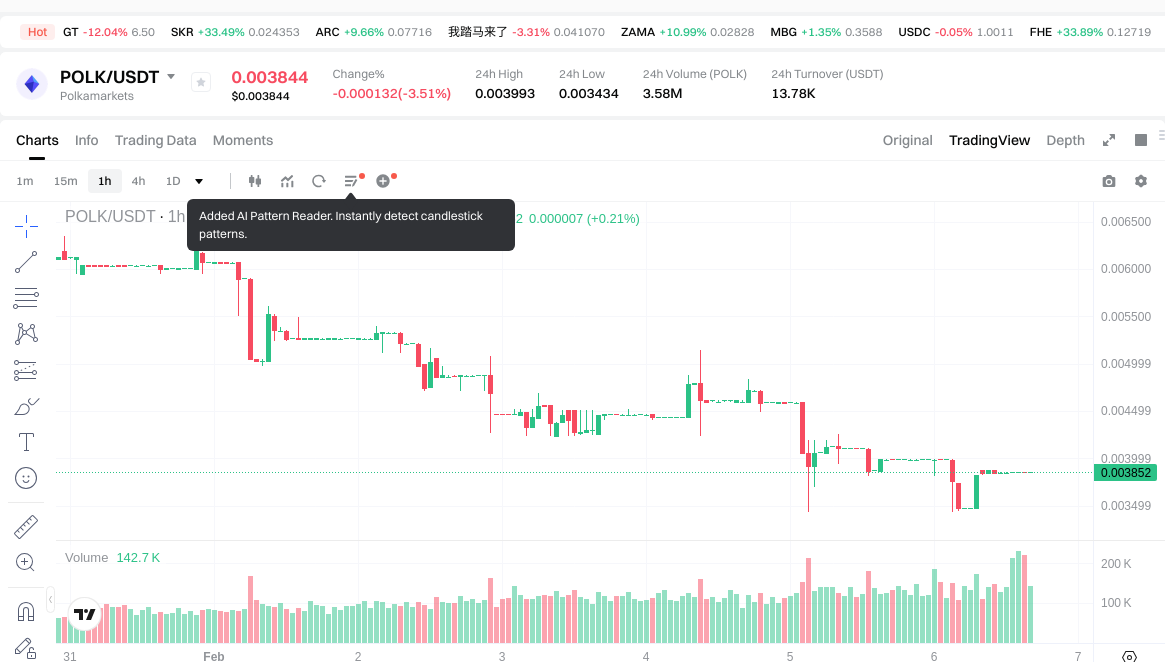
Polkamarkets (POLK) reached a notable price level of $4.18 on March 16, 2021, influenced by broader market momentum and increased interest in DeFi-powered prediction market platforms during that period. The token experienced its lowest recorded price of $0.00343311 on February 6, 2026, reflecting challenging market conditions and sentiment shifts. These price movements demonstrate the impact of market dynamics, adoption patterns, and external factors on the asset's valuation. Recent performance shows notable volatility, with a 24-hour price change of -3.51%, 7-day decline of -41.37%, and 30-day decrease of -48.07%.
Click to view current POLK market price
On-Chain Metrics
- Holder Count: Approximately 8,814 addresses hold POLK tokens, indicating a distributed community base
- 24-Hour Trading Volume: $13,724.41 in trading activity, reflecting current market participation levels
- Market Capitalization: $385,200, representing the total market valuation of circulating tokens
Polkamarkets Ecosystem Applications and Partners
Core Use Cases
Polkamarkets' ecosystem supports various applications:
- Prediction Markets: Polkamarkets platform enables users to take positions on real-world event outcomes through its DeFi-powered infrastructure.
- Cross-chain Information Exchange: The platform facilitates decentralized and interoperable trading based on Polkadot technology.
Strategic Partnerships
While specific partnership details are not extensively documented in available materials, Polkamarkets has established its position within the Polkadot ecosystem, leveraging the network's interoperability capabilities to enhance its technical foundation and market reach.
Challenges and Controversies
Polkamarkets faces several challenges:
- Market Volatility: The token has experienced significant price fluctuations, with a 1-year decline of approximately 66.60%
- Competition Pressure: Operating in a competitive DeFi prediction market space alongside other blockchain platforms
- Market Capitalization: With a relatively modest market cap of $385,200, the project faces challenges in achieving broader market recognition
These factors have sparked discussions within the community and continue to drive the project's evolutionary trajectory.
Polkamarkets Community and Social Media Atmosphere
Community Engagement
Polkamarkets maintains an active presence with approximately 8,814 token holders participating in its ecosystem. On X platform, community discussions around Polkamarkets and its prediction market applications generate ongoing interest among DeFi enthusiasts.
Social Media Sentiment
Sentiment on X presents a mixed perspective:
- Supporters highlight Polkamarkets' innovative approach to decentralized prediction markets and its integration with Polkadot's cross-chain infrastructure.
- Critics express concerns about price volatility and market performance, particularly given recent downward trends.
Recent patterns indicate cautious sentiment influenced by broader market conditions and token performance metrics.
Popular Topics
X users actively discuss topics related to Polkamarkets' DeFi prediction market functionality, cross-chain capabilities, and potential use cases for real-world event forecasting, reflecting both the platform's innovative potential and challenges in achieving mainstream adoption.
More Information Sources for Polkamarkets
- Official Website: Visit Polkamarkets Official Site for platform features, use cases, and latest updates.
- X Platform: Follow Polkamarkets on X via @polkamarkets for technical updates, community activities, and partnership announcements.
- Block Explorer: View on-chain data at Etherscan for transaction history and token metrics.
How to Participate in Polkamarkets?
- Purchase Channels: Acquire POLK tokens through Gate.com and other supported platforms
- Storage Solutions: Securely store tokens using compatible wallets that support ERC-20 tokens on the Ethereum network
- Platform Participation: Engage with the Polkamarkets prediction market platform to create or participate in forecasting markets
- Ecosystem Building: Explore development opportunities through the platform's decentralized prediction market infrastructure
Summary
Polkamarkets leverages blockchain technology to create a decentralized prediction market platform, offering transparency, interoperability, and DeFi-powered trading capabilities. Its integration with Polkadot technology and focus on cross-chain information exchange positions it within the evolving DeFi landscape. Despite facing challenges including market volatility and competitive pressures, Polkamarkets' innovative approach to prediction markets demonstrates potential within the decentralized technology ecosystem. Whether you are new to prediction markets or an experienced DeFi participant, Polkamarkets presents an interesting case study in blockchain-based forecasting platforms.
FAQ
What is Polkadot (POLK) and how does it work?
Polkadot is a multi-chain blockchain network enabling secure data and asset transfers between different blockchains. It uses a relay chain and parachains for interoperability. DOT tokens support governance and staking within the ecosystem.
What are the main use cases and features of Polkadot?
Polkadot enables cross-chain interoperability, scalable dApps, and smart contracts. Main use cases include supply chain management, identity verification, asset tokenization, and seamless communication between different blockchain networks through its multi-chain architecture.
How can I buy and store POLK tokens?
Buy POLK tokens on decentralized exchanges through trading pairs. Store them securely in self-custody wallets or hardware wallets for optimal security and long-term holding.
What are the risks and security considerations when investing in POLK?
POLK investment risks include market volatility and price fluctuations. Security considerations involve verifying wallet protection, smart contract audits, and choosing reputable platforms. Always conduct thorough research and understand the project fundamentals before investing.
How does Polkadot differ from Ethereum and other blockchain platforms?
Polkadot enables multi-chain interoperability through its relay chain architecture, allowing different blockchains to communicate seamlessly. Unlike Ethereum's single-chain approach, Polkadot offers superior scalability via parallel processing, stronger cross-chain functionality, and enhanced network flexibility for diverse applications.
Share
Content
Polkamarkets' Positioning and Significance
Origin and Development History
How Polkamarkets Works?
Polkamarkets (POLK) Market Performance
Polkamarkets Ecosystem Applications and Partners
Challenges and Controversies
Polkamarkets Community and Social Media Atmosphere
More Information Sources for Polkamarkets
How to Participate in Polkamarkets?
Summary
FAQ
How to Buy Cryptocurrency


Trending Cryptocurrencies



2025 SUI coin: price, buying guide, and Staking rewards
How to Buy Crypto: A Step-by-Step Guide with Gate.com

HNT Price in 2025: Helium Network Token Value and Market Analysis

What is SwissCheese (SWCH) and How Does It Democratize Investment?

Cardano (ADA) Price Analysis and Outlook for 2025

How to Invest in Metaverse Crypto
Is PlayZap Games (PZP) a good investment?: A Comprehensive Analysis of the Gaming Token's Potential, Risks, and Market Outlook

Is SubQuery Network (SQT) a good investment?: A Comprehensive Analysis of Token Utility, Market Position, and Future Growth Potential

Is Juice (JUC) a good investment?: A Comprehensive Analysis of Market Potential, Risk Factors, and Future Prospects
Is Nodecoin (NC) a good investment?: A Comprehensive Analysis of Features, Risks, and Market Potential
What does the Metaverse, or the digital world of the future, mean?