


Former Mt. Gox CEO proposes a Bitcoin hard fork to recover $5.2 billion

Former Mt. Gox CEO Mark Karpelès has proposed a plan calling for a hard fork of Bitcoin to recover approximately 79,956 BTC (worth over $5.2 billion at current market prices) from long-dormant addresses related to the 2011 Mt. Gox hack. These coins have remained untouched for over 15 years and are not part of the assets currently being distributed to creditors.
Proposal Details: Address-specific Recovery Mechanism at the Protocol Level
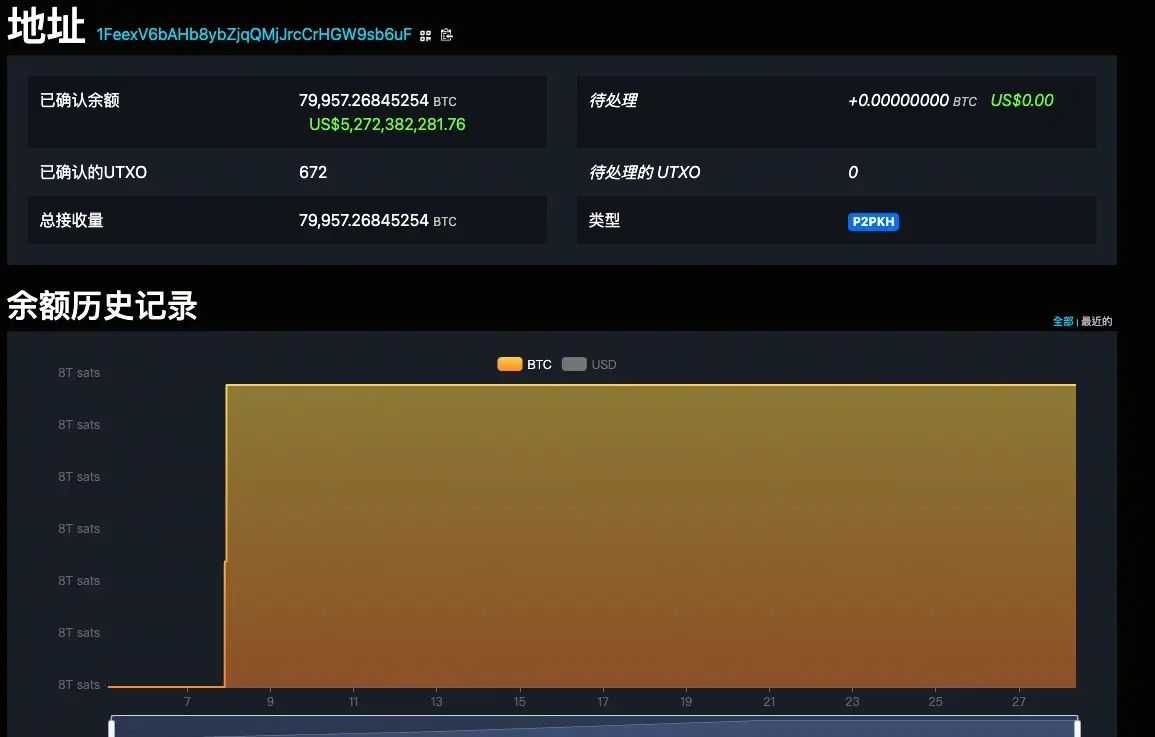 (Source: Mempool.Space)
The proposal targets address 1Feex…sb6uF, which received nearly 80,000 BTC after Mt. Gox was hacked in June 2011. Karpelès notes that these funds have never moved in 15 years, suggesting the attacker may have lost the private keys or chosen not to transfer these assets. Under current Bitcoin rules, these funds can only be spent with the corresponding private keys.
The proposal suggests adding a new consensus rule to the Bitcoin protocol, allowing signatures from the Mt. Gox recovery address to spend the unspent outputs locked in the theft address. This would enable the funds to be spent and, through an existing court-supervised recovery process, returned to verified Mt. Gox creditors.
Karpelès emphasizes that this change is technically narrow in scope, applying only to this specific address, and is characterized as a “one-time hardcoded exception for a unique case,” not a general mechanism to reverse transactions or recover stolen funds. He states that the main purpose of the draft is to “initiate a discussion within the Bitcoin community on whether this special case warrants attention.”
Support and Opposition: The Fundamental Test of Immutability
Karpelès cites three main reasons supporting the proposal: the theft is “undoubtedly” confirmed; the funds have been idle for over 15 years with no signs of return; and courts have established a robust oversight framework for the recovery process.
However, the proposal also openly acknowledges fundamental objections. The core concern is that modifying ownership rules for a specific address sets a precedent that could undermine Bitcoin’s immutability. “Some believe that if it can be done once, it can be done again,” the draft admits. Additionally, who has the authority to decide which cases warrant protocol intervention? If approved, other victims of major hacks might also request similar measures.
From a technical perspective, coordinating a hard fork carries the risk of chain split: if some network participants refuse to upgrade, it could result in a fork, creating two parallel chains.
Comparison of Key Arguments
Supporters: Confirmed theft, funds idle for over 15 years, court oversight framework in place, narrow scope of technical change, one-time exception
Opponents: Sets a precedent undermining immutability, unclear criteria for case eligibility, potential for other victims to follow, risk of chain split during hard fork
Involved Funds: About 79,956 BTC, completely separate from the 200,000 BTC currently being distributed to creditors, still in the original theft address
Frequently Asked Questions
Are the Bitcoins involved in this proposal the same as the funds currently being used for Mt. Gox creditor repayments?
No, they are entirely different. The currently distributed funds are approximately 200,000 BTC recovered after Mt. Gox’s 2014 collapse, managed by a court-appointed trustee, Shinichi Kobayashi, with repayments starting mid-2024 and extended to October 2026. The roughly 80,000 BTC involved in this proposal originate from the 2011 hack and remain in the original theft address, outside the trustee’s control.
Why is Bitcoin hard forking controversial both technically and philosophically?
Technically, a hard fork is a non-backward-compatible upgrade to the Bitcoin protocol, requiring all network nodes to upgrade. Participants who refuse to upgrade will be on a different chain, resulting in a chain split. Philosophically, one of Bitcoin’s core values is that no one can alter the state of others’ funds. Creating exceptions for specific addresses directly challenges this principle and raises deep questions about how to define the scope of such exceptions.
What is the current status of this proposal, and how likely is it to be adopted?
Karpelès states that the main goal of the proposal is to spark discussion, not immediate implementation. Modifying Bitcoin’s protocol typically requires broad community consensus. Given the strong emphasis on immutability within the community and concerns over setting dangerous precedents, this proposal currently faces significant resistance.
Related Articles
Bitcoin Drops Below $64,000 as Israel Launches Strikes on Iran
Citrini AI reports warn of an economic collapse? Bitcoin and stablecoins become safe havens, institutions bet on a new payment system
Here’s Why the Crypto Market Is Crashing Again as Bitcoin Dips Toward $60K
Will Bitcoin Cash (BCH) succeed in replicating the 28% growth pattern from 2025?
Bitcoin falls below $64,000! The US and Israel carry out airstrikes on Iran, Middle East conflict escalates, impacting the crypto market