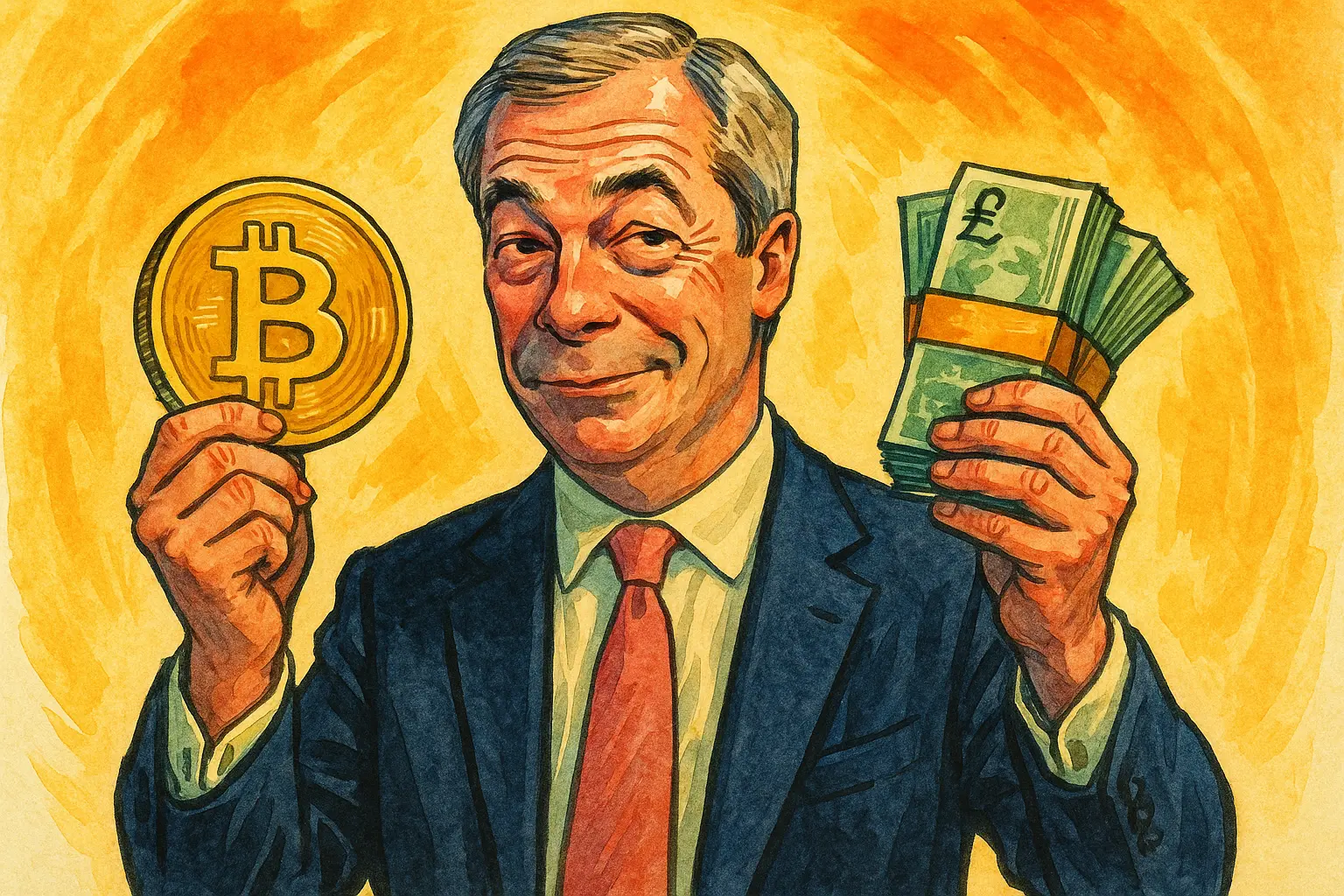
Nigel Farage, leader of the Reform Party, announced that he will spend roughly £2 million to buy Bitcoin, becoming the first sitting member of Parliament in UK history to publicly disclose a Bitcoin investment of such a magnitude. The investment is carried out through Stack BTC, a Bitcoin treasury company listed in London. Farage acquires a 6.3% stake in Stack BTC through his own company, Thorn In The Side Ltd.
Investment Structure: A Two-Layer Setup of Corporate Treasury and Equity
Farage’s Bitcoin holdings are made up of two layers. The first layer is an approximately £2 million direct Bitcoin exposure completed through Stack BTC, tying the value of his coin holdings directly to the growth of the company’s Bitcoin reserves. The second layer is that he acquires a 6.3% stake in Stack BTC through Thorn In The Side Ltd., adding an equity exposure to publicly listed Bitcoin-related companies on top of his coin base.
As of March 2026, Stack BTC holds about 31 Bitcoins and has entered into a partnership with Blockchain.com, adopting a single, clear strategy of “holding Bitcoin as a long-term treasury asset.” Its operating model is highly similar to the U.S. Strategy (formerly MicroStrategy). Chaired by former UK Chancellor of the Exchequer Kwasi Kwarteng, this adds both political and financial validation to Farage’s investment.
Political Significance: Personal Confirmation of the Reform Party’s Crypto Stance
Farage’s investment carries symbolic meaning that goes beyond a personal financial decision. The Reform Party is the first major political party in the UK to formally accept cryptocurrency donations, and this public announcement of holding coins is a natural extension of the party’s position.
In recent years, the UK has faced international criticism for progressing slowly on cryptocurrency regulation and innovation policy. Farage’s public act of holding coins injects additional political momentum into the UK policy debate. Some crypto supporters believe that this helps push the UK government to take clearer action on the regulatory framework.
Three Core Issues Raised by Farage’s Bitcoin Holdings Investment
Risk of conflicts of interest: Political figures who hold Bitcoin-related assets face questions about their impartiality in subsequent digital-asset regulatory decision-making; under UK rules, members of Parliament must publicly register their investment interests, and Farage has already made a public disclosure
Potential impact on UK crypto policy: A well-known political leader publicly signals support for Bitcoin, which could accelerate the entry of cryptocurrency into the UK’s mainstream policy agenda, but at the same time raise concerns about policy independence
Precedent effect: After Farage became the first sitting MP in the UK to publicly disclose that he holds Bitcoin, it is expected that more political figures will follow with similar disclosures, further reducing the sensitivity of crypto investments in political circles
Frequently Asked Questions
Why is Nigel Farage’s Bitcoin investment historically significant?
Farage is the first sitting member of Parliament in UK history to publicly announce that he holds Bitcoin at such a scale, marking a new milestone in Bitcoin’s acceptance within UK political circles. Before this, public attitudes toward cryptocurrencies among figures in UK politics were generally cautious. This proactive disclosure changes that default stance.
What is Stack BTC, and why does Farage invest through it?
Stack BTC is a Bitcoin treasury company listed on the London Aquis Growth Market. It is chaired by former UK Chancellor of the Exchequer Kwasi Kwarteng. The company holds about 31 Bitcoins and works with Blockchain.com. By holding Bitcoin within a regulated, listed-company framework, it gives Farage a compliant and publicly transparent channel for Bitcoin exposure.
Does Farage’s Bitcoin investment involve a conflict of interest?
UK lawmakers are required to publicly register major investments; Farage has disclosed accordingly. However, because the Reform Party has a clear policy stance on cryptocurrency regulation issues, his personal Bitcoin holdings may still raise questions about conflicts of interest in future policy discussions—especially during the process of drafting the UK’s cryptocurrency regulatory framework.
Disclaimer: The information on this page may come from third parties and does not represent the views or opinions of Gate. The content displayed on this page is for reference only and does not constitute any financial, investment, or legal advice. Gate does not guarantee the accuracy or completeness of the information and shall not be liable for any losses arising from the use of this information. Virtual asset investments carry high risks and are subject to significant price volatility. You may lose all of your invested principal. Please fully understand the relevant risks and make prudent decisions based on your own financial situation and risk tolerance. For details, please refer to
Disclaimer.
Related Articles
BTC rises 0.64% in 15 minutes: long-position amplification combined with spot fund inflows drives the move
2026-04-17 12:45 to 2026-04-17 13:00 (UTC), the BTC price fluctuated within the 75720.6 to 76256.6 USDT range, and the return rate within 15 minutes reached +0.64%, with a range of 0.71%. During this period, market attention stayed high, trading activity increased, short-term volatility intensified, reflecting a rapid market move driven by concentrated capital.
The main driving force behind this anomaly is that the long-position structure has been significantly amplified on coin-margined perpetual contracts, along with rapid inflows of funds into the long direction. Data shows that in the 12:45–13:00 window, the long contract positions for BTC surged from 8M to 11.4M, accounting for 57% to 77%. Short-term long funds concentrated into the market, and buy-side strength rose markedly, forming a direct impetus for price upside. At the same time, net inflows of ETF funds in the spot market increased, with holdings in major ETF products rising; institutional buying became more active, and the coordination strengthened spot price support.
In addition, on-chain active addresses remained at a high level, trading volume expanded significantly, and BTC net inflows on mainstream trading platforms on April 17 also rose—together indicating increased market participation. Meanwhile, BTC broke through a key historical price range ($75,000), and technical buying as well as momentum-chasing funds entered in line with the move. Besides structural factors, global macro environmental risks remain elevated. Some capital is inclined toward BTC as a safe haven, and in the short term, multiple factors have converged, jointly pushing up the market’s volatility.
In the near term, with the share of long positions and trading volume rising, if there is an unexpected news event or a reversal in sentiment, it is likely to trigger a rapid pullback. Key risk focus points include: changes in capital flows on mainstream trading platforms, the strength of support in the $75,000 range, and how macro events evolve. Users should be alert to short-term risks during periods of high volatility, monitor key on-chain and macro indicators in real time, and stay on top of more market updates.
GateNews12m ago
American Bitcoin (ABTC) to Release Q1 2026 Earnings on May 6
American Bitcoin (ABTC) will release its Q1 2026 earnings report on May 6, 2026, after U.S. market close, followed by a live earnings call and webcast at 4:30 PM ET.
GateNews28m ago
Solv Protocol and Utexo Launch Bitcoin-Native Yield Infrastructure
Solv Protocol has integrated with Utexo to launch a bitcoin-native yield infrastructure that uses the RGB protocol and Lightning Network to enable direct, atomic swaps between bitcoin and USDT.
Key Takeaways:
Solv Protocol and Utexo integrated to launch native BTC yield with atomic swaps for $2 b
Coinpedia49m ago
Zonda Exchange CEO Blames Missing Founder for $336M in Lost Bitcoin
Zonda CEO Przemysław Kral has attributed the exchange's loss of access to 4,500 BTC, valued at $336 million, to missing founder Sylwester Suszek's failure to transfer private keys. Amid allegations of bankruptcy and intensified withdrawal requests, Kral insists Zonda remains solvent and will pursue legal action while searching for Suszek, who disappeared in 2022.
GateNews2h ago
BTC drops 0.52% in 15 minutes: Whale inflows to exchanges combined with insufficient liquidity amplify sell pressure
From 2026-04-17 10:15 to 2026-04-17 10:30 (UTC), the BTC price rapidly fell within the 75214.3 – 75725.9 USDT range. The cumulative return over 15 minutes was -0.52%, and the amplitude reached 0.68%. During this period, market sentiment shifted from cautious to bearish, volatility on the board increased, mainstream trading pairs saw an increase in主动 sell-side volume, buy-side acceptance became constrained, and overall trading activity declined significantly.
The primary driver behind this unusual move is that large holders (whales) concentrated their short-term inflows into exchanges. On-chain data shows that net inflows to addresses holding more than 1000 BTC per address changed from a steady state to a positive value, directly boosting exchange balances over the short term. Historical data indicates that whale inflows to exchanges are highly correlated with sell pressure in the medium to short term. In the same period, order book snapshots reflected a significant increase in the volume of主动 sell orders, and the成交价梯度 shifted downward, highlighting that weak market absorption capacity caused a short-term drop in price.
In addition, in the derivatives market, the long/short positioning structure tilted toward shorts. The number of主动 sell contracts exceeded that of buys in a short time, and rising pressure to close long positions further intensified the downtrend. Market liquidity overall was relatively weak; the number of active addresses over the past 10 minutes was only about 42k, and both fees and the mempool were near their lowest levels of the recent month. Against a backdrop of insufficient capital absorption, the marginal impact of large sell orders was amplified. On the macro front, the Federal Reserve’s monetary policy tightening and industry media repeatedly downgraded BTC’s near-term expectations led investors’ risk appetite to generally decline, creating a resonance at the level of market sentiment.
In the short term, it is still necessary to stay alert to liquidity risk and the price impact of one-way large transactions in specific trading pairs. Going forward, focus on key developments such as changes in whales’ on-chain holdings, exchange balances, and rebounds in activity metrics, as well as the potential impact of macro policy direction on risk assets. Relevant users should primarily guard against the risk of sharply amplified short-term price volatility and promptly track more market information.
GateNews2h ago
Bitcoin Developers Propose Freezing Coins That Skip Quantum-Safe Migration Under BIP-361
A draft proposal circulating among Bitcoin developers would give holders roughly five years to move their coins to quantum-resistant addresses or watch them become permanently unspendable on the network.
Key Takeaways:
BIP-361, co-authored by Casa CTO Jameson Lopp, proposes freezing Bitcoin in le
Coinpedia3h ago


