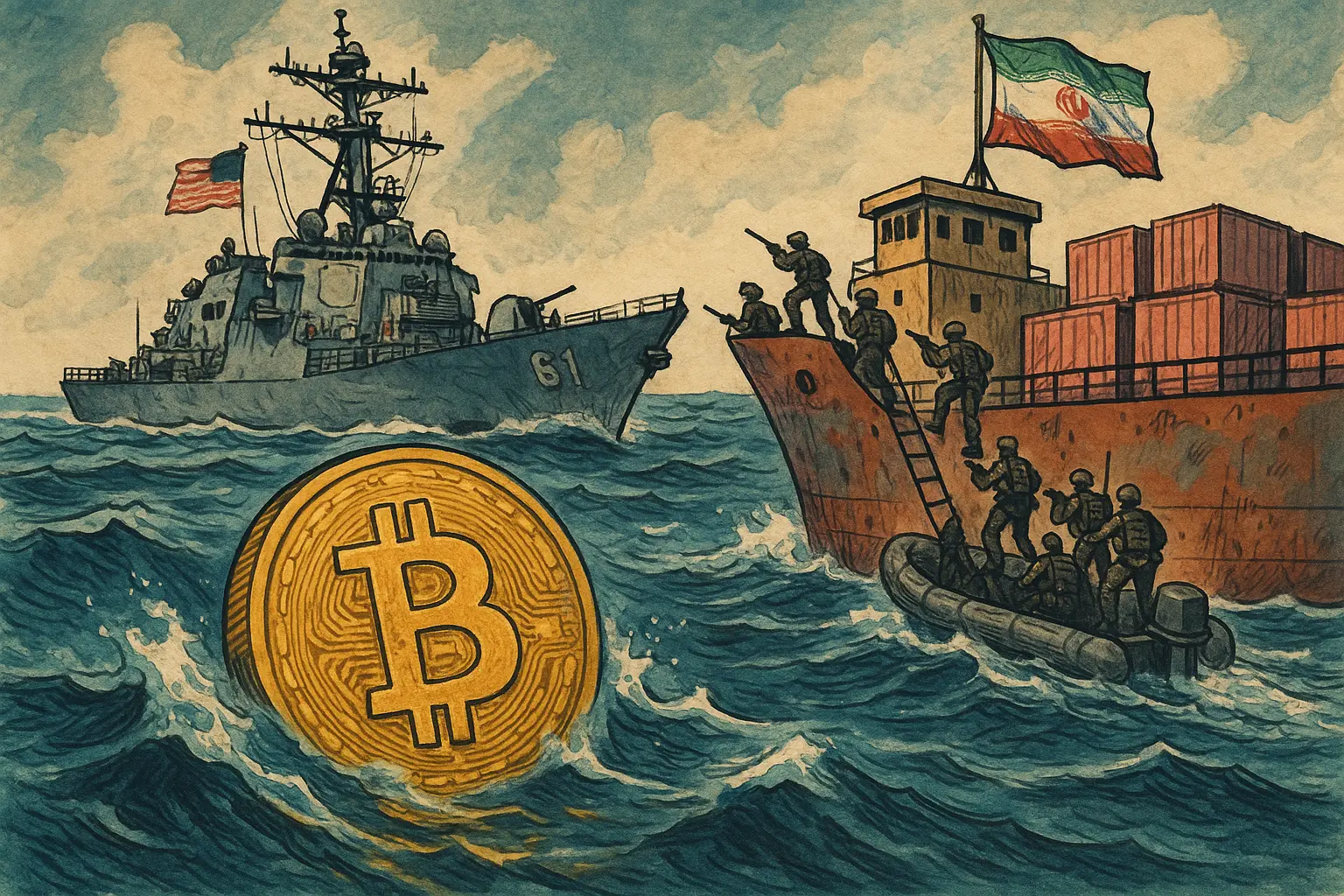
A U.S. Navy destroyer, the “USS Spruance,” on Sunday blew up the engine room of the Iranian cargo ship “Tosca” in the Gulf of Oman and seized it, triggering a flight-to-safety mood in the market. During Monday’s Asian trading session, Bitcoin fell 2.5%, trading near $73,996. Iran’s military immediately vowed direct retaliation against U.S. Navy vessels, and Brent crude briefly surged to $97.50. Market attention shifted to the ceasefire deadline on Wednesday; whether diplomatic talks can take place as scheduled remains uncertain.
Details of the Seizure Incident: Gunfire after a Six-Hour Refusal to Stop
A statement from U.S. Central Command said that the “Tosca” repeatedly refused to comply with stop warnings for as long as six hours. The U.S. later ordered the crew to evacuate the engine room, and fired several rounds from a 5-inch MK45 naval gun at the engine room to disable the ship’s power. The U.S. Marine Corps then boarded the vessel and took control. Trump confirmed on social media that the ship “tried to break through our naval blockade, but it didn’t go smoothly for them,” and said the ship had already been sanctioned by the U.S. Treasury Department beforehand.
Iran’s Joint Command Center said the boarding action was illegal, vowed to respond directly, and Iran’s Supreme National Security Council also stated that traffic-control measures would continue until the end of hostilities.
Market Impact: Bitcoin Ranges Between 73.9K and 76.2K, Oil Touches $97
In Monday’s Asian session, Bitcoin moved within the $73,886 to $76,165 range, with intraday pressure concentrated in the early part of the day. The total market value of cryptocurrencies was about $1.48 trillion, and trading volume was close to $62 billion. Despite the drop, Bitcoin has still risen 4.3% over the past seven days, and the weekly uptrend remains intact.
Brent crude briefly jumped 7.9% to $97.50 per barrel. Traders expect the situation of disruption or blockade in the Strait of Hormuz to persist. Normally, the Strait of Hormuz carries about one-fifth of global oil and LNG shipments, and it is currently basically idle.
Diplomatic Outlook: Wednesday’s Ceasefire Deadline as the Final Turning Point
Vice President Vance (JD Vance), envoy Steve Witkoff, and Jared Kushner plan to depart for Islamabad on Monday night to attend talks in Tuesday. However, Iran’s state television, citing negotiation representatives, said, “We don’t see any clear prospect for effective negotiations to make progress,” and the negotiation landscape is highly uncertain.
On the same day, Trump warned: “If Iran refuses to accept the conditions, the United States will destroy every power plant and every bridge in Iran.” The direction of Wednesday’s ceasefire deadline will be a key point in determining where geopolitical tensions go and how much the global energy market may fluctuate next.
Common Questions
How does the continued blockade of the Strait of Hormuz affect the global energy market?
In normal circumstances, the Strait of Hormuz carries about one-fifth of the world’s oil and LNG shipments. At present, the strait is basically idle, and Iran has announced that control measures will continue until the end of hostilities, meaning the risk of an energy supply disruption will remain. This standoff has already pushed Brent crude’s single-day gain to 7.9%, approaching the $100 per barrel threshold.
Why did Bitcoin fall during this geopolitical escalation?
In some market conditions, Bitcoin has a safe-haven characteristic, but when geopolitical uncertainty surges, the overall market’s risk sentiment tightening also suppresses Bitcoin. The uncertainty surrounding Wednesday’s ceasefire deadline, combined with the threat of Iran’s retaliation, led investors to reduce their exposure to risk assets in the short term, putting pressure on both Bitcoin and traditional stock markets.
What are the two main scenarios after Wednesday’s ceasefire deadline expires?
If negotiations succeed and result in a postponement or a formal agreement, market safe-haven sentiment is expected to ease, and Bitcoin and energy markets could see a clear rebound. If the ceasefire breaks down and the conflict escalates further—including additional U.S. military actions against Iranian infrastructure—oil and the energy market could keep surging, while risk assets including Bitcoin would face greater downside pressure.
Disclaimer: The information on this page may come from third parties and does not represent the views or opinions of Gate. The content displayed on this page is for reference only and does not constitute any financial, investment, or legal advice. Gate does not guarantee the accuracy or completeness of the information and shall not be liable for any losses arising from the use of this information. Virtual asset investments carry high risks and are subject to significant price volatility. You may lose all of your invested principal. Please fully understand the relevant risks and make prudent decisions based on your own financial situation and risk tolerance. For details, please refer to
Disclaimer.
Related Articles
Tensions around the Strait of Hormuz have been fluctuating, and Bitcoin falls below $74,000
The Strait of Hormuz blockade triggers a major shock in the crypto market: after Bitcoin first breaks above $78,000, it then falls back to $74,000, and the market remains in panic. This article provides an in-depth analysis of the transmission mechanism between geopolitical shocks and crypto market price action.
GateInstantTrends2h ago
BTC rose 0.56% in 15 minutes: trading volume surges and buy-side dominance drives a spot rebound
From 07:15 to 07:30 on April 20, 2026 (UTC), BTC achieved a +0.56% short-term return in mainstream markets. The price range touched 74718.5 - 75568.1 USDT, and the 15-minute intraday swing reached 1.14%. In this phase, market attention warmed up, trading activity rose noticeably, and overall volatility increased.
The main driver behind this deviation is that for mainstream trading pairs such as BTC/USDT, the 15-minute trading volume increased month-over-month to +15%, forming a buy-side dominant pattern that pushed spot prices upward to break higher. Inflows directly drove the short-term upside. On-chain data shows that large BTC transfers were dispatched to new wallets in a structured, staged manner, with no concentrated sell pressure flowing to trading platforms. This releases a rebalancing signal rather than a sell signal, which helps ease short-term sell pressure. The chain
GateNews4h ago
ETH jumps 1.22% in 15 minutes: DeFi segment activity and trading volume surge resonate to drive the move
2026-04-20 07:15 to 07:30 (UTC), ETH’s short-term return reached +1.22%. The price range spanned from 2285.19 to 2332.62 USDT, with a 2.07% amplitude. During this period, market attention heated up, volatility noticeably intensified. On-chain transaction volume rose in tandem, and key mainstream on-chain activity indicators expanded significantly on a month-over-month basis.
The primary driver of this deviation was an increase in transaction activity related to DeFi protocols, which boosted the share of on-chain Gas consumption. At the same time, total on-chain transaction volume saw a sharp surge in a short time. DeFi scenarios such as decentralized exchanges and lending protocols led to a direct surge in demand for ETH, driving funds to flow quickly into the market. In addition, the average Gas fees and Gas prices on the ETH network continued to climb in this window, further validating that high-frequency trading and active capital were accelerating into the market and strengthening short-term bullish sentiment.
Second, on-chain data also showed an expansion in liquidity related to stablecoins and ERC20 assets, strengthening market buy-side power. Although historical large-wallets such as Wilcke still held a large amount of ETH after early March, this cycle did not trigger abnormal transfers or large-scale sell-offs. Meanwhile, the positioning structure of mainstream ETH did not show passive deleveraging or concentrated liquidation. Under the combined effects of multiple factors, global buy-side demand was amplified, and short-term ETH volatility was further elevated.
Be alert to the risk of capital sustainability after a surge in high-frequency trading volume and Gas fees. If subsequent incremental buying is lacking or on-chain attention cools down, ETH may face short-term pullback pressure. Monitor changes in large-holder positions, any abnormal shifts in network fees, and liquidity volatility on the DeFi protocol chain. While there have been no signs of security incidents involving major contracts and protocols so far, short-term liquidity disturbances still need close observation. Keep monitoring fund flows and on-chain structure to stay informed about subsequent market changes.
GateNews4h ago
Hong Kong-Listed Qunhe Technology Surges Over 100%
Gate News message, April 20 — Qunhe Technology, a company listed on the Hong Kong stock exchange, surged 106.99% in today's trading session.
GateNews4h ago
BTC breaks through 75000 USDT
Gate News bot message, Gate market shows that BTC has broken through 75000 USDT, with the current price at 75007.8 USDT.
CryptoRadar4h ago
CHZ (Chiliz) up 6.98% in 24 hours
Gate News update, April 20, according to Gate market data. As of the time of writing, CHZ (Chiliz) is trading at $0.0434. It is up 6.98% over the past 24 hours, with a high of $0.0443 and a low of $0.0398. The 24-hour trading volume is $323.8k. The current market cap is approximately $448 million.
As the exclusive utility token of Socios.com, Chiliz gives sports and esports fans the right to jointly manage teams, events, leagues, and other activities. Through voting, Chiliz grants fans in the sports and esports space the right to "joint control," allowing them to participate in team management and strategic decision-making. Any league, team, or event can implement this model by applying blockchain. Fans can become opinion leaders for any competition project by using the Socios.com platform that supports Chiliz payments. Teams, leagues, and other types of projects in sports and esports can also be monetized by giving fans a certain degree of decision-making power.
This information does not constitute investment advice. Investors should be aware of market volatility risks.
GateNews4h ago


