This comprehensive guide compares BSW and UNI, two prominent decentralized exchange tokens with distinct market positioning. BSW, launched in 2021, offers cost-efficient DEX services with 0.1% trading fees and referral incentives, currently trading at $0.002349 with limited liquidity. UNI, established in 2020 as Ethereum's pioneering automated market maker, demonstrates significantly stronger market presence with $4.41 million daily trading volume at $3.932 per token. The article analyzes historical price trends showing both assets declined substantially from 2021 peaks, examines tokenomics and institutional adoption, and provides 2026-2031 price forecasts suggesting conservative appreciation potential. Investment strategy recommendations differentiate between conservative investors favoring UNI's stability and aggressive investors considering BSW's volatility potential. Comprehensive risk analysis covers market, technical, and regulatory factors, addressing which token suits specific investor profiles throug
Introduction: Investment Comparison Between BSW and UNI
In the cryptocurrency market, the comparison between BSW vs UNI has consistently drawn investor attention. These two tokens exhibit notable differences in market cap ranking, application scenarios, and price performance, representing distinct positioning within the crypto asset landscape.
Biswap (BSW): Launched in 2021, this decentralized exchange platform has gained market recognition through its three-tier referral system and competitive trading fees of 0.1%, positioning itself as a cost-efficient DEX alternative.
Uniswap (UNI): Introduced in 2020 as the first automated market-making protocol on the Ethereum blockchain, UNI has established itself as one of the leading decentralized exchange governance tokens by trading volume and market capitalization.
This article will provide a comprehensive analysis of BSW vs UNI investment value comparison, examining historical price trends, supply mechanisms, institutional adoption, technical ecosystems, and future projections, attempting to address investors' most pressing question:
"Which is the better buy right now?"
I. Historical Price Comparison and Current Market Status
BSW (Coin A) and UNI (Coin B) Historical Price Trends
- 2021: BSW reached a notable price level of $2.1 in December 2021 during a period of heightened market activity. UNI achieved its peak at $44.92 in May 2021, reflecting significant trading momentum during the broader crypto market expansion.
- 2026: BSW recorded a price of $0.0021886 on February 2, 2026, representing a period of price compression. UNI was trading at $1.03 in September 2020, marking an early-stage valuation level.
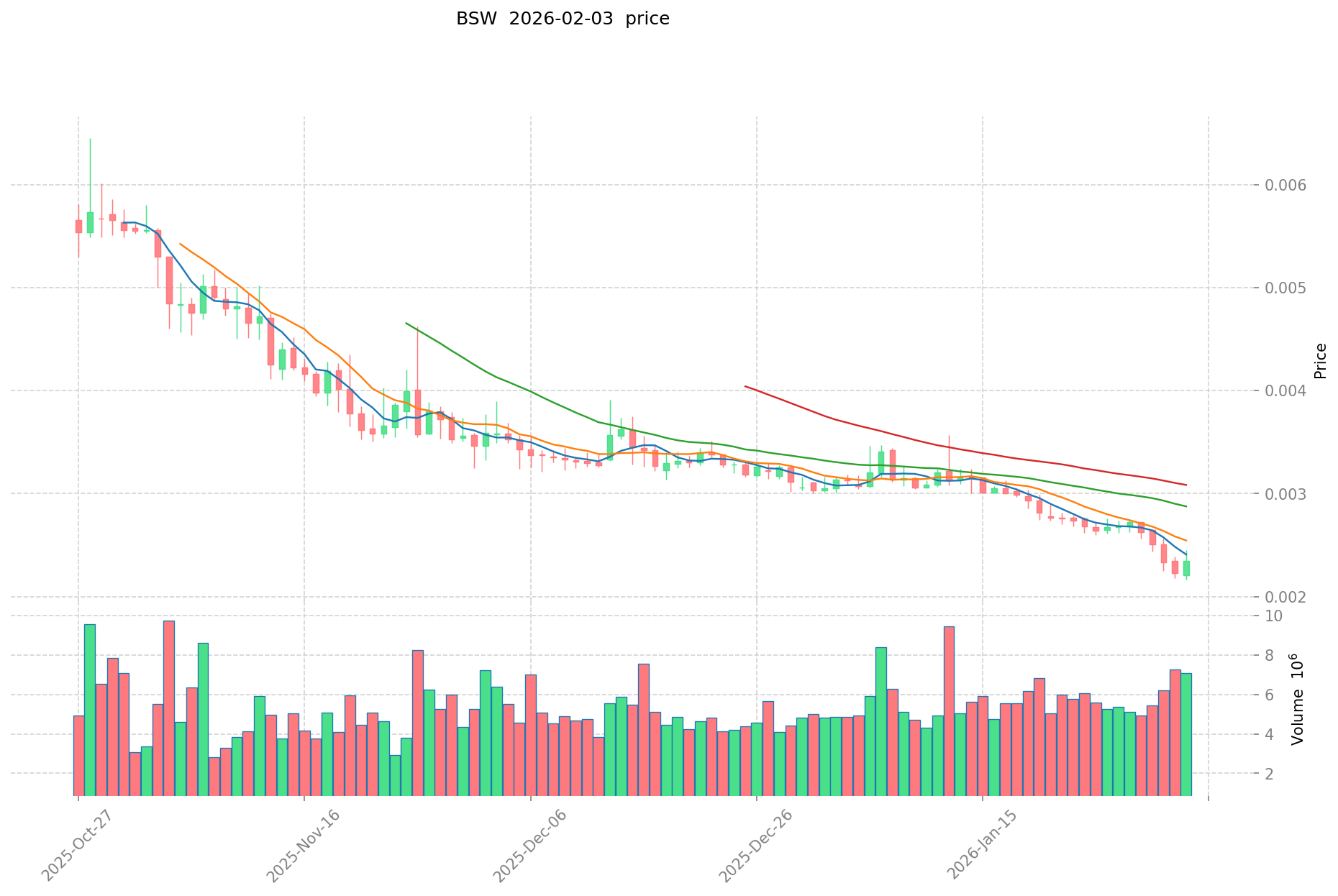
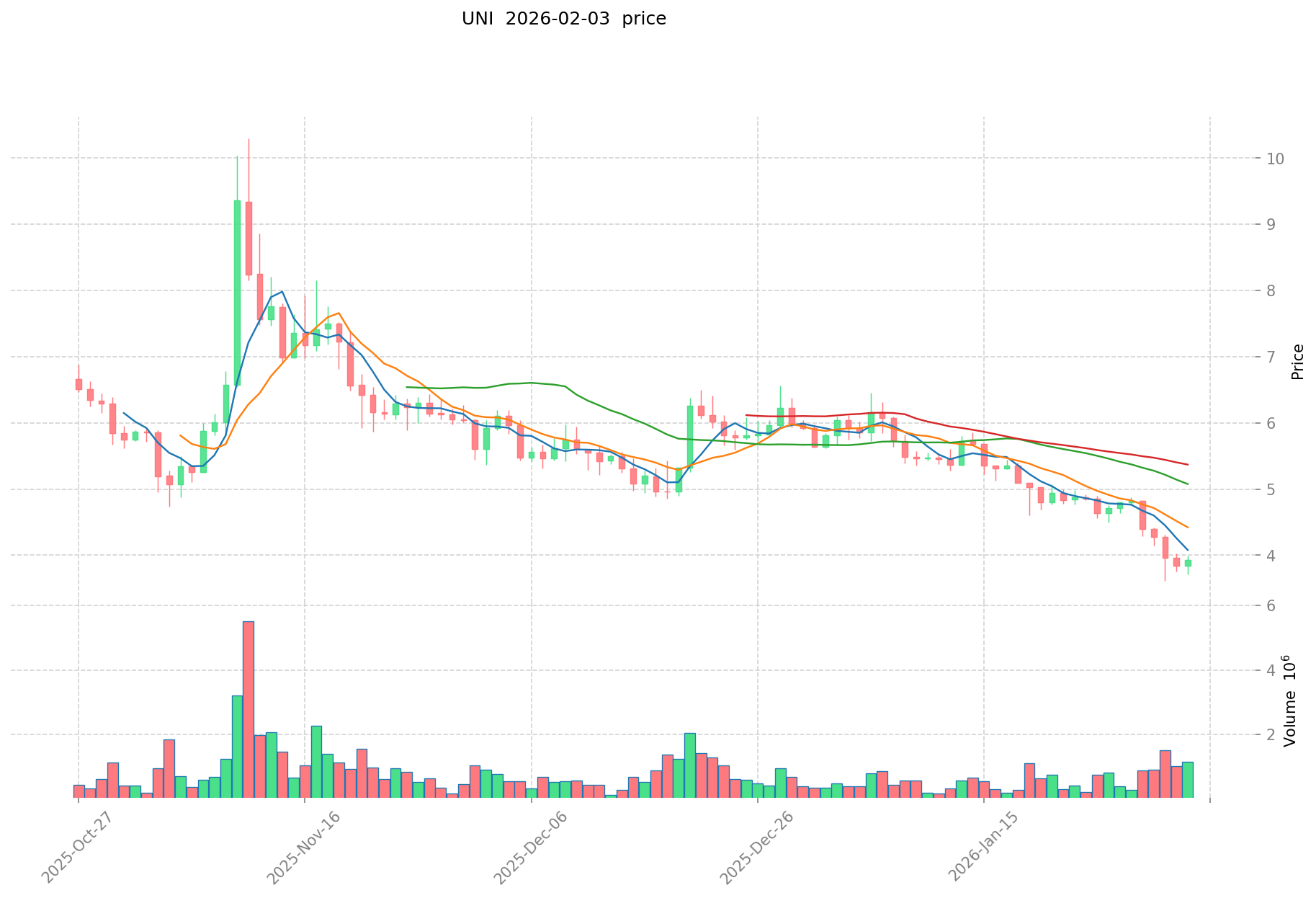
- Comparative Analysis: During the market cycle from late 2021 through early 2026, BSW declined from $2.1 to approximately $0.002349, while UNI decreased from $44.92 to approximately $3.932 over a similar timeframe.
Current Market Situation (2026-02-03)
- BSW Current Price: $0.002349
- UNI Current Price: $3.932
- 24-Hour Trading Volume: BSW $16,024.83 vs UNI $4,410,922.77
- Market Sentiment Index (Fear & Greed Index): 14 (Extreme Fear)
View real-time prices:
II. Core Factors Influencing BSW vs UNI Investment Value
Supply Mechanism Comparison (Tokenomics)
- BSW: The available materials do not provide specific information about BSW's supply mechanism or tokenomics model.
- UNI: The available materials do not provide specific information about UNI's supply mechanism or tokenomics model.
- 📌 Historical Pattern: Supply mechanisms can influence price cycles through deflationary pressure, emission schedules, and burning mechanisms, though specific data for these assets is not available in the provided materials.
Institutional Adoption and Market Application
- Institutional Holdings: The provided materials do not contain comparative data on institutional preference between BSW and UNI.
- Enterprise Adoption: Information regarding BSW or UNI applications in cross-border payments, settlements, or investment portfolios is not available in the reference materials.
- National Policies: The materials do not address regulatory attitudes toward either asset across different jurisdictions.
Technical Development and Ecosystem Building
- BSW Technical Upgrades: Specific technical development information for BSW is not available in the provided materials.
- UNI Technical Development: Specific technical development information for UNI is not available in the provided materials.
- Ecosystem Comparison: The materials do not provide details on DeFi, NFT, payment systems, or smart contract implementation for either BSW or UNI.
Macroeconomic Conditions and Market Cycles
- Performance in Inflationary Environments: The reference materials do not contain data comparing the inflation-hedging properties of BSW versus UNI.
- Macroeconomic Monetary Policy: According to renewable energy investment data from 2007-2017, global investment patterns showed sensitivity to policy frameworks and economic conditions, suggesting that interest rates and currency strength can influence asset valuations, though specific impacts on BSW or UNI are not documented in the materials.
- Geopolitical Factors: The materials mention cross-border considerations in various contexts but do not specifically address how international situations or cross-border transaction demands affect BSW or UNI investment value.
III. 2026-2031 Price Forecast: BSW vs UNI
Short-term Forecast (2026)
- BSW: Conservative $0.00153 - $0.00235 | Optimistic $0.00235 - $0.00296
- UNI: Conservative $2.07 - $3.90 | Optimistic $3.90 - $4.14
Mid-term Forecast (2028-2029)
- BSW may enter a gradual growth phase, with estimated prices ranging from $0.00228 to $0.00551
- UNI may enter an expansion phase, with estimated prices ranging from $3.05 to $7.94
- Key drivers: institutional capital inflows, ETF developments, ecosystem expansion
Long-term Forecast (2030-2031)
- BSW: Baseline scenario $0.00370 - $0.00463 | Optimistic scenario $0.00516 - $0.00602
- UNI: Baseline scenario $3.80 - $6.67 | Optimistic scenario $6.12 - $11.60
View detailed price predictions for BSW and UNI
Disclaimer
BSW:
| Year |
Predicted High Price |
Predicted Average Price |
Predicted Low Price |
Price Change |
| 2026 |
0.00295722 |
0.002347 |
0.00152555 |
0 |
| 2027 |
0.0039516439 |
0.00265211 |
0.0018829981 |
12 |
| 2028 |
0.0041933837265 |
0.00330187695 |
0.0022782950955 |
40 |
| 2029 |
0.005509016597227 |
0.00374763033825 |
0.00224857820295 |
59 |
| 2030 |
0.00601682050806 |
0.004628323467738 |
0.003702658774191 |
97 |
| 2031 |
0.005854829186689 |
0.005322571987899 |
0.005162894828262 |
126 |
UNI:
| Year |
Predicted High Price |
Predicted Average Price |
Predicted Low Price |
Price Change |
| 2026 |
4.13824 |
3.904 |
2.06912 |
0 |
| 2027 |
4.9459776 |
4.02112 |
2.7343616 |
2 |
| 2028 |
6.321803808 |
4.4835488 |
3.048813184 |
14 |
| 2029 |
7.94193416688 |
5.402676304 |
3.72784664976 |
37 |
| 2030 |
9.007612067844 |
6.67230523544 |
3.8032139842008 |
69 |
| 2031 |
11.60313880443016 |
7.839958651642 |
6.11516774828076 |
99 |
IV. Investment Strategy Comparison: BSW vs UNI
Long-term vs Short-term Investment Strategies
-
BSW: May suit investors seeking cost-efficient DEX alternatives with tolerance for higher volatility. The platform's competitive 0.1% trading fee structure and three-tier referral system could appeal to users focused on transaction cost optimization within decentralized exchange environments.
-
UNI: May suit investors interested in established automated market-making protocols with governance participation opportunities. As one of the leading decentralized exchange tokens by trading volume and market capitalization, UNI represents exposure to the broader Ethereum-based DeFi ecosystem.
Risk Management and Asset Allocation
-
Conservative Investors: Potential allocation consideration might favor UNI due to its established market position and comparatively larger 24-hour trading volume ($4,410,922.77 vs BSW's $16,024.83 as of February 3, 2026). A sample allocation could range from BSW 10-20% vs UNI 80-90% within the crypto portfolio segment.
-
Aggressive Investors: Those with higher risk tolerance might explore increased BSW allocation given its lower absolute price point and potential for percentage-based appreciation, though with corresponding volatility considerations. A sample allocation could range from BSW 40-60% vs UNI 40-60% within the crypto portfolio segment.
-
Hedging Instruments: Portfolio protection strategies may include stablecoin reserves for rebalancing opportunities, options contracts where available, and diversified token holdings across multiple blockchain ecosystems to manage concentration risk.
V. Potential Risk Comparison
Market Risk
-
BSW: The asset experienced price compression from $2.1 in December 2021 to approximately $0.002349 as of February 3, 2026. The relatively limited 24-hour trading volume of $16,024.83 may present liquidity considerations during periods of market stress. Current market sentiment indicated by the Fear & Greed Index at 14 (Extreme Fear) suggests heightened volatility potential.
-
UNI: The token demonstrated price movement from $44.92 in May 2021 to approximately $3.932 as of February 3, 2026. While UNI maintains substantially higher trading volume at $4,410,922.77, broader market sentiment conditions (Fear & Greed Index: 14) indicate continued exposure to cryptocurrency market cycles and potential downside scenarios.
Technical Risk
-
BSW: Specific technical development information and network stability metrics are not available in the provided materials. Investors should independently verify scalability parameters, security audit status, and infrastructure robustness.
-
UNI: Specific technical development information regarding network upgrades, security audits, and scalability solutions is not available in the provided materials. As an Ethereum-based protocol, UNI's performance characteristics may correlate with underlying blockchain network conditions.
Regulatory Risk
- Global regulatory frameworks for decentralized exchange tokens continue to evolve across jurisdictions. Both BSW and UNI, as assets associated with decentralized trading platforms, may encounter varying regulatory treatment depending on classification approaches adopted by different regulatory authorities. Investors should monitor jurisdiction-specific developments that could affect token utility, trading availability, or compliance requirements.
VI. Conclusion: Which Is the Better Buy?
📌 Investment Value Summary:
-
BSW Characteristics: Launched in 2021 with competitive fee structure (0.1% trading fees) and referral incentive mechanisms. Current price of $0.002349 represents a different risk-return profile compared to peak levels. Conservative 2026-2031 forecasts suggest gradual appreciation potential from baseline scenarios of $0.00153-$0.00235 (2026) to $0.00370-$0.00463 (2030-2031).
-
UNI Characteristics: Established in 2020 as a pioneering automated market maker on Ethereum with substantial market recognition and trading volume ($4.41 million 24-hour volume). Current price of $3.932 with conservative 2026-2031 forecasts ranging from $2.07-$3.90 (2026) to $3.80-$6.67 (2030-2031) in baseline scenarios.
✅ Investment Considerations:
-
Novice Investors: May consider starting with established assets like UNI that demonstrate higher liquidity levels and market recognition, while maintaining position sizes aligned with individual risk tolerance and thorough independent research.
-
Experienced Investors: Could evaluate portfolio diversification strategies incorporating both assets based on specific investment objectives, risk parameters, and correlation analysis with existing holdings. Position sizing should reflect liquidity differences and volatility characteristics of each asset.
-
Institutional Investors: Should conduct comprehensive due diligence including technical infrastructure assessment, regulatory compliance review, and liquidity analysis before establishing positions. Portfolio integration strategies may benefit from structured allocation frameworks accounting for market cycle positioning and correlation dynamics.
⚠️ Risk Disclosure: Cryptocurrency markets exhibit substantial volatility characteristics. The current Fear & Greed Index reading of 14 (Extreme Fear) indicates elevated market uncertainty. This analysis does not constitute investment advice, financial guidance, or recommendation to buy, sell, or hold any asset. Investors should conduct independent research, consult qualified financial advisors, and only allocate capital they can afford to lose.
VII. FAQ
Q1: What are the main differences in trading volume between BSW and UNI?
UNI demonstrates significantly higher trading volume at $4,410,922.77 compared to BSW's $16,024.83 (24-hour volume as of February 3, 2026). This substantial difference reflects UNI's established market position as one of the leading decentralized exchange tokens by trading volume and market capitalization since its 2020 launch. BSW, launched in 2021, operates with notably lower liquidity levels, which may present different considerations for entry and exit strategies, particularly during periods of market volatility. The volume disparity indicates UNI's broader market acceptance and deeper order books.
Q2: How have BSW and UNI performed from their peak prices to current levels?
BSW declined from $2.1 (December 2021) to $0.002349 (February 3, 2026), while UNI decreased from $44.92 (May 2021) to $3.932 (February 3, 2026). Both assets experienced substantial price compression during the 2021-2026 period, reflecting broader cryptocurrency market cycle dynamics. In percentage terms, BSW demonstrated approximately 99.89% decline from its peak, while UNI showed approximately 91.25% decline. These historical patterns underscore the volatility characteristics inherent in cryptocurrency assets and the importance of understanding market cycle positioning when evaluating investment timing.
Q3: What allocation strategies are suggested for conservative versus aggressive investors?
Conservative investors might consider BSW 10-20% versus UNI 80-90% allocation within their crypto portfolio segment, favoring UNI's established market position and substantially higher trading volume. Aggressive investors with higher risk tolerance could explore BSW 40-60% versus UNI 40-60% allocation, recognizing BSW's lower absolute price point and corresponding volatility potential. These sample allocations reflect different risk-return preferences, with conservative approaches emphasizing liquidity and market recognition, while aggressive strategies incorporate higher exposure to assets with greater percentage-based appreciation potential alongside increased volatility considerations.
Q4: What are the projected price ranges for BSW and UNI by 2031?
BSW conservative 2031 forecasts range from $0.005162 (low) to $0.005855 (high) with an average of $0.005323, representing potential appreciation of approximately 126% from current levels. UNI conservative 2031 forecasts range from $6.115 (low) to $11.603 (high) with an average of $7.840, indicating potential appreciation of approximately 99% from current levels. These projections assume baseline growth scenarios incorporating institutional capital inflows, ecosystem expansion, and continued market development. However, actual performance may vary significantly based on macroeconomic conditions, regulatory developments, and technological adoption rates.
Q5: What specific features differentiate BSW from UNI as decentralized exchange tokens?
BSW positions itself as a cost-efficient DEX alternative with competitive 0.1% trading fees and a three-tier referral system designed to incentivize user acquisition and platform growth. UNI represents the governance token for the first automated market-making protocol on Ethereum, with established infrastructure and pioneering role in decentralized exchange development. BSW's approach emphasizes transaction cost optimization and referral mechanisms, while UNI's value proposition centers on governance participation and exposure to Ethereum's DeFi ecosystem. These fundamental differences reflect distinct strategic positioning within the decentralized exchange landscape.
Q6: How does current market sentiment affect investment timing for BSW and UNI?
The Fear & Greed Index currently stands at 14 (Extreme Fear) as of February 3, 2026, indicating heightened market uncertainty and elevated volatility potential for both BSW and UNI. Historically, extreme fear readings have sometimes corresponded with accumulation opportunities for long-term investors with appropriate risk tolerance, though they also signal increased downside risk in near-term scenarios. Investors should evaluate whether current sentiment levels align with their investment timeframes and risk parameters. Market timing remains challenging, and dollar-cost averaging strategies may help mitigate the impact of short-term volatility for those establishing positions during periods of extreme sentiment.
Q7: What regulatory considerations should investors monitor for BSW and UNI?
Both BSW and UNI, as tokens associated with decentralized trading platforms, face evolving regulatory frameworks across global jurisdictions. Regulatory authorities continue developing classification approaches that could affect token utility, trading availability, and compliance requirements. Investors should monitor jurisdiction-specific developments including securities classification determinations, exchange listing requirements, taxation treatment, and cross-border transaction regulations. The decentralized nature of these platforms presents unique regulatory considerations compared to traditional financial instruments, and regulatory clarity varies significantly across different geographic regions. Staying informed about regulatory evolution remains essential for managing compliance-related risks.
Q8: What liquidity considerations should investors understand when comparing BSW and UNI?
UNI's 24-hour trading volume of $4,410,922.77 versus BSW's $16,024.83 represents approximately 275 times greater liquidity depth. This substantial difference impacts several practical considerations: larger positions in BSW may experience greater slippage during execution, exit strategies during market stress may face liquidity constraints, and price discovery mechanisms operate with different efficiency levels. Higher liquidity generally facilitates smoother entry and exit execution with reduced market impact costs. Investors planning significant position sizes should factor liquidity characteristics into allocation decisions, particularly for assets like BSW with comparatively limited trading volume relative to established tokens like UNI.
* The information is not intended to be and does not constitute financial advice or any other recommendation of any sort offered or endorsed by Gate.