This comprehensive guide compares DBC and OP as cryptocurrency investment opportunities. DBC, a decentralized AI computing infrastructure token launched in 2018, currently trades at $0.0001909 with limited liquidity. OP, an Ethereum Layer 2 scaling solution from 2022, trades at $0.2299 with substantially higher trading volume. The article analyzes historical price trends, market positioning, and tokenomics to guide investment decisions. DBC peaked at $0.66203 in 2018, while OP reached $4.84 in March 2024, reflecting different market trajectories. The analysis includes price forecasts through 2031, risk assessment covering market, technical, and regulatory factors, and tailored investment strategies for conservative, aggressive, new, and institutional investors. Current extreme fear sentiment (Index: 14) presents both risks and opportunities. The guide concludes OP suits Ethereum ecosystem exposure with higher liquidity, while DBC appeals to speculative investors seeking emerging AI infrastructure opportunitie
Introduction: Investment Comparison Between DBC and OP
In the cryptocurrency market, the comparison between DBC vs OP continues to draw investor attention. The two tokens exhibit notable differences in market cap ranking, application scenarios, and price performance, representing distinct crypto asset positioning.
DeepBrain Chain (DBC): Launched in 2018, it has gained market recognition through its positioning as a decentralized AI infrastructure layer, offering developers one-click tokenization and GPU computing power.
Optimism (OP): Introduced in 2022, it is recognized as a low-cost, high-speed Ethereum Layer 2 solution, addressing scalability challenges for developers and users within the Ethereum ecosystem.
This article will comprehensively analyze the investment value comparison of DBC vs OP by examining historical price trends, supply mechanisms, institutional adoption, technical ecosystems, and future projections, attempting to address investors' most pressing question:
"Which is the better buy right now?"
I. Historical Price Comparison and Market Status
DBC and OP Historical Price Trends
- 2018: DBC experienced a price peak of $0.66203 in January 2018, reflecting early market enthusiasm for decentralized AI computing solutions during the broader cryptocurrency bull market.
- 2024: OP reached its peak price of $4.84 in March 2024, driven by increased adoption of Layer 2 scaling solutions and Ethereum ecosystem expansion.
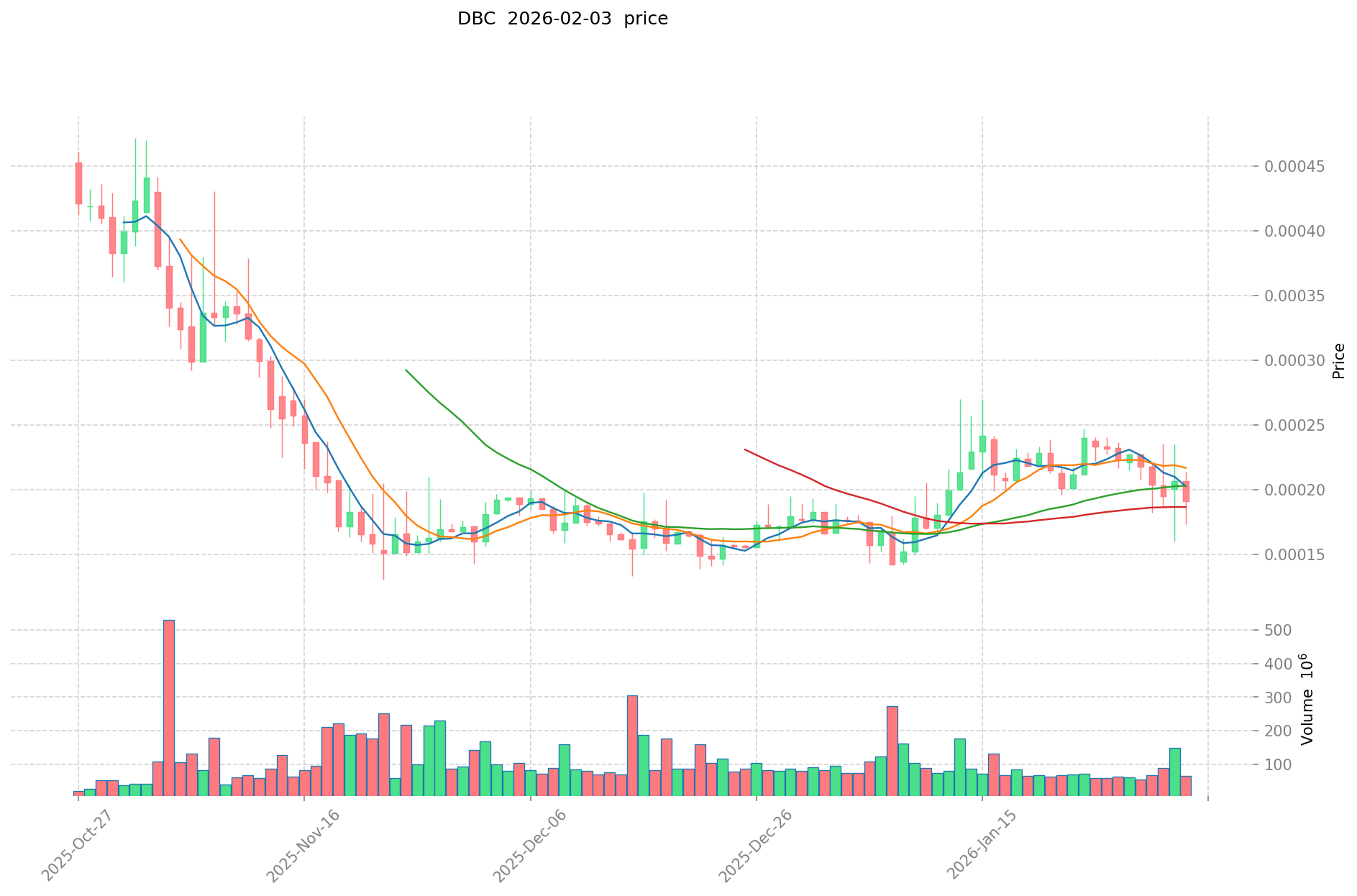
- 2025: DBC recorded its historical low of $0.000135 in December 2025, reflecting sustained downward pressure. Meanwhile, OP maintained relatively higher price levels compared to DBC, though both tokens experienced declines during this period.
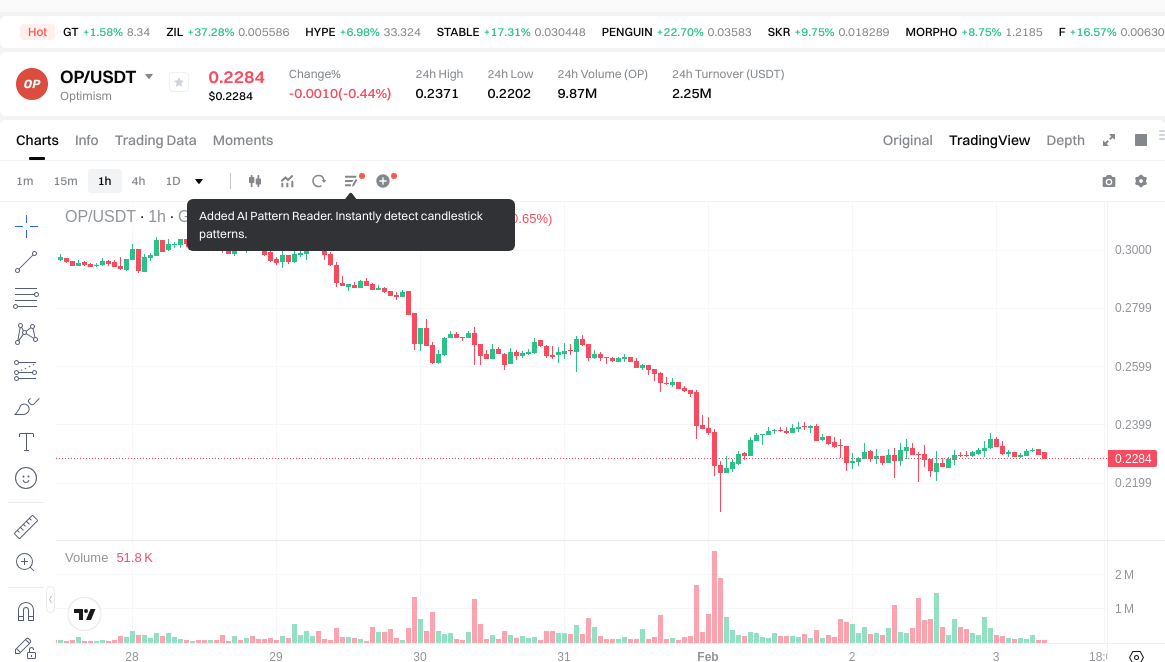
- Comparative Analysis: During the 2021-2025 market cycle, DBC declined from its peak of $0.66203 to a low of $0.000135, representing a significant decrease. OP, while also experiencing volatility, demonstrated relatively stronger price resilience with a decline from $4.84 to $0.221322 during its measured range.
Current Market Status (2026-02-03)
- DBC current price: $0.0001909
- OP current price: $0.2299
- 24-hour trading volume: DBC $12,890.55 vs OP $2,262,736.42
- Market Sentiment Index (Fear & Greed Index): 14 (Extreme Fear)
View real-time prices:
II. Core Factors Influencing DBC vs OP Investment Value
Supply Mechanism Comparison (Tokenomics)
- DBC: The reference materials do not provide specific information regarding DBC's supply mechanism, token distribution model, or inflationary/deflationary characteristics.
- OP: The reference materials do not contain details about OP's tokenomics, supply schedule, or emission model.
- 📌 Historical Pattern: Supply mechanisms can influence price cycles through scarcity dynamics, emission schedules, and token unlock events, though specific historical data for these projects is not available in the provided materials.
Institutional Adoption and Market Application
- Institutional Holdings: The reference materials do not provide comparative data on institutional investment preferences between DBC and OP.
- Enterprise Adoption: Information regarding enterprise-level applications in cross-border payments, settlement systems, or investment portfolios for either DBC or OP is not available in the provided materials.
- Regulatory Landscape: The materials note that different countries maintain varying regulatory approaches, though specific policy stances toward DBC or OP are not detailed.
Technological Development and Ecosystem Building
- DBC Technical Progress: The reference materials mention that Deep Brain Chain regularly releases development updates and plans, which are relevant for tracking project advancement. However, specific technical upgrades and their potential impacts are not elaborated.
- OP Technical Development: The provided materials do not contain information about OP's technological roadmap or upgrade schedule.
- Ecosystem Comparison: Specific deployment details regarding DeFi integration, NFT platforms, payment systems, or smart contract implementations for either project are not available in the reference materials.
Macroeconomic Environment and Market Cycles
- Performance in Inflationary Environments: The reference materials do not provide comparative analysis of anti-inflation characteristics for either asset.
- Macroeconomic Monetary Policy: While the materials reference risk management in futures markets and trading mechanisms across various exchanges, specific correlations between interest rates, dollar index movements, and the performance of DBC or OP are not documented.
- Geopolitical Factors: The materials acknowledge that cross-border transaction demand and international situations can impact markets, though specific implications for DBC or OP are not detailed in the provided sources.
III. 2026-2031 Price Forecast: DBC vs OP
Short-term Forecast (2026)
- DBC: Conservative $0.0001482 - $0.00019 | Optimistic $0.00019 - $0.0002641
- OP: Conservative $0.157596 - $0.2284 | Optimistic $0.2284 - $0.29692
Mid-term Forecast (2028-2029)
- DBC may enter a consolidation phase, with projected price range of $0.00017265 - $0.000417240
- OP may enter a growth phase, with projected price range of $0.22693824 - $0.41290152
- Key drivers: institutional capital inflows, ETF developments, ecosystem expansion
Long-term Forecast (2030-2031)
- DBC: Base scenario $0.00019387 - $0.00036307 | Optimistic scenario $0.000373646 - $0.000424793
- OP: Base scenario $0.27677956 - $0.389830 | Optimistic scenario $0.395591 - $0.41322019
View detailed price predictions for DBC and OP
Disclaimer
DBC:
| Year |
Predicted High Price |
Predicted Average Price |
Predicted Low Price |
Price Change |
| 2026 |
0.0002641 |
0.00019 |
0.0001482 |
0 |
| 2027 |
0.000313329 |
0.00022705 |
0.00018164 |
18 |
| 2028 |
0.000305314135 |
0.0002701895 |
0.00019453644 |
41 |
| 2029 |
0.000417240135375 |
0.0002877518175 |
0.0001726510905 |
50 |
| 2030 |
0.000373645735023 |
0.000352495976437 |
0.00019387278704 |
84 |
| 2031 |
0.000424792901204 |
0.00036307085573 |
0.000283195267469 |
90 |
OP:
| Year |
Predicted High Price |
Predicted Average Price |
Predicted Low Price |
Price Change |
| 2026 |
0.29692 |
0.2284 |
0.157596 |
0 |
| 2027 |
0.367724 |
0.26266 |
0.1418364 |
14 |
| 2028 |
0.41290152 |
0.315192 |
0.22693824 |
37 |
| 2029 |
0.4040919036 |
0.36404676 |
0.2402708616 |
58 |
| 2030 |
0.395591411754 |
0.3840693318 |
0.295733385486 |
67 |
| 2031 |
0.41322019408362 |
0.389830371777 |
0.27677956396167 |
69 |
IV. Investment Strategy Comparison: DBC vs OP
Long-term vs Short-term Investment Strategies
-
DBC: May appeal to investors focused on emerging decentralized AI computing infrastructure and seeking high-risk, speculative opportunities in nascent technology sectors. The token's lower price point and positioning in AI-related blockchain applications could attract those exploring alternative narratives beyond mainstream crypto assets.
-
OP: May suit investors prioritizing Ethereum ecosystem expansion and Layer 2 scaling solutions. Those seeking exposure to established infrastructure projects with demonstrated market presence and higher liquidity profiles may find OP's positioning more aligned with their investment thesis.
Risk Management and Asset Allocation
- Conservative Investors: DBC 5-10% vs OP 15-25% (within overall crypto portfolio allocation)
- Aggressive Investors: DBC 15-25% vs OP 25-40% (within overall crypto portfolio allocation)
- Hedging Tools: Stablecoin reserves for portfolio rebalancing, cross-asset diversification strategies, risk-adjusted position sizing
V. Potential Risk Comparison
Market Risks
-
DBC: Exhibits elevated volatility characteristics, with historical price movements showing substantial decline from peak levels. The token's lower trading volume ($12,890.55 as of February 3, 2026) may present liquidity constraints during market stress periods. Price discovery mechanisms may be impacted by limited market depth.
-
OP: While demonstrating relatively higher liquidity with 24-hour trading volume of $2,262,736.42, the token remains subject to broader cryptocurrency market cycles and Ethereum ecosystem developments. Correlation with Layer 2 sector performance and general market sentiment may influence price movements.
Technical Risks
-
DBC: The reference materials note that Deep Brain Chain releases development updates regularly, though specific technical implementation details and network performance metrics are not elaborated in available sources. Investors should monitor project development progress independently.
-
OP: Technical considerations related to Layer 2 scaling solutions, including network performance, security model robustness, and integration dynamics with Ethereum mainnet, represent ongoing evaluation areas. Specific technical risk factors are not detailed in the provided materials.
Regulatory Risks
- Cryptocurrency regulatory frameworks continue evolving across jurisdictions, with varying approaches toward digital assets. Both DBC and OP may be subject to regulatory developments affecting trading access, compliance requirements, and market participation across different regions. Investors should monitor regulatory developments in their respective jurisdictions.
VI. Conclusion: Which Is the Better Buy?
📌 Investment Value Summary:
-
DBC Characteristics: Positioned in the decentralized AI computing sector with lower entry price point. Historical performance shows significant volatility. Current market metrics indicate limited liquidity relative to major crypto assets. May represent higher-risk positioning for investors exploring emerging technology narratives.
-
OP Characteristics: Established presence in Ethereum Layer 2 ecosystem with comparatively higher market liquidity. Price performance demonstrates relative resilience within its operational timeframe. May align with investors seeking exposure to Ethereum scaling infrastructure developments.
✅ Investment Considerations:
-
New Investors: Consider prioritizing fundamental understanding of blockchain technology, market cycles, and risk tolerance assessment before allocation. Starting with smaller position sizes in more liquid assets while building knowledge foundation may be prudent.
-
Experienced Investors: Evaluate portfolio diversification objectives, risk-adjusted return profiles, and correlation dynamics with existing holdings. Consider phased entry strategies and predetermined risk management parameters aligned with overall investment framework.
-
Institutional Participants: Assess liquidity requirements, custody infrastructure compatibility, regulatory compliance frameworks, and portfolio construction mandates. Due diligence regarding technical development roadmaps, governance structures, and ecosystem sustainability may inform allocation decisions.
⚠️ Risk Disclosure: Cryptocurrency markets exhibit substantial volatility and uncertainty. This analysis does not constitute investment advice, financial guidance, or recommendations for specific trading actions. Investors should conduct independent research, consult qualified financial professionals, and carefully evaluate their risk tolerance and financial circumstances before making any investment decisions.
VII. FAQ
Q1: What are the primary differences between DBC and OP in terms of market positioning?
DBC positions itself as a decentralized AI computing infrastructure layer offering GPU computing power and one-click tokenization for developers, while OP serves as an Ethereum Layer 2 scaling solution focused on reducing transaction costs and increasing throughput. The fundamental distinction lies in their technological focus: DBC targets the intersection of blockchain and artificial intelligence computing, whereas OP addresses Ethereum's scalability challenges. This difference is reflected in their market metrics, with OP demonstrating significantly higher trading volume ($2,262,736.42) compared to DBC ($12,890.55) as of February 3, 2026, indicating varying levels of market adoption and liquidity.
Q2: How do the historical price performances of DBC and OP compare?
DBC reached its historical peak of $0.66203 in January 2018 but declined to a low of $0.000135 in December 2025, representing a substantial decrease over the period. OP achieved its peak price of $4.84 in March 2024 and declined to $0.221322 during its measured range, demonstrating relatively stronger price resilience compared to DBC. As of February 3, 2026, DBC trades at $0.0001909 while OP is priced at $0.2299, highlighting the significant price differential and different market valuation trajectories between the two assets.
Q3: What are the projected price ranges for DBC and OP through 2031?
Short-term forecasts for 2026 project DBC between $0.0001482-$0.0002641 under conservative to optimistic scenarios, while OP is projected at $0.157596-$0.29692. Long-term projections for 2031 estimate DBC reaching $0.000283195-$0.000424793 and OP achieving $0.27677956-$0.41322019 under base to optimistic scenarios. These forecasts suggest both assets may experience growth from current levels, though projections involve substantial uncertainty and depend on factors including institutional adoption, technological development, ecosystem expansion, and broader macroeconomic conditions affecting cryptocurrency markets.
Q4: What risk factors should investors consider when comparing DBC and OP?
Both assets present distinct risk profiles: DBC exhibits elevated volatility with limited trading volume, potentially creating liquidity constraints during market stress periods and impacting price discovery mechanisms. OP, while demonstrating higher liquidity, remains subject to Ethereum ecosystem developments and Layer 2 sector performance dynamics. Market risks include exposure to cryptocurrency market cycles and the extreme fear sentiment (Fear & Greed Index: 14) currently affecting the broader market. Technical risks relate to ongoing development progress for DBC and network performance considerations for OP's Layer 2 infrastructure. Additionally, evolving regulatory frameworks across jurisdictions present compliance uncertainties affecting both assets.
Q5: How should different investor types approach allocation between DBC and OP?
Conservative investors might consider allocating 5-10% to DBC and 15-25% to OP within their overall cryptocurrency portfolio, reflecting OP's more established market presence and higher liquidity. Aggressive investors could increase exposure to 15-25% for DBC and 25-40% for OP, accepting higher volatility for potential growth opportunities. New investors should prioritize fundamental understanding of blockchain technology and start with smaller positions in more liquid assets while building knowledge. Experienced investors should evaluate these allocations within their broader portfolio diversification objectives and risk management frameworks. Institutional participants require assessment of liquidity requirements, custody infrastructure compatibility, and regulatory compliance mandates before determining appropriate allocation strategies.
Q6: What are the key technological differentiators between DBC and OP ecosystems?
DBC focuses on decentralized AI computing infrastructure, providing developers with GPU computing resources and tokenization capabilities for artificial intelligence applications. This positions DBC within the emerging intersection of blockchain and AI computing sectors. OP operates as an Ethereum Layer 2 scaling solution, utilizing optimistic rollup technology to process transactions off the main Ethereum chain while maintaining security guarantees. OP's ecosystem benefits from Ethereum's established developer community and infrastructure, addressing scalability challenges that affect decentralized applications, DeFi protocols, and NFT platforms. The technological distinction reflects different value propositions: DBC targets specialized AI computing demand, while OP serves the broader Ethereum ecosystem's scalability needs.
Q7: How does current market sentiment affect the investment outlook for DBC versus OP?
The current Fear & Greed Index reading of 14 (Extreme Fear) as of February 3, 2026, indicates significantly negative market sentiment affecting the entire cryptocurrency sector. This sentiment context impacts both DBC and OP, though their different market positions may produce varied responses. OP's higher trading volume and established presence in the Ethereum ecosystem may provide relatively greater resilience during periods of extreme fear, as investors may gravitate toward more liquid assets with clearer use cases. DBC's lower trading volume and speculative positioning in emerging AI computing infrastructure may experience amplified volatility effects during negative sentiment periods. Investors should recognize that extreme fear conditions historically present both elevated risks and potential accumulation opportunities, though timing market bottoms involves substantial uncertainty.
Q8: What institutional adoption factors should investors monitor for DBC and OP?
While specific institutional holding data is not available in the reference materials, investors should monitor several key indicators of institutional interest: trading volume trends indicating sustained participation beyond retail activity, integration announcements with enterprise-level platforms or infrastructure providers, custody solution availability from major digital asset custodians, and regulatory clarity developments that facilitate institutional participation. For OP, Ethereum ecosystem adoption metrics, Layer 2 solution integration by major DeFi protocols, and institutional Ethereum exposure strategies represent relevant monitoring areas. For DBC, developments in enterprise AI computing adoption, partnerships with cloud computing providers, and institutional interest in blockchain-based AI infrastructure would constitute significant signals. Both assets benefit from broader institutional cryptocurrency market maturation, though specific adoption pathways differ based on their distinct technological positioning.
* The information is not intended to be and does not constitute financial advice or any other recommendation of any sort offered or endorsed by Gate.