This comprehensive analysis compares DEFI and Optimism (OP) as Layer 2 investment options for decentralized finance users. The article evaluates both assets across multiple dimensions: historical price performance, tokenomics structures, institutional adoption rates, and technological ecosystems. DEFI positions itself as an emerging Web3 SocialFi platform with high-risk speculative potential, while OP provides established Ethereum Layer 2 infrastructure with institutional backing since 2022. Through detailed examination of market capitalization, trading volumes on Gate, ecosystem development, and regulatory positioning, investors gain clarity on risk-adjusted returns. The guide presents tailored allocation strategies for conservative, experienced, and institutional investors, coupled with technical risk analysis covering market volatility, smart contract security, and regulatory frameworks. Ultimately, OP emerges as the infrastructure-focused choice with clearer long-term value, while DEFI appeals exclusively
Introduction: Investment Comparison Between DEFI and OP
In the cryptocurrency market, the comparison between De.Fi and Optimism has consistently been a topic that investors cannot avoid. The two not only exhibit significant differences in market cap ranking, application scenarios, and price performance, but also represent distinct positioning within the crypto asset landscape.
De.Fi (DEFI): Since its launch in January 2024, it has gained market recognition through its positioning as Web3 SocialFi and antivirus technology, combining accessibility and gamification with risk mitigation solutions.
Optimism (OP): Launched in May 2022, it has been recognized as a low-cost, high-speed Ethereum Layer 2 blockchain solution, addressing practical needs of developers and users within the Ethereum ecosystem.
This article will provide a comprehensive analysis of the investment value comparison between De.Fi and Optimism, focusing on historical price trends, supply mechanisms, institutional adoption, technological ecosystems, and future forecasts, attempting to answer the question that investors care about most:
"Which is the better buy right now?"
I. Historical Price Comparison and Current Market Status
Historical Price Trends of DEFI (Coin A) and OP (Coin B)
- 2024: DEFI reached a price level of $1.09 on January 31, 2024, marking a notable price point in its trading history.
- 2024: OP experienced a price peak of $4.84 on March 6, 2024, representing a significant milestone in its market performance.
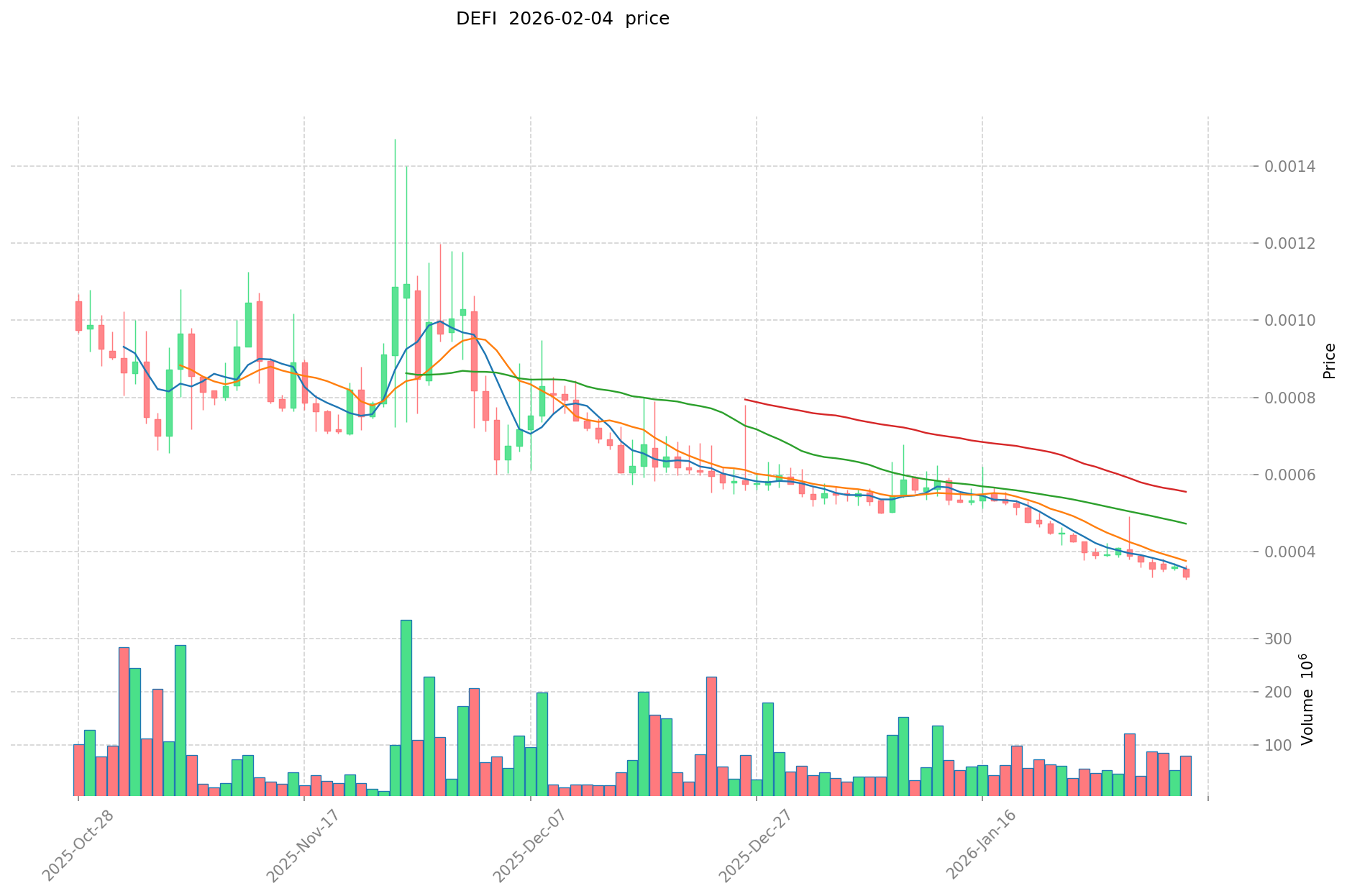
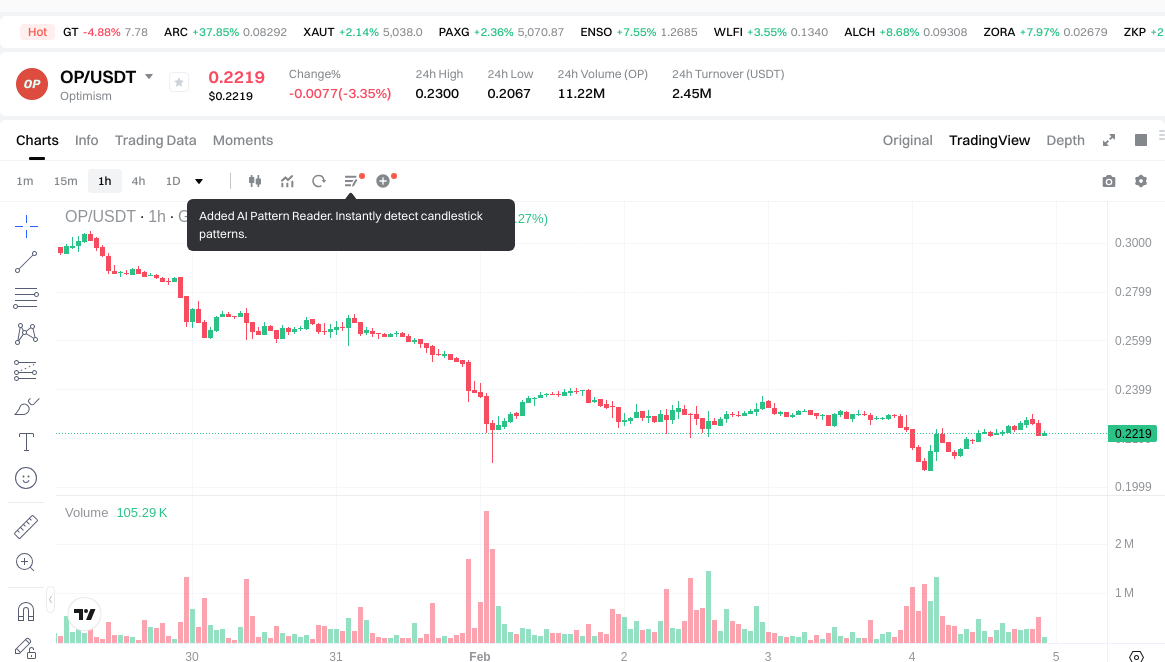
- Comparative Analysis: During the observed market cycle, DEFI declined from $1.09 to $0.0003271, while OP decreased from $4.84 to $0.207182, demonstrating substantial price corrections for both assets.
Current Market Status (February 4, 2026)
- DEFI Current Price: $0.000349
- OP Current Price: $0.2211
- 24-Hour Trading Volume: DEFI $31,824.33 vs OP $2,432,921.25
- Market Sentiment Index (Fear & Greed Index): 14 (Extreme Fear)
View real-time prices:
II. Core Factors Influencing DEFI vs OP Investment Value
Tokenomics Comparison
-
DeFi Projects: Economic models vary significantly across protocols, with common mechanisms including ve(vote-escrowed) models, liquidity mining, and protocol fee distribution. Leading protocols like Curve employ veCRV systems where users lock tokens for governance rights and fee sharing, while others utilize escrowed token models to incentivize long-term participation and reduce circulating supply.
-
OP (Optimism): Features a foundation-controlled token distribution system with OP tokens serving governance functions within the Optimism Collective. Token holders can become citizens with voting rights after meeting certain conditions, participating in RetroPGF (Retroactive Public Goods Funding) allocation decisions. The model emphasizes ecosystem development and public goods funding rather than direct value capture.
-
📌 Historical Pattern: Token economics design directly influences protocol sustainability and value accrual mechanisms. Protocols with effective value capture mechanisms tend to demonstrate stronger long-term price performance, while those relying heavily on emission-based incentives face inflationary pressure.
Institutional Adoption and Market Application
-
Institutional Holdings: DeFi protocols increasingly attract institutional participation through yield-generating strategies and traditional finance integration. Real-world asset tokenization and U.S. Treasury integration in protocols like MakerDAO demonstrate growing institutional involvement.
-
Enterprise Adoption: OP Mainnet benefits from strong institutional backing since inception, originating from Ethereum core developers. Its modular OP Stack architecture attracts enterprise deployment for application-specific rollups. DeFi protocols serve broader financial applications including lending, trading, and yield generation across multiple chains.
-
Regulatory Landscape: Jurisdictional approaches vary significantly. DeFi protocols face ongoing regulatory scrutiny regarding securities classification and operational compliance. Layer 2 solutions like OP benefit from clearer classification as infrastructure providers, though remain subject to base layer regulatory considerations.
Technology Development and Ecosystem Building
-
DeFi Technology Upgrades: Recent developments include yield tokenization through protocols like Pendle, real yield mechanisms replacing pure emission-based models, and De-CeFi hybrid approaches combining centralized and decentralized elements. Infrastructure improvements enable applications like Polymarket and Pump.fun that function without native tokens.
-
OP Technology Development: The Bedrock upgrade introduced improved modularity through OP Stack, enabling customizable Layer 2 construction. Enhanced data availability layer compatibility, particularly with EIP-4844, significantly reduces transaction costs. The architecture supports future fault proof implementations (Cannon) and potential zero-knowledge proof integration.
-
Ecosystem Comparison: DeFi encompasses diverse applications including DEXs, lending protocols, yield markets, and derivatives. Total Value Locked experienced notable growth, with specific sectors like restaking emerging as significant narratives. OP ecosystem focuses on scalability solutions, with growing DeFi activity anticipated following network upgrades. The shared sequencer model enables atomic interactions across multiple OP chains, reducing boundaries between networks.
Macroeconomic Environment and Market Cycles
-
Performance in Inflationary Conditions: DeFi protocols offering real yield through mechanisms like fee-based revenue sharing or Treasury-backed returns provide potential inflation hedges. Value proposition strengthens when traditional yields remain suppressed. Layer 2 solutions benefit indirectly through increased blockchain adoption during periods of monetary expansion.
-
Macroeconomic Monetary Policy: Interest rate environments significantly impact DeFi yield attractiveness relative to traditional finance alternatives. Higher rates may reduce speculative DeFi activity while increasing demand for stable, yield-bearing protocols. Layer 2 adoption correlates with overall crypto market conditions influenced by liquidity environments.
-
Geopolitical Factors: Cross-border transaction demand drives both DeFi protocol usage and Layer 2 adoption. Regulatory fragmentation across jurisdictions creates opportunities for decentralized alternatives. International settlement requirements and remittance use cases support long-term growth trajectories for both categories.
III. 2026-2031 Price Prediction: DEFI vs OP
Short-term Prediction (2026)
- DEFI: Conservative $0.00023034 - $0.000349 | Optimistic $0.00023034 - $0.00036994
- OP: Conservative $0.137578 - $0.2219 | Optimistic $0.137578 - $0.286251
Medium-term Prediction (2028-2029)
- DEFI may enter a gradual growth phase, with estimated price range between $0.00035911053 and $0.000645062264805
- OP may enter an expansion phase, with estimated price range between $0.17823396325 and $0.443948661905
- Key drivers: institutional capital inflows, ETF developments, ecosystem expansion
Long-term Prediction (2030-2031)
- DEFI: Baseline scenario $0.000382416938063 - $0.000538994979652 | Optimistic scenario $0.0006198442266 - $0.000730068699939
- OP: Baseline scenario $0.192930083987025 - $0.4388213674999 | Optimistic scenario $0.4993484526723 - $0.52658564099988
View detailed price predictions for DEFI and OP
Disclaimer
DEFI:
| Year |
Predicted High Price |
Predicted Average Price |
Predicted Low Price |
Price Change |
| 2026 |
0.00036994 |
0.000349 |
0.00023034 |
0 |
| 2027 |
0.0004385534 |
0.00035947 |
0.0003414965 |
3 |
| 2028 |
0.000466843689 |
0.0003990117 |
0.00035911053 |
14 |
| 2029 |
0.000645062264805 |
0.0004329276945 |
0.000385305648105 |
24 |
| 2030 |
0.0006198442266 |
0.000538994979652 |
0.000458145732704 |
54 |
| 2031 |
0.000730068699939 |
0.000579419603126 |
0.000382416938063 |
66 |
OP:
| Year |
Predicted High Price |
Predicted Average Price |
Predicted Low Price |
Price Change |
| 2026 |
0.286251 |
0.2219 |
0.137578 |
0 |
| 2027 |
0.33029815 |
0.2540755 |
0.2032604 |
14 |
| 2028 |
0.3330929805 |
0.292186825 |
0.17823396325 |
32 |
| 2029 |
0.443948661905 |
0.31263990275 |
0.256364720255 |
41 |
| 2030 |
0.4993484526723 |
0.3782942823275 |
0.192930083987025 |
71 |
| 2031 |
0.52658564099988 |
0.4388213674999 |
0.315951384599928 |
98 |
IV. Investment Strategy Comparison: DEFI vs OP
Long-term vs Short-term Investment Strategies
-
DEFI: Suitable for speculative traders focused on emerging SocialFi narratives and high-risk, high-reward opportunities. The asset exhibits characteristics of early-stage projects with limited liquidity, making it appropriate primarily for investors with substantial risk tolerance and short-term tactical approaches.
-
OP: Suitable for investors seeking exposure to Ethereum Layer 2 infrastructure development and ecosystem growth. The asset serves investors interested in scalability solutions with established institutional backing, appealing to both medium-term holders anticipating network upgrade catalysts and long-term positions in Ethereum scaling technology.
Risk Management and Asset Allocation
-
Conservative Investors: DEFI 5-10% vs OP 15-25% (within overall crypto portfolio allocation). Conservative strategies emphasize established infrastructure projects with clearer regulatory positioning and institutional participation.
-
Aggressive Investors: DEFI 15-20% vs OP 30-40% (within overall crypto portfolio allocation). Higher allocations reflect increased risk appetite for emerging narratives and Layer 2 growth potential, while maintaining diversification across risk profiles.
-
Hedging Instruments: Stablecoin reserves (20-30% of crypto allocation) for rebalancing opportunities, options strategies for downside protection during volatility periods, and cross-asset combinations including Bitcoin and Ethereum exposure to balance sector-specific risks.
V. Potential Risk Comparison
Market Risks
-
DEFI: Exposure to extreme volatility given limited trading volume ($31,824.33 daily) and market capitalization. Price movements may experience disproportionate impact from relatively small transaction volumes. Liquidity constraints present challenges for position entry and exit, particularly during market stress periods. The asset remains highly sensitive to broader crypto market sentiment shifts.
-
OP: Susceptibility to Ethereum ecosystem performance and overall Layer 2 competitive dynamics. Market sentiment toward scaling solutions influences price action, with correlation to Ethereum mainnet adoption trends. Competition from alternative Layer 2 protocols (Arbitrum, zkSync, Polygon) creates ongoing pressure on market positioning and potential value capture.
Technical Risks
-
DEFI: Network stability considerations given early-stage development status. Scalability parameters remain largely untested under high-usage scenarios. Limited historical data on protocol performance during stress conditions. Smart contract risks associated with newer codebases requiring comprehensive audit verification.
-
OP: Sequencer centralization presents single points of failure, though decentralization roadmap addresses this concern. Bridge security represents ongoing consideration given historical vulnerabilities in cross-chain infrastructure. Fraud proof mechanism implementation timeline impacts security model maturation. Dependency on Ethereum base layer introduces inherited technical constraints and upgrade coordination requirements.
Regulatory Risks
-
Global regulatory approaches diverge significantly between infrastructure providers and application-layer protocols. DEFI faces potential classification scrutiny regarding token utility and securities characteristics, particularly concerning SocialFi components. Jurisdictional fragmentation creates operational complexity for user-facing applications.
-
OP benefits from positioning as infrastructure technology, potentially receiving more favorable regulatory treatment compared to financial applications. However, regulatory developments affecting Ethereum directly impact Layer 2 ecosystems. Cross-border transaction capabilities subject both assets to evolving compliance frameworks, anti-money laundering requirements, and reporting obligations across multiple jurisdictions.
VI. Conclusion: Which Is the Better Buy?
📌 Investment Value Summary:
-
DEFI Advantages: Early-stage positioning in SocialFi narrative offers asymmetric return potential for risk-tolerant investors. Gamification elements and accessibility features target emerging use cases. Lower absolute price point enables larger token quantity accumulation for speculative positions.
-
OP Advantages: Established Layer 2 infrastructure with institutional backing from Ethereum core development community. OP Stack architecture enables ecosystem expansion through application-specific rollup deployments. RetroPGF model demonstrates sustainable ecosystem funding approach. Technical upgrades including Bedrock improve cost efficiency and modularity. Clearer regulatory positioning as infrastructure provider compared to application-layer protocols.
✅ Investment Recommendations:
-
Novice Investors: Consider OP allocation within diversified portfolio approach, limiting exposure to 5-10% of overall crypto holdings. Prioritize understanding Layer 2 value proposition and Ethereum ecosystem fundamentals before deployment. Avoid DEFI positions until gaining experience with market volatility and liquidity dynamics.
-
Experienced Investors: Evaluate OP for core Layer 2 exposure while maintaining 20-30% position sizing within crypto allocation. Consider DEFI tactical positions (5-10% allocation) only with clear risk management protocols and predefined exit strategies. Monitor ecosystem developments, upgrade implementations, and competitive positioning across both assets.
-
Institutional Investors: Focus OP allocation around infrastructure thesis supporting Ethereum scaling solutions. Conduct comprehensive due diligence on governance structures, treasury management, and regulatory compliance frameworks. Consider DEFI exposure only through specialized venture strategies with appropriate risk provisioning. Implement systematic rebalancing protocols aligned with market cycle positioning.
⚠️ Risk Warning: The cryptocurrency market exhibits extreme volatility characteristics. This analysis does not constitute investment advice. Investors should conduct independent research, assess personal risk tolerance, and consult qualified financial advisors before making investment decisions. Past performance does not guarantee future results.
VII. FAQ
Q1: What is the main difference between DEFI and OP in terms of their core functionality?
DEFI focuses on Web3 SocialFi and antivirus technology with gamification features, while OP provides Ethereum Layer 2 scaling infrastructure. DEFI represents an early-stage application-layer project targeting social finance use cases with accessibility-focused design elements. OP, launched in May 2022, serves as a foundational infrastructure solution addressing Ethereum's scalability limitations through optimistic rollup technology, enabling developers to build low-cost, high-speed applications within the Ethereum ecosystem.
Q2: Which asset carries higher risk for investors?
DEFI carries significantly higher risk compared to OP. DEFI exhibits extreme volatility with limited daily trading volume ($31,824.33) and minimal liquidity, making it susceptible to disproportionate price movements from small transactions. As an early-stage project with untested scalability and limited historical performance data, DEFI presents substantial technical and market risks. OP, while still volatile, benefits from established institutional backing, clearer regulatory positioning as infrastructure technology, and proven operational history since 2022, making it a relatively lower-risk investment within the cryptocurrency space.
Q3: What are the price predictions for DEFI and OP by 2031?
By 2031, DEFI's baseline scenario projects $0.000382 to $0.000539, with an optimistic scenario reaching $0.000620 to $0.000730, representing a 66% increase from 2026 levels. OP's baseline scenario forecasts $0.193 to $0.439, with an optimistic scenario reaching $0.499 to $0.527, representing a 98% increase from 2026 levels. These predictions suggest OP demonstrates stronger projected growth potential with more substantial absolute price appreciation, though both assets remain speculative investments subject to significant market uncertainty and evolving ecosystem dynamics.
Q4: How should conservative investors allocate between DEFI and OP?
Conservative investors should allocate 5-10% to DEFI and 15-25% to OP within their overall cryptocurrency portfolio. This allocation strategy reflects the significantly higher risk profile of DEFI compared to OP's more established infrastructure positioning. Conservative approaches should prioritize OP given its institutional backing, clearer regulatory framework, and proven operational track record. DEFI allocation should remain minimal, serving only as a small speculative component for those willing to accept extreme volatility and liquidity constraints. Additionally, maintaining 20-30% in stablecoin reserves enables rebalancing opportunities during market corrections.
Q5: What technological advantages does OP offer over DEFI?
OP provides proven Layer 2 scaling infrastructure through its Bedrock upgrade and modular OP Stack architecture, enabling customizable blockchain construction with enhanced data availability compatibility via EIP-4844. This results in significantly reduced transaction costs and improved interoperability across multiple OP chains through shared sequencer models. DEFI, as an early-stage application project, lacks comparable infrastructure-level innovations and remains untested under high-usage scenarios. OP's technical foundation supports future implementations including fault proofs and potential zero-knowledge proof integration, providing a clear technological roadmap backed by Ethereum core development expertise.
Q6: How does current market sentiment affect DEFI and OP investments?
With the Fear & Greed Index at 14 (Extreme Fear) as of February 4, 2026, both assets face significant downward pressure, though impacts differ by risk profile. DEFI, with its limited liquidity and speculative nature, experiences amplified negative effects during extreme fear periods, as investors flee high-risk assets. OP, while also affected by negative sentiment, benefits from its infrastructure positioning and institutional backing, potentially experiencing less severe corrections. Extreme fear conditions may present accumulation opportunities for long-term OP investors, while DEFI positions require heightened caution given increased volatility and potential liquidity crises during market stress periods.
Q7: What regulatory risks should investors consider for DEFI versus OP?
DEFI faces higher regulatory uncertainty regarding potential securities classification, particularly concerning its SocialFi components and token utility characteristics. Application-layer protocols typically encounter more stringent regulatory scrutiny across multiple jurisdictions, creating operational complexity and compliance challenges. OP benefits from more favorable positioning as infrastructure technology, likely receiving treatment similar to other network-layer solutions. However, OP remains subject to regulatory developments affecting Ethereum and cross-border transaction frameworks. Both assets face evolving compliance requirements including anti-money laundering obligations and reporting standards, though OP's clearer infrastructure classification provides relatively more regulatory clarity for institutional investors.
Q8: What are the key catalysts that could drive price appreciation for each asset?
For DEFI, key catalysts include successful SocialFi narrative adoption, strategic partnerships expanding user base, technological upgrades improving scalability, and broader market recovery lifting speculative assets. However, given limited institutional adoption and unclear regulatory positioning, positive catalysts remain highly uncertain. For OP, primary catalysts include Ethereum ecosystem growth driving Layer 2 demand, successful OP Stack deployments by major projects, RetroPGF funding attracting developer talent, technical upgrades reducing costs further, institutional adoption of Ethereum scaling solutions, and potential ETF developments recognizing Layer 2 infrastructure value. OP's catalysts demonstrate greater probability and institutional support compared to DEFI's speculative growth drivers.
* The information is not intended to be and does not constitute financial advice or any other recommendation of any sort offered or endorsed by Gate.