FUSE vs AVAX: Comparing Two Leading Layer-1 Blockchain Networks for DeFi and Web3 Applications

Introduction: Investment Comparison Between FUSE and AVAX
In the cryptocurrency market, the comparison between FUSE and AVAX has been a topic of ongoing interest among investors. These two assets differ significantly in market capitalization ranking, application scenarios, and price performance, representing distinct positioning within the crypto asset landscape.
FUSE (FUSE): Launched in 2019, Fuse Network has positioned itself around bringing mobile payment capabilities to communities worldwide through accessible and user-friendly tools.
AVAX (AVAX): Since its launch in 2020, Avalanche has established itself as an open-source platform for decentralized applications and interoperable blockchains, featuring a revolutionary consensus protocol with 1-second transaction finality.
This article will comprehensively analyze the investment value comparison between FUSE and AVAX through the lens of historical price trends, supply mechanisms, institutional adoption, technical ecosystems, and future projections, while addressing the question investors care about most:
"Which option may align better with different investment strategies?"
By examining market data as of February 2, 2026, where FUSE ranks 2307th with a price of $0.00436 and AVAX ranks 28th with a price of $9.989, we will explore how these distinct positions reflect their respective market roles and potential trajectories.
I. Historical Price Comparison and Current Market Status
FUSE (Coin A) vs AVAX (Coin B) Historical Price Trends
- 2022: FUSE experienced significant price volatility, with values fluctuating amid broader market conditions.
- 2021: AVAX benefited from ecosystem expansion and DeFi adoption, showing notable growth during that period.
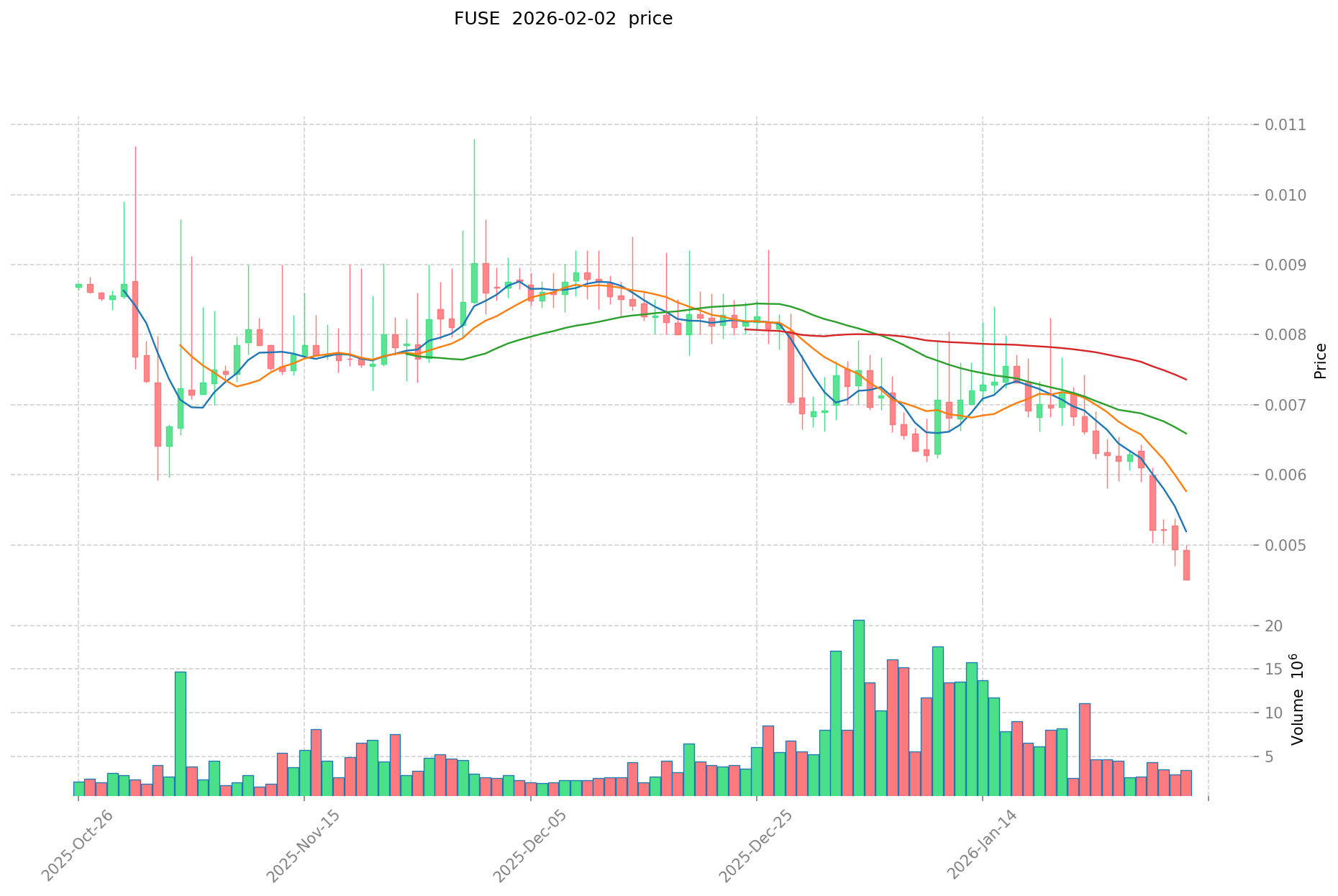
- Comparative Analysis: During recent market cycles, FUSE declined from $2.13 to its all-time low of $0.00412172, while AVAX dropped from its historical high of $144.96 to current levels near $9.989.
Current Market Status (2026-02-02)
- FUSE Current Price: $0.00436
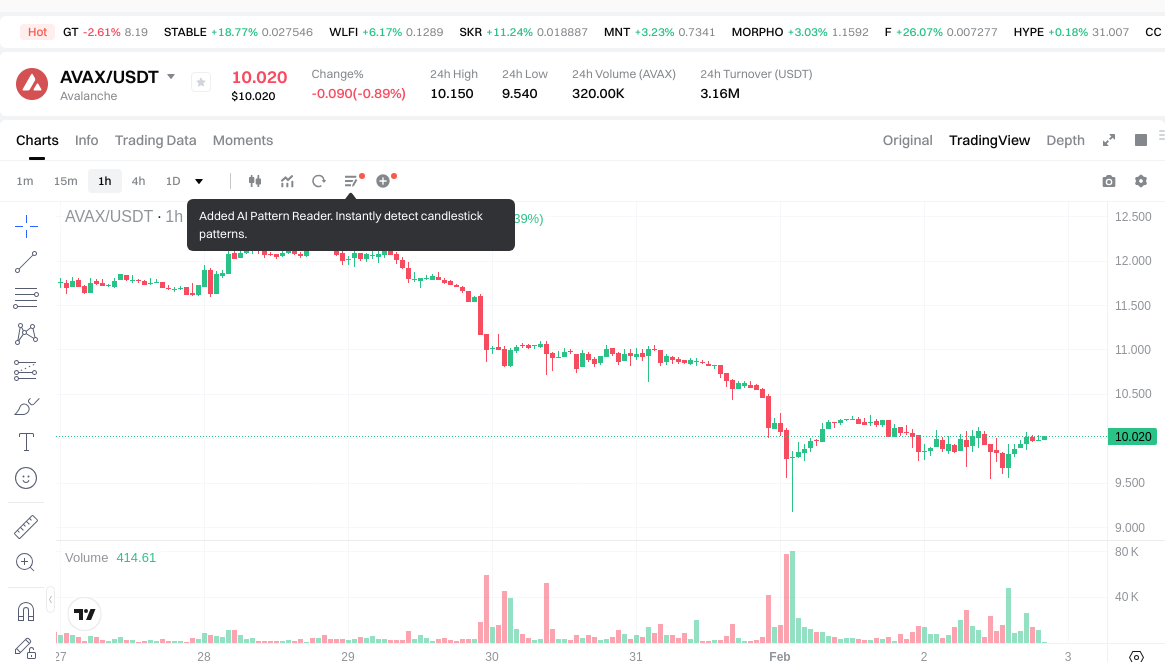
- AVAX Current Price: $9.989
- 24-Hour Trading Volume: FUSE $20,666.48 vs AVAX $3,180,385.85
- Market Sentiment Index (Fear & Greed Index): 14 (Extreme Fear)
View real-time prices:
- View FUSE current price Market Price
- View AVAX current price Market Price
II. Core Factors Influencing FUSE vs AVAX Investment Value
Supply Mechanism Comparison (Tokenomics)
- FUSE: The token supply mechanism is designed to support the decentralized payment platform's long-term ecosystem development, with scarcity serving as a core foundation for investment value.
- AVAX: Market sentiment and technical upgrades, such as the Granite upgrade, influence the token's supply dynamics and price performance.
- 📌 Historical Pattern: Supply mechanisms play a role in shaping price cycles, with token scarcity and distribution models affecting market volatility.
Institutional Adoption and Market Application
- Institutional Holdings: Available data regarding institutional positions in FUSE remains limited, while AVAX has experienced varying levels of institutional interest influenced by broader market conditions.
- Enterprise Adoption: FUSE is positioned within mobile payment and community network applications, while AVAX serves decentralized applications across multiple sectors. Both tokens' adoption by enterprises may enhance their investment prospects.
- National Policies: The impact of regulatory policies on FUSE's investment outlook remains subject to ongoing developments, while AVAX's performance is similarly affected by evolving regulatory frameworks across jurisdictions.
Technology Development and Ecosystem Building
- FUSE Technology Upgrades: The platform emphasizes security and user trust through its decentralized application environment, which has been recognized for its utility by regulatory bodies. The focus on mobile payment and social network infrastructure represents key technical directions.
- AVAX Technology Development: The Granite upgrade and other technical enhancements aim to improve network performance and scalability, potentially influencing market perception and adoption rates.
- Ecosystem Comparison: FUSE concentrates on mobile payment and community-driven networks, while AVAX supports a broader range of decentralized applications including DeFi and smart contract implementations. Both ecosystems are in various stages of development.
Macroeconomic Conditions and Market Cycles
- Performance Under Inflation: Both assets are characterized by notable volatility, with their performance influenced by broader cryptocurrency market trends and macroeconomic factors.
- Macroeconomic Monetary Policy: Interest rate adjustments and dollar index movements affect cryptocurrency markets broadly, impacting both FUSE and AVAX through changes in market sentiment and capital flows.
- Geopolitical Factors: Cross-border transaction demand and international developments contribute to market dynamics, though specific impacts on FUSE and AVAX vary based on their respective use cases and market positioning.
III. 2026-2031 Price Prediction: FUSE vs AVAX
Short-term Prediction (2026)
- FUSE: Conservative $0.00244216 - $0.004361 | Optimistic $0.004361 - $0.00571291
- AVAX: Conservative $6.0108 - $10.018 | Optimistic $10.018 - $10.41872
Mid-term Prediction (2028-2029)
- FUSE may enter a consolidation phase, with predicted price range of $0.0035364461055 - $0.007237726563375
- AVAX may enter a growth phase, with predicted price range of $7.47983952 - $19.05676113708
- Key drivers: institutional capital inflow, ETF developments, ecosystem expansion
Long-term Prediction (2030-2031)
- FUSE: Baseline scenario $0.00543556411747 - $0.006968671945475 | Optimistic scenario $0.006765700917937 - $0.010034887601484
- AVAX: Baseline scenario $11.1637165823964 - $19.2827831877756 | Optimistic scenario $16.91472209454 - $26.803068631008084
Disclaimer: Price predictions are based on historical data analysis and market trends. Actual results may vary significantly due to market volatility, regulatory changes, technological developments, and other unforeseen factors. This information is for reference purposes only and does not constitute investment advice.
FUSE:
| Year | Predicted High Price | Predicted Average Price | Predicted Low Price | Price Change |
|---|---|---|---|---|
| 2026 | 0.00571291 | 0.004361 | 0.00244216 | 0 |
| 2027 | 0.0069509979 | 0.005036955 | 0.0035258685 | 15 |
| 2028 | 0.006593374095 | 0.00599397645 | 0.0035364461055 | 37 |
| 2029 | 0.007237726563375 | 0.0062936752725 | 0.003965015421675 | 44 |
| 2030 | 0.007171642973013 | 0.006765700917937 | 0.006562729890399 | 55 |
| 2031 | 0.010034887601484 | 0.006968671945475 | 0.00543556411747 | 59 |
AVAX:
| Year | Predicted High Price | Predicted Average Price | Predicted Low Price | Price Change |
|---|---|---|---|---|
| 2026 | 10.41872 | 10.018 | 6.0108 | 0 |
| 2027 | 14.7144384 | 10.21836 | 6.0288324 | 1 |
| 2028 | 17.078966904 | 12.4663992 | 7.47983952 | 24 |
| 2029 | 19.05676113708 | 14.772683052 | 13.88632206888 | 47 |
| 2030 | 21.6508442810112 | 16.91472209454 | 11.1637165823964 | 68 |
| 2031 | 26.803068631008084 | 19.2827831877756 | 15.42622655022048 | 92 |
IV. Investment Strategy Comparison: FUSE vs AVAX
Long-term vs Short-term Investment Strategies
- FUSE: May align with investors focusing on emerging mobile payment infrastructure and community-driven network development, considering the platform's positioning in decentralized payment solutions.
- AVAX: May align with investors seeking exposure to established smart contract platforms with broader ecosystem applications across DeFi and decentralized applications.
Risk Management and Asset Allocation
- Conservative Investors: FUSE 20% vs AVAX 80% - This allocation reflects AVAX's higher market capitalization ranking (28th) and greater liquidity compared to FUSE's position at 2307th.
- Aggressive Investors: FUSE 40% vs AVAX 60% - Higher FUSE allocation may appeal to those accepting increased volatility in exchange for potential growth from lower market cap positions.
- Hedging Tools: Stablecoin allocation for liquidity management, options strategies for downside protection, cross-asset diversification to reduce correlation risk.
V. Potential Risk Comparison
Market Risks
- FUSE: Significant price volatility reflected in the decline from $2.13 to current levels near $0.00436, with limited trading volume of $20,666.48 indicating lower liquidity conditions.
- AVAX: Price fluctuations from historical levels of $144.96 to current $9.989, though supported by substantially higher trading volume of $3,180,385.85, suggesting relatively better market depth.
Technical Risks
- FUSE: Scalability considerations related to mobile payment infrastructure development, network stability requirements for community-driven applications.
- AVAX: Network performance dependencies on consensus protocol efficiency, ongoing development requirements for maintaining 1-second transaction finality across growing ecosystem.
Regulatory Risks
- Both assets face evolving regulatory frameworks across jurisdictions. FUSE's focus on mobile payments may encounter specific payment-related regulations, while AVAX's broader DeFi applications could be subject to securities and financial services regulations. The impact of regulatory developments may vary based on each platform's specific use cases and geographic adoption patterns.
VI. Conclusion: Which Is the Better Buy?
📌 Investment Value Summary:
- FUSE Characteristics: Positioned in mobile payment and community network infrastructure with lower market capitalization, representing a specialized application focus within the cryptocurrency landscape.
- AVAX Characteristics: Established presence in smart contract platforms with broader ecosystem support across DeFi applications, higher market ranking, and greater trading liquidity.
✅ Investment Considerations:
- New Investors: May consider starting with assets having higher liquidity and established ecosystems, allowing for easier entry and exit positions while building understanding of cryptocurrency markets.
- Experienced Investors: Could evaluate portfolio diversification across different market cap segments and application scenarios, balancing exposure between established platforms and emerging infrastructure projects.
- Institutional Investors: May assess factors including liquidity requirements, regulatory clarity, ecosystem maturity, and alignment with broader portfolio mandates when considering exposure to either asset.
⚠️ Risk Disclosure: The cryptocurrency market exhibits extreme volatility. This content is for informational purposes only and does not constitute investment advice. Market conditions as of February 2, 2026 show a Fear & Greed Index of 14 (Extreme Fear), indicating heightened market uncertainty. Investment decisions should be based on individual circumstances, risk tolerance, and thorough due diligence.
VII. FAQ
Q1: What are the main differences between FUSE and AVAX in terms of their core use cases?
FUSE focuses on mobile payment infrastructure and community-driven networks, while AVAX serves as a broader smart contract platform supporting diverse DeFi applications. FUSE's specialized positioning targets accessible payment solutions for global communities, emphasizing user-friendly mobile capabilities launched in 2019. AVAX, introduced in 2020, operates as an open-source platform for decentralized applications with interoperable blockchain functionality, featuring a revolutionary consensus protocol achieving 1-second transaction finality. This fundamental distinction reflects their different market positioning: FUSE addresses specific payment and social network use cases, whereas AVAX competes in the general-purpose smart contract platform space alongside established networks.
Q2: How do the current market capitalizations and liquidity levels of FUSE and AVAX compare?
AVAX demonstrates significantly higher market capitalization and liquidity compared to FUSE, ranking 28th versus FUSE's 2307th position as of February 2, 2026. The 24-hour trading volume disparity illustrates this difference clearly: AVAX records $3,180,385.85 in daily volume compared to FUSE's $20,666.48, representing approximately 154 times greater liquidity. This substantial difference in market depth affects trading execution, price stability, and ease of entering or exiting positions. Higher liquidity generally reduces slippage and allows for larger transactions without significant price impact, making AVAX more accessible for institutional-scale allocations and providing more efficient market pricing mechanisms.
Q3: What risk factors should investors consider when comparing FUSE and AVAX?
Both assets face distinct risk profiles related to market volatility, technical development, and regulatory environments. FUSE exhibits extreme price volatility, declining from $2.13 to $0.00436, coupled with limited liquidity that may amplify price swings and increase execution risk. AVAX, despite dropping from $144.96 to $9.989, benefits from substantially deeper markets and more established ecosystem support. Technical risks differ: FUSE must scale mobile payment infrastructure while maintaining network stability for community applications, whereas AVAX must sustain consensus protocol efficiency and 1-second finality across expanding use cases. Regulatory considerations vary based on their applications—FUSE may encounter payment-specific regulations, while AVAX faces broader DeFi and securities frameworks across multiple jurisdictions.
Q4: How do the price predictions for 2026-2031 differ between FUSE and AVAX?
Price projections suggest contrasting trajectories reflecting their different market positions and growth stages. For 2026, FUSE predictions range from $0.00244216 to $0.00571291 under various scenarios, while AVAX ranges from $6.0108 to $10.41872. By 2031, FUSE's projected range extends from $0.00543556411747 to $0.010034887601484 (baseline to optimistic scenarios), representing potential increases from current levels but maintaining relatively modest absolute values. AVAX's 2031 projections span $11.1637165823964 to $26.803068631008084, suggesting higher absolute price potential. These predictions incorporate factors including institutional capital flows, ETF developments, and ecosystem expansion, though actual outcomes may vary significantly due to market volatility, regulatory changes, and unforeseen technological developments.
Q5: What investment allocation strategies might suit different investor profiles when considering FUSE and AVAX?
Investment allocation recommendations vary based on risk tolerance and investment objectives. Conservative investors might consider an 80% AVAX / 20% FUSE allocation, emphasizing AVAX's higher market ranking (28th), greater liquidity, and more established ecosystem while maintaining limited exposure to FUSE's specialized mobile payment focus. Aggressive investors accepting higher volatility for potential growth from lower market cap positions could evaluate a 60% AVAX / 40% FUSE split, increasing exposure to FUSE's emerging infrastructure development. Both strategies should incorporate hedging tools including stablecoin allocations for liquidity management, options strategies for downside protection, and cross-asset diversification to reduce correlation risk. New investors may prioritize assets with higher liquidity and established ecosystems, while experienced participants could assess portfolio diversification across different market cap segments and application scenarios.
Q6: What technological developments are most significant for FUSE and AVAX's future value proposition?
Technological advancement paths differ substantially between the two platforms. FUSE emphasizes security and user trust through its decentralized application environment, focusing on mobile payment capabilities and social network infrastructure development. The platform's value proposition centers on accessibility and user-friendly tools for community-driven payment networks. AVAX's technical development focuses on network performance enhancements like the Granite upgrade, aiming to improve scalability while maintaining its distinctive 1-second transaction finality. AVAX's broader ecosystem supports diverse decentralized applications across DeFi, smart contracts, and interoperable blockchain implementations. These different technical priorities reflect their distinct market positioning: FUSE targets specific mobile payment use cases requiring accessibility, while AVAX competes across general-purpose blockchain infrastructure requiring high performance and versatility.
Q7: How do current market conditions in 2026 affect the investment outlook for FUSE and AVAX?
As of February 2, 2026, market sentiment indicators show a Fear & Greed Index of 14 (Extreme Fear), suggesting heightened uncertainty affecting both assets. This environment presents both challenges and potential opportunities. FUSE's limited liquidity of $20,666.48 daily volume may amplify volatility during periods of market stress, potentially creating wider bid-ask spreads and execution difficulties. AVAX's substantially higher volume of $3,180,385.85 provides relatively better market stability, though both assets remain subject to broader cryptocurrency market trends. Historical patterns indicate that extreme fear conditions have preceded both extended downturns and significant recovery periods in cryptocurrency markets. Investment timing should account for these sentiment extremes, with dollar-cost averaging strategies potentially mitigating risks associated with market timing during volatile periods. Both platforms' fundamentals—FUSE's payment infrastructure development and AVAX's ecosystem expansion—may influence medium-term value independent of short-term sentiment fluctuations.
Share
Content
Introduction: Investment Comparison Between FUSE and AVAX
I. Historical Price Comparison and Current Market Status
II. Core Factors Influencing FUSE vs AVAX Investment Value
III. 2026-2031 Price Prediction: FUSE vs AVAX
IV. Investment Strategy Comparison: FUSE vs AVAX
V. Potential Risk Comparison
VI. Conclusion: Which Is the Better Buy?
VII. FAQ
How to Buy Cryptocurrency


Trending Cryptocurrencies



What will be the market capitalization of USDC in 2025? Analysis of the stablecoin market landscape.

How is DeFi different from Bitcoin?

What is DeFi: Understanding Decentralized Finance in 2025

USDC stablecoin 2025 Latest Analysis: Principles, Advantages, and Web3 Eco-Applications
Development of Decentralized Finance Ecosystem in 2025: Integration of Decentralized Finance Applications with Web3

2025 USDT USD Complete Guide: A Must-Read for Newbie Investors

How to Create an NFT and Maximize Profits in Today’s Market Conditions

GetAgent: Advanced AI Trading Assistant vs Traditional Trading Bots

Is NFT Dead? A Guide to NFT Use Cases

What Is an Airdrop in Cryptocurrency?

What is GMRT: Understanding the Giant Metrewave Radio Telescope and Its Role in Modern Astronomy