GMRT vs STX: A Comprehensive Comparison of Two Leading Storage Technology Platforms

Introduction: Investment Comparison Between GMRT and STX
In the cryptocurrency market, the comparison between GMRT vs STX continues to be a topic investors cannot avoid. The two not only differ significantly in market cap ranking, application scenarios, and price performance, but also represent distinct crypto asset positioning.
The Game Company (GMRT): Since its launch in 2025, it has gained market recognition by positioning itself as a next-generation cloud gaming platform that integrates Web3 elements including tournaments, fantasy leagues, and Play-to-Earn mechanics.
Stacks (STX): Since its inception in 2019, it has been regarded as a blockchain infrastructure project enabling decentralized applications with built-in privacy features, and represents one of the pioneering protocols bringing smart contract functionality to Bitcoin.
This article will comprehensively analyze the investment value comparison between GMRT vs STX through historical price trends, supply mechanisms, institutional adoption, technical ecosystems, and future forecasts, attempting to answer investors' most pressing question:
"Which is the better buy right now?"
I. Historical Price Comparison and Current Market Status
Historical Price Trends of GMRT (Coin A) and STX (Coin B)
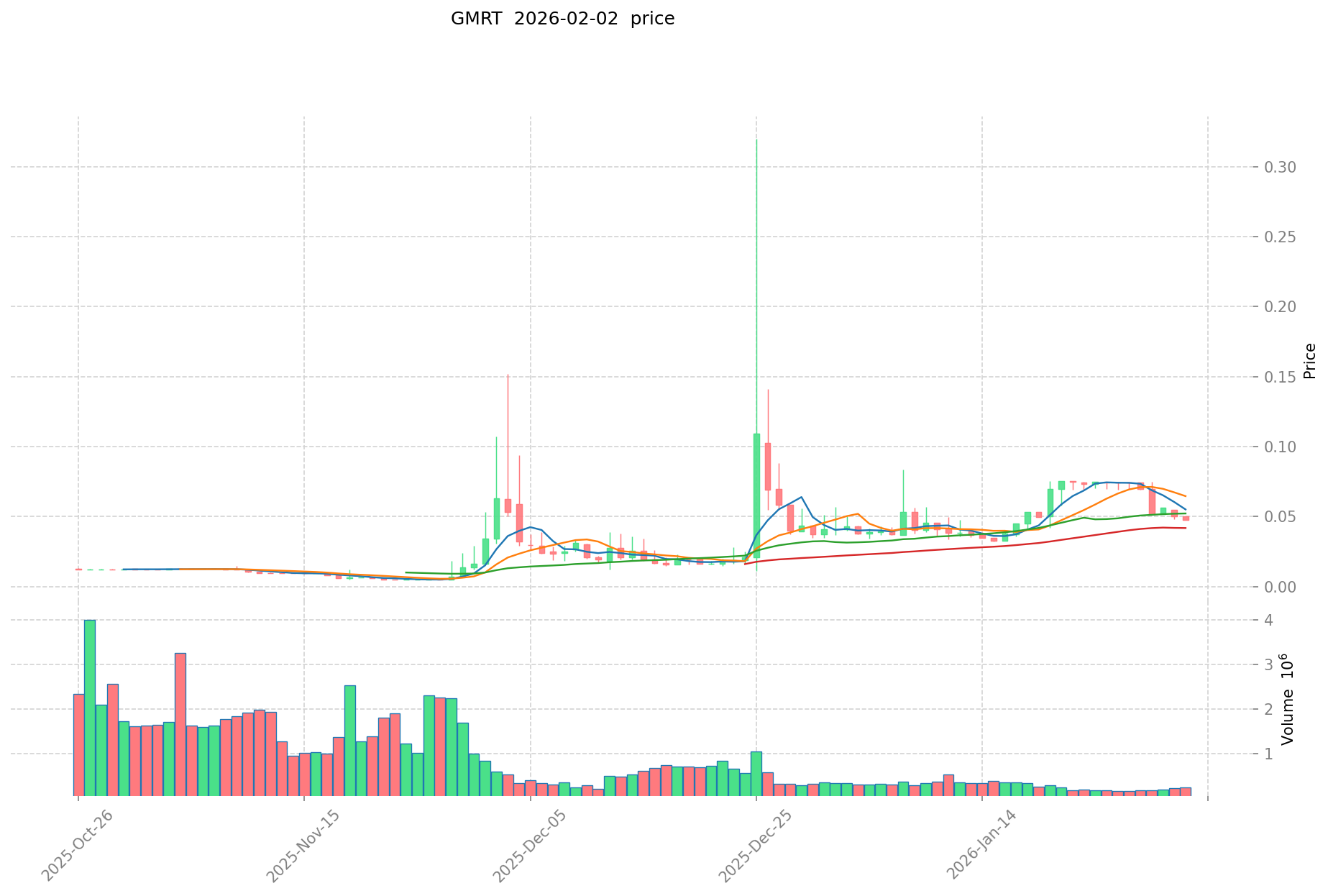
- 2025: GMRT experienced significant volatility following its January 2025 launch, reaching an all-time high of $0.52 in February 2025 before declining substantially.
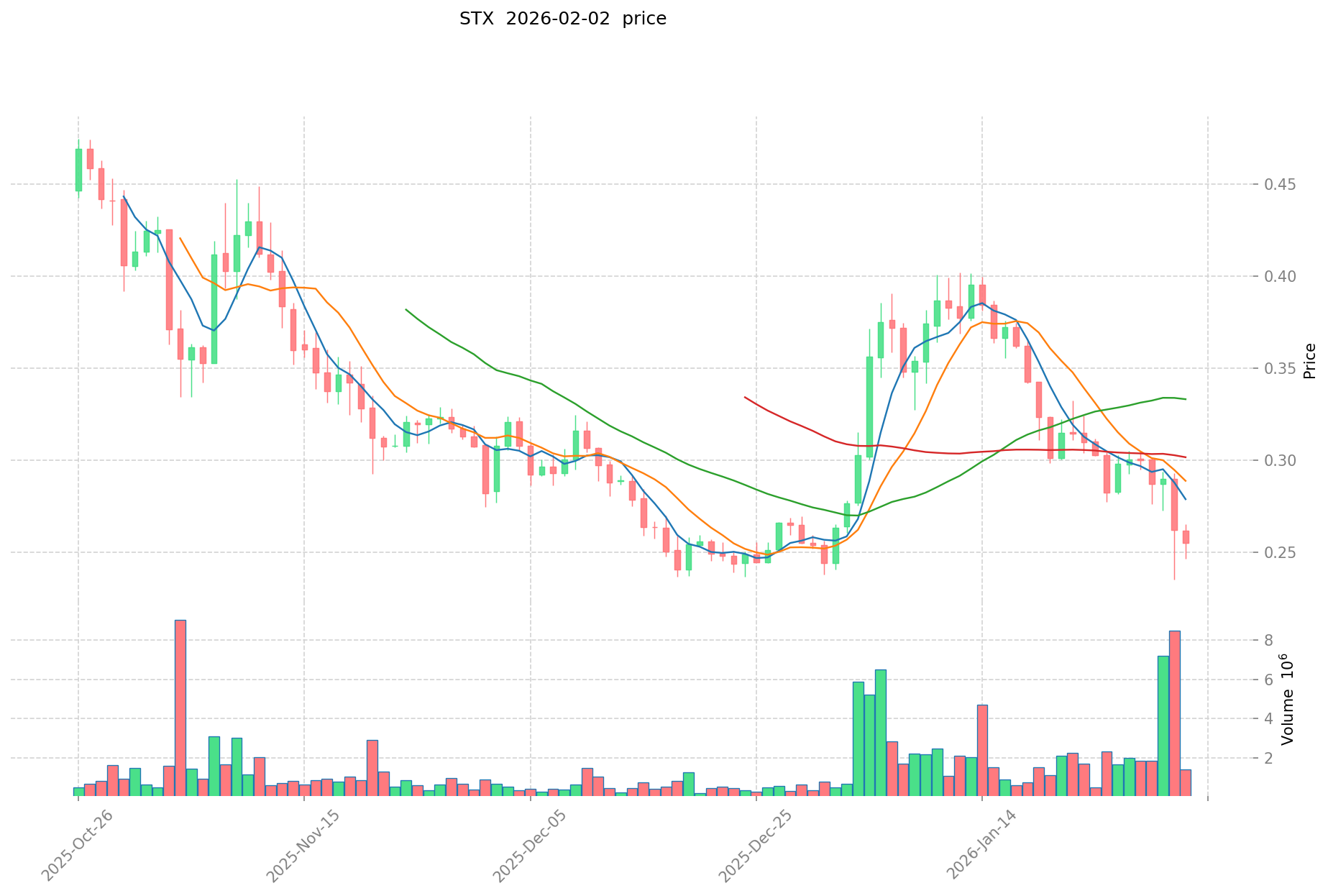
- 2024: STX was impacted by broader market conditions, reaching its historical peak of $3.86 in April 2024 before entering a prolonged correction phase.
- Comparative Analysis: During the 2025-2026 market cycle, GMRT declined from its peak of $0.52 to $0.047182, while STX dropped from $3.86 to $0.2545, reflecting different magnitudes of market correction.
Current Market Status (2026-02-02)
- GMRT Current Price: $0.047182
- STX Current Price: $0.2545
- 24-Hour Trading Volume: GMRT $11,677.21 vs STX $495,078.82
- Market Sentiment Index (Fear & Greed Index): 14 (Extreme Fear)
View Real-Time Prices:
- Check GMRT Current Price Market Price
- Check STX Current Price Market Price
II. Core Factors Influencing GMRT vs STX Investment Value
Supply Mechanism Comparison (Tokenomics)
Due to the absence of specific tokenomics data in the provided materials, a direct comparison of supply mechanisms between GMRT and STX cannot be established. Generally, supply mechanisms such as fixed supply caps, inflationary models, or deflationary burn mechanisms play significant roles in shaping price dynamics and investment attractiveness.
Institutional Adoption and Market Application
- Institutional Holdings: Information regarding institutional preference between GMRT and STX is not available in the reference materials.
- Enterprise Adoption: The extent to which GMRT or STX are utilized in cross-border payments, settlement systems, or institutional investment portfolios remains unclear based on current data.
- National Policies: Regulatory stances across different jurisdictions toward GMRT and STX are not documented in the provided sources.
Technological Development and Ecosystem Building
- GMRT Technical Upgrades: No specific technical developments or upgrade pathways for GMRT are mentioned in the available materials.
- STX Technical Development: Similarly, detailed information on STX's technological advancements is not present in the reference data.
- Ecosystem Comparison: The application landscape for both assets in areas such as DeFi, NFT, payment systems, and smart contract implementation is not addressed in the provided context.
Macroeconomic Environment and Market Cycles
- Performance in Inflationary Environments: Data comparing the anti-inflation properties of GMRT versus STX is not available.
- Macroeconomic Monetary Policy: The impact of interest rates, US Dollar Index fluctuations, and other macroeconomic variables on both assets is not covered in the reference materials.
- Geopolitical Factors: The influence of cross-border transaction demand and international geopolitical situations on GMRT and STX remains undocumented in the provided sources.
III. 2026-2031 Price Forecast: GMRT vs STX
Short-term Forecast (2026)
- GMRT: Conservative $0.0318 - $0.0468 | Optimistic $0.0469 - $0.0487
- STX: Conservative $0.2214 - $0.2545 | Optimistic $0.2546 - $0.2978
Mid-term Forecast (2028-2029)
- GMRT may enter a gradual growth phase, with estimated price range of $0.0272 - $0.0598
- STX may enter an expansion phase, with estimated price range of $0.1688 - $0.4589
- Key drivers: institutional capital inflows, ETF, ecosystem development
Long-term Forecast (2030-2031)
- GMRT: Baseline scenario $0.0322 - $0.0626 | Optimistic scenario $0.0607 - $0.0685
- STX: Baseline scenario $0.2810 - $0.4888 | Optimistic scenario $0.3128 - $0.7233
Disclaimer
GMRT:
| Year | Predicted High Price | Predicted Average Price | Predicted Low Price | Price Change |
|---|---|---|---|---|
| 2026 | 0.0486876 | 0.046815 | 0.0318342 | 0 |
| 2027 | 0.051093891 | 0.0477513 | 0.028173267 | 1 |
| 2028 | 0.05733021078 | 0.0494225955 | 0.027182427525 | 4 |
| 2029 | 0.0597815715168 | 0.05337640314 | 0.0309583138212 | 13 |
| 2030 | 0.068460574667364 | 0.0565789873284 | 0.032250022777188 | 19 |
| 2031 | 0.068146561287691 | 0.062519780997882 | 0.060644187567945 | 32 |
STX:
| Year | Predicted High Price | Predicted Average Price | Predicted Low Price | Price Change |
|---|---|---|---|---|
| 2026 | 0.297765 | 0.2545 | 0.221415 | 0 |
| 2027 | 0.323075025 | 0.2761325 | 0.223667325 | 8 |
| 2028 | 0.36551659025 | 0.2996037625 | 0.188750370375 | 17 |
| 2029 | 0.4589330433975 | 0.332560176375 | 0.16960568995125 | 30 |
| 2030 | 0.581747516532787 | 0.39574660988625 | 0.280980093019237 | 55 |
| 2031 | 0.723345653550087 | 0.488747063209518 | 0.312798120454092 | 92 |
IV. Investment Strategy Comparison: GMRT vs STX
Long-term vs Short-term Investment Strategies
- GMRT: May suit investors interested in emerging gaming and Web3 integration opportunities, with focus on early-stage platform development and community-driven growth potential.
- STX: May appeal to investors seeking exposure to Bitcoin-layer infrastructure projects with established blockchain protocol foundations and smart contract capabilities.
Risk Management and Asset Allocation
- Conservative Investors: GMRT 20-30% vs STX 70-80%
- Aggressive Investors: GMRT 40-50% vs STX 50-60%
- Hedging Tools: stablecoin allocation, options strategies, cross-asset portfolio diversification
V. Potential Risk Comparison
Market Risks
- GMRT: Exposure to higher volatility given recent launch and lower trading volumes ($11,677.21 daily), alongside current extreme fear market sentiment (Fear & Greed Index: 14).
- STX: Subject to broader cryptocurrency market cycles and correlation with Bitcoin network developments, with moderate trading volumes ($495,078.82 daily).
Technical Risks
- GMRT: Scalability challenges in cloud gaming integration, network stability during platform expansion phases.
- STX: Considerations around computing resource distribution, potential security vulnerabilities in smart contract implementation layers.
Regulatory Risks
- Both assets face evolving global regulatory frameworks affecting cryptocurrency operations, though specific jurisdictional stances toward GMRT and STX may vary based on their respective use cases and technological implementations.
VI. Conclusion: Which Is the Better Buy?
📌 Investment Value Summary:
- GMRT Advantages: Positioned in the intersection of gaming and Web3 sectors, early-stage entry opportunity with integration of tournaments and Play-to-Earn mechanics.
- STX Advantages: Established blockchain infrastructure since 2019, bringing smart contract functionality to Bitcoin ecosystem with built-in privacy features.
✅ Investment Recommendations:
- Novice Investors: Consider starting with STX for its longer operational history and relatively established infrastructure, while limiting exposure to 5-10% of portfolio in either asset.
- Experienced Investors: May explore diversified allocation between both assets based on risk tolerance, with emphasis on dollar-cost averaging strategies during current market conditions (Extreme Fear sentiment).
- Institutional Investors: Conduct thorough due diligence on regulatory compliance, liquidity requirements, and integration with existing portfolio strategies before allocation decisions.
⚠️ Risk Disclaimer: The cryptocurrency market exhibits high volatility. This content does not constitute investment advice.
VII. FAQ
Q1: Which cryptocurrency offers better long-term investment potential between GMRT and STX?
STX demonstrates stronger long-term investment potential based on current market data and forecasts. STX, operational since 2019, provides established blockchain infrastructure with smart contract capabilities on Bitcoin, projecting a price range of $0.2810-$0.7233 by 2030-2031. GMRT, launched in 2025, represents an emerging gaming-focused platform with projected prices of $0.0322-$0.0685 in the same timeframe. STX's longer operational history, higher trading volume ($495,078.82 vs $11,677.21 daily), and established ecosystem positioning suggest more mature investment characteristics compared to GMRT's early-stage development phase.
Q2: What are the primary risk differences between investing in GMRT versus STX?
GMRT carries significantly higher volatility risk due to its recent market entry (January 2025) and substantially lower daily trading volume of $11,677.21, which may result in liquidity challenges and price slippage during transactions. The platform's dependence on cloud gaming adoption and Web3 integration adds technological execution risk. STX, while more established, faces risks tied to Bitcoin network developments and smart contract security considerations. Both assets operate under evolving regulatory frameworks, though GMRT's gaming-specific focus may attract different regulatory scrutiny compared to STX's infrastructure positioning.
Q3: How do the current market conditions affect GMRT and STX investment decisions?
The current Extreme Fear sentiment (Fear & Greed Index: 14) suggests both assets are trading under significant market pessimism as of February 2, 2026. GMRT has declined approximately 91% from its February 2025 peak of $0.52 to current $0.047182, while STX dropped roughly 93% from its April 2024 high of $3.86 to $0.2545. These severe corrections may present entry opportunities for risk-tolerant investors employing dollar-cost averaging strategies. However, the low sentiment indicates potential for continued downward pressure, making immediate large-scale allocation inadvisable without comprehensive risk management protocols.
Q4: What allocation strategy should different investor types consider for GMRT vs STX?
Conservative investors should consider allocating 70-80% to STX and 20-30% to GMRT, prioritizing the more established infrastructure project while maintaining limited exposure to emerging gaming opportunities. Aggressive investors might balance allocations at 50-60% STX and 40-50% GMRT to capture potential higher returns from GMRT's early-stage positioning. Novice investors are advised to begin with STX given its longer operational track record, limiting total cryptocurrency exposure to 5-10% of overall portfolio. All strategies should incorporate stablecoin hedging components and avoid concentrated positions given current extreme market conditions.
Q5: What are the key technical differences between GMRT and STX ecosystems?
STX functions as blockchain infrastructure enabling smart contract functionality on Bitcoin with built-in privacy features, representing a foundational protocol layer operational since 2019. This positions STX within decentralized application development and Bitcoin ecosystem expansion use cases. GMRT operates as a next-generation cloud gaming platform integrating Web3 elements including tournaments, fantasy leagues, and Play-to-Earn mechanics since 2025. The fundamental distinction lies in STX's infrastructure-layer positioning versus GMRT's application-layer gaming focus, creating different technological dependencies, scalability requirements, and ecosystem development pathways for each project.
Q6: How do price forecasts compare between GMRT and STX through 2031?
Price projections indicate divergent growth trajectories. GMRT's conservative scenario estimates $0.0318-$0.0487 for 2026, expanding to $0.0322-$0.0626 by 2030-2031, representing approximately 32% cumulative growth potential from current levels. STX forecasts show $0.2214-$0.2978 for 2026, reaching $0.2810-$0.7233 by 2030-2031, indicating up to 92% cumulative growth potential. These projections assume varying degrees of ecosystem development, institutional adoption, and favorable macroeconomic conditions. However, cryptocurrency price predictions carry substantial uncertainty, and actual performance may significantly deviate from estimates based on market cycles, technological developments, and regulatory changes.
Q7: What role do trading volumes play in evaluating GMRT versus STX investment viability?
Trading volume represents a critical liquidity indicator. STX's 24-hour volume of $495,078.82 substantially exceeds GMRT's $11,677.21, creating approximately 42 times greater liquidity depth. Higher volumes typically enable easier position entry and exit, reduced price slippage, and more accurate price discovery mechanisms. GMRT's limited trading activity increases execution risk, particularly for larger transactions that could significantly impact market prices. This volume disparity suggests institutional and larger retail participants may find STX more suitable for meaningful allocation sizes, while GMRT positions should be sized appropriately considering liquidity constraints and potential difficulty in liquidating positions during adverse market conditions.
Q8: Should investors prioritize GMRT's gaming focus or STX's infrastructure positioning?
The choice depends on investment thesis and risk tolerance. STX's infrastructure positioning offers exposure to fundamental blockchain development layers supporting broader ecosystem applications, potentially benefiting from Bitcoin network effects and smart contract adoption trends. This represents a more diversified value proposition across multiple use cases. GMRT's gaming focus provides concentrated exposure to Web3 gaming growth, tournaments, and Play-to-Earn mechanics, sectors demonstrating strong engagement metrics but facing technological scalability challenges. Infrastructure investments typically exhibit more stable long-term trajectories, while application-layer gaming platforms may generate higher volatility with corresponding upside potential. Portfolio diversification between infrastructure and application layers may offer balanced exposure to different cryptocurrency market segments.
Share
Content
Introduction: Investment Comparison Between GMRT and STX
I. Historical Price Comparison and Current Market Status
II. Core Factors Influencing GMRT vs STX Investment Value
III. 2026-2031 Price Forecast: GMRT vs STX
IV. Investment Strategy Comparison: GMRT vs STX
V. Potential Risk Comparison
VI. Conclusion: Which Is the Better Buy?
VII. FAQ
How to Buy Cryptocurrency


Trending Cryptocurrencies



2025 Vertus daily combo code: Web3 gamers rewards guide

Today's Vertus Daily Combo Code: Boost Your Web3 Gaming Rewards (April 29, 2025)
GALA Coin (GALA) – Web3 Gaming Token Overview, Price Prediction & Trading on Gate.com

What is Gaming Crypto?How Gaming Crypto Works?

Detailed analysis of the top ten encryption game coins to be launched in 2025
Top 6 Best Gaming Currencies

What is GMRT: A Comprehensive Guide to the Giant Metrewave Radio Telescope and Its Revolutionary Role in Astronomy

What is AIR: A Comprehensive Guide to Understanding Artificial Intelligence Revolution

What is GMEE: A Comprehensive Guide to Global Mobile Education Ecosystem

What is TONC: A Comprehensive Guide to Tongan Culture and Traditions

Ultimate Guide to Cryptocurrency Trading Strategies