Is Archway (ARCH) a good investment?: A Comprehensive Analysis of Performance, Use Cases, and Market Potential


Introduction: Archway (ARCH) Investment Status and Market Outlook
ARCH is an asset in the cryptocurrency space, serving as the native token of Archway, an incentivized smart contract platform designed to reward developers building next-generation dApps. As of February 3, 2026, ARCH has a market capitalization of approximately $1.26 million, with a circulating supply of around 640 million tokens, and the current price maintains at approximately $0.00197. With its positioning as a developer-centric smart contract platform, ARCH has gradually become a focal point for investors discussing "Is Archway (ARCH) a good investment?" The platform provides tools for developers to quickly build and launch scalable cross-chain dApps while receiving rewards based on the value their applications contribute to the network. This article will comprehensively analyze ARCH's investment characteristics, historical trends, future price considerations, and investment risks to provide reference for investors.
I. Archway (ARCH) Price History Review and Current Investment Value
ARCH Historical Price Trends and Investment Returns (Archway (ARCH) Investment Performance)
- December 2023: ARCH reached a notable price level of $0.28899, representing a significant milestone in the token's early trading phase
- February 2026: Price declined to $0.00197, reflecting broader market adjustments and evolving project dynamics
- Historical volatility: The token experienced substantial price fluctuations, with movements between different price ranges demonstrating the characteristics of emerging blockchain platform assets
Current ARCH Investment Market Status (February 2026)
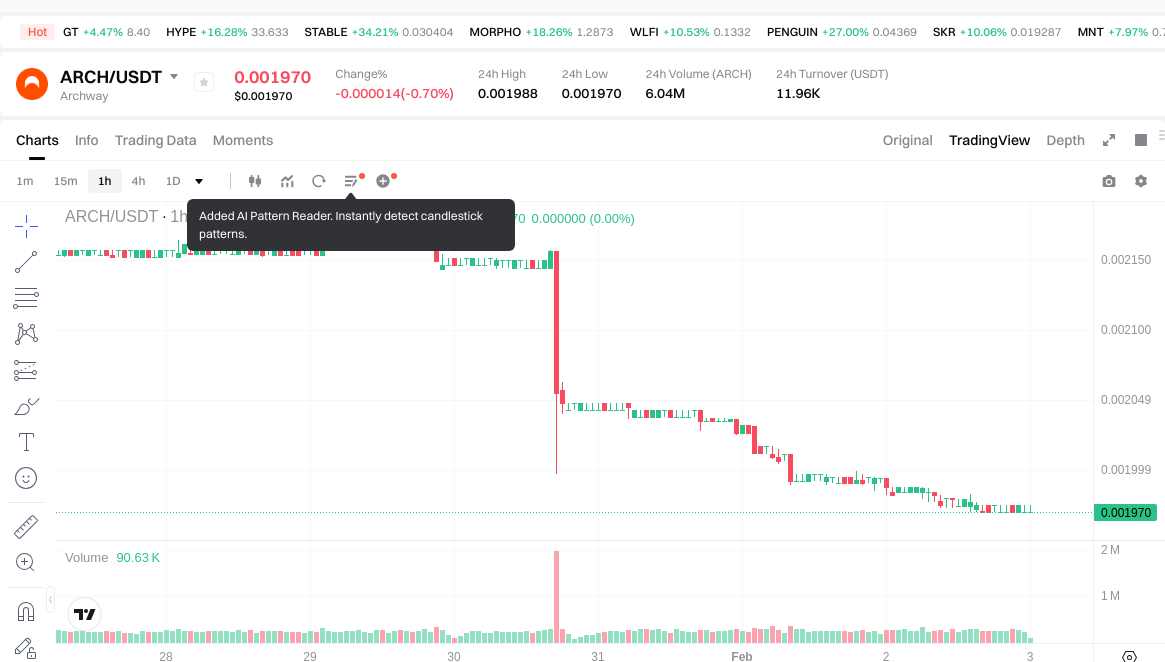
- ARCH Current Price: $0.00197
- 24-hour Trading Volume: $11,950.18
- Market Capitalization: $1,260,856.21
- Circulating Supply: 640,028,533.55 ARCH tokens
- Price Changes: -0.063% (1H), -0.95% (24H), -8.44% (7D), -10.51% (30D)
Click to view real-time ARCH market price
II. Core Factors Affecting Whether ARCH is a Good Investment (Is Archway(ARCH) a Good Investment)
Supply Mechanism and Scarcity (ARCH investment scarcity)
- Supply dynamics → impacts price and investment value
- Market context: ARCH has experienced substantial price fluctuations, with data showing approximately 89% decline over one year, reflecting significant supply and demand imbalances
- Investment consideration: The token has a max supply of 1,000,000,000 ARCH with current circulating supply at 640,028,533.55 tokens (64% circulation ratio), indicating ongoing token distribution patterns
Institutional Investment and Mainstream Adoption (Institutional investment in ARCH)
- Market positioning: ARCH ranks at position 2,356 with a market capitalization of approximately $1.26 million
- Trading presence: Currently listed on limited exchanges, which may impact liquidity and accessibility for institutional participants
- Adoption indicators: The project focuses on developer incentivization within the smart contract platform ecosystem, though specific enterprise adoption data was not provided in available materials
Macroeconomic Environment's Impact on ARCH Investment
- Market volatility: ARCH demonstrated negative returns across multiple timeframes: -0.95% (24H), -8.44% (7D), -10.51% (30D), and -89.19% (1Y) as of February 3, 2026
- Risk context: The current price of $0.00197 represents the observed low price point in available historical data
- Investment outlook: Various technical analyses present mixed forecasts for 2026, with some projections indicating bearish trends while others suggest modest recovery potential
Technology and Ecosystem Development (Technology & Ecosystem for ARCH investment)
- Platform capabilities: Archway operates as an incentivized smart contract platform designed to reward developers for building cross-chain dApps
- Value proposition: The protocol implements built-in mechanisms to distribute rewards based on dApp contributions to network value
- Ecosystem focus: Archway aims to foster diverse and sustainable applications through developer incentivization, differentiating from traditional Web 2.0 and early Web 3 models where token concentration favored initial participants
III. ARCH Future Investment Forecast and Price Outlook (Is Archway(ARCH) worth investing in 2026-2030)
Short-term Investment Forecast (2026, short-term ARCH investment outlook)
- Conservative forecast: $0.001182 - $0.00197
- Neutral forecast: $0.00197 - $0.002227
- Optimistic forecast: $0.002227 - $0.0025807
Mid-term Investment Outlook (2027-2028, mid-term Archway(ARCH) investment forecast)
- Market stage expectation: The token may experience gradual price appreciation driven by ecosystem development and broader crypto market conditions.
- Investment return forecast:
- 2027: $0.0022070895 - $0.00318549
- 2028: $0.002593899 - $0.0033857208
- Key catalysts: Platform adoption growth, dApp ecosystem expansion, and overall crypto market sentiment.
Long-term Investment Outlook (Is ARCH a good long-term investment?)
- Base scenario: $0.0019258198344 - $0.003501490608 (assuming steady platform development and moderate market conditions)
- Optimistic scenario: $0.003501490608 - $0.004606911192945 (assuming accelerated adoption and favorable market environment)
- Risk scenario: Below $0.0019258198344 (under adverse market conditions or development challenges)
Click to view ARCH long-term investment and price forecast: Price Prediction
2026-02-03 - 2030 Long-term Outlook
- Base scenario: $0.0019258198344 - $0.003501490608 (corresponding to steady progress and gradual mainstream application growth)
- Optimistic scenario: $0.003501490608 - $0.004606911192945 (corresponding to large-scale adoption and favorable market environment)
- Transformative scenario: Above $0.004606911192945 (if the ecosystem achieves breakthrough progress and mainstream adoption)
- 2030-12-31 forecast high: $0.00430683344784 (based on optimistic development assumptions)
Disclaimer: Price forecasts are based on historical data, market analysis, and prediction models. Cryptocurrency markets are highly volatile and subject to numerous unpredictable factors. These forecasts do not constitute financial advice, and actual results may differ significantly from projections.
| Year | Predicted High Price | Predicted Average Price | Predicted Low Price | Price Change |
|---|---|---|---|---|
| 2026 | 0.0025807 | 0.00197 | 0.001182 | 0 |
| 2027 | 0.00318549 | 0.00227535 | 0.0022070895 | 15 |
| 2028 | 0.0033857208 | 0.00273042 | 0.002593899 | 38 |
| 2029 | 0.003944910816 | 0.0030580704 | 0.00214064928 | 55 |
| 2030 | 0.00430683344784 | 0.003501490608 | 0.0019258198344 | 77 |
| 2031 | 0.004606911192945 | 0.00390416202792 | 0.002810996660102 | 98 |
IV. ARCH Investment Strategy and Risk Management (How to invest in Archway)
Investment Strategy (ARCH investment strategy)
Long-term Holding (HODL ARCH)
For conservative investors seeking stable exposure to blockchain infrastructure, a long-term holding strategy may be considered. This approach involves acquiring ARCH tokens and maintaining positions through market cycles, focusing on the protocol's fundamental development rather than short-term price movements. Investors adopting this strategy typically monitor network growth metrics, developer activity, and ecosystem expansion as key indicators.
Active Trading
Active trading strategies rely on technical analysis and swing trading techniques. Given ARCH's 24-hour trading volume of approximately $11,950 and notable price volatility (with 7-day changes of -8.44% and 30-day changes of -10.51%), traders may identify entry and exit points using chart patterns, volume indicators, and support/resistance levels. This approach requires continuous market monitoring and understanding of cryptocurrency market dynamics.
Risk Management (Risk management for ARCH investment)
Asset Allocation Ratios
- Conservative Investors: May consider allocating 1-3% of their cryptocurrency portfolio to ARCH, maintaining larger positions in more established digital assets
- Aggressive Investors: Could allocate 5-10% while accepting higher volatility in exchange for potential growth exposure
- Professional Investors: May use dynamic allocation strategies based on market conditions, technical indicators, and fundamental analysis
Risk Hedging Solutions
- Multi-asset Portfolio: Diversification across different blockchain protocols and asset classes to reduce concentration risk
- Hedging Tools: Consideration of derivatives or stablecoin positions to manage downside exposure during volatile periods
Secure Storage
- Cold and Hot Wallet Strategy: Maintaining majority holdings in cold storage (offline wallets) while keeping smaller amounts in hot wallets for trading purposes
- Hardware Wallet Recommendations: Using reputable hardware wallet solutions for long-term storage of significant ARCH holdings
- Security Practices: Implementing multi-signature requirements, regular backup procedures, and secure key management protocols
V. ARCH Investment Risks and Challenges (Risks of investing in Archway)
Market Risk
High Volatility: ARCH has demonstrated significant price fluctuations, with a one-year decline of -89.19% from its peak. The token's current price of $0.00197 represents a substantial decrease from its all-time high of $0.28899 recorded on December 24, 2023. Such volatility presents both opportunities and risks for investors.
Liquidity Considerations: With a 24-hour trading volume of approximately $11,950 and a circulating market cap of around $1.26 million, ARCH exhibits relatively limited liquidity compared to larger market cap assets. This may result in wider bid-ask spreads and potential price impact during larger transactions.
Regulatory Risk
Policy Uncertainty: Cryptocurrency regulations vary significantly across jurisdictions and continue to evolve. Changes in regulatory frameworks could affect the operation of blockchain platforms and the trading of associated tokens. Investors should monitor regulatory developments in their respective regions and key markets where Archway operates.
Compliance Requirements: Future regulatory requirements may impact the protocol's operations, token distribution mechanisms, or the ability of certain users to access the network, potentially affecting token value.
Technical Risk
Network Security: As with any blockchain protocol, Archway faces potential vulnerabilities including smart contract exploits, consensus mechanism weaknesses, or infrastructure attacks. The protocol's security depends on ongoing audits, bug bounty programs, and community vigilance.
Upgrade Challenges: Protocol upgrades and network improvements carry execution risks. Implementation failures, unexpected bugs, or community disagreements over technical directions could impact network stability and investor confidence.
Cross-chain Dependencies: Given Archway's focus on scalable cross-chain dApp development, the protocol may be exposed to risks associated with interoperability infrastructure and external blockchain networks.
VI. Conclusion: Is Archway a Good Investment?
Investment Value Summary
ARCH presents characteristics of an emerging blockchain infrastructure project with a developer-focused incentive model. The protocol's emphasis on rewarding developers based on dApp value creation represents an innovative approach to fostering sustainable application ecosystems. However, the token has experienced significant price depreciation over the past year, and its relatively small market capitalization of approximately $1.26 million (ranking #2,356) indicates early-stage market positioning.
The circulating supply represents about 64% of the total supply (640,028,533 ARCH out of 1,150,198,258 total supply), suggesting ongoing token distribution dynamics that investors should monitor.
Investor Recommendations
✅ Beginners: Consider dollar-cost averaging (DCA) strategies to mitigate entry timing risk, combined with secure cold storage solutions. Focus on understanding the protocol fundamentals before investing.
✅ Experienced Investors: May explore swing trading opportunities while maintaining diversified positions across multiple blockchain protocols. Monitor developer activity, network metrics, and ecosystem growth indicators.
✅ Institutional Investors: Could evaluate ARCH as a strategic allocation within broader blockchain infrastructure portfolios, considering factors such as technological differentiation, team execution capability, and long-term ecosystem development potential.
⚠️ Important Notice: Cryptocurrency investments involve substantial risk, including the possibility of complete loss of capital. This content is provided for informational purposes only and does not constitute investment advice. Investors should conduct thorough due diligence, consider their financial situation and risk tolerance, and consult with qualified financial advisors before making investment decisions.
VII. FAQ
Q1: Is Archway (ARCH) a good investment for beginners in 2026?
ARCH represents a high-risk investment option that beginners should approach with caution. Given the token's significant volatility (-89.19% decline over one year) and limited liquidity ($11,950 daily trading volume), beginners should only allocate a small portion (1-3%) of their cryptocurrency portfolio to ARCH. The recommended strategy for newcomers is dollar-cost averaging (DCA) combined with secure cold storage solutions, allowing them to gradually build positions while minimizing timing risk and learning about the protocol's fundamentals.
Q2: What is the realistic price forecast for ARCH in 2026-2030?
Based on market analysis and prediction models, ARCH price forecasts vary by scenario. For 2026, conservative estimates range from $0.001182 to $0.00197, while optimistic projections reach $0.0025807. Looking toward 2030, the base scenario suggests prices between $0.0019258198344 and $0.003501490608, with optimistic forecasts reaching up to $0.00430683344784. However, these forecasts depend on numerous factors including ecosystem development, market conditions, and adoption rates. Investors should note that actual results may differ significantly from projections due to cryptocurrency market volatility.
Q3: What are the main risks associated with investing in ARCH?
ARCH investment involves three primary risk categories: Market Risk includes extreme volatility (current price at $0.00197 versus all-time high of $0.28899) and limited liquidity with relatively low trading volumes. Regulatory Risk encompasses policy uncertainty across jurisdictions and potential compliance requirements that could affect operations. Technical Risk involves network security vulnerabilities, smart contract exploits, protocol upgrade challenges, and cross-chain dependencies. The combination of these factors creates a high-risk investment profile requiring careful risk management strategies.
Q4: How does ARCH's developer incentive model affect its investment value?
ARCH's unique value proposition lies in its built-in mechanism to reward developers based on the value their dApps contribute to the network. This developer-centric approach differentiates Archway from traditional blockchain platforms where token concentration typically favors early participants. The incentive model aims to foster a diverse and sustainable application ecosystem, potentially driving long-term network growth. However, the success of this model depends on developer adoption rates, dApp quality, and overall ecosystem expansion, which remain key factors investors should monitor when evaluating ARCH's investment potential.
Q5: What investment strategies work best for ARCH tokens?
Two primary strategies suit different investor profiles: Long-term holding (HODL) benefits conservative investors focusing on fundamental development, monitoring metrics like network growth and developer activity rather than short-term price movements. Active trading suits experienced investors who can leverage technical analysis, with ARCH's volatility (-8.44% weekly, -10.51% monthly) providing potential swing trading opportunities. Proper asset allocation is critical—conservative investors should limit ARCH to 1-3% of portfolios, while aggressive investors might allocate 5-10%. Both strategies require secure storage solutions combining cold wallets for majority holdings and hot wallets for trading.
Q6: How does ARCH's market capitalization compare to other blockchain platforms?
ARCH currently ranks #2,356 with a market capitalization of approximately $1.26 million, positioning it as a micro-cap cryptocurrency project. This places ARCH significantly below established blockchain platforms and indicates early-stage market positioning. The small market cap combined with 64% circulation ratio (640,028,533 circulating supply out of 1,150,198,258 total supply) suggests ongoing token distribution dynamics. While micro-cap status offers potential for significant gains during adoption growth, it also amplifies risks including liquidity constraints, price volatility, and susceptibility to market manipulation.
Q7: Should institutional investors consider ARCH for their portfolios?
Institutional investors may evaluate ARCH as a strategic allocation within diversified blockchain infrastructure portfolios, but should approach with careful due diligence. Key evaluation factors include: technological differentiation through the developer incentive model, team execution capability in delivering roadmap objectives, and long-term ecosystem development potential. The limited liquidity ($11,950 daily volume) and small market cap ($1.26 million) present challenges for larger institutional positions. Institutions considering ARCH exposure should use dynamic allocation strategies, implement robust risk management frameworks, and maintain positions as minor components of broader crypto infrastructure allocations.
Q8: What metrics should investors monitor to evaluate ARCH's investment potential?
Investors should track multiple categories of metrics: Market Metrics include price movements, trading volumes, market capitalization trends, and circulating supply changes. Network Metrics encompass developer activity levels, dApp ecosystem growth, cross-chain transaction volumes, and active user counts. Technical Indicators involve support/resistance levels, volume patterns, and trend analysis. Fundamental Factors include protocol upgrades, partnership announcements, regulatory developments, and competitive positioning. Monitoring these comprehensive metrics provides investors with a holistic view of ARCH's performance and helps inform investment decisions based on both quantitative data and qualitative developments.
Share
Content
Introduction: Archway (ARCH) Investment Status and Market Outlook
I. Archway (ARCH) Price History Review and Current Investment Value
II. Core Factors Affecting Whether ARCH is a Good Investment (Is Archway(ARCH) a Good Investment)
III. ARCH Future Investment Forecast and Price Outlook (Is Archway(ARCH) worth investing in 2026-2030)
IV. ARCH Investment Strategy and Risk Management (How to invest in Archway)
V. ARCH Investment Risks and Challenges (Risks of investing in Archway)
VI. Conclusion: Is Archway a Good Investment?
VII. FAQ
How to Buy Cryptocurrency


Trending Cryptocurrencies



Bitcoin Fear and Greed Index: Market Sentiment Analysis for 2025
Hedera Hashgraph (HBAR): Founders, Technology, and Price Outlook to 2030

Cardano (ADA) Price Prediction 2025 & 2030 – Is ADA Set to Soar?

2025 SUI coin: price, buying guide, and Staking rewards

Cardano (ADA): A History, Tech Overview, and Price Outlook

Jasmy Coin: A Japanese Crypto Tale of Ambition, Hype, and Hope

What is PUSH: A Comprehensive Guide to Understanding Push Technology and Its Applications in Modern Digital Communication
What is NEURO: A Comprehensive Guide to Understanding Neural Networks and Brain-Inspired Computing Technologies
What is PAI: A Comprehensive Guide to Platform for Artificial Intelligence and Its Applications in Modern Technology

What is HTM: A Comprehensive Guide to Hierarchical Temporal Memory and Its Applications in Machine Learning

Comprehensive Guide to APR and APY in Cryptocurrency