This comprehensive guide evaluates whether Chirp (CHIRP) represents a viable investment opportunity for 2024-2031. Built on Sui blockchain as a DePIN-focused IoT project, CHIRP has declined from $0.7308 (January 2025) to $0.009173 (February 2026), presenting both risks and potential. The analysis examines historical price movements, tokenomics with 106,266,000 circulating tokens of 300,000,000 maximum supply, and ecosystem development factors. Short-term forecasts range $0.0052-$0.0134, while long-term projections reach $0.0234 by 2031 under optimistic scenarios. Investment strategies vary by risk tolerance: beginners should use dollar-cost averaging with 2-5% allocation; experienced investors may allocate 5-10% within diversified portfolios. Critical risks include high volatility, regulatory uncertainty, Sui blockchain dependency, and limited liquidity across 3,685 holders. Trading on Gate exchange provides accessible entry points for evaluating this early-stage DePIN infrastructure project.
Introduction: Chirp (CHIRP) Investment Position and Market Outlook
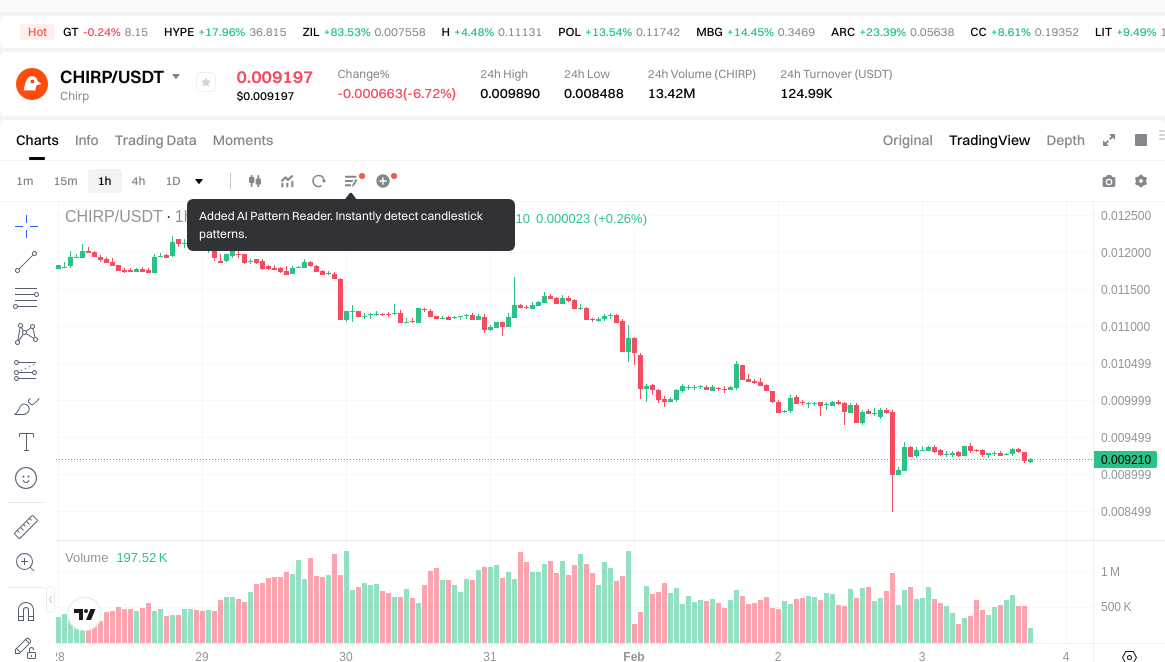
CHIRP is a digital asset in the cryptocurrency field that has been operating within the IoT and DePIN sectors. As of February 03, 2026, Chirp maintains a market capitalization of approximately $974,778.02 with a circulating supply of about 106,266,000 tokens, while the current price stands at around $0.009173. Positioned as an IoT ecosystem built on the Sui blockchain, CHIRP has gradually become a subject of discussion among investors examining "Is Chirp (CHIRP) a good investment?" This article provides a comprehensive analysis of CHIRP's investment characteristics, historical price movements, future price projections, and associated investment risks to serve as a reference for investors.
I. Chirp (CHIRP) Price History Review and Investment Value Status
- 2025: Token launch at $0.15 → Early investors experienced initial market entry
- January 2025: Price reached $0.7308 → CHIRP demonstrated notable price movement during initial trading period
- February 2026: Market conditions led to price adjustment → Trading activity reflected at $0.009173
Current CHIRP Investment Market Status (February 2026)
- CHIRP current price: $0.009173
- 24-hour trading volume: $125,611.57
- Market capitalization: $974,778.02
- Circulating supply: 106,266,000 CHIRP tokens
- Token holders: 3,685 addresses
Click to view real-time CHIRP market price
II. Core Factors Influencing Whether CHIRP is a Good Investment
Supply Mechanism and Scarcity (CHIRP Investment Scarcity)
- Maximum Supply of 300,000,000 CHIRP tokens with current circulating supply of 106,266,000 tokens (35.42% of max supply) → influences price dynamics and investment value
- Circulating supply represents approximately one-third of total planned issuance → potential dilution considerations for investors
- Investment significance: controlled token release schedule may support price stability as ecosystem develops
Institutional Investment and Mainstream Adoption (Institutional Investment in CHIRP)
- Current holder base includes 3,685 addresses → indicates early-stage adoption level
- Listed on cryptocurrency exchanges, providing accessibility for various investor types
- DePIN model enables community participation through miner ownership → decentralized infrastructure approach
- IoT platform integration with Sui blockchain creates utility foundation for Real-World Asset (RWA) projects and businesses
Macroeconomic Environment's Impact on CHIRP Investment
- IoT sector growth trends → potential tailwind for DePIN infrastructure projects
- Blockchain adoption in enterprise IoT solutions → creates addressable market for CHIRP ecosystem
- Regulatory developments in cryptocurrency markets → may affect accessibility and liquidity conditions
Technology and Ecosystem Development (Technology & Ecosystem for CHIRP Investment)
- Built on Sui blockchain infrastructure → benefits from underlying network performance characteristics
- DePIN network operated through community-owned miners → provides connectivity services for IoT devices with $CHIRP token incentives
- IoT platform offers comprehensive toolset for device management and blockchain data integration → creates utility value for ecosystem participants
- Dual-component architecture combining physical infrastructure with software tools → aims to serve individuals, businesses, and RWA projects
- Ecosystem designed to link IoT device data with blockchain technology → addresses connectivity and data management needs in emerging sectors
III. CHIRP Future Investment Forecast and Price Outlook (Is Chirp(CHIRP) worth investing in 2026-2031)
Short-term Investment Forecast (2026, short-term CHIRP investment outlook)
- Conservative forecast: $0.0052 - $0.0092
- Neutral forecast: $0.0092 - $0.0113
- Optimistic forecast: $0.0113 - $0.0134
Mid-term Investment Outlook (2027-2029, mid-term Chirp(CHIRP) investment forecast)
- Market stage expectation: The token may experience gradual development as its IoT ecosystem and DePIN infrastructure potentially expand, with moderate adoption across Real-World Asset projects and IoT device connectivity solutions.
- Investment return forecast:
- 2027: $0.0100 - $0.0130
- 2028: $0.0097 - $0.0135
- 2029: $0.0069 - $0.0182
- Key catalysts: Ecosystem development on Sui blockchain, expansion of community-owned miner network, adoption by IoT and RWA projects, and broader DePIN sector trends.
Long-term Investment Outlook (Is CHIRP a good long-term investment?)
- Base scenario: $0.0121 - $0.0180 (assuming steady ecosystem growth and moderate market conditions)
- Optimistic scenario: $0.0180 - $0.0234 (assuming accelerated adoption and favorable market environment)
- Risk scenario: $0.0069 - $0.0100 (under challenging market conditions or slower-than-expected adoption)
Click to view CHIRP long-term investment and price forecast: Price Prediction
2026-02-03 - 2031 Long-term Outlook
- Base scenario: $0.0100 - $0.0180 USD (corresponding to steady progress and gradual mainstream application advancement)
- Optimistic scenario: $0.0180 - $0.0234 USD (corresponding to large-scale adoption and favorable market environment)
- Transformative scenario: Above $0.0234 USD (if ecosystem achieves breakthrough progress and mainstream popularization)
- 2031-12-31 forecast high: $0.0234 USD (based on optimistic development assumptions)
Disclaimer: Price forecasts are subject to significant uncertainty and should not be considered as financial advice. Cryptocurrency markets are highly volatile, and actual outcomes may differ substantially from predictions.
| Year |
Predicted High Price |
Predicted Average Price |
Predicted Low Price |
Price Change |
| 2026 |
0.0134466 |
0.00921 |
0.0052497 |
0 |
| 2027 |
0.013027545 |
0.0113283 |
0.010082187 |
23 |
| 2028 |
0.013517493975 |
0.0121779225 |
0.009742338 |
32 |
| 2029 |
0.01824374569725 |
0.0128477082375 |
0.00693776244825 |
40 |
| 2030 |
0.020520359596935 |
0.015545726967375 |
0.0124365815739 |
69 |
| 2031 |
0.023442956266801 |
0.018033043282155 |
0.012082138999043 |
96 |
IV. Chirp Investment Strategy and Risk Management (How to invest in Chirp)
Investment Methodology (Chirp investment strategy)
Long-term Holding (HODL Chirp): This approach may suit investors seeking exposure to the IoT and DePIN sector built on Sui blockchain. Given Chirp's focus on decentralized physical infrastructure and IoT device connectivity, long-term holders might consider the project's technological development trajectory and ecosystem expansion as key evaluation factors.
Active Trading: Traders utilizing technical analysis may monitor Chirp's price movements, which have shown notable volatility. Recent data indicates significant price fluctuations, with 24-hour changes of -6.96% and 7-day movements of -22.39%. Active trading strategies may involve analyzing support and resistance levels, volume patterns, and broader market sentiment toward DePIN projects.
Risk Management (Risk management for Chirp investment)
Asset Allocation Ratio:
- Conservative investors: Consider limiting Chirp exposure to a small percentage of total portfolio (typically under 2-5%) due to its early-stage nature and market volatility
- Moderate investors: May allocate 5-10% to emerging IoT blockchain projects like Chirp within a diversified crypto portfolio
- Experienced investors: Could increase allocation based on thorough due diligence, risk tolerance, and conviction in the DePIN narrative
Risk Hedging Strategies: Investors might consider diversifying across multiple blockchain ecosystems, established cryptocurrencies, and traditional assets. Position sizing and stop-loss mechanisms may help manage downside risk given Chirp's price volatility.
Secure Storage:
- Cold Wallets: Hardware wallets supporting Sui network tokens provide enhanced security for long-term storage
- Hot Wallets: Sui-compatible wallets may be suitable for active trading, though they carry higher security risks
- Best Practice: Store the majority of holdings in cold storage while maintaining smaller amounts in hot wallets for trading purposes
V. Chirp Investment Risks and Challenges (Risks of investing in Chirp)
Market Risk: Chirp has demonstrated high volatility, with price movements showing a -32.9% change over 30 days and -88.8% over one year from its historical high of $0.7308 to current levels around $0.009173. The token's market capitalization of approximately $974,778 and relatively low trading volume of $125,611 suggest limited liquidity, which may amplify price swings during periods of buying or selling pressure.
Regulatory Risk: As an IoT and DePIN project operating in the blockchain space, Chirp may face evolving regulatory frameworks across different jurisdictions. Policies governing decentralized physical infrastructure networks, IoT device connectivity, and cryptocurrency operations remain uncertain in many regions, potentially impacting the project's operations and token utility.
Technology Risk: The project's reliance on Sui blockchain infrastructure introduces dependency on the underlying network's performance and security. Smart contract vulnerabilities, network congestion, or potential issues in the Sui ecosystem could affect Chirp's functionality. Additionally, the integration of IoT devices with blockchain technology presents unique technical challenges that require ongoing development and maintenance.
Project-Specific Risks: With a circulating supply of 106,266,000 CHIRP tokens representing only 35.42% of the maximum supply of 300,000,000 tokens, future token unlocks could introduce selling pressure. The project's limited exchange availability (trading on 1 exchange) may restrict accessibility and liquidity for potential investors.
VI. Conclusion: Is Chirp a Good Investment?
Investment Value Summary: Chirp represents an emerging project at the intersection of IoT, DePIN, and blockchain technology built on the Sui network. While the project addresses the growing demand for decentralized infrastructure and IoT connectivity solutions, it has experienced substantial price volatility, declining approximately 88.8% from its historical high. The token's early-stage nature, limited market capitalization, and small holder base of 3,685 participants suggest it remains a speculative investment opportunity with both potential upside and considerable risks.
Investor Recommendations:
✅ Beginners: Consider extensive research before investment; if proceeding, use dollar-cost averaging (DCA) strategies with small position sizes and store tokens securely in Sui-compatible wallets. Focus on understanding the IoT and DePIN sectors before committing capital.
✅ Experienced Investors: May explore tactical trading opportunities based on technical analysis and market sentiment toward DePIN projects. Maintain strict position sizing within a diversified portfolio and monitor project development milestones and ecosystem growth.
✅ Institutional Investors: Conduct comprehensive due diligence on Chirp's technology, team, partnerships, and competitive positioning within the IoT blockchain space. Evaluate the project's long-term viability within broader DePIN investment theses.
⚠️ Disclaimer: Cryptocurrency investments carry high risk and significant volatility. This analysis is for informational purposes only and does not constitute investment advice. Investors should conduct independent research and consult financial professionals before making investment decisions.
VII. FAQ
Q1: What is Chirp (CHIRP) and what makes it unique in the cryptocurrency market?
Chirp is a DePIN (Decentralized Physical Infrastructure Network) project built on the Sui blockchain that focuses on IoT (Internet of Things) connectivity solutions. The project operates through a community-owned miner network that provides connectivity services for IoT devices, with participants earning $CHIRP token incentives. What distinguishes Chirp is its dual-component architecture combining physical infrastructure with comprehensive software tools for device management and blockchain data integration, specifically designed to serve individuals, businesses, and Real-World Asset (RWA) projects seeking decentralized IoT solutions.
Q2: Has Chirp (CHIRP) experienced significant price volatility since launch?
Yes, CHIRP has demonstrated substantial price volatility since its inception. The token launched at $0.15 in 2025, reached a peak of $0.7308 in January 2025, but has declined approximately 88.8% to its current price of around $0.009173 as of February 2026. Recent performance shows -6.96% in 24 hours, -22.39% over 7 days, and -32.9% over 30 days. This volatility pattern is characteristic of early-stage cryptocurrency projects and reflects both market sentiment toward DePIN projects and the token's limited liquidity with a modest trading volume of approximately $125,611.
Q3: What are the price predictions for Chirp (CHIRP) in the coming years?
Price forecasts for CHIRP vary across different timeframes and scenarios. For 2026, conservative estimates range from $0.0052-$0.0092, while optimistic forecasts suggest $0.0113-$0.0134. Mid-term projections through 2029 anticipate gradual development with prices potentially ranging from $0.0069-$0.0182 depending on ecosystem adoption. Long-term outlook for 2031 presents a base scenario of $0.0121-$0.0180, an optimistic scenario of $0.0180-$0.0234, and a predicted high of $0.0234 under favorable conditions. These forecasts assume steady ecosystem growth, expansion of the miner network, and broader DePIN sector adoption, though investors should note that cryptocurrency predictions carry significant uncertainty.
Q4: What investment strategies are appropriate for different types of Chirp investors?
Investment approaches vary based on risk tolerance and experience level. Conservative investors should consider limiting CHIRP exposure to 2-5% of their total portfolio, utilizing dollar-cost averaging strategies and secure cold storage solutions. Moderate investors might allocate 5-10% to Chirp within a diversified crypto portfolio while monitoring project development milestones. Active traders may focus on technical analysis given the token's volatility, analyzing support/resistance levels and volume patterns. Long-term holders (HODL strategy) should evaluate the project's technological trajectory and ecosystem expansion as key factors. All investor types should prioritize secure storage using Sui-compatible wallets, with the majority of holdings in cold storage and smaller amounts in hot wallets for trading purposes.
Q5: What are the main risks associated with investing in Chirp (CHIRP)?
CHIRP investment carries multiple risk categories. Market risk includes high volatility and limited liquidity, with a small market capitalization of approximately $974,778 and modest trading volume that can amplify price swings. Regulatory risk stems from uncertain frameworks governing DePIN projects and cryptocurrency operations across jurisdictions. Technology risk involves dependency on Sui blockchain performance, potential smart contract vulnerabilities, and challenges in integrating IoT devices with blockchain technology. Project-specific risks include future token unlocks (only 35.42% of maximum supply currently circulating), limited exchange availability (trading on 1 exchange), and a relatively small holder base of 3,685 addresses. The 88.8% decline from historical highs demonstrates the substantial downside potential inherent in early-stage cryptocurrency projects.
Q6: How does Chirp's tokenomics structure affect its investment potential?
Chirp's tokenomics feature a maximum supply of 300,000,000 CHIRP tokens with a current circulating supply of 106,266,000 tokens (35.42% of max supply). This controlled release schedule may support price stability as the ecosystem develops, but also presents potential dilution considerations for investors as additional tokens enter circulation. The token serves as an incentive mechanism within the DePIN network, rewarding community-owned miners for providing IoT connectivity services. With 3,685 token holders and trading primarily on one exchange, the tokenomics reflect an early-stage project with room for expansion. Investors should monitor token unlock schedules and distribution patterns as these factors will influence supply-demand dynamics and potentially impact price movements.
Q7: What role does the Sui blockchain play in Chirp's value proposition?
The Sui blockchain infrastructure provides the foundational layer for Chirp's DePIN operations, offering performance characteristics that support the project's IoT connectivity solutions. Building on Sui allows Chirp to benefit from the network's scalability and transaction processing capabilities, which are critical for managing IoT device data and blockchain integration at scale. The relationship introduces both opportunities and dependencies—while Chirp gains access to Sui's technological advantages, the project's success is partially tied to the underlying network's adoption and continued development. Investors evaluating Chirp should consider the broader Sui ecosystem's health and trajectory as complementary factors in their investment analysis.
Q8: Is Chirp (CHIRP) suitable for long-term investment or short-term trading?
The suitability of CHIRP for different investment horizons depends on individual objectives and risk tolerance. For long-term investment, Chirp offers exposure to the emerging IoT and DePIN sectors, with potential value tied to ecosystem development, miner network expansion, and adoption by RWA projects. However, the early-stage nature, limited track record, and 88.8% decline from peak levels suggest significant uncertainty. For short-term trading, the token's high volatility (daily swings of -6.96% and weekly movements of -22.39%) presents opportunities for active traders using technical analysis, though this approach requires careful risk management and position sizing. Institutional and experienced investors might consider tactical allocations based on comprehensive due diligence, while beginners should approach with caution and potentially favor DCA strategies with minimal position sizes if pursuing exposure to this segment.
* The information is not intended to be and does not constitute financial advice or any other recommendation of any sort offered or endorsed by Gate.