Is Credefi (CREDI) a good investment?: A Comprehensive Analysis of Risk, Potential Returns, and Market Outlook for 2024

Introduction: Credefi (CREDI) Investment Position and Market Outlook
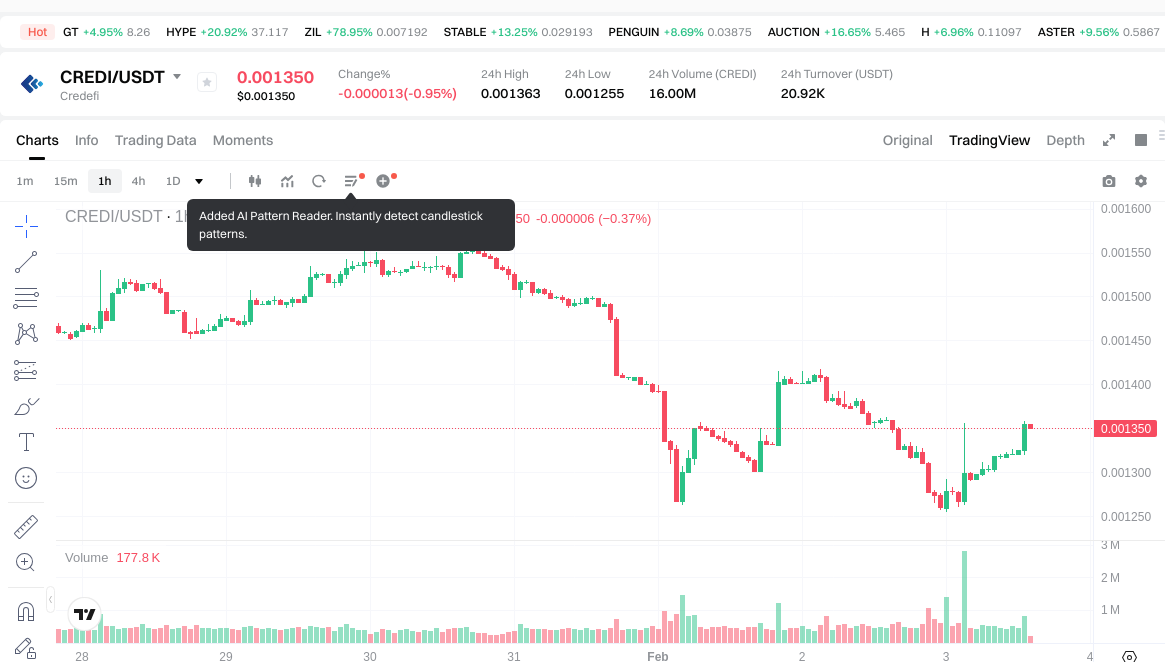
CREDI is a digital asset in the cryptocurrency sector that has been operating since its launch in December 2021. As an alternative lending FinTech solution, Credefi connects crypto lenders with SME borrowers from the real economy, focusing on bridging Traditional Finance (TradFi) and Decentralized Finance (DeFi). As of February 3, 2026, CREDI holds a market capitalization of approximately 1.01 million USD, with a circulating supply of around 748.57 million tokens, and the current price is maintained at approximately 0.001355 USD. With its positioning as a platform offering real-world asset-backed lending services, CREDI has gradually become a subject of discussion among investors exploring "Is Credefi (CREDI) a good investment?" This article will comprehensively analyze CREDI's investment value, historical trends, future price predictions, and investment risks to provide reference for investors.
I. CREDI Price History Review and Investment Value Status
Credefi (CREDI) Investment Performance
- December 2021: CREDI launched at $0.014, entering the alternative lending FinTech sector connecting crypto lenders with SME borrowers.
- May 2024: Token price reached $0.03456, reflecting market recognition of the platform's real-world asset-backed lending model.
- February 2026: Price declined to approximately $0.001355, experiencing notable market volatility over the multi-year period.
Current CREDI Investment Market Status (February 2026)
- Current CREDI price: $0.001355
- 24-hour trading volume: $20,873.50
- Market capitalization: $1,014,317.61
- Circulating supply: 748,573,880 CREDI (74.86% of total supply)
- Token holder count: 3,647 addresses
- Trading availability: Listed on 3 exchanges
Click to view real-time CREDI market price
II. Core Factors Influencing Whether CREDI is a Good Investment
Supply Mechanism and Scarcity (CREDI Investment Scarcity)
- Circulating Supply: 748,573,880 CREDI (74.86% of total supply)
- Total Supply: 939,978,336 CREDI
- Maximum Supply: 1,000,000,000 CREDI
- The token's supply structure indicates a relatively high circulation ratio, with approximately 25% remaining for future distribution, which may influence long-term scarcity dynamics and investment considerations.
Institutional Investment and Mainstream Adoption (Institutional Investment in CREDI)
- Holder Distribution: 3,647 token holders as of current data
- Exchange Availability: Listed on 3 exchanges, including Gate.com
- The limited exchange presence and relatively small holder base suggest that mainstream institutional adoption remains in early stages, which presents both opportunities and risks for investment consideration.
Macroeconomic Environment Impact on CREDI Investment
- Real Economy Connection: Credefi bridges cryptocurrency liquidity with SME financing needs in traditional finance
- Market Position: Addresses financing gaps for European SMEs (which represent 99% of businesses in the EU)
- The platform's focus on real-world asset-backed lending may provide some insulation from pure cryptocurrency market volatility, offering diversification potential for investors seeking exposure to alternative lending models.
Technology and Ecosystem Development (Technology & Ecosystem for CREDI Investment)
- Token Standard: ERC20 on Ethereum blockchain
- Contract Address: 0xae6e307c3fe9e922e5674dbd7f830ed49c014c6b
- Core Platform Function: Alternative lending FinTech solution connecting crypto lenders with SME borrowers backed by real-world assets (real estate, future receivables)
- The platform aims to create synergy between Traditional Finance (TradFi) and Decentralized Finance (DeFi), addressing deficiencies in both segments while facilitating stable returns from the real economy with reduced correlation to cryptocurrency market fluctuations.
III. CREDI Future Investment Forecast and Price Outlook (Is Credefi(CREDI) worth investing in 2026-2031)
Short-term Investment Forecast (2026, short-term CREDI investment outlook)
- Conservative estimate: 0.001040 - 0.001350 USD
- Neutral estimate: 0.001350 - 0.001600 USD
- Optimistic estimate: 0.001600 - 0.001877 USD
Mid-term Investment Outlook (2027-2028, mid-term Credefi(CREDI) investment forecast)
- Market phase expectation: The token may experience moderate volatility with potential stabilization as the lending platform matures and expands its SME borrower base.
- Investment return forecast:
- 2027: 0.001436 - 0.001710 USD
- 2028: 0.001429 - 0.001844 USD
- Key catalysts: Growth in real-world asset-backed lending adoption, expansion of SME partnerships in European markets, and integration between traditional finance and decentralized finance ecosystems.
Long-term Investment Outlook (Is Credefi a good long-term investment?)
- Base scenario: 0.001508 - 0.002174 USD (assuming steady growth in alternative lending adoption and moderate market conditions)
- Optimistic scenario: 0.001963 - 0.003423 USD (assuming accelerated SME financing demand and favorable regulatory environment for crypto-backed lending)
- Risk scenario: 0.001335 - 0.001769 USD (under challenging market conditions or reduced demand for alternative financing solutions)
For detailed CREDI long-term investment and price forecasts: Price Prediction
2026-2031 Long-term Outlook
- Base scenario: 0.001040 - 0.002174 USD (corresponding to stable progress and steady growth in mainstream application)
- Optimistic scenario: 0.001877 - 0.003423 USD (corresponding to large-scale adoption and favorable market environment)
- Transformative scenario: Above 0.003423 USD (if the ecosystem achieves breakthrough developments and mainstream popularization)
- 2031-12-31 predicted high: 0.003423 USD (based on optimistic development assumptions)
Disclaimer: The above forecasts are based on historical data analysis and market trend projections and do not constitute investment advice. Cryptocurrency markets are highly volatile, and actual prices may differ significantly from predictions. Investors should conduct their own research and assess risks carefully before making any investment decisions.
| Year | Predicted High Price | Predicted Average Price | Predicted Low Price | Price Change |
|---|---|---|---|---|
| 2026 | 0.0018765 | 0.00135 | 0.0010395 | 0 |
| 2027 | 0.001710045 | 0.00161325 | 0.0014357925 | 19 |
| 2028 | 0.001844428725 | 0.0016616475 | 0.00142901685 | 22 |
| 2029 | 0.0021737672595 | 0.0017530381125 | 0.00150761277675 | 29 |
| 2030 | 0.00263095959924 | 0.001963402686 | 0.00133511382648 | 44 |
| 2031 | 0.003422799902503 | 0.00229718114262 | 0.001768829479817 | 69 |
IV. Credefi Investment Strategy and Risk Management (How to invest in Credefi)
Investment Strategy (Credefi investment strategy)
Long-term Holding (HODL Credefi)
A long-term holding strategy may be suitable for conservative investors who believe in Credefi's vision of bridging Traditional Finance (TradFi) and Decentralized Finance (DeFi). This approach involves purchasing CREDI tokens and holding them through market cycles, focusing on the platform's fundamental value proposition rather than short-term price movements. Given that Credefi addresses financing needs for SMEs in the European Union—where 99% of businesses are SMEs—investors with this strategy would be betting on the platform's ability to capture market share in the alternative lending sector over an extended period.
Active Trading
Active trading strategies rely on technical analysis and swing trading to capitalize on CREDI's price volatility. With recent price changes showing fluctuations of 2.26% (1H), -0.44% (24H), and -6.18% (7D), the token demonstrates short-term volatility that may present opportunities for experienced traders. This approach requires continuous market monitoring, understanding of chart patterns, and disciplined entry and exit points. Traders should be aware that CREDI's 24-hour trading volume of approximately $20,873 suggests relatively limited liquidity, which could impact execution prices during larger trades.
Risk Management (Risk management for Credefi investment)
Asset Allocation Ratio
Conservative Investors: May consider allocating 1-3% of their cryptocurrency portfolio to CREDI, given its relatively low market capitalization of approximately $1.01 million and ranking at #2493. This minimal allocation limits exposure while maintaining potential upside participation.
Moderate Investors: Could allocate 3-7% to CREDI as part of a diversified DeFi lending and real-world asset (RWA) tokenization strategy, balancing risk across multiple blockchain projects.
Aggressive/Professional Investors: Might allocate 7-15% or more, particularly if they have conviction in Credefi's business model and the SME lending market opportunity in Europe. This strategy requires thorough due diligence and active portfolio monitoring.
Risk Hedging Solutions
Investors should implement multi-asset portfolio strategies to mitigate concentration risk. This could include:
- Diversifying across different cryptocurrency categories (Layer 1s, DeFi protocols, stablecoins)
- Maintaining positions in negatively correlated assets to buffer against market downturns
- Utilizing stablecoins as a hedge to quickly exit positions if needed
- Considering regulated crypto derivatives where available to hedge directional exposure
Given CREDI's market dominance of only 0.000046%, investors should be particularly cautious about over-concentration in this single asset.
Secure Storage
Cold Wallets: For long-term holdings, investors should consider transferring CREDI tokens to cold storage solutions. Since CREDI is an ERC20 token deployed on the Ethereum blockchain (contract address: 0xae6e307c3fe9e922e5674dbd7f830ed49c014c6b), it is compatible with most Ethereum-supporting hardware wallets.
Hot Wallets: For active trading, small amounts may be kept on exchanges or in software wallets for quick access. However, only funds needed for immediate trading should remain in hot storage due to security considerations.
Hardware Wallet Recommendations: Popular options supporting ERC20 tokens include Ledger devices and Trezor hardware wallets, which provide secure offline storage while maintaining the ability to interact with the Ethereum blockchain when needed.
Security Best Practices:
- Enable two-factor authentication on all accounts
- Verify contract addresses before transactions (official CREDI contract: 0xae6e307c3fe9e922e5674dbd7f830ed49c014c6b)
- Regularly backup wallet recovery phrases in secure, offline locations
- Avoid storing large amounts on centralized exchanges
V. Credefi Investment Risks and Challenges (Risks of investing in Credefi)
Market Risk
High Volatility: CREDI has demonstrated significant price volatility, with a 30-day decline of -28.65% and a 1-year decline of -83.91%. The token reached its highest price of $0.03456 on May 22, 2024, and its lowest price of $0.001255 on February 2, 2026, representing a decline of over 96% from its peak. This extreme volatility exposes investors to substantial potential losses, particularly those entering at elevated price levels.
Limited Liquidity: With a 24-hour trading volume of approximately $20,873 and availability on only 3 exchanges, CREDI faces liquidity constraints that could impact price stability. Limited liquidity may result in wider bid-ask spreads and difficulty executing large orders without significant price impact.
Low Market Capitalization: CREDI's circulating market cap of approximately $1.01 million and total market cap of approximately $1.27 million indicate a micro-cap asset that may be susceptible to price manipulation and high volatility from relatively small trading volumes.
Regulatory Risk
Cross-jurisdictional Complexity: Credefi's business model of connecting crypto lenders with SME borrowers in the real economy operates at the intersection of cryptocurrency regulation and traditional lending regulations. This dual regulatory exposure creates uncertainty, as the platform must navigate both DeFi regulations and traditional financial services regulations across multiple European jurisdictions.
Evolving Regulatory Frameworks: Regulatory approaches to crypto-backed lending and real-world asset tokenization continue to evolve globally. Changes in securities laws, lending regulations, or cryptocurrency classification could impact Credefi's ability to operate its platform or could require significant operational modifications.
Compliance Requirements: As Credefi facilitates loans backed by real-world assets including real estate and future receivables, the platform may face increasing scrutiny regarding KYC (Know Your Customer), AML (Anti-Money Laundering), and consumer protection requirements, potentially impacting operational costs and user experience.
Technical Risk
Network Security: As an ERC20 token on the Ethereum blockchain, CREDI inherits both the security features and potential vulnerabilities of the Ethereum network. While Ethereum's established security track record provides some assurance, smart contract vulnerabilities in Credefi's own contracts could expose users to risks.
Platform Dependency: The value proposition of CREDI tokens is closely tied to the success and security of Credefi's lending platform. Technical failures, security breaches, or operational issues with the platform could negatively impact token utility and value.
Integration Challenges: Credefi's model of bridging TradFi and DeFi requires complex technical integrations between blockchain infrastructure and traditional financial systems. Technical difficulties in maintaining these integrations could affect platform functionality and user confidence.
Ethereum Network Risks: CREDI's dependence on the Ethereum blockchain exposes it to network congestion, high gas fees, and potential protocol-level changes that could affect token functionality or transaction costs for users.
VI. Conclusion: Is Credefi a Good Investment?
Investment Value Summary
Credefi presents an investment opportunity centered on bridging Traditional Finance and Decentralized Finance through alternative lending to European SMEs. The platform addresses a potential market gap, as approximately one-third of SMEs in the EU face financing challenges despite available crypto liquidity. However, CREDI's recent price performance has been challenging, with declines of -28.65% over 30 days and -83.91% over one year, alongside a significant drop from its historical high of $0.03456 to current levels around $0.001355. The token's low market capitalization (approximately $1.01 million circulating), limited exchange listings (3 exchanges), and modest trading volume (approximately $20,873 daily) indicate early-stage development with associated risks and uncertainties.
Investor Recommendations
✅ Beginners: Consider implementing a dollar-cost averaging approach with very small allocations (1-2% maximum of crypto portfolio) to limit downside exposure while participating in potential upside. Prioritize secure storage using hardware wallets compatible with ERC20 tokens. Thoroughly research Credefi's business model and the SME lending market before investing. Given the token's high volatility and recent significant declines, beginners should approach with particular caution.
✅ Experienced Investors: May consider swing trading strategies to capitalize on CREDI's price volatility, using technical analysis and strict stop-loss disciplines. Position sizing should account for limited liquidity and high volatility. Consider CREDI as part of a broader portfolio allocation to DeFi lending and real-world asset tokenization projects rather than as a standalone investment. Active monitoring of platform developments and SME lending market trends is important.
✅ Institutional Investors: Could evaluate CREDI as a strategic allocation within alternative finance and blockchain adoption themes, particularly if focusing on European fintech innovation. However, the token's current low liquidity, limited exchange availability, and early-stage market position may not meet institutional minimum liquidity requirements. Any allocation should be part of a well-diversified venture-style portfolio with appropriate risk tolerance for potential total loss.
⚠️ Disclaimer: Cryptocurrency investments carry substantial risk of loss. The information presented in this analysis is for educational and informational purposes only and does not constitute financial, investment, legal, or other professional advice. Prospective investors should conduct independent research, consult with qualified financial advisors, and carefully consider their risk tolerance and financial circumstances before making any investment decisions. Past performance does not indicate future results.
VII. FAQ
Q1: What is Credefi (CREDI) and how does its lending model work?
Credefi (CREDI) is an ERC20 token on the Ethereum blockchain that powers an alternative lending FinTech platform connecting crypto lenders with SME (Small and Medium-sized Enterprise) borrowers from the real economy. The platform bridges Traditional Finance (TradFi) and Decentralized Finance (DeFi) by facilitating loans backed by real-world assets such as real estate and future receivables. Launched in December 2021, Credefi addresses financing gaps for European SMEs—which represent 99% of businesses in the EU—by enabling crypto holders to provide liquidity to businesses that face difficulties accessing traditional financing. This model aims to create synergy between both financial sectors while offering stable returns from the real economy with reduced correlation to cryptocurrency market fluctuations.
Q2: What is CREDI's current market performance and how has it changed historically?
As of February 3, 2026, CREDI trades at approximately $0.001355 with a market capitalization of around $1.01 million and a 24-hour trading volume of $20,873.50. The token has experienced significant volatility since its launch at $0.014 in December 2021. It reached its peak price of $0.03456 on May 22, 2024, but has since declined substantially, showing a 30-day decline of -28.65% and a 1-year decline of -83.91%. The circulating supply consists of 748.57 million tokens (74.86% of total supply), with token holders numbering 3,647 addresses across 3 exchanges. This performance trajectory indicates considerable market volatility and presents both risks and potential opportunities for investors.
Q3: What are the key risks associated with investing in CREDI?
CREDI investment carries several significant risks. Market risk includes extreme price volatility, with the token declining over 96% from its peak, limited liquidity due to modest trading volume ($20,873 daily) and availability on only 3 exchanges, and micro-cap status with a market capitalization of approximately $1.01 million making it susceptible to price manipulation. Regulatory risk arises from Credefi's operation at the intersection of cryptocurrency and traditional lending regulations, requiring compliance across multiple European jurisdictions with evolving frameworks. Technical risk includes potential smart contract vulnerabilities, platform dependency where CREDI's value is closely tied to the lending platform's success, integration challenges between blockchain and traditional financial systems, and Ethereum network risks such as congestion and high gas fees. These combined risks require careful consideration and appropriate position sizing.
Q4: What price predictions exist for CREDI between 2026 and 2031?
Price forecasts for CREDI vary significantly based on different scenarios. For 2026, short-term predictions range from a conservative estimate of $0.001040-$0.001350, a neutral estimate of $0.001350-$0.001600, and an optimistic estimate of $0.001600-$0.001877. Mid-term forecasts for 2027-2028 suggest potential stabilization with 2027 ranging from $0.001436-$0.001710 and 2028 from $0.001429-$0.001844. Long-term predictions through 2031 include a base scenario of $0.001508-$0.002174, an optimistic scenario of $0.001963-$0.003423, and a risk scenario of $0.001335-$0.001769. The most optimistic projection suggests CREDI could reach $0.003423 by December 31, 2031, representing a potential 152% increase from current levels. However, these forecasts are based on historical data analysis and market trend projections, and actual prices may differ significantly due to high market volatility.
Q5: What investment strategies are appropriate for different investor types considering CREDI?
Investment strategies should align with investor experience and risk tolerance. Conservative investors and beginners should consider very small allocations (1-3% of crypto portfolio maximum) using dollar-cost averaging to limit downside exposure, with assets stored in hardware wallets compatible with ERC20 tokens. Moderate investors might allocate 3-7% within a diversified DeFi lending and real-world asset tokenization strategy, potentially employing swing trading strategies to capitalize on CREDI's volatility using technical analysis and strict stop-loss disciplines. Aggressive or professional investors could allocate 7-15% or more if they have conviction in Credefi's business model, but should maintain diversification across different cryptocurrency categories, utilize stablecoins as hedges, and implement multi-asset portfolio strategies. All investors should prioritize secure storage, enable two-factor authentication, verify contract addresses (0xae6e307c3fe9e922e5674dbd7f830ed49c014c6b), and conduct thorough independent research before investing.
Q6: How does Credefi's supply mechanism affect its investment potential?
CREDI's supply structure includes a maximum supply of 1 billion tokens, with a total supply of 939.98 million tokens and a circulating supply of 748.57 million tokens (74.86% of total supply). This relatively high circulation ratio indicates that approximately 25% remains for future distribution, which may influence long-term scarcity dynamics. The token standard is ERC20 on the Ethereum blockchain with the contract address 0xae6e307c3fe9e922e5674dbd7f830ed49c014c6b. With 3,647 token holders and availability on only 3 exchanges including Gate.com, the limited exchange presence and relatively small holder base suggest that mainstream institutional adoption remains in early stages. This supply structure and distribution pattern present both opportunities for potential appreciation if adoption accelerates and risks associated with continued token distribution and limited market liquidity.
Q7: What factors could drive CREDI's value in the future?
Several key factors could influence CREDI's future value trajectory. Growth in real-world asset-backed lending adoption represents a primary catalyst, particularly as the platform expands its SME borrower base in European markets where approximately one-third of SMEs face financing challenges. The integration between traditional finance and decentralized finance ecosystems could drive mainstream acceptance, while accelerated SME financing demand and favorable regulatory environment for crypto-backed lending would support an optimistic scenario. Technology and ecosystem development, including platform maturation and enhanced security measures, could strengthen investor confidence. Macroeconomic factors such as traditional banking sector constraints and increased acceptance of blockchain-based financial solutions may also benefit the platform. However, the realization of these potential catalysts depends on Credefi's ability to execute its business model, navigate regulatory complexities, and overcome current limitations in liquidity and market presence.
Q8: Is Credefi suitable as a long-term investment and what precautions should investors take?
Credefi's suitability as a long-term investment depends significantly on individual risk tolerance and investment objectives. The platform addresses a genuine market need by bridging crypto liquidity with SME financing, potentially offering exposure to the growing real-world asset tokenization sector. Long-term holding may be appropriate for investors who believe in the platform's vision and can withstand substantial volatility, as evidenced by the token's -83.91% decline over one year. However, several precautions are essential: investors should limit exposure based on risk capacity (1-3% for conservatives, up to 7-15% for aggressive investors), maintain diversification across multiple assets and cryptocurrency categories, use secure cold storage for holdings, implement regular portfolio rebalancing, and actively monitor platform developments and regulatory changes. Most critically, investors should only allocate capital they can afford to lose completely, conduct independent research beyond this analysis, and consult qualified financial advisors. The cryptocurrency market's inherent volatility and CREDI's early-stage status mean that long-term investment carries significant uncertainty alongside potential opportunities.
Share
Content
Introduction: Credefi (CREDI) Investment Position and Market Outlook
I. CREDI Price History Review and Investment Value Status
II. Core Factors Influencing Whether CREDI is a Good Investment
III. CREDI Future Investment Forecast and Price Outlook (Is Credefi(CREDI) worth investing in 2026-2031)
IV. Credefi Investment Strategy and Risk Management (How to invest in Credefi)
V. Credefi Investment Risks and Challenges (Risks of investing in Credefi)
VI. Conclusion: Is Credefi a Good Investment?
VII. FAQ
How to Buy Cryptocurrency


Trending Cryptocurrencies



Detailed Analysis of the Top 10 RWA Cryptocurrencies in 2025

Benefits of RWAs in Crypto

How to Earn with The RWA DePin Protocol in 2025
Detailed Analysis of RWA in Crypto Assets

Rexas Finance: A Blockchain-Powered Real-World Asset Tokenization Ecosystem
SIX Token (SIX): Core Logic, Use Cases and 2025 Roadmap Analysis

What is RING: Understanding the Revolutionary Technology Behind Distributed Systems and Decentralized Networks

What is TURBOS: A Comprehensive Guide to Understanding Leveraged Trading Instruments

What is TREAT: A Comprehensive Guide to Understanding the Revolutionary Therapeutic Framework

What is ROUTE: A Comprehensive Guide to Understanding Network Routing Protocols and Best Practices

Comprehensive Guide to Web3 Marketing