This comprehensive analysis examines whether Crust (CRU) represents a viable investment opportunity within the decentralized storage sector. The article evaluates CRU's market position, having declined 91.57% from its $179.24 all-time high to the current price of $0.02255 as of February 2026. Key factors addressed include market capitalization ($602,447.77), unlimited token supply implications, ecosystem technology supporting IPFS and Web3 infrastructure, and trading availability on Gate and one additional exchange. The analysis presents detailed price forecasts spanning 2026-2031, ranging from conservative estimates of $0.02147 to optimistic scenarios reaching $0.054204001199302 by 2031. Investment strategies tailored to different investor profiles emphasize risk management through portfolio allocation (1-2% for beginners, 3-5% for moderate investors), secure storage solutions, and diversification. Critical risks including extreme volatility, low liquidity, regulatory uncertainty, and technical challenges re
Introduction: Crust (CRU) Investment Position and Market Outlook
CRU is a notable asset in the cryptocurrency field, launched in 2020, and has made significant progress in the decentralized storage sector. As of February 2026, Crust holds a market capitalization of approximately $602,447.77, with a circulating supply of around 26,716,087.33 tokens, and the current price stands at approximately $0.02255. Positioned as a decentralized storage network for the Web3 ecosystem, supporting multiple storage layer protocols including IPFS and providing storage interfaces to the application layer, Crust has gradually become a focal point for investors discussing "Is Crust (CRU) a good investment?". This article will comprehensively analyze the investment value of Crust, historical trends, future price predictions, and investment risks to provide reference for investors.
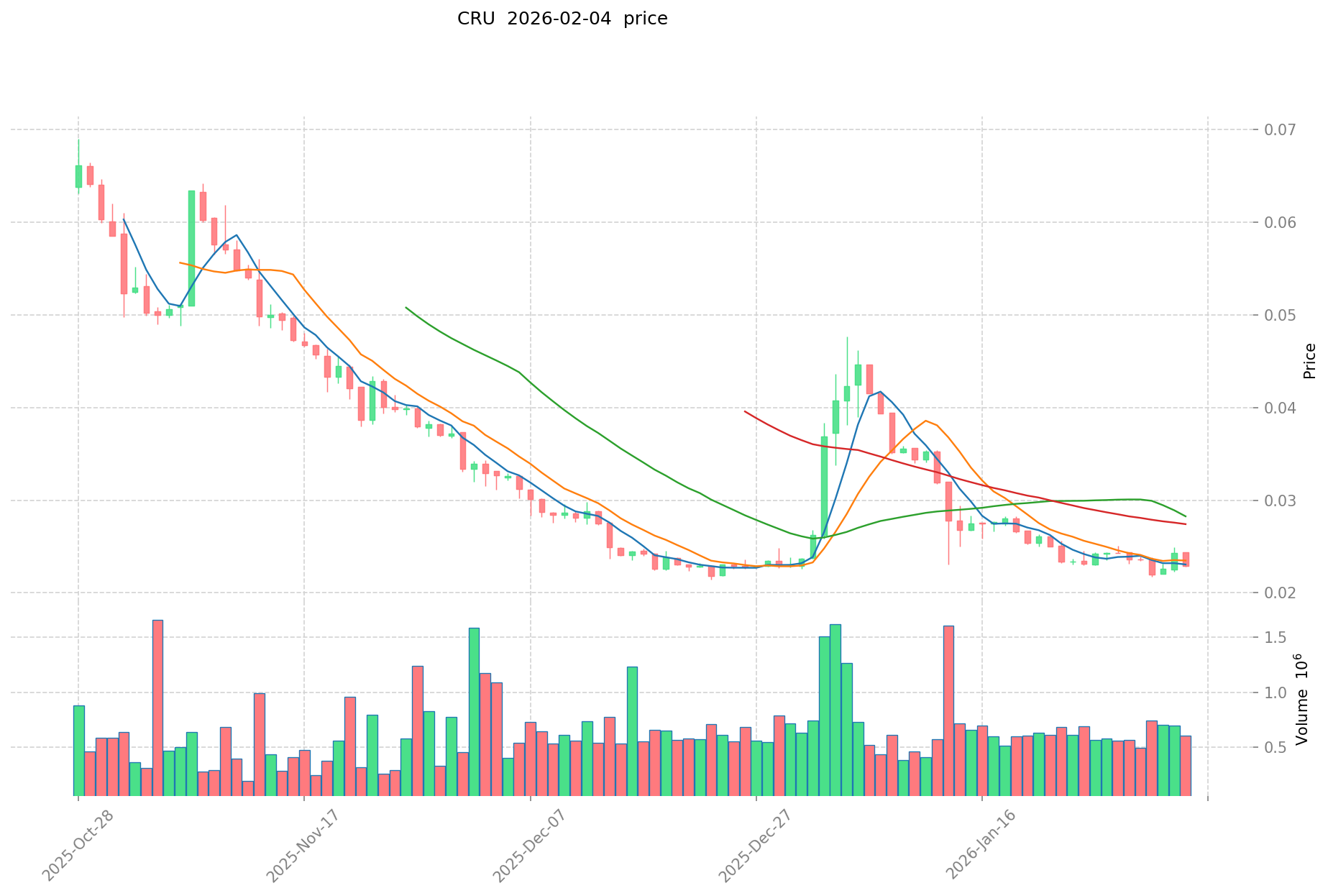
I. Crust (CRU) Price History Review and Current Investment Status
- 2021: All-time high recorded in April → CRU reached $179.24, representing a significant milestone in the token's trading history
- 2025: Price stabilization period → CRU price settled around $0.0408, reflecting a substantial adjustment from previous levels
- 2026: Market cycle fluctuation → Price moved from approximately $0.0231 to $0.0216 during early February
Current CRU Investment Market Status (February 2026)
- CRU current price: $0.02255
- Market sentiment (Fear & Greed Index): Data not available in provided materials
- 24-hour trading volume: $13,397.96
- Institutional investor holdings: Data not available in provided materials
Click to view real-time CRU market price
II. Core Factors Influencing Whether CRU is a Good Investment (Is Crust(CRU) a Good Investment)
Supply Mechanism and Scarcity (CRU investment scarcity)
- Unlimited maximum supply (∞) → potential impact on long-term value perception
- Circulating supply of 26,716,087 CRU represents approximately 76.27% of total supply (35,025,067 CRU)
- Investment significance: the unlimited supply model may influence long-term investment considerations compared to assets with fixed supply caps
Institutional Investment and Mainstream Adoption (Institutional investment in CRU)
- Current holder base comprises 8,033 addresses as of February 05, 2026
- Trading availability on 2 exchanges with 24-hour trading volume of $13,397.96
- Market share stands at 0.000030% of the overall crypto market
Macroeconomic Environment Impact on CRU Investment
- Broader market conditions may affect decentralized storage network adoption rates
- Economic uncertainty could influence demand for Web3 infrastructure solutions
- Monetary policy shifts may impact overall crypto asset allocation strategies
Technology and Ecosystem Development (Technology & Ecosystem for CRU investment)
- Decentralized storage network supporting multiple storage layer protocols including IPFS
- Storage interface provision for application layers within the Web3 ecosystem
- Technology stack capabilities extend to supporting decentralized computing layers
- Focus on building a distributed cloud ecosystem emphasizing data privacy and ownership
III. CRU Future Investment Forecast and Price Outlook (Is Crust(CRU) worth investing in 2026-2031)
Short-term Investment Forecast (2026, short-term CRU investment outlook)
- Conservative forecast: $0.02147 - $0.0226
- Neutral forecast: $0.0226 - $0.024634
- Optimistic forecast: $0.024634 - $0.026668
Mid-term Investment Outlook (2027-2028, mid-term Crust(CRU) investment forecast)
-
Market stage expectations: During this period, CRU may experience moderate growth driven by continued development of decentralized storage solutions and increased adoption within the Web3 ecosystem. Market conditions and broader crypto trends will influence price movements.
-
Investment return forecast:
- 2027: $0.01896818 - $0.03424126
- 2028: $0.0229613514 - $0.0314982641
-
Key catalysts: Expansion of IPFS integration, growth in decentralized cloud storage demand, technological improvements in the Crust network, and broader Web3 ecosystem development.
Long-term Investment Outlook (Is CRU a good long-term investment?)
- Base scenario: $0.026268092888892 - $0.042045766929 (assuming steady ecosystem development and moderate market conditions through 2029)
- Optimistic scenario: $0.027917779881915 - $0.054204001199302 (assuming accelerated adoption of decentralized storage solutions and favorable market conditions through 2031)
- Risk scenario: Below $0.02147 (under conditions of prolonged market downturn, technological setbacks, or increased competition in the decentralized storage sector)
Click to view CRU long-term investment and price forecast: Price Prediction
2026-02-05 - 2031 Long-term Outlook
- Base scenario: $0.026268092888892 - $0.042045766929 (corresponding to steady progress and gradual mainstream application growth)
- Optimistic scenario: $0.027917779881915 - $0.054204001199302 (corresponding to large-scale adoption and favorable market environment)
- Transformative scenario: Above $0.054204001199302 (if ecosystem achieves breakthrough developments and mainstream adoption)
- 2031-12-31 forecast high: $0.054204001199302 (based on optimistic development assumptions)
Disclaimer: The above forecasts are based on historical data and market analysis as of February 5, 2026. Cryptocurrency markets are highly volatile and subject to numerous unpredictable factors. These projections should not be considered as investment advice. Investors should conduct their own research and consider their risk tolerance before making investment decisions.
| Year |
Predicted High Price |
Predicted Average Price |
Predicted Low Price |
Price Change |
| 2026 |
0.026668 |
0.0226 |
0.02147 |
0 |
| 2027 |
0.03424126 |
0.024634 |
0.01896818 |
9 |
| 2028 |
0.0314982641 |
0.02943763 |
0.0229613514 |
30 |
| 2029 |
0.042045766929 |
0.03046794705 |
0.0228509602875 |
35 |
| 2030 |
0.04713391408635 |
0.0362568569895 |
0.027917779881915 |
60 |
| 2031 |
0.054204001199302 |
0.041695385537925 |
0.026268092888892 |
84 |
IV. CRU Investment Strategy and Risk Management (How to invest in decentralized storage tokens)
Investment Strategy (CRU investment strategy)
Long-term Holding (HODL CRU)
Long-term holding may suit investors who believe in the potential of decentralized storage infrastructure and Web3 ecosystem development. This approach typically involves:
- Accumulating positions during market downturns
- Holding through market cycles without frequent trading
- Focusing on fundamental developments rather than short-term price movements
This strategy may be more appropriate for investors with:
- Higher risk tolerance
- Longer investment horizons
- Belief in the long-term adoption of decentralized storage solutions
Active Trading
Active trading strategies rely on technical analysis and market timing:
- Monitoring price action within the 24-hour range (recent data shows movement between $0.0225 and $0.02307)
- Analyzing volume patterns (24-hour volume: $13,397.96)
- Implementing swing trading during periods of volatility
Traders should note that CRU has experienced significant price movements, with recent declines of 7.03% over 7 days and 50.93% over 30 days.
Risk Management (Risk management for CRU investment)
Asset Allocation Guidelines
Conservative Investors:
- Allocate no more than 1-2% of total portfolio to CRU
- Focus on established cryptocurrencies with majority allocation
- Maintain significant cash or stablecoin reserves
Moderate Investors:
- Consider 3-5% allocation to CRU within a diversified crypto portfolio
- Balance with other blockchain infrastructure tokens
- Implement regular rebalancing strategies
Aggressive Investors:
- May allocate 5-10% to CRU and similar infrastructure projects
- Accept higher volatility in exchange for potential upside
- Actively monitor project developments and market conditions
Risk Hedging Approaches
Portfolio Diversification:
- Combine CRU with other storage-focused tokens
- Include different crypto categories (Layer 1, DeFi, storage)
- Maintain exposure to traditional assets outside crypto
Hedging Tools:
- Consider stablecoin positions for quick redeployment
- Use dollar-cost averaging to reduce timing risk
- Set predetermined exit points based on technical levels
Secure Storage Solutions
Cold Wallet Storage:
- Hardware wallets (Ledger, Trezor) for long-term holdings
- Paper wallets for maximum security (with proper backup procedures)
- Offline storage eliminates online hacking risks
Hot Wallet Management:
- Keep only trading amounts on exchanges
- Use wallets with multi-signature capabilities
- Enable two-factor authentication and withdrawal whitelist features
Best Practices:
- Never store large amounts on centralized exchanges
- Maintain multiple backup copies of recovery phrases
- Store backup information in secure, separate physical locations
- Regularly verify wallet access and update security protocols
V. CRU Investment Risks and Challenges (Risks of investing in decentralized storage tokens)
Market Risks
High Volatility:
CRU has demonstrated significant price volatility across multiple timeframes:
- 1-hour change: -0.17%
- 24-hour change: -1.13%
- 7-day change: -7.03%
- 30-day change: -50.93%
- 1-year change: -91.57%
The current price of $0.02255 represents a substantial decline from the historical high of $179.24 (recorded on April 12, 2021), indicating the potential for extreme price swings in both directions.
Liquidity Concerns:
With a 24-hour trading volume of approximately $13,397.96 and availability on only 2 exchanges, CRU faces potential liquidity challenges that could:
- Result in wider bid-ask spreads
- Create difficulties executing large orders
- Amplify price impact during volatile periods
Market Manipulation Risks:
Lower market capitalization tokens (CRU's current market cap: $602,447.77) may be more susceptible to:
- Whale activity affecting price discovery
- Coordinated trading that creates artificial price movements
- Lower trading volumes making manipulation easier
Regulatory Risks
Policy Uncertainty:
Decentralized storage networks and associated tokens face evolving regulatory frameworks:
- Different jurisdictions may classify storage tokens differently
- Potential changes in securities classification could impact trading availability
- Cross-border data storage regulations may affect network operations
Compliance Requirements:
- Exchanges listing CRU may face changing regulatory demands
- Know Your Customer (KYC) and Anti-Money Laundering (AML) requirements may expand
- Tax treatment of storage tokens varies by jurisdiction
Geographic Restrictions:
- Some regions may restrict access to decentralized storage tokens
- Regulatory changes could limit trading venues or liquidity
- International investors may face varying levels of legal protection
Technical Risks
Network Security:
- Potential vulnerabilities in the storage protocol could affect token value
- Smart contract risks if CRU is deployed on multiple chains
- Dependencies on underlying infrastructure (IPFS and other storage protocols)
Technology Evolution:
- Competing storage solutions may offer superior technology
- Network upgrades could introduce unforeseen issues
- Adoption rates may not meet projected growth expectations
Integration Challenges:
- Compatibility with evolving Web3 ecosystem standards
- Competition from established cloud storage providers entering blockchain space
- Technical barriers to mainstream adoption
VI. Conclusion: Is Decentralized Storage a Good Investment?
Investment Value Summary
CRU represents exposure to the decentralized storage sector within the Web3 ecosystem. The project supports multiple storage layer protocols including IPFS and provides storage interfaces for application layers, positioning itself within the growing demand for data privacy and ownership solutions.
However, the token has experienced substantial price decline, with a 91.57% decrease over the past year and a 50.93% drop in the last 30 days. The current price of $0.02255 sits near historical lows (historical low: $0.02160223 on February 1, 2026), suggesting either a potential value opportunity or fundamental challenges.
Key considerations:
- Market capitalization of approximately $602,447 indicates a smaller-scale project
- Limited exchange availability (2 exchanges) may restrict liquidity
- Circulating supply represents approximately 76.3% of total supply
- Market share of 0.000030% reflects minimal current market presence
Recommendations for Different Investor Types
✅ Beginner Investors:
- Consider dollar-cost averaging if interested in decentralized storage exposure
- Limit allocation to a small percentage of overall portfolio (1-2%)
- Use secure storage solutions (hardware wallets) from the beginning
- Focus on understanding the underlying technology and use cases
- Avoid investing amounts you cannot afford to lose entirely
✅ Experienced Investors:
- Evaluate CRU within the broader context of storage and infrastructure tokens
- Consider technical analysis for potential entry points given recent price declines
- Implement portfolio allocation based on risk tolerance (3-5% for moderate profiles)
- Monitor project development updates and ecosystem growth metrics
- Use diversified positions across multiple storage-focused projects
✅ Institutional Investors:
- Conduct thorough due diligence on technology stack and competitive positioning
- Assess regulatory compliance and jurisdictional risks
- Consider strategic allocation as part of Web3 infrastructure thesis
- Evaluate liquidity constraints for position sizing
- Implement professional custody solutions for asset security
⚠️ Important Disclaimer
Cryptocurrency investments carry substantial risk and may not be suitable for all investors. The extreme volatility demonstrated by CRU, including a decline of over 90% from historical highs, illustrates the potential for significant capital loss. Past performance does not indicate future results.
This analysis is provided for informational purposes only and does not constitute investment advice, financial advice, trading advice, or any other type of advice. You should conduct your own research and consult with qualified financial advisors before making any investment decisions.
Factors to consider before investing:
- Only invest capital you can afford to lose completely
- Understand the technology and project fundamentals
- Be aware of tax implications in your jurisdiction
- Recognize that low liquidity may prevent timely exits
- Stay informed about regulatory developments affecting crypto assets
The cryptocurrency market remains highly speculative, and investments in smaller market cap tokens like CRU carry additional risks beyond established cryptocurrencies.
VII. FAQ
Q1: Is Crust (CRU) a good investment for beginners in 2026?
CRU may not be ideal for beginners due to its high volatility and limited liquidity. The token has experienced a 91.57% decline over the past year and currently trades at $0.02255, near its historical low of $0.02160223. For beginners interested in decentralized storage exposure, it's recommended to allocate only 1-2% of your total portfolio to CRU, use dollar-cost averaging to reduce timing risk, and store assets in secure hardware wallets. The limited exchange availability (only 2 exchanges) and low 24-hour trading volume ($13,397.96) present additional challenges for new investors who may need to exit positions quickly.
Q2: What are the main risks of investing in Crust (CRU)?
The primary risks include extreme price volatility, low liquidity, and market manipulation potential. CRU has demonstrated significant price swings, including a 50.93% decline in the past 30 days and a 7.03% drop over 7 days. With a market capitalization of only $602,447.77 and trading on just 2 exchanges, investors may face wide bid-ask spreads and difficulty executing large orders. Additionally, regulatory uncertainty surrounding decentralized storage tokens, technical risks related to network security, and competition from established cloud storage providers entering the blockchain space pose substantial challenges to long-term value appreciation.
Q3: How does CRU's unlimited supply affect its investment potential?
The unlimited maximum supply (∞) may negatively impact long-term value perception compared to cryptocurrencies with fixed supply caps. Currently, 26,716,087 CRU tokens are in circulation, representing approximately 76.27% of the total supply (35,025,067 CRU). Unlike Bitcoin's fixed 21 million supply or other scarcity-based models, CRU's unlimited supply means there's no built-in scarcity mechanism to support price appreciation through supply constraints. This fundamental characteristic requires investors to focus primarily on demand-side factors, such as adoption rates of decentralized storage solutions and ecosystem growth, rather than supply dynamics when evaluating investment potential.
Q4: What is the price forecast for CRU in 2026-2031?
Short-term forecasts for 2026 range from $0.02147 (conservative) to $0.026668 (optimistic). For mid-term outlook, 2027 predictions range from $0.01896818 to $0.03424126, while 2028 estimates span $0.0229613514 to $0.0314982641. Long-term projections through 2031 suggest a base scenario range of $0.026268092888892 to $0.042045766929, with an optimistic scenario reaching up to $0.054204001199302 by December 2031. However, these forecasts assume favorable market conditions, continued ecosystem development, and increased adoption of Web3 infrastructure. Given CRU's recent 91.57% decline and current volatility, investors should treat these projections with caution and recognize that actual performance may significantly deviate from predictions.
Q5: Should I hold CRU long-term or actively trade it?
The choice depends on your investment profile and risk tolerance. Long-term holding (HODL) may suit investors who believe in decentralized storage infrastructure's future and can withstand significant volatility, as CRU has declined over 99% from its all-time high of $179.24. This strategy requires accepting paper losses during downturns while focusing on fundamental developments. Active trading involves monitoring 24-hour price ranges and volume patterns, which recent data shows includes movements between $0.0225 and $0.02307 with $13,397.96 in daily volume. However, low liquidity may create challenges for active traders. Conservative investors should limit CRU to 1-2% of their portfolio, while aggressive investors might allocate 5-10% within a diversified crypto portfolio.
Q6: What secure storage options are recommended for CRU tokens?
For long-term holdings, hardware wallets (Ledger, Trezor) provide the highest security by keeping private keys offline and eliminating online hacking risks. Paper wallets offer maximum security with proper backup procedures but require careful handling. For active trading, keep only necessary amounts on exchanges and use wallets with multi-signature capabilities, two-factor authentication, and withdrawal whitelist features. Never store large amounts on centralized exchanges, maintain multiple backup copies of recovery phrases in separate physical locations, and regularly verify wallet access. Given CRU's limited exchange availability and liquidity concerns, having direct control of your tokens through self-custody solutions becomes particularly important for protecting your investment.
Q7: How does CRU compare to other decentralized storage investments?
CRU positions itself as a decentralized storage network supporting multiple protocols including IPFS and providing storage interfaces for Web3 applications. With a current market share of only 0.000030% and 8,033 holder addresses as of February 2026, CRU represents a smaller player in the decentralized storage sector. Its market capitalization of $602,447.77 and limited exchange availability (2 exchanges) contrast with larger competitors that may offer better liquidity and wider adoption. When evaluating CRU against alternatives, consider factors such as technology stack maturity, ecosystem partnerships, developer activity, and competitive advantages in data privacy and ownership solutions. Diversifying across multiple storage-focused projects rather than concentrating solely on CRU may provide better risk-adjusted exposure to this sector.
Q8: What catalysts could drive CRU's price in the coming years?
Potential positive catalysts include expansion of IPFS integration, growth in decentralized cloud storage demand driven by increasing data privacy concerns, technological improvements in the Crust network that enhance performance and usability, and broader Web3 ecosystem development that creates organic demand for decentralized storage solutions. Additionally, mainstream adoption by application developers, strategic partnerships with major Web3 projects, and favorable regulatory frameworks for decentralized infrastructure could support price appreciation. However, investors should balance these potential catalysts against risks such as increased competition from established cloud providers entering the blockchain space, technological setbacks, prolonged market downturns, and slower-than-expected adoption rates that could prevent CRU from achieving projected growth targets through 2031.
* The information is not intended to be and does not constitute financial advice or any other recommendation of any sort offered or endorsed by Gate.