Is DIN (DIN) a good investment?: A Comprehensive Analysis of Market Potential, Risk Factors, and Future Outlook for 2024


Introduction: DIN's Investment Position and Market Outlook
DIN represents a notable digital asset in the cryptocurrency sector, positioning itself as the first AI agent blockchain. Built on the foundation of the Data Intelligence Network, DIN provides comprehensive solutions and infrastructure for AI agents and decentralized AI applications (dAI-Apps). As of February 5, 2026, DIN maintains a market capitalization of approximately $544,844.12, with a circulating supply of 13,025,200 tokens. The current trading price stands at $0.04183, with a 24-hour trading volume of $12,239.86. With only 13.03% of its maximum supply of 100,000,000 tokens currently in circulation, DIN has attracted attention from 24,282 holders. Operating on the BSC network using the BEP-20 standard, DIN has been listed on 2 exchanges since its launch in February 2025 at an initial price of $0.8. This article examines DIN's investment characteristics, historical price movements, future price projections, and associated risks to provide analytical perspectives for market participants.
I. DIN (DIN) Price History Review and Current Investment Value
DIN Historical Price Trends and Investment Performance
- February 2025: Network launch milestone → Price reached $3.6641, representing an initial phase of market valuation
- October 2025: Market adjustment period → Price declined to $0.03501, reflecting broader cryptocurrency market volatility
- February 2026: Current trading phase → Price stabilized around $0.04183, showing signs of market equilibrium after earlier fluctuations
Current DIN Investment Market Status (February 2026)
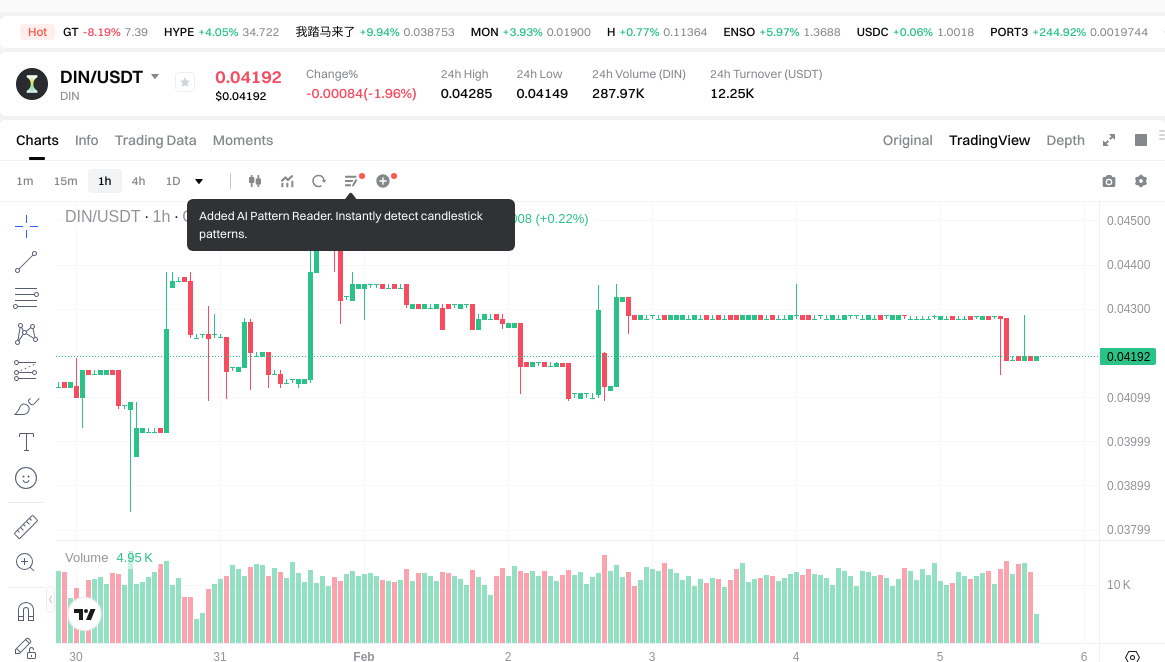
- DIN current price: $0.04183
- 24-hour trading volume: $12,239.86
- Market capitalization: $544,844.12
- Circulating supply: 13,025,200 DIN (13.03% of total supply)
- Market dominance: 0.00016%
- Exchange availability: Listed on 2 exchanges
- Holder base: 24,282 addresses
Click to view real-time DIN market price
II. Core Factors Affecting Whether DIN is a Good Investment
Supply Mechanism and Scarcity (DIN Investment Scarcity)
- Fixed Supply Cap: DIN has a maximum supply of 100,000,000 tokens and a total supply of 100,000,000 tokens, establishing a clear supply ceiling that may support long-term value appreciation
- Current Circulation: With a circulating supply of 13,025,200 tokens (approximately 13.03% of total supply), the majority of tokens remain to be released into circulation, which may impact future supply dynamics
- Investment Significance: The limited maximum supply provides a degree of scarcity, though the low current circulation ratio suggests potential dilution as more tokens enter the market
Institutional Investment and Mainstream Adoption (Institutional Investment in DIN)
- Holder Base: As of current data, DIN has 24,282 token holders, indicating a developing community base
- Exchange Presence: DIN is listed on 2 exchanges, representing relatively limited mainstream exchange adoption at this stage
- Market Position: With a market capitalization ranking of 2,973 and a dominance of 0.00016%, DIN represents a smaller-cap asset within the broader cryptocurrency market
Macroeconomic Environment Impact on DIN Investment
- Market Performance: DIN has experienced notable volatility, with a 1-year decline of 98.60% from its previous levels, reflecting sensitivity to broader market conditions
- Price Range: The token has traded between a low of $0.03501 and a high of $3.6641, demonstrating substantial price fluctuation
- Current Market Sentiment: Recent short-term trends show declines of 0.21% (1H), 2.38% (24H), 5.59% (7D), and 19.54% (30D), indicating ongoing downward pressure
Technology and Ecosystem Development (Technology & Ecosystem for DIN Investment)
- AI Agent Blockchain: DIN positions itself as the first AI agent blockchain, built on the Data Intelligence Network foundation
- Infrastructure Focus: The project is designed to provide comprehensive solutions and infrastructure for AI agents and decentralized AI applications (dAI-Apps)
- Technical Standard: DIN utilizes the BEP-20 standard on the BSC (Binance Smart Chain), with contract address 0x3ab1a5f76e12202d1ad1548a08a799501581da4e
- Ecosystem Development: The project's focus on AI and data intelligence represents participation in emerging technological trends, though the practical deployment and adoption of these applications remain key factors for long-term investment value
III. DIN Future Investment Forecast and Price Outlook (Is DIN Worth Investing in 2026-2031)
Short-term Investment Forecast (2026, Short-term DIN Investment Outlook)
Based on available market data as of February 5, 2026, DIN is trading at $0.04183. Short-term price forecasts for 2026 suggest the following scenarios:
- Conservative Forecast: $0.03765 - $0.04183
- Neutral Forecast: $0.04183 - $0.04477
- Optimistic Forecast: $0.04477 - $0.04769
The token has experienced notable volatility, with a 24-hour decline of 2.38% and a 7-day decline of 5.59%. The current price represents a significant decrease of 98.60% over the past year from its historical high of $3.6641 recorded on February 14, 2025. Market participants should consider that DIN's circulating supply stands at 13.03 million tokens (13.03% of maximum supply), with a market capitalization of approximately $544,844.
Mid-term Investment Outlook (2027-2029, Mid-term DIN Investment Forecast)
-
Market Stage Expectation: The mid-term period may reflect recovery and stabilization phases as the AI agent blockchain sector matures. Market sentiment indicators suggest a cautious yet gradually improving outlook.
-
Investment Return Forecast:
- 2027: $0.03536 - $0.05147 (representing approximately 7% growth from 2026 base levels)
- 2028: $0.03753 - $0.05389 (reflecting approximately 15% cumulative growth)
- 2029: $0.03570 - $0.06477 (indicating approximately 21% cumulative growth)
-
Key Catalysts: Potential growth drivers include broader adoption of AI agent infrastructure, increased development activity within the Data Intelligence Network ecosystem, expansion of decentralized AI applications (dAI-Apps), and overall cryptocurrency market recovery trends. The BEP-20 token standard deployment on BSC provides established infrastructure support.
Long-term Investment Outlook (Is DIN a Good Long-term Investment?)
Long-term forecasts for DIN through 2031 present varied scenarios based on different market conditions:
- Base Scenario: $0.04454 - $0.06454 (corresponding to steady progress and gradual mainstream application adoption)
- Optimistic Scenario: $0.05615 - $0.07745 (corresponding to accelerated ecosystem development and favorable market conditions)
- High-growth Scenario: Above $0.07745 (contingent upon breakthrough developments in AI agent infrastructure and widespread mainstream adoption)
- 2031 Year-end Forecast High: $0.07745 (based on optimistic development assumptions)
The token's relatively low market share of 0.00016% and ranking of 2,973 indicate substantial room for potential growth, though this also reflects competitive challenges within the broader cryptocurrency landscape. With 24,282 holders and availability on 2 exchanges, DIN's current adoption remains in early stages.
View detailed DIN long-term investment and price predictions: Price Forecast
Disclaimer: These forecasts are based on historical data, market trends, and predictive models as of February 5, 2026. Cryptocurrency markets exhibit high volatility and unpredictability. Price predictions should not be construed as investment advice, and actual future prices may differ substantially from projections. Multiple factors including technological developments, regulatory changes, market sentiment, macroeconomic conditions, and competitive dynamics can significantly impact actual outcomes. Investors should conduct thorough independent research and consider their risk tolerance before making investment decisions.
| Year | Predicted High Price | Predicted Average Price | Predicted Low Price | Price Change |
|---|---|---|---|---|
| 2026 | 0.0476862 | 0.04183 | 0.037647 | 0 |
| 2027 | 0.051471815 | 0.0447581 | 0.035358899 | 7 |
| 2028 | 0.0538887524 | 0.0481149575 | 0.03752966685 | 15 |
| 2029 | 0.0647723557865 | 0.05100185495 | 0.035701298465 | 21 |
| 2030 | 0.071201139602947 | 0.05788710536825 | 0.056150492207202 | 38 |
| 2031 | 0.077452946982718 | 0.064544122485598 | 0.044535444515063 | 54 |
IV. DIN Investment Strategy and Risk Management (How to invest in AI Agent Blockchain)
Investment Methodology (DIN investment strategy)
-
Long-term Holding (HODL DIN): Suitable for conservative investors who believe in the long-term development of AI agent blockchain infrastructure. This approach focuses on holding DIN tokens for extended periods, anticipating value appreciation as the Data Intelligence Network ecosystem expands and adoption of decentralized AI applications grows.
-
Active Trading: Relies on technical analysis and swing trading strategies. Given DIN's price volatility, experienced traders may identify entry and exit points based on market indicators, trend patterns, and volume analysis to capture short-term price movements.
Risk Management (Risk management for DIN investment)
-
Asset Allocation Ratio:
- Conservative investors: Allocate 1-3% of portfolio to DIN
- Aggressive investors: Allocate 5-10% of portfolio to DIN
- Professional investors: May allocate 10-15% with active monitoring
-
Risk Hedging Solutions: Implement multi-asset portfolio diversification by combining DIN with established cryptocurrencies and traditional assets. Consider hedging tools such as stablecoins to reduce exposure during high volatility periods.
-
Secure Storage: Utilize cold wallets for long-term holdings and hot wallets for active trading needs. Hardware wallets are recommended for enhanced security of significant holdings.
V. DIN Investment Risks and Challenges (Risks of investing in AI Agent Blockchain)
-
Market Risk: DIN exhibits significant price volatility, with 24-hour fluctuations and substantial price movements observed in various time frames. The token experienced notable price variations since its launch, indicating susceptibility to market sentiment shifts and potential price manipulation in lower liquidity conditions.
-
Regulatory Risk: As an AI agent blockchain project, DIN operates in an evolving regulatory landscape where different jurisdictions maintain varying approaches to cryptocurrency and AI technology regulation. Policy uncertainty across countries may impact token accessibility, trading options, and project development.
-
Technology Risk: The project's infrastructure for AI agents and decentralized AI applications faces potential network security vulnerabilities, smart contract risks, and challenges associated with protocol upgrades. The BEP-20 standard implementation requires ongoing security audits to maintain network integrity.
VI. Conclusion: Is AI Agent Blockchain a Good Investment?
-
Investment Value Summary: DIN presents potential opportunities in the emerging AI agent blockchain sector, positioning itself as infrastructure for decentralized AI applications. However, the token demonstrates considerable price fluctuations and remains in early development stages.
-
Investor Recommendations:
✅ Beginners: Consider dollar-cost averaging (DCA) approach with secure wallet storage. Start with minimal allocation to understand market dynamics.
✅ Experienced Investors: Implement swing trading strategies combined with diversified portfolio configuration. Monitor technical indicators and project development milestones.
✅ Institutional Investors: Evaluate strategic long-term positioning based on comprehensive due diligence of the Data Intelligence Network ecosystem and AI agent market development.
⚠️ Disclaimer: Cryptocurrency investments carry substantial risk. This content is for informational purposes only and does not constitute investment advice. Conduct thorough research and consult financial professionals before making investment decisions.
VII. FAQ
Q1: Is DIN a good investment for beginners in cryptocurrency?
DIN may be suitable for beginners only with a conservative approach and proper risk management. As a smaller-cap AI agent blockchain project with a market capitalization of approximately $544,844 and ranking #2,973, DIN carries higher volatility compared to established cryptocurrencies. The token has experienced a significant 98.60% decline from its historical high of $3.6641 in February 2025 to the current price of $0.04183 as of February 2026. Beginners should consider implementing dollar-cost averaging (DCA) with minimal portfolio allocation of 1-3%, utilize secure cold wallet storage for holdings, and thoroughly understand the project's AI agent infrastructure before investing.
Q2: What makes DIN different from other blockchain projects?
DIN distinguishes itself as the first AI agent blockchain built on the Data Intelligence Network foundation. Unlike traditional blockchain platforms, DIN specifically provides comprehensive solutions and infrastructure for AI agents and decentralized AI applications (dAI-Apps). The project operates on the BSC network using the BEP-20 standard (contract address: 0x3ab1a5f76e12202d1ad1548a08a799501581da4e), positioning itself at the intersection of artificial intelligence and blockchain technology. However, practical deployment and adoption of these AI applications remain critical factors determining DIN's long-term competitive advantage in the evolving cryptocurrency landscape.
Q3: How does DIN's tokenomics affect its investment potential?
DIN's tokenomics present both opportunities and challenges for investors. The project maintains a fixed maximum supply of 100,000,000 tokens, establishing scarcity through a supply cap. However, with only 13,025,200 tokens (13.03%) currently in circulation, approximately 86.97% of the total supply remains to be released. This low circulation ratio creates potential dilution risk as more tokens enter the market, which could exert downward pressure on price. The relatively limited holder base of 24,282 addresses and availability on only 2 exchanges indicate early-stage adoption, suggesting both growth potential and liquidity challenges.
Q4: What are the primary risks associated with investing in DIN?
DIN investment carries multiple significant risks that investors should carefully evaluate. Market risk is substantial, evidenced by the token's 98.60% decline over one year and ongoing short-term downward pressure (2.38% decline in 24 hours, 5.59% decline in 7 days). Regulatory risk exists as the project operates in an evolving legal landscape for both cryptocurrency and AI technology, with different jurisdictions maintaining varying regulatory approaches. Technology risk includes potential smart contract vulnerabilities, network security challenges, and implementation complexities associated with AI agent infrastructure on the BEP-20 standard. The project's small market capitalization and limited exchange listings also present liquidity risk.
Q5: What is the realistic price forecast for DIN in the next few years?
Based on current market conditions and historical performance as of February 5, 2026, price forecasts for DIN vary across different timeframes. Short-term forecasts for 2026 range from $0.03765 to $0.04769, depending on market conditions. Mid-term projections suggest gradual recovery potential: 2027 forecasts range from $0.03536 to $0.05147, 2028 from $0.03753 to $0.05389, and 2029 from $0.03570 to $0.06477. Long-term projections through 2031 indicate potential growth to $0.04454-$0.07745 under optimistic scenarios. However, these forecasts carry significant uncertainty, as cryptocurrency markets exhibit high volatility and actual outcomes may differ substantially based on ecosystem development, market adoption, and macroeconomic factors.
Q6: How can investors effectively manage risk when investing in DIN?
Effective risk management for DIN investment requires a multi-layered approach. Conservative investors should limit DIN allocation to 1-3% of their total portfolio, while aggressive investors may allocate 5-10% with active monitoring. Implementing portfolio diversification by combining DIN with established cryptocurrencies and traditional assets helps reduce concentration risk. Consider using dollar-cost averaging (DCA) to mitigate timing risk and reduce exposure to price volatility. Employ secure storage solutions: cold wallets (hardware wallets) for long-term holdings and hot wallets for active trading needs. Establish clear exit strategies with predetermined stop-loss levels and profit-taking targets to protect capital during adverse market movements.
Q7: What factors could drive DIN's price growth in the future?
Several key factors may influence DIN's price trajectory positively. Technological advancement in AI agent infrastructure and successful deployment of decentralized AI applications (dAI-Apps) could drive adoption and demand. Expansion of the Data Intelligence Network ecosystem, increased developer activity, and practical use cases demonstrating value proposition would strengthen fundamentals. Broader cryptocurrency market recovery and improved sentiment toward AI-related blockchain projects may provide tailwinds. Additional exchange listings beyond the current 2 exchanges would improve liquidity and accessibility. Growth in the holder base beyond the current 24,282 addresses and institutional interest in AI agent blockchain infrastructure could support price appreciation. However, these catalysts remain speculative and dependent on successful execution of the project's development roadmap.
Q8: Should investors consider DIN as a long-term hold or short-term trade?
The optimal investment approach for DIN depends on individual risk tolerance, market expertise, and investment objectives. Long-term holding (HODL) strategy suits investors with high risk tolerance who believe in the fundamental value of AI agent blockchain infrastructure and can withstand substantial volatility. This approach assumes the Data Intelligence Network ecosystem will achieve meaningful adoption over multiple years. Short-term trading may be more appropriate for experienced traders capable of technical analysis and comfortable navigating DIN's significant price fluctuations. Given the token's early-stage development, limited liquidity (24-hour volume of $12,239.86), and substantial historical volatility, most conservative investors should approach DIN as a high-risk, speculative position rather than a core portfolio holding.
Share
Content
Introduction: DIN's Investment Position and Market Outlook
I. DIN (DIN) Price History Review and Current Investment Value
II. Core Factors Affecting Whether DIN is a Good Investment
III. DIN Future Investment Forecast and Price Outlook (Is DIN Worth Investing in 2026-2031)
IV. DIN Investment Strategy and Risk Management (How to invest in AI Agent Blockchain)
V. DIN Investment Risks and Challenges (Risks of investing in AI Agent Blockchain)
VI. Conclusion: Is AI Agent Blockchain a Good Investment?
VII. FAQ
How to Buy Cryptocurrency


Trending Cryptocurrencies



Survey Note: Detailed Analysis of the Best AI in 2025

What Is the Best AI Crypto in 2025?

What is the Best AI Now?

Why ChatGPT is Likely the Best AI Now?
How Does Solidus Ai Tech's Market Cap Compare to Other AI Cryptocurrencies?
MomoAI: AI-Powered Social Gaming Revolution on Solana

Inverted Hammer Candlestick Pattern: A Comprehensive Guide

How Liquidity Provider Tokens Work

What Is Staking? How to Earn Passive Income with Staking

Top White Label Cryptocurrency Exchanges Today
Understanding Governance Tokens: Key Features and Essential Considerations Explained