This comprehensive analysis evaluates whether GATA, a decentralized AI infrastructure token on Binance Smart Chain, represents a viable investment opportunity. The article examines GATA's current market position (trading at $0.004003 with $980,735 market cap), historical price performance showing 97.32% decline over one year, and core fundamentals including its technology for distributed GPU collaboration and 24.5% circulating supply ratio. It provides detailed price outlooks from 2026-2031 across conservative, neutral, and optimistic scenarios, alongside strategic investment approaches for different investor profiles. The analysis addresses critical risk factors including market volatility, regulatory uncertainty, technical implementation challenges, and dilution risks. Suitable for investors seeking entry into emerging AI-blockchain infrastructure projects, this guide emphasizes portfolio allocation limits (1-10% depending on risk tolerance), secure storage requirements through Gate.com or hardware wallets,
Introduction: Gata (GATA) Investment Position and Market Outlook
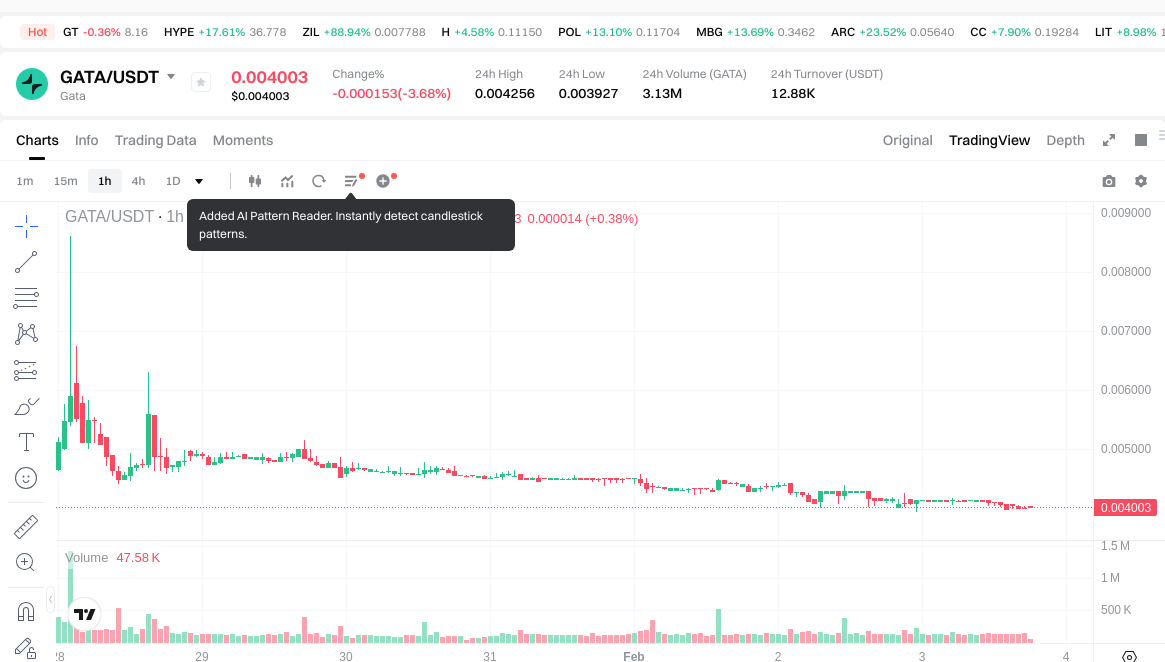
GATA is an emerging digital asset in the cryptocurrency sector that has been operating on the BSC (Binance Smart Chain) network. As of February 3, 2026, GATA holds a market capitalization of approximately $980,734.99 with a circulating supply of 245,000,000 tokens out of a maximum supply of 1,000,000,000 tokens. The current trading price stands at around $0.004003. Gata is building advanced decentralized AI inference and training technologies, enabling large-scale AI models to collaborate efficiently across globally distributed GPUs. This positioning has drawn attention from market participants interested in the intersection of artificial intelligence and blockchain technology. This article provides a comprehensive analysis of GATA's investment characteristics, historical price performance, future price considerations, and associated investment risks to serve as a reference for potential investors evaluating this digital asset.
I. Gata (GATA) Historical Price Review and Current Investment Value
- 2025: On September 24, 2025, GATA recorded a notable price level at $0.09911, which represented a significant point in its trading history. Following this period, the token experienced substantial price movement.
- 2026: Between early 2025 and February 2, 2026, GATA underwent considerable price fluctuation, with the price declining from the September 2025 level to approximately $0.003927.
- Current Period: As of February 3, 2026, GATA is trading at $0.004003, reflecting varied market dynamics over the past months.
Current GATA Investment Market Status (February 2026)
- GATA current price: $0.004003
- 24-hour trading volume: $12,860.09
- Token holders: 4,619 addresses
- Circulating supply: 245,000,000 GATA (24.5% of total supply)
- Market capitalization: $980,734.99
Click to view real-time GATA market price
II. Core Factors Affecting Whether GATA is a Good Investment (Is Gata(GATA) a Good Investment)
Supply Mechanism and Scarcity (GATA investment scarcity)
- Maximum supply capped at 1,000,000,000 tokens with current circulating supply of 245,000,000 (24.5% circulation ratio) → impacts price dynamics and investment considerations
- Circulating supply represents less than one-quarter of total supply → potential for future dilution as additional tokens enter circulation
- Investment consideration: the fixed maximum supply establishes an upper boundary, though substantial uncirculated supply may influence future price behavior
Institutional Investment and Mainstream Adoption (Institutional investment in GATA)
- Current holder count stands at 4,619 addresses → indicates early-stage adoption level
- Token listed on 5 exchanges with Gate.com trading availability → provides basic market access
- Project focuses on decentralized AI inference and training technologies enabling large-scale AI model collaboration across distributed GPUs → positions within AI and decentralized computing sectors
Macroeconomic Environment's Impact on GATA Investment
- As a small-cap asset with market capitalization of approximately $980,735 and 24-hour trading volume of $12,860 → susceptible to broader cryptocurrency market trends and risk sentiment
- Market dominance of 0.00014% → indicates minimal market share and higher volatility exposure
- Price movements show correlation with general cryptocurrency market conditions → broader economic factors including monetary policy shifts may indirectly affect investment performance
Technology and Ecosystem Development (Technology & Ecosystem for GATA investment)
- Core technology: advanced decentralized AI inference and training capabilities → targets efficiency in large-scale AI model collaboration across globally distributed GPU networks
- Technical foundation: BEP20 standard token deployed on BSC (Binance Smart Chain) → provides compatibility with BSC ecosystem infrastructure
- Documentation available through GitBook whitepaper → offers technical specification transparency for evaluation
- Application focus: decentralized AI infrastructure → addresses growing demand for distributed computing resources in AI applications
III. GATA Future Investment Prediction and Price Outlook (Is Gata(GATA) worth investing in 2026-2031)
Short-term Investment Prediction (2026, short-term GATA investment outlook)
- Conservative Forecast: $0.0038 - $0.0040
- Neutral Forecast: $0.0040 - $0.0042
- Optimistic Forecast: $0.0042 - $0.0045
Mid-term Investment Outlook (2027-2028, mid-term Gata(GATA) investment forecast)
- Market Stage Expectation: During this period, GATA may experience moderate growth as the project continues to develop its decentralized AI infrastructure and expand its GPU network capabilities.
- Investment Return Prediction:
- 2027: $0.0038 - $0.0060
- 2028: $0.0036 - $0.0073
- Key Catalysts: The advancement of decentralized AI inference and training technologies, expansion of the global distributed GPU network, and broader adoption of AI-related blockchain solutions.
Long-term Investment Outlook (Is GATA a good long-term investment?)
- Baseline Scenario: $0.0040 - $0.0087 (assuming steady development of the platform and gradual market acceptance)
- Optimistic Scenario: $0.0087 - $0.0117 (assuming significant adoption of decentralized AI solutions and favorable market conditions)
- Risk Scenario: Below $0.0038 (under conditions of prolonged market downturn or failure to achieve technical milestones)
Click to view GATA long-term investment and price prediction: Price Prediction
2026-02-03 - 2031 Long-term Outlook
- Base Scenario: $0.0040 - $0.0070 (corresponding to steady progress and gradual mainstream application growth)
- Optimistic Scenario: $0.0087 - $0.0117 (corresponding to large-scale adoption and favorable market environment)
- Transformative Scenario: Above $0.0117 (subject to breakthrough ecosystem developments and mainstream penetration)
- 2031-12-31 Predicted High: $0.0117 (based on optimistic development assumptions)
Disclaimer: The above predictions are based on historical data analysis and market trend assessments. Cryptocurrency markets are highly volatile and subject to various risk factors. Past performance does not guarantee future results. Investors should conduct thorough research and consider their risk tolerance before making investment decisions.
| Year |
Predicted High Price |
Predicted Average Price |
Predicted Low Price |
Price Change |
| 2026 |
0.00452339 |
0.004003 |
0.00380285 |
0 |
| 2027 |
0.00601110495 |
0.004263195 |
0.0038368755 |
6 |
| 2028 |
0.0072947529645 |
0.005137149975 |
0.00364737648225 |
28 |
| 2029 |
0.007769939337187 |
0.00621595146975 |
0.005842994381565 |
55 |
| 2030 |
0.010349559197133 |
0.006992945403468 |
0.004055908334011 |
75 |
| 2031 |
0.011706190605406 |
0.008671252300301 |
0.004422338673153 |
117 |
IV. Gata Investment Strategy and Risk Management (How to invest in AI Infrastructure tokens)
Investment Methodology (Gata investment strategy)
-
Long-term Holding (HODL Gata): Suitable for conservative investors who believe in the long-term potential of decentralized AI infrastructure. This approach involves accumulating GATA tokens during market downturns and holding through volatility cycles, focusing on the project's fundamental development rather than short-term price movements.
-
Active Trading: Relies on technical analysis and swing trading strategies. Given GATA's price volatility (24-hour change: -3.09%, 7-day change: -9.36%), traders may capitalize on price fluctuations using chart patterns, volume indicators, and support/resistance levels. The token's 24-hour trading volume of approximately $12,860 suggests moderate liquidity for active trading strategies.
Risk Management (Risk management for Gata investment)
-
Asset Allocation Ratio:
- Conservative investors: Allocate no more than 1-3% of total crypto portfolio to GATA, given its current ranking (#2523) and market volatility.
- Aggressive investors: May allocate 5-10% for higher risk-reward potential, particularly if bullish on decentralized AI infrastructure.
- Professional investors: Consider strategic allocation of 3-7% with active rebalancing based on market conditions and project milestones.
-
Risk Hedging Solutions: Implement multi-asset portfolio diversification across different cryptocurrency categories (Layer-1 protocols, DeFi, stablecoins) to mitigate sector-specific risks. Consider using stablecoin positions or hedging instruments during periods of high market uncertainty.
-
Secure Storage:
- Cold wallet storage: Recommended for long-term holdings (hardware wallets such as Ledger or Trezor).
- Hot wallet solutions: For active trading portions, use reputable exchange wallets or software wallets with two-factor authentication.
- Contract verification: GATA's BSC contract address (0x46ee3bfc281d59009ccd06f1dd6abdbfcd82ffc3) should be verified before any transaction to avoid scam tokens.
V. Gata Investment Risks and Challenges (Risks of investing in AI Infrastructure tokens)
-
Market Risk: GATA exhibits significant price volatility, with a 30-day decline of -41.57% and a 1-year decline of -97.32%. The token's current price of $0.004003 represents a substantial decrease from its all-time high of $0.09911 (recorded on September 24, 2025), indicating potential for continued price fluctuations. The relatively low market capitalization ($980,735) and modest trading volume suggest susceptibility to large price swings from concentrated trading activity.
-
Regulatory Risk: As a BEP20 token operating in the AI and blockchain infrastructure space, GATA faces evolving regulatory frameworks across different jurisdictions. Policy changes regarding cryptocurrency trading, AI technology regulation, or cross-border data flow could impact the project's development trajectory and token value. Investors should monitor regulatory developments in major markets.
-
Technical Risk:
- Network security vulnerabilities: As the project builds decentralized AI inference and training infrastructure across distributed GPUs, potential security exploits in smart contracts or network protocols could compromise user assets or system integrity.
- Upgrade challenges: Technical implementation of large-scale AI model collaboration across globally distributed infrastructure presents complex engineering challenges that could face delays or technical failures.
- Smart contract risk: Despite operating on the BSC network, investors should be aware of potential bugs or vulnerabilities in the token's smart contract code.
VI. Conclusion: Is AI Infrastructure token a Good Investment?
-
Investment Value Summary: Gata presents a speculative investment opportunity in the emerging decentralized AI infrastructure sector. While the project's focus on enabling large-scale AI models to collaborate across distributed GPUs addresses a growing market need, the token has experienced considerable price depreciation (-97.32% over one year) and maintains a relatively small market presence (ranking #2523, with market dominance of 0.00014%). The circulating supply represents 24.5% of total supply, suggesting potential future dilution risks. Long-term investment potential depends heavily on successful technical execution and broader adoption of decentralized AI infrastructure.
-
Investor Recommendations:
✅ Beginners: Consider dollar-cost averaging (DCA) with small amounts only after thorough research. Prioritize secure storage using hardware wallets, and avoid investing more than you can afford to lose given the token's high volatility and early-stage nature.
✅ Experienced Investors: May explore swing trading opportunities based on technical patterns, but should maintain strict stop-loss disciplines. Portfolio allocation should remain limited (3-5% maximum) with active monitoring of project development milestones and market sentiment.
✅ Institutional Investors: Could consider strategic long-term positioning if bullish on decentralized AI infrastructure, but should conduct comprehensive due diligence on technical architecture, team capabilities, and competitive positioning. Position sizing should reflect the high-risk, early-stage nature of the project.
⚠️ Disclaimer: Cryptocurrency investment carries significant risks, including potential total loss of capital. This analysis is for informational purposes only and does not constitute financial, investment, or legal advice. Investors should conduct independent research and consult with qualified financial advisors before making investment decisions.
VII. FAQ
Q1: What is GATA and what makes it different from other cryptocurrency projects?
GATA is a BEP20 token operating on the Binance Smart Chain that focuses on building advanced decentralized AI inference and training technologies. The project enables large-scale AI models to collaborate efficiently across globally distributed GPU networks, positioning itself at the intersection of artificial intelligence and blockchain technology. Unlike traditional cryptocurrency projects, GATA addresses the growing demand for decentralized computing resources in AI applications by creating infrastructure that allows distributed GPU networks to work together seamlessly for AI model training and inference tasks.
Q2: How has GATA performed historically and what is its current market position?
GATA has experienced significant price volatility since its launch. The token reached an all-time high of $0.09911 on September 24, 2025, but has since declined substantially. As of February 3, 2026, GATA trades at approximately $0.004003, representing a 97.32% decrease from its peak over one year. The token currently maintains a market capitalization of approximately $980,735 with a market ranking of #2523 and market dominance of 0.00014%. The circulating supply stands at 245,000,000 tokens (24.5% of the 1,000,000,000 maximum supply), with 4,619 holder addresses and a 24-hour trading volume of approximately $12,860.
Q3: What are the main risks associated with investing in GATA?
GATA carries several significant investment risks. Market risk is substantial, evidenced by the 97.32% price decline over one year and 41.57% decline over 30 days, indicating high volatility. The relatively low market capitalization and modest trading volume make the token susceptible to large price swings. Technical risks include potential vulnerabilities in smart contracts, challenges in implementing complex distributed AI infrastructure, and possible delays in achieving technical milestones. Regulatory uncertainty surrounding both cryptocurrency and AI technology regulation adds another layer of risk. Additionally, with only 24.5% of total supply currently in circulation, future token releases could create dilution pressure on price.
Q4: What is the price outlook for GATA in 2026 and beyond?
Short-term predictions for 2026 suggest a conservative forecast range of $0.0038 - $0.0040, with neutral forecasts between $0.0040 - $0.0042 and optimistic scenarios reaching $0.0042 - $0.0045. Mid-term outlook (2027-2028) shows potential ranges of $0.0038 - $0.0060 for 2027 and $0.0036 - $0.0073 for 2028, contingent on successful development of decentralized AI infrastructure and market adoption. Long-term projections through 2031 indicate a baseline scenario of $0.0040 - $0.0087, an optimistic scenario of $0.0087 - $0.0117, and a risk scenario below $0.0038. These predictions assume continued platform development, though actual performance will depend on market conditions, technical execution, and adoption rates.
Q5: How should different types of investors approach GATA investment?
Investment approach should vary significantly based on investor experience and risk tolerance. Beginners should consider dollar-cost averaging with small amounts only after thorough research, prioritizing secure hardware wallet storage and investing only what they can afford to lose entirely. Experienced investors may explore swing trading opportunities using technical analysis but should maintain strict stop-loss disciplines and limit portfolio allocation to 3-5% maximum. Institutional investors could consider strategic long-term positioning if bullish on decentralized AI infrastructure, but must conduct comprehensive due diligence on technical architecture, team capabilities, and competitive positioning. All investor categories should recognize GATA as a high-risk, early-stage project requiring active monitoring.
Q6: What factors could drive GATA's value in the future?
Several key factors could influence GATA's future value proposition. Technical advancement in decentralized AI inference and training capabilities represents a primary catalyst, particularly successful implementation of large-scale AI model collaboration across distributed GPU networks. Broader market adoption of AI-related blockchain solutions and growing demand for decentralized computing resources could drive increased usage. Expansion of the global distributed GPU network and achievement of major technical milestones would strengthen fundamental value. Additionally, favorable macroeconomic conditions in cryptocurrency markets, increased institutional interest in AI infrastructure projects, and successful ecosystem partnerships could positively impact token value. Conversely, failure to deliver on technical promises or prolonged cryptocurrency market downturns could suppress price performance.
Q7: What security measures should investors take when holding GATA?
Investors should implement multiple layers of security protection for GATA holdings. For long-term holdings, cold wallet storage using hardware wallets such as Ledger or Trezor is strongly recommended to minimize exposure to online threats. Active traders may use hot wallet solutions including reputable exchange wallets or software wallets, but should enable two-factor authentication and use strong, unique passwords. Before any transaction, investors must verify GATA's BSC contract address (0x46ee3bfc281d59009ccd06f1dd6abdbfcd82ffc3) to avoid scam tokens or phishing attempts. Regular security audits of wallet software, avoiding suspicious links, and maintaining separate devices for cryptocurrency transactions can further enhance asset protection. Never share private keys or seed phrases with anyone under any circumstances.
Q8: Is GATA suitable for long-term investment compared to short-term trading?
The suitability of GATA for long-term versus short-term strategies depends on individual investment objectives and market perspectives. Long-term holding (HODL strategy) suits conservative investors who believe in the fundamental potential of decentralized AI infrastructure and can tolerate significant volatility while focusing on multi-year development timelines rather than short-term price movements. This approach requires conviction in the project's technical vision and patience through market cycles. Short-term trading may be more appropriate for experienced traders who can capitalize on GATA's substantial price volatility (evidenced by recent price swings) using technical analysis and disciplined risk management. However, the token's relatively low trading volume ($12,860 daily) may create liquidity challenges for larger short-term positions. Both approaches carry significant risks given GATA's early-stage nature and historical price depreciation.
* The information is not intended to be and does not constitute financial advice or any other recommendation of any sort offered or endorsed by Gate.