Is GT-Protocol (GTAI) a good investment?: A Comprehensive Analysis of Market Potential, Risk Factors, and Investment Outlook for 2024

Introduction: GT-Protocol (GTAI) Investment Position and Market Outlook
GTAI is a notable asset in the cryptocurrency sector, launched in 2024 with a focus on AI-driven portfolio management and trading across CeFi, DeFi, and NFT markets. As of February 2026, GTAI holds a market capitalization of approximately $1.18 million, with a circulating supply of around 40.58 million tokens and a current price of $0.02907. Positioned as a Web3 AI execution platform, GT-Protocol aims to make sophisticated investment strategies accessible through conversational AI interfaces. With its integration capabilities across Web3 and Web2 platforms, GTAI has become a subject of interest when investors consider "Is GT-Protocol (GTAI) a good investment?" This article provides a comprehensive analysis of GTAI's investment value, historical price movements, future price projections, and associated risks to serve as a reference for potential investors.
I. GT-Protocol (GTAI) Price History Review and Investment Value Status
GTAI Historical Price Performance and Investment Returns (GT-Protocol (GTAI) investment performance)
-
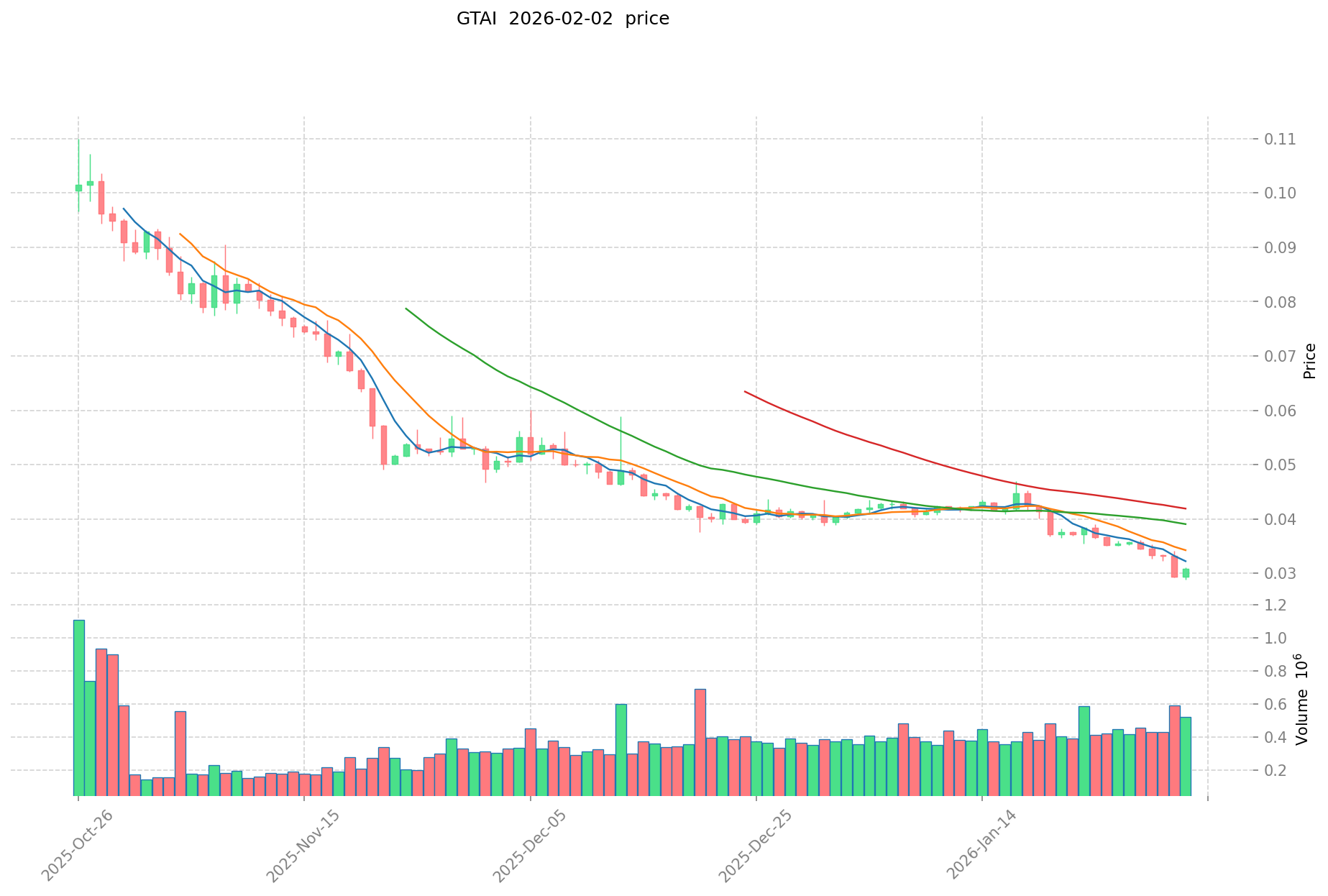
2024: GTAI reached a peak of $5.4994 in March 2024, representing a significant milestone for early investors who participated in the $0.2 launch price, achieving returns exceeding 2,600%. However, momentum gradually weakened following this period.
-
2025-2026: Market conditions shifted notably as GTAI experienced substantial price corrections. From mid-2024 levels, the token declined to approximately $0.02907 by early February 2026, reflecting broader market cycle adjustments.
-
February 2026: GTAI recorded its lowest observed price level of $0.02736 on February 2, 2026, followed by a modest recovery to $0.02907 by February 3, 2026, indicating potential stabilization attempts amid challenging market conditions.
Current GTAI Investment Market Status (February 2026)
- Current GTAI Price: $0.02907
- Market Sentiment (Fear & Greed Index): Data indicates cautious investor positioning
- 24-Hour Trading Volume: $18,812.78 across 8 exchanges
- Token Circulation: 40,576,979.24 GTAI (54.10% of total supply) with market capitalization of approximately $1.18 million
- Institutional Holdings: Limited visibility on major institutional positions at current market conditions
Click to view real-time GTAI market price
Note: GT-Protocol operates as a Web3 AI execution platform serving CeFi, DeFi, and NFT markets with AI-portfolio management capabilities. The platform targets democratized investment access through AI-conversational interfaces, though current market valuations suggest investors should carefully assess technology adoption rates and competitive positioning within the evolving AI-crypto intersection.
II. Core Factors Influencing Whether GTAI is a Good Investment
Supply Mechanism and Scarcity (GTAI Investment Scarcity)
- Total Supply: 75,000,000 GTAI tokens with a maximum supply cap of 75,000,000 tokens
- Current Circulating Supply: approximately 40,576,979 tokens (54.1% of total supply)
- Market Cap to Fully Diluted Valuation ratio stands at 54.1%, indicating over half of the total supply is already in circulation
- The fixed supply cap may contribute to potential scarcity dynamics as adoption increases
- Investment Consideration: the controlled supply model represents a structural characteristic that may influence long-term value considerations
Institutional Investment and Mainstream Adoption (Institutional Investment in GTAI)
- Holder Base: currently tracked at 18,487 holders according to available data
- Exchange Presence: listed on 8 cryptocurrency exchanges, providing multiple access points for market participants
- Trading Activity: 24-hour trading volume of approximately $18,812.78 reflects current market liquidity levels
- The token follows the BEP20 standard and is deployed on the BSC (Binance Smart Chain) network
- Broader adoption metrics and institutional participation data beyond holder counts were not detailed in available materials
Macroeconomic Environment's Impact on GTAI Investment
- General market conditions affect cryptocurrency investments broadly, though specific correlations to macroeconomic indicators for GTAI were not detailed in available materials
- As a Web3 AI-focused project, GTAI operates within both the artificial intelligence and decentralized finance sectors, which may respond differently to various economic conditions
- Market dominance currently stands at 0.000078%, positioning GTAI as a smaller-cap asset in the broader cryptocurrency market
- The intersection of AI technology trends and cryptocurrency adoption may create unique dynamics independent of traditional economic cycles
Technology and Ecosystem Development (Technology & Ecosystem for GTAI Investment)
- Core Technology: GT-Protocol leverages Web3 AI execution technology for portfolio management and trading across CeFi, DeFi, and NFT markets
- User Interface: features an AI conversational interface that responds to prompts and voice commands, designed to make investment strategies accessible
- Integration Capability: engineered for seamless integration with both Web3 and Web2 platforms
- Strategic Vision: the project aims to onboard 100 million users by creating an AI layer for Web3 to democratize investment opportunities
- Ecosystem Applications: the protocol addresses AI-portfolio management, AI-trading, and investment functionalities across multiple market segments including centralized finance, decentralized finance, and NFT markets
III. GTAI Future Investment Forecast and Price Outlook (Is GT-Protocol(GTAI) Worth Investing in 2026-2031)
Short-Term Investment Forecast (2026, Short-term GTAI Investment Outlook)
- Conservative Forecast: $0.0160 - $0.0250
- Neutral Forecast: $0.0250 - $0.0291
- Optimistic Forecast: $0.0291 - $0.0314
Mid-Term Investment Outlook (2027-2029, Mid-term GT-Protocol(GTAI) Investment Forecast)
-
Market Stage Expectations: The mid-term outlook suggests gradual price appreciation as the project develops its AI-driven trading tools and portfolio management systems. Market adoption of AI trading solutions may influence performance during this phase.
-
Investment Return Forecast:
- 2027: $0.0251 - $0.0408
- 2028: $0.0202 - $0.0426
- 2029: $0.0266 - $0.0461
-
Key Catalysts: Expansion of AI trading bot functionality, development of social trading platform features, potential integration with additional Web3 and Web2 platforms, and market sentiment toward AI-driven DeFi solutions.
Long-Term Investment Outlook (Is GTAI a Good Long-term Investment?)
- Base Scenario: $0.0383 - $0.0528 (assuming steady development of AI trading infrastructure and moderate user adoption through 2030-2031)
- Optimistic Scenario: $0.0528 - $0.0697 (contingent on successful platform expansion, increased trading volume, and favorable market conditions for AI-powered financial tools)
- Risk Scenario: $0.0160 - $0.0383 (reflecting potential market downturns, competitive pressures, or slower-than-expected adoption of AI trading solutions)
For detailed GTAI long-term investment and price forecasts, visit: Price Prediction
2026-02-03 to 2031 Long-Term Outlook
- Base Scenario: $0.0383 - $0.0528 (corresponding to steady progress and gradual mainstream application advancement)
- Optimistic Scenario: $0.0528 - $0.0697 (corresponding to large-scale adoption and favorable market environment)
- Transformative Scenario: Above $0.0697 (contingent on breakthrough ecosystem developments and mainstream penetration)
- 2031-12-31 Projected High: $0.0697 (based on optimistic development assumptions)
Disclaimer: Price forecasts are based on historical data analysis and predictive models. Cryptocurrency markets exhibit high volatility, and actual outcomes may differ materially from projections. These forecasts do not constitute investment advice, and investors should conduct independent research and consult financial professionals before making investment decisions.
| Year | Predicted High Price | Predicted Average Price | Predicted Low Price | Price Change |
|---|---|---|---|---|
| 2026 | 0.0313956 | 0.02907 | 0.0159885 | 0 |
| 2027 | 0.04081428 | 0.0302328 | 0.025093224 | 4 |
| 2028 | 0.042628248 | 0.03552354 | 0.0202484178 | 22 |
| 2029 | 0.04610955492 | 0.039075894 | 0.02657160792 | 34 |
| 2030 | 0.0630372322008 | 0.04259272446 | 0.038333452014 | 46 |
| 2031 | 0.069715771396128 | 0.0528149783304 | 0.04225198266432 | 81 |
IV. GTAI Investment Strategy and Risk Management (How to invest in AI-powered Web3 protocols)
Investment Methodology (GTAI investment strategy)
-
Long-term Holding (HODL GTAI): This approach suits conservative investors who believe in the protocol's long-term vision of democratizing investment opportunities through AI-powered Web3 technology. Given GTAI's focus on integrating AI execution across CeFi, DeFi, and NFT markets, holding may benefit from gradual ecosystem development and user adoption progress.
-
Active Trading: Traders relying on technical analysis and swing trading strategies may find opportunities in GTAI's price movements. The token has exhibited notable volatility, with a 24-hour change of -5.68% and weekly fluctuation of -18.19% as of February 3, 2026. Active traders should monitor short-term price patterns, trading volume trends (currently $18,812.78 in 24-hour volume), and support/resistance levels between the recent low of $0.02736 and high of $0.0311.
Risk Management (Risk management for GTAI investment)
-
Asset Allocation Ratio:
- Conservative investors: Consider limiting GTAI exposure to 1-3% of crypto portfolio
- Moderate investors: May allocate 3-7% depending on risk tolerance
- Experienced investors: Could consider up to 10% allocation with strict position management
-
Risk Hedging Solutions: Diversify across multiple blockchain protocols and AI-related tokens to reduce concentration risk. Consider balancing GTAI holdings with established cryptocurrencies and stablecoins to manage overall portfolio volatility.
-
Secure Storage:
- Cold wallets: Hardware wallets for long-term storage of significant GTAI holdings
- Hot wallets: Use reputable software wallets for active trading amounts only
- Security practices: Enable two-factor authentication and regularly verify the contract address (0x003d87d02A2A01E9E8a20f507C83E15DD83A33d1 on BSC) before transactions
V. GTAI Investment Risks and Challenges (Risks of investing in AI-powered Web3 protocols)
-
Market Risk: GTAI demonstrates substantial price volatility, with a 30-day decline of -30.74% and one-year change of -91.84% as of February 3, 2026. The current price of $0.02907 represents a considerable distance from its previous level of $5.4994 reached on March 10, 2024. The relatively modest 24-hour trading volume of approximately $18,812 may indicate lower liquidity, potentially leading to increased price slippage during larger transactions.
-
Regulatory Risk: AI-powered trading protocols may face evolving regulatory scrutiny across different jurisdictions. As governments develop frameworks for AI applications in financial services and cryptocurrency trading automation, compliance requirements could impact the protocol's operations and token utility. Policy uncertainty surrounding both cryptocurrency regulations and AI governance creates potential operational challenges.
-
Technical Risk: The integration of AI execution technology with Web3 infrastructure introduces complex technical dependencies. Potential vulnerabilities include smart contract security concerns, AI algorithm accuracy and reliability, integration issues between Web2 and Web3 platforms, and challenges in maintaining the conversational interface functionality. The protocol's BEP20 token standard implementation relies on BSC network security and performance.
VI. Conclusion: Is AI-powered Web3 protocol investment a Good Investment?
-
Investment Value Summary: GTAI represents an emerging approach to combining AI technology with decentralized finance, offering potential opportunities in portfolio management and trading automation across multiple markets. However, the token has experienced substantial price declines and demonstrates ongoing volatility. The protocol's circulating supply of approximately 40.58 million tokens represents 54.10% of the maximum supply of 75 million tokens, with a market capitalization of approximately $1.18 million as of February 3, 2026.
-
Investor Recommendations:
✅ Beginners: Consider dollar-cost averaging with small amounts while learning about AI-Web3 protocols. Prioritize secure wallet storage and understand the technology before increasing position size.
✅ Experienced Investors: May explore swing trading opportunities based on technical analysis while maintaining strict risk management. Consider GTAI as a small portion of a diversified portfolio focused on AI and DeFi sectors.
✅ Institutional Investors: Conduct thorough due diligence on the protocol's technology infrastructure, team credentials, competitive positioning, and long-term viability before considering strategic allocation.
⚠️ Notice: Cryptocurrency investment carries substantial risk. This content is for informational purposes only and does not constitute investment advice. Conduct independent research and consider your financial situation before making investment decisions.
VII. FAQ
Q1: What is GT-Protocol (GTAI) and how does its AI technology work?
GT-Protocol (GTAI) is a Web3 AI execution platform that leverages artificial intelligence for portfolio management and trading across CeFi, DeFi, and NFT markets. The platform features an AI conversational interface that responds to prompts and voice commands, designed to make sophisticated investment strategies accessible to users. GTAI operates on the BSC (Binance Smart Chain) network as a BEP20 token and aims to democratize investment opportunities by creating an AI layer for Web3. The protocol's technology integrates seamlessly with both Web3 and Web2 platforms, offering AI-driven trading automation and portfolio management capabilities.
Q2: How has GTAI performed historically as an investment?
GTAI has experienced significant volatility since its launch in 2024. The token reached a peak price of $5.4994 in March 2024, delivering returns exceeding 2,600% for early investors who participated at the $0.2 launch price. However, the token subsequently declined substantially, falling to approximately $0.02907 by February 3, 2026, representing a one-year decline of -91.84%. Recent short-term performance shows a 24-hour change of -5.68%, a weekly decline of -18.19%, and a 30-day decrease of -30.74%. This volatility reflects broader market cycle adjustments and highlights the high-risk nature of this investment.
Q3: What are the price predictions for GTAI from 2026 to 2031?
According to predictive models based on historical data analysis, GTAI price forecasts vary significantly across different scenarios. For 2026, the conservative forecast ranges from $0.0160 to $0.0250, while the optimistic scenario projects $0.0291 to $0.0314. Mid-term outlook for 2027-2029 suggests gradual appreciation, with 2029 projections ranging from $0.0266 to $0.0461. Long-term outlook through 2031 presents a base scenario of $0.0383 to $0.0528, an optimistic scenario of $0.0528 to $0.0697, and a transformative scenario above $0.0697. However, these forecasts do not constitute investment advice and actual outcomes may differ materially due to market volatility.
Q4: What are the main risks associated with investing in GTAI?
GTAI investment carries several significant risks. Market risk includes substantial price volatility, with the token demonstrating a 30-day decline of -30.74% and relatively modest 24-hour trading volume of $18,812, which may result in lower liquidity and increased price slippage. Regulatory risk stems from evolving frameworks for AI applications in financial services and cryptocurrency trading automation across different jurisdictions. Technical risks involve smart contract security concerns, AI algorithm accuracy and reliability, integration challenges between Web2 and Web3 platforms, and dependencies on BSC network security and performance. Additionally, the token has experienced a considerable distance from its all-time high, indicating sustained downward pressure.
Q5: How should different types of investors approach GTAI investment?
Investment approach should vary based on investor experience level. Beginners should consider dollar-cost averaging with small amounts while learning about AI-Web3 protocols, prioritize secure wallet storage, and understand the technology before increasing position size. Experienced investors may explore swing trading opportunities based on technical analysis while maintaining strict risk management, treating GTAI as a small portion (3-7%) of a diversified portfolio focused on AI and DeFi sectors. Institutional investors should conduct thorough due diligence on the protocol's technology infrastructure, team credentials, competitive positioning, and long-term viability before considering strategic allocation. All investors should implement proper asset allocation, with conservative investors limiting exposure to 1-3% of their crypto portfolio.
Q6: What factors influence GTAI's investment value and potential?
Several core factors influence GTAI's investment value. The supply mechanism features a fixed total supply of 75 million tokens with approximately 40.58 million (54.1%) currently in circulation, creating potential scarcity dynamics. The protocol's technology and ecosystem development includes AI-driven portfolio management and trading capabilities across CeFi, DeFi, and NFT markets, with a strategic vision to onboard 100 million users. Current market metrics show 18,487 holders and listing on 8 cryptocurrency exchanges, though institutional participation data remains limited. The project's intersection of AI technology trends and cryptocurrency adoption may create unique dynamics independent of traditional economic cycles, though its market dominance currently stands at only 0.000078% of the broader cryptocurrency market.
Share
Content
Introduction: GT-Protocol (GTAI) Investment Position and Market Outlook
I. GT-Protocol (GTAI) Price History Review and Investment Value Status
II. Core Factors Influencing Whether GTAI is a Good Investment
III. GTAI Future Investment Forecast and Price Outlook (Is GT-Protocol(GTAI) Worth Investing in 2026-2031)
IV. GTAI Investment Strategy and Risk Management (How to invest in AI-powered Web3 protocols)
V. GTAI Investment Risks and Challenges (Risks of investing in AI-powered Web3 protocols)
VI. Conclusion: Is AI-powered Web3 protocol investment a Good Investment?
VII. FAQ
How to Buy Cryptocurrency


Trending Cryptocurrencies



What will be the market capitalization of USDC in 2025? Analysis of the stablecoin market landscape.

How is DeFi different from Bitcoin?

What is DeFi: Understanding Decentralized Finance in 2025

USDC stablecoin 2025 Latest Analysis: Principles, Advantages, and Web3 Eco-Applications

Development of Decentralized Finance Ecosystem in 2025: Integration of Decentralized Finance Applications with Web3

2025 USDT USD Complete Guide: A Must-Read for Newbie Investors

What is VERT: A Comprehensive Guide to Vertical Exchange and Routing Technology

What is QSP: A Comprehensive Guide to Quality System Procedures in Modern Manufacturing
Everything About Pepecoin: A Comprehensive Guide
What is WAMPL: A Comprehensive Guide to Web Application Markup and Programming Language
What is ISLAND: A Comprehensive Guide to Understanding Island Formation, Geography, and Ecological Significance