Is iExec (RLC) a good investment? A Comprehensive Analysis of the Decentralized Cloud Computing Platform's Potential and Risks in 2024


Introduction: iExec (RLC) Investment Position and Market Prospects
RLC is an important asset in the cryptocurrency field. As the native token of iExec, the first virtual cloud resource marketplace, RLC has established its role in the decentralized computing ecosystem. As of December 2025, RLC maintains a market capitalization of approximately $53.42 million USD, with a circulating supply of approximately 72.38 million tokens and a current price hovering around $0.614 USD. With its positioning as a utility token for renting servers, data, and applications on the iExec platform, RLC has gradually become a focal point when investors discuss the investment potential of decentralized cloud computing assets.
RLC's historical performance reveals significant volatility, having reached an all-time high of $15.51 USD in May 2021 and a low of $0.153815 USD in December 2018, reflecting the dynamic nature of the cryptocurrency market and the evolving demand for decentralized computing resources. Currently ranked 534 in global cryptocurrency market capitalization with a market dominance of 0.0017%, RLC operates on the Ethereum blockchain and is traded across 27 exchanges, indicating steady liquidity and accessibility for market participants.
This article will provide a comprehensive analysis of RLC's investment value, historical price trends, future price projections, and associated investment risks to serve as a reference for investors evaluating this digital asset.
iExec (RLC) Market Analysis Report
I. RLC Historical Price Review and Current Investment Status
RLC Historical Price Movements and Investment Performance
Based on available data as of December 18, 2025:
- All-time high (ATH): USD 15.51 (May 11, 2021) → Peak valuation period during cryptocurrency bull market
- All-time low (ATL): USD 0.153815 (December 15, 2018) → Market bottom during crypto winter
- One-year performance: Declined 73.09% from previous year levels → Significant downtrend
- 30-day performance: Declined 19.13% → Continued bearish pressure
- 7-day performance: Declined 16.41% → Short-term weakness
Current RLC Market Status (December 18, 2025)
Price Metrics:
- Current Price: USD 0.614
- 24-hour price range: USD 0.6086 - USD 0.6796
- 24-hour change: -7.99% (down USD 0.0533)
- 1-hour change: +0.69% (up USD 0.0042)
Market Capitalization & Liquidity:
- Current Market Cap: USD 44,442,884.51
- Fully Diluted Valuation (FDV): USD 53,417,867.98
- Market Cap to FDV Ratio: 83.20%
- 24-hour Trading Volume: USD 93,909.52
- Market Dominance: 0.0017%
Supply Metrics:
- Circulating Supply: 72,382,548.07 RLC (83.20% of total)
- Total Supply: 86,999,784.99 RLC
- Number of Token Holders: 25,259
- Listed on 27 exchanges
Visit real-time RLC market price
II. Project Overview
Core Value Proposition
iExec is the first virtual cloud resource marketplace on blockchain. The platform enables distributed applications (DApps) running on blockchains to access scalable, secure, and easily deployable services, datasets, and computing resources. RLC serves as the native utility token for the iExec cloud platform, functioning as the medium of exchange for renting servers, data, and applications.
Blockchain Infrastructure
Smart Contract Details:
- Network: Ethereum (ETH)
- Contract Address: 0x607F4C5BB672230e8672085532f7e901544a7375
- Token Standard: ERC-20
III. Project Resources & Community
Official Channels:
- Website: http://iex.ec/
- Twitter: https://twitter.com/iEx_ec
- Reddit: https://www.reddit.com/r/iexec
- Facebook: https://www.facebook.com/iexecteam
Development Resources:
- GitHub repositories including: iexec-sdk, iexec-stack, and PoCo (Proof of Contribution)
- Whitepaper available at: coinspeaker.com
IV. Risk Considerations
Market Position:
- Ranking: #534 among all cryptocurrencies
- Relatively small market cap compared to major digital assets
- Limited trading volume relative to market cap
- Historical volatility: From USD 15.51 to USD 0.153815 represents extreme price fluctuation
Performance Concerns:
- Long-term decline of 73.09% over one year
- Recent 7-day decline of 16.41% indicates continued downward pressure
- Price remains significantly below all-time high (96.04% below ATH)
V. Disclaimer
This report provides factual market data and project information as of December 18, 2025. It does not constitute investment advice, financial recommendation, or solicitation to buy or sell RLC tokens. Cryptocurrency markets are highly volatile and subject to substantial risk. Investors should conduct independent research and consult with qualified financial advisors before making investment decisions.
iExec RLC Comprehensive Investment Analysis Report
Report Date: December 18, 2025
I. Executive Summary
iExec (RLC) is the first virtual cloud resource marketplace on blockchain, operating as a distributed application platform that enables scalable and secure access to computing services, datasets, and applications. As of the report date, RLC trades at $0.614 with a market capitalization of approximately $44.4 million, ranking 534th among cryptocurrencies. The token has experienced significant downward pressure over the long term, declining 73.09% over the past year.
II. Core Factors Influencing RLC Investment Viability
Supply Mechanism and Scarcity
- Current Supply Structure: Total supply is fixed at 86,999,784.9868455 RLC tokens, with 72,382,548.06525737 tokens currently in circulation, representing 83.20% circulation ratio.
- Fully Diluted Valuation: At full circulation, the market capitalization would reach approximately $53.4 million, indicating 16.80% of tokens remain unvested or reserved.
- Supply Impact on Investment: The capped supply mechanism provides theoretical scarcity support, though the current circulation ratio suggests substantial dilution potential as remaining tokens enter circulation.
Technology and Ecosystem Development
- Core Platform Function: iExec operates as a decentralized cloud computing marketplace, enabling users to rent servers, data, and applications through blockchain-based transactions.
- Smart Contract Infrastructure: The project maintains active development across multiple repositories including iexec-sdk, iexec-stack, and PoCo (Proof of Contribution) protocol.
- Ecosystem Participants: The platform has accumulated 25,259 token holders, indicating moderate community engagement and distributed token ownership.
Market Adoption and Trading Activity
- Exchange Distribution: RLC is listed on 27 exchanges, facilitating liquidity and accessibility across multiple trading venues.
- Trading Volume: 24-hour trading volume stands at $93,909.52, indicating relatively modest daily transaction volume relative to market capitalization.
- Network Activity: Active development on GitHub repositories and presence across Twitter and Reddit suggest ongoing community engagement.
III. Market Performance Analysis
Price Trend Assessment
| Time Period | Price Change | Change Amount |
|---|---|---|
| 1 Hour | +0.69% | +$0.0042 |
| 24 Hours | -7.99% | -$0.0533 |
| 7 Days | -16.41% | -$0.1205 |
| 30 Days | -19.13% | -$0.1452 |
| 1 Year | -73.09% | -$1.6677 |
Historical Price Context
- All-Time High: $15.51 (May 11, 2021)
- All-Time Low: $0.153815 (December 15, 2018)
- Current Price Position: Trading 96.04% below all-time high and 299.10% above all-time low
- Price Range (24h): $0.6086 - $0.6796
Market Metrics
- Market Dominance: 0.0017% of total cryptocurrency market
- Market Cap to FDV Ratio: 83.2%, indicating substantial token concentration relative to full dilution
- Market Sentiment: Neutral positioning based on technical indicators
IV. Risk Assessment
Downward Pressure Factors
- Long-Term Decline: 73.09% depreciation over 12 months indicates sustained bearish pressure
- Trading Volume Concerns: Limited 24-hour volume ($93,909.52) relative to market cap suggests potential liquidity constraints
- Market Positioning: Ranked 534th globally indicates limited market recognition and adoption
Technical Indicator Signals
Based on available technical analysis data:
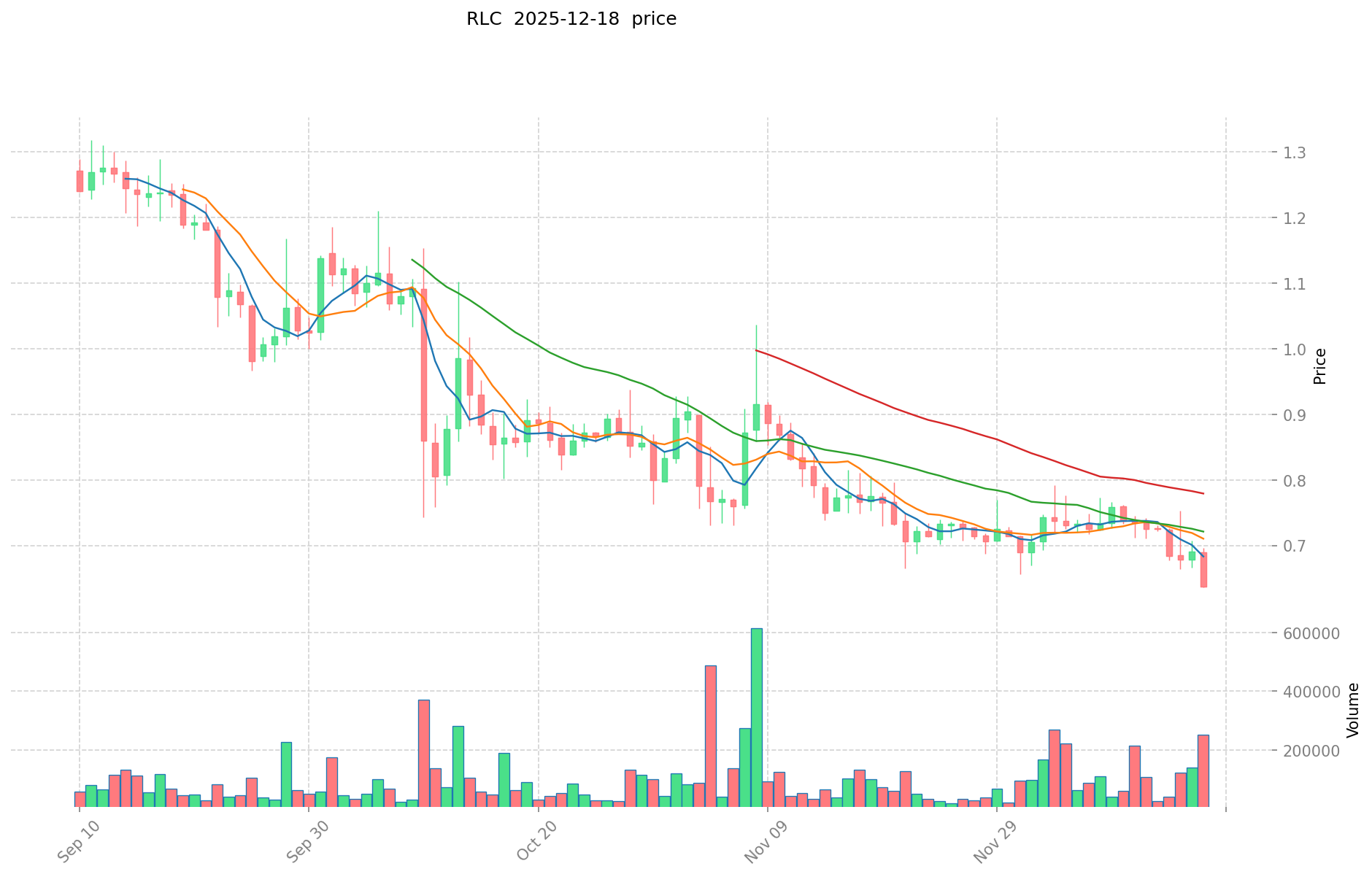
- Multiple moving averages (SMA 3, 5, 10, 21, 50, 100) signal SELL positions
- RSI (14) at 42.60 indicates neutral momentum
- Stochastic indicators suggest neutral positioning
- MACD at 0.00 shows equilibrium with neutral signals
V. Project Resources and Transparency
- Official Website: http://iex.ec/
- Smart Contract Address (Ethereum): 0x607F4C5BB672230e8672085532f7e901544a7375
- Community Channels: Twitter, Reddit, Facebook presence maintained
- Technical Documentation: Active GitHub repositories with public code access
- White Paper: Available documentation on blockchain cloud computing architecture
VI. Important Disclaimer
This report provides factual analysis based on available data as of December 18, 2025, and does not constitute investment advice. Cryptocurrency investments carry substantial risk, including potential total loss of capital. The project's long-term technical decline and modest trading volume present material risks. Investors should conduct independent research, assess personal risk tolerance, and consult qualified financial advisors before making investment decisions.
III. RLC Future Investment Predictions and Price Outlook (Is iExec(RLC) worth investing in 2025-2030)
Short-term Investment Prediction (2025, short-term RLC investment outlook)
- Conservative forecast: $0.57 - $0.64
- Neutral forecast: $0.61 - $0.89
- Optimistic forecast: $0.71 - $0.89
Mid-term Investment Outlook (2026-2028, mid-term iExec(RLC) investment forecast)
- Market stage expectation: Gradual recovery phase with increased adoption of decentralized cloud computing services and potential expansion of the iExec ecosystem.
- Investment return forecast:
- 2026: $0.70 - $0.93
- 2027: $0.57 - $1.09
- 2028: $0.67 - $1.18
- Key catalysts: Mainnet upgrades, enterprise partnerships for distributed computing, growth in DApp ecosystem utilization, and increased demand for decentralized computing resources.
Long-term Investment Outlook (Is iExec(RLC) a good long-term investment?)
- Base case scenario: $0.72 - $1.66 USD (assumes steady ecosystem development and moderate adoption of cloud computing solutions)
- Optimistic scenario: $1.07 - $1.93 USD (assumes breakthrough in enterprise adoption and significant expansion of decentralized computing applications)
- Risk scenario: $0.57 - $0.80 USD (assumes market downturn, competitive pressures, or slower-than-expected ecosystem adoption)
Visit RLC long-term investment and price prediction: Price Forecast
2025-12-18 to 2030 Long-term Outlook
- Base case scenario: $0.72 - $1.66 USD (corresponds to steady advancement and mainstream application development)
- Optimistic scenario: $1.07 - $1.93 USD (corresponds to large-scale adoption and favorable market conditions)
- Transformative scenario: $2.00 USD and above (if ecosystem achieves breakthrough progress and mainstream adoption)
- 2030-12-31 forecast high point: $1.66 USD (based on optimistic development assumptions)
Disclaimer: This analysis is for informational purposes only and does not constitute investment advice. Price predictions involve substantial risks and uncertainties. Past performance does not guarantee future results. Investors should conduct their own research and consult with financial professionals before making investment decisions.
| 年份 | 预测最高价 | 预测平均价格 | 预测最低价 | 涨跌幅 |
|---|---|---|---|---|
| 2025 | 0.89059 | 0.6142 | 0.571206 | 0 |
| 2026 | 0.9329698 | 0.752395 | 0.69972735 | 22 |
| 2027 | 1.087060296 | 0.8426824 | 0.573024032 | 36 |
| 2028 | 1.17714304456 | 0.964871348 | 0.66576123012 | 56 |
| 2029 | 1.5422503626432 | 1.07100719628 | 0.80325539721 | 73 |
| 2030 | 1.659418549916232 | 1.3066287794616 | 0.71864582870388 | 111 |
iExec (RLC) Investment Analysis Report
Executive Summary
iExec (RLC) is the native token of the first virtual cloud resource marketplace on blockchain. As of December 18, 2025, RLC is trading at $0.614 with a market capitalization of $44.44 million, ranking #534 globally. The token has experienced significant downward pressure over the past year, declining 73.09% annually.
I. Project Overview
Project Introduction
iExec is the first virtual cloud resource market built on blockchain technology. It provides distributed applications (DApps) running on blockchains that are scalable, secure, and offer easy access to required services, datasets, and computing resources. RLC is the native token issued by the iExec cloud platform, used for renting servers, data, and applications within the ecosystem.
Token Economics
| Metric | Value |
|---|---|
| Current Price | $0.614 |
| Market Capitalization | $44.44 million |
| Fully Diluted Valuation | $53.42 million |
| Circulating Supply | 72,382,548.07 RLC |
| Total Supply | 86,999,784.99 RLC |
| Circulating Supply Ratio | 83.20% |
| All-Time High | $15.51 (May 11, 2021) |
| All-Time Low | $0.153815 (December 15, 2018) |
| Initial Launch Price | $0.2026 |
| Number of Holders | 25,259 |
| Listed Exchanges | 27 |
II. Market Performance Analysis
Price Trends
| Time Frame | Change | Price Movement |
|---|---|---|
| 1 Hour | +0.69% | +$0.0042 |
| 24 Hours | -7.99% | -$0.0533 |
| 7 Days | -16.41% | -$0.1205 |
| 30 Days | -19.13% | -$0.1452 |
| 1 Year | -73.09% | -$1.6677 |
24-Hour Trading Metrics
- 24-Hour High: $0.6796
- 24-Hour Low: $0.6086
- 24-Hour Trading Volume: $93,909.52
- Market Dominance: 0.0017%
Performance Assessment
RLC demonstrates sustained downward pressure across all timeframes. The 73.09% annual decline and 19.13% monthly decrease indicate significant bearish momentum. The token's distance from its all-time high of $15.51 represents a 96.04% depreciation from peak valuation.
III. On-Chain and Ecosystem Data
Network Information
- Blockchain: Ethereum (ETH)
- Contract Address: 0x607F4C5BB672230e8672085532f7e901544a7375
- Launch Date: April 18, 2017
Community Presence
- Official Website: http://iex.ec/
- Twitter: https://twitter.com/iEx_ec
- Reddit Community: https://www.reddit.com/r/iexec
- GitHub Repositories:
- iexec-sdk
- iexec-stack
- PoCo (Proof of Contribution)
- Facebook: https://www.facebook.com/iexecteam
IV. Investment Strategy and Risk Management
Investment Methodology
Long-Term Holding (HODL RLC)
- Suitable for conservative investors seeking exposure to decentralized cloud computing infrastructure
- Requires tolerance for extended volatility and potential capital depreciation
- Benefits from potential ecosystem adoption growth
Active Trading
- Relies on technical analysis of price action within the $0.60-$0.68 range
- Requires careful entry/exit points given limited 24-hour trading volume of ~$93,909
- High liquidity risk given relatively small daily volume
Risk Management
Asset Allocation Recommendations
- Conservative Investors: 1-3% maximum portfolio allocation
- Aggressive Investors: 3-5% portfolio allocation
- Institutional Investors: Position-dependent based on strategic objectives
Risk Mitigation Strategy
- Multi-asset portfolio diversification to reduce concentration risk
- Consider hedging positions through stablecoins or inverse position structures
- Limit position sizing given low market capitalization ($44.44M) and thin liquidity
Secure Storage
- Cold wallet Storage: Recommended for long-term holdings (hardware wallets, offline storage)
- Hot Wallet Usage: MetaMask, Ledger Live for smaller active trading amounts
- Security Consideration: Use hardware wallets (Ledger Nano S/X, Trezor) for significant holdings
V. Investment Risks and Challenges
Market Risks
- Extreme Volatility: 73% annual decline demonstrates substantial price instability
- Low Liquidity: Limited 24-hour volume of $93,909 creates challenges for significant position entry/exit
- Market Capitalization Risk: $44.44M market cap indicates limited institutional capital and potential for sharp price movements
Regulatory Risks
- Jurisdiction Uncertainty: Cryptocurrency regulatory frameworks vary significantly by country and continue to evolve
- Compliance Requirements: Changes in institutional cryptocurrency classification could impact adoption and trading
- Policy Changes: Future restrictions on blockchain applications or decentralized computing infrastructure
Technical Risks
- Smart Contract Vulnerabilities: Potential security issues in the iExec protocol or integrated DApps
- Network Scalability: Competition from alternative decentralized computing platforms
- Ecosystem Adoption: Reliance on successful adoption of the iExec cloud computing marketplace
VI. Conclusion: Is RLC a Good Investment?
Investment Value Summary
iExec operates in a compelling niche—decentralized cloud computing infrastructure—which addresses genuine market needs for scalable, secure distributed computing resources. However, the token has experienced severe long-term depreciation (-73.09% annually), trading 96% below its all-time high. Current market metrics suggest limited institutional confidence and capital inflows.
Investor Recommendations
✅ Beginners
- Dollar-cost averaging (DCA) strategy to reduce timing risk
- Minimum 1-2% portfolio allocation
- Use hardware wallets for secure long-term storage
- Start with small positions to understand project development
✅ Experienced Investors
- Technical analysis-based swing trading within established support/resistance levels
- Multi-asset portfolio composition to mitigate concentration risk
- Monitor ecosystem developments and partnership announcements
- Maintain risk discipline given low liquidity conditions
✅ Institutional Investors
- Strategic long-term positioning based on decentralized computing infrastructure thesis
- Thorough due diligence on protocol development, governance, and competitive positioning
- Structured entry strategy to minimize slippage given limited market depth
Disclaimer
⚠️ Important Notice: Cryptocurrency investment carries substantial risk, including potential total capital loss. RLC exhibits high volatility, limited liquidity, and significant distance from historical valuations. This report provides informational analysis only and does not constitute investment advice. Conduct independent research and consult qualified financial advisors before making investment decisions. Past performance does not guarantee future results. Regulatory changes could materially impact token value.
Report Generated: December 18, 2025
Data Source: Gate Market Data
Disclaimer: This analysis is for informational purposes only and should not be construed as financial or investment advice.
iExec (RLC) Frequently Asked Questions
I. Project and Technology
Q1: What is iExec (RLC) and how does it function in the decentralized computing ecosystem?
A: iExec is the first virtual cloud resource marketplace built on blockchain technology. It operates as a distributed application (DApp) platform enabling users to access scalable, secure computing services, datasets, and applications through decentralized infrastructure. RLC serves as the native utility token for the iExec platform, functioning as the medium of exchange for renting servers, data, and applications. The project runs on the Ethereum blockchain as an ERC-20 token (contract address: 0x607F4C5BB672230e8672085532f7e901544a7375) and maintains active development across repositories including iexec-sdk, iexec-stack, and the PoCo (Proof of Contribution) protocol.
Q2: What makes iExec different from centralized cloud computing providers?
A: iExec differentiates itself through decentralization, providing a peer-to-peer marketplace for computing resources rather than relying on centralized cloud providers. The blockchain-based infrastructure enables transparent transactions, reduced intermediaries, enhanced security, and distributed resource allocation. Users can rent computing power directly from resource providers without intermediaries, theoretically reducing costs and improving efficiency. The decentralized model also provides censorship resistance and enables access to computing resources across geographic boundaries without centralized control.
Q3: How is RLC token supply structured, and what are the implications for investors?
A: RLC has a fixed total supply of 86,999,784.99 tokens, with 72,382,548.07 tokens currently in circulation (83.20% circulation ratio). The remaining 16.80% of tokens are unvested or reserved for future distribution. This capped supply mechanism provides theoretical scarcity support, but the significant percentage of non-circulating tokens presents dilution risk as additional tokens enter circulation. Investors should monitor token vesting schedules to anticipate supply pressure. The relatively small circulating supply compared to total supply indicates potential for substantial price volatility upon future token releases.
II. Market Performance and Investment Viability
Q4: Why has RLC experienced such significant price decline, and what are the underlying causes?
A: RLC has declined 73.09% over the past 12 months, currently trading at $0.614 compared to $15.51 at its all-time high in May 2021. Multiple factors contribute to this performance: (1) General cryptocurrency market downturn and reduced institutional investment in alternative layer-1 projects; (2) Limited trading volume ($93,909.52 in 24-hour volume) relative to market capitalization, indicating low liquidity and retail-focused trading; (3) Moderate market rank (#534 globally) suggesting limited mainstream adoption and institutional confidence; (4) Slow ecosystem adoption compared to competing decentralized computing platforms; (5) Extended bear market conditions affecting smaller-cap digital assets disproportionately. The project's niche market focus and modest community size (25,259 token holders) further limit capital inflows and price support.
Q5: Is RLC a suitable investment for 2025-2026, and what price targets should investors consider?
A: Investment suitability depends on individual risk tolerance and investment horizon. Short-term forecasts (2025) suggest price ranges of $0.57-$0.89 under various scenarios. Mid-term projections (2026-2028) indicate potential recovery to $0.70-$1.18 if ecosystem adoption accelerates and enterprise partnerships materialize. Long-term scenarios (2030) project $0.72-$1.93 under base-case to optimistic assumptions. However, these forecasts carry substantial uncertainty. Conservative investors should limit allocation to 1-3% of portfolio given low liquidity and high volatility. Price predictions are speculative and should not be treated as guarantees. Past performance (73% annual decline) suggests downside risks remain material.
III. Risk Assessment and Investment Considerations
Q6: What are the primary risks associated with RLC investment, and how should investors manage exposure?
A: Key risks include: (1) Liquidity Risk: Limited 24-hour trading volume creates challenges for significant position entry/exit without substantial slippage; (2) Market Cap Risk: $44.44 million market capitalization makes RLC vulnerable to sharp price movements from relatively small capital flows; (3) Regulatory Risk: Evolving cryptocurrency regulations could impact blockchain infrastructure projects and token valuations; (4) Technology Risk: Smart contract vulnerabilities or protocol obsolescence pose development risks; (5) Adoption Risk: Ecosystem success depends on widespread adoption of decentralized cloud computing services, which remains uncertain; (6) Dilution Risk: 16.80% of non-circulating tokens pending distribution may create future price pressure. Risk management strategies include position sizing (limit to 1-5% of portfolio), dollar-cost averaging entry, diversification across multiple assets, use of hardware wallets for secure storage, and regular monitoring of ecosystem developments.
Q7: What factors should investors monitor to evaluate RLC's investment potential going forward?
A: Monitor these key indicators: (1) Ecosystem Development: Track GitHub repository activity, protocol upgrades, and technical implementation progress; (2) Adoption Metrics: Monitor growth in token holders, exchange listings, and integration with major DApp platforms; (3) Partnership Announcements: Watch for enterprise partnerships and integration with institutional cloud computing providers; (4) Trading Volume Trends: Increasing volume suggests growing institutional and retail interest; (5) Token Vesting Schedule: Track non-circulating token releases that may create supply pressure; (6) Regulatory Developments: Monitor cryptocurrency regulatory changes affecting blockchain infrastructure projects; (7) Competitive Landscape: Evaluate alternative decentralized computing platforms and their market progress; (8) Technical Analysis: Track price action relative to support/resistance levels and moving averages to identify trend changes. Investors should establish clear entry/exit criteria before investing and regularly reassess position thesis based on fundamental and technical developments.
Q8: What investment strategy is most appropriate for different investor profiles considering RLC's current market position?
A: Beginners: Implement dollar-cost averaging (DCA) strategy to reduce timing risk, allocate maximum 1-2% of portfolio, use hardware wallets (Ledger, Trezor) for storage security, and maintain positions for long-term (3+ years) to reduce volatility impact. Start with small positions to understand project fundamentals before larger commitment. Experienced Traders: Utilize technical analysis for swing trading within established support ($0.60) and resistance ($0.68) levels, maintain multi-asset diversification to mitigate concentration risk, implement strict stop-loss orders at 10-15% below entry, and actively monitor news/developments. Institutional Investors: Conduct thorough due diligence on protocol governance, team credentials, and competitive positioning; develop structured entry strategy to minimize slippage given thin order books; consider strategic long-term positioning (5+ years) based on decentralized computing infrastructure thesis; maintain separate risk management framework for alternative asset allocation. All investor types should avoid leveraged positions given high volatility and maintain emergency liquidity reserves outside RLC holdings.
Disclaimer: This FAQ provides informational analysis based on market data as of December 18, 2025, and does not constitute investment advice. Cryptocurrency investments carry substantial risk, including potential total capital loss. Conduct independent research and consult qualified financial advisors before making investment decisions. Past performance does not guarantee future results.
Share
How to Buy Cryptocurrency


Trending Cryptocurrencies



2025 BLESS Price Prediction: Analyzing Market Trends and Future Potential for Investors

2025 HONEYPrice Prediction: Market Analysis and Future Outlook for the Sweet Commodity

Is Roam (ROAM) a Good Investment?: Analyzing Market Potential and Long-Term Prospects for this Digital Nomad Token
2025 GRASS Price Prediction: Analyzing Market Trends and Potential Growth Factors
Is Fluence (FLT) a good investment?: Analyzing the potential and risks of this decentralized cloud computing platform

Is Dimitra (DMTR) a Good Investment?: Analyzing the Potential and Risks of Agricultural Blockchain Technology
Top Tezos Wallet for Web3 Enthusiasts
Is Lista (LISTA) a good investment?: A comprehensive analysis of tokenomics, market potential, and risk factors for 2024

Unlocking Creativity: Steps to Becoming an NFT Artist

Claim Your SEI Airdrop Rewards: A Comprehensive Participation Guide

Top Upcoming NFT Projects to Watch in 2024