Is Keep3rV1 (KP3R) a good investment?: A Comprehensive Analysis of Market Potential, Risk Factors, and Future Prospects


Introduction: Keep3rV1 (KP3R) Investment Position and Market Outlook
KP3R is a functional token within the cryptocurrency sector, launched in October 2020 as part of the Keep3rV1 decentralized work coordination platform. As of February 4, 2026, KP3R maintains a market capitalization of approximately $819,866, with a circulating supply of around 476,113 tokens, and a current trading price near $1.72. The platform operates as a work matching system connecting external developers (Keepers) with projects requiring operational tasks (Jobs), utilizing KP3R for fee payments, governance participation, and liquidity provision. Positioned as an infrastructure component within the decentralized oracle and automation space, KP3R has attracted attention among observers examining "Is Keep3rV1 (KP3R) a good investment?" This analysis examines KP3R's investment characteristics, historical price performance, future price considerations, and associated risks to provide informational context for interested parties.
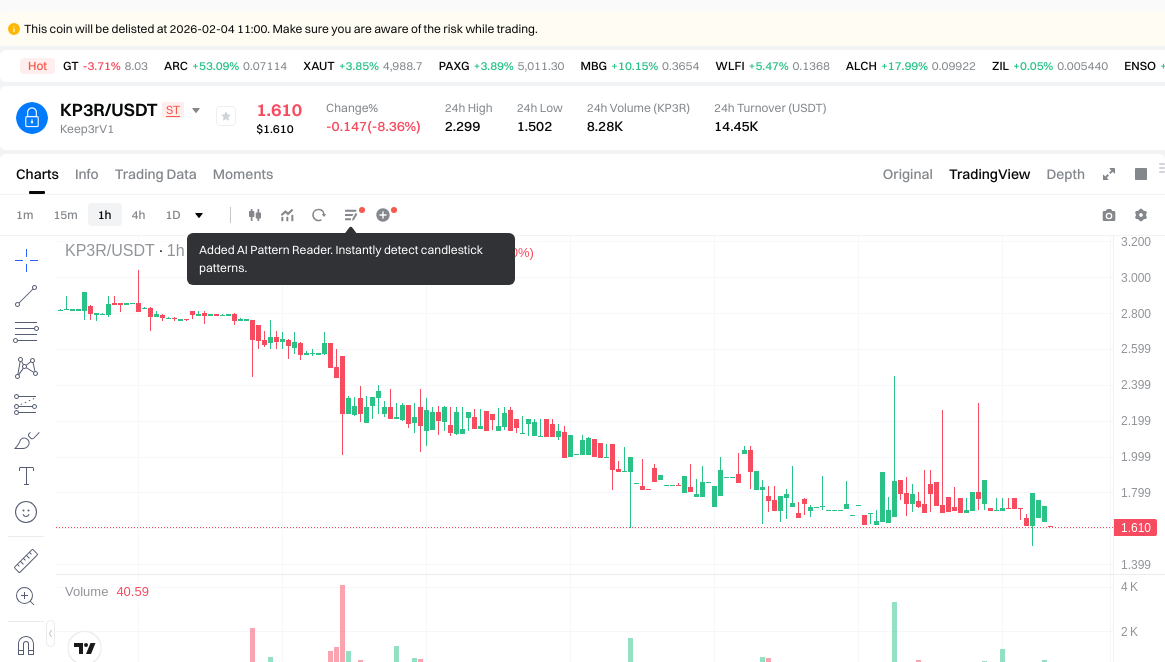
The token currently trades across 3 exchanges with approximately 8,460 holders. The platform's initial implementation included UniswapV2Oracle as its first Job contract, establishing functionality for collecting time-weighted average prices from Uniswap trading pairs. The token experienced price fluctuations ranging from $1.72 to $1,995.53 between its launch and February 2026, reflecting volatility patterns common in cryptocurrency markets. Recent performance shows declines of 1.99% over 24 hours, 39.07% over 7 days, 42.27% over 30 days, and 91.11% over one year, with 24-hour trading volume at approximately $14,386.
I. Keep3rV1 (KP3R) Price History Review and Current Investment Value
KP3R Historical Price Movement and Investment Performance
- 2021: KP3R experienced significant price appreciation, with trading activity reflecting growing interest in decentralized keeper networks during the DeFi expansion period.
- 2021-11-13: The token reached a notable price level of $1,995.53, representing a period of heightened market attention and liquidity.
- 2021-2026: From the elevated levels observed in November 2021, KP3R declined to $1.72, reflecting broader market corrections and shifts in DeFi sector dynamics over the following years.
Current KP3R Investment Market Status (February 2026)
- KP3R current price: $1.722
- Market sentiment (Fear & Greed Index): Data not available in provided materials
- 24-hour trading volume: $14,386.29
- Institutional investor holdings: Data not available in provided materials
Click to view real-time KP3R market price
II. Core Factors Affecting Whether KP3R is a Good Investment
Supply Mechanism and Scarcity (KP3R Investment Scarcity)
- Total Supply and Circulation: KP3R has a total supply of 476,113.208604948 tokens with a circulating supply of 476,113.208604948 tokens, representing a circulation ratio of approximately 100.14%. The maximum supply is listed as infinite (∞), indicating no hard cap on token issuance.
- Supply Distribution Impact: With full circulation and no maximum supply limit, the scarcity model differs from capped-supply tokens. The absence of a supply cap may introduce uncertainty regarding long-term scarcity dynamics, which could influence price appreciation potential.
- Investment Consideration: Unlike tokens with fixed supply mechanisms, KP3R's infinite maximum supply suggests that scarcity-driven value appreciation may be less pronounced. Investors should evaluate how token emissions and demand dynamics interact to affect investment value over time.
Institutional Investment and Mainstream Adoption (Institutional Investment in KP3R)
- Holder Distribution: As of the reference date, KP3R has approximately 8,460 token holders. The relatively modest holder base suggests limited mainstream adoption compared to larger crypto assets.
- Exchange Availability: KP3R is listed on three exchanges, indicating constrained liquidity channels. Limited exchange presence may affect accessibility for institutional investors and broader market participation.
- Market Positioning: With a market cap of approximately $819,866.95 and a market dominance of 0.000030%, KP3R represents a micro-cap asset within the cryptocurrency market. This positioning indicates minimal institutional adoption at present.
Macroeconomic Environment Impact on KP3R Investment
- Market Volatility Context: KP3R experienced a 24-hour price decline of 1.99%, a 7-day decline of 39.07%, and a 1-year decline of 91.11% as of February 4, 2026. These fluctuations reflect sensitivity to broader market conditions and risk appetite shifts.
- Economic Environment Sensitivity: As a micro-cap token, KP3R may exhibit heightened volatility in response to macroeconomic factors such as monetary policy changes, interest rate adjustments, and shifts in investor risk preferences.
- Investment Risk Consideration: The substantial price declines across multiple timeframes suggest that KP3R's investment value is influenced by broader market sentiment and macroeconomic uncertainties, requiring careful risk assessment.
Technology and Ecosystem Development (Technology & Ecosystem for KP3R Investment)
- Platform Functionality: Keep3rV1 operates as a decentralized work-matching platform connecting external developers (Keepers) with project teams requiring task execution (Jobs). The platform facilitates decentralized task completion through smart contracts.
- Use Cases: KP3R serves as the native functional token with specific utilities including payment for Keeper task completion, distribution of revenue from non-KP3R payment transactions, and participation in governance voting for managing project reserves.
- Ecosystem Application: Keep3rV1 launched its first job contract, UniswapV2Oracle, which collects moving average prices for Uniswap trading pairs. Keepers completing this work receive KP3R token rewards, demonstrating practical application in decentralized oracle functionality.
- Investment Relevance: The platform's ecosystem development and practical use cases provide foundational utility for KP3R. However, the extent of ecosystem expansion, developer activity, and broader DeFi integration will influence long-term investment value and adoption potential.
III. KP3R Future Investment Forecast and Price Outlook (Is Keep3rV1(KP3R) Worth Investing in 2026-2031)
Short-term Investment Forecast (2026, Short-term KP3R Investment Outlook)
- Conservative forecast: $1.16 - $1.61
- Neutral forecast: $1.61 - $1.72
- Optimistic forecast: $1.72 - $2.88
Mid-term Investment Outlook (2027-2029, Mid-term Keep3rV1(KP3R) Investment Forecast)
- Market stage expectation: The token may experience moderate volatility with potential gradual recovery from previous declines, subject to broader market conditions and ecosystem developments.
- Investment return forecast:
- 2027: $1.33 - $2.05
- 2028: $1.17 - $2.19
- 2029: $1.22 - $2.33
- Key catalysts: Development of the Keep3r Network ecosystem, adoption rate of keeper services, broader DeFi market sentiment, and integration with major protocols.
Long-term Investment Outlook (Is KP3R a Good Long-term Investment?)
- Base scenario: $1.26 - $2.50 (assuming steady ecosystem growth and stable market conditions)
- Optimistic scenario: $2.50 - $9.02 (assuming accelerated adoption and favorable market environment)
- Risk scenario: Below $1.20 (under adverse market conditions or significant ecosystem challenges)
View KP3R long-term investment and price forecast: Price Prediction
2026-2031 Long-term Outlook
- Base scenario: $1.26 - $2.60 USD (corresponding to steady progress and gradual mainstream application improvement)
- Optimistic scenario: $2.60 - $9.02 USD (corresponding to large-scale adoption and favorable market environment)
- Transformative scenario: Above $9.02 USD (in case of breakthrough ecosystem developments and mainstream adoption)
- 2031-12-31 forecast high: $2.60 USD (based on optimistic development assumptions)
Disclaimer: Price forecasts are subject to high uncertainty and should not be considered as investment advice. Cryptocurrency markets are highly volatile, and past performance does not guarantee future results. Investors should conduct thorough research and consider their risk tolerance before making investment decisions.
| Year | Predicted High Price | Predicted Average Price | Predicted Low Price | Price Change |
|---|---|---|---|---|
| 2026 | 1.7227 | 1.61 | 1.1592 | -6 |
| 2027 | 2.0496105 | 1.66635 | 1.33308 | -3 |
| 2028 | 2.192416695 | 1.85798025 | 1.1705275575 | 7 |
| 2029 | 2.328978243375 | 2.0251984725 | 1.2151190835 | 17 |
| 2030 | 2.503651611628125 | 2.1770883579375 | 1.26271124760375 | 26 |
| 2031 | 2.597810683108921 | 2.340369984782812 | 1.919103387521906 | 35 |
IV. KP3R Investment Strategy and Risk Management (How to invest in Keep3rV1)
Investment Methodology (KP3R investment strategy)
-
Long-term Holding (HODL KP3R): Suitable for conservative investors who believe in the long-term value proposition of decentralized keeper networks. This approach involves accumulating KP3R tokens during market downturns and holding through volatility cycles, focusing on the platform's fundamental utility in connecting developers with job opportunities.
-
Active Trading: Relies on technical analysis and swing trading strategies. Given KP3R's price volatility (with 24-hour changes of -1.99% and 7-day changes of -39.07% as of February 4, 2026), traders may identify entry and exit points based on support and resistance levels, volume patterns, and momentum indicators.
Risk Management (Risk management for KP3R investment)
-
Asset Allocation Ratio:
- Conservative investors: 1-3% of crypto portfolio
- Aggressive investors: 5-10% of crypto portfolio
- Professional investors: Up to 15% with active monitoring
-
Risk Hedging Solutions: Diversified asset portfolios combining major cryptocurrencies with mid-cap tokens like KP3R, alongside stablecoin reserves for capital preservation during market downturns.
-
Secure Storage:
- Hot wallets for active trading amounts
- Cold storage solutions for long-term holdings
- Hardware wallet recommendations for enhanced security of ERC-20 tokens
V. KP3R Investment Risks and Challenges (Risks of investing in Keep3rV1)
-
Market Risk: KP3R exhibits considerable volatility, with price fluctuations ranging from $1.502 to $2.299 within a 24-hour period. The token has experienced substantial declines, with a 1-year change of -91.11%. Trading volume of approximately $14,386 indicates relatively limited liquidity, which may amplify price swings during market stress.
-
Regulatory Risk: As a decentralized work coordination platform, Keep3rV1 operates in a regulatory environment that varies across jurisdictions. Changes in policies regarding decentralized finance platforms, token classifications, or work coordination mechanisms could impact the platform's operations and token value.
-
Technical Risk:
- Smart contract vulnerabilities in the keeper network or job execution mechanisms
- Potential integration issues with external protocols
- Network security concerns related to keeper operations and job validation
- Platform upgrade challenges that could affect existing keeper workflows
VI. Conclusion: Is Keep3rV1 a Good Investment?
-
Investment Value Summary: KP3R represents an infrastructure token in the decentralized work coordination sector, with a market capitalization of approximately $819,867 and a circulating supply of 476,113 tokens. The platform's unique positioning in connecting keepers with jobs offers specialized utility, though the token has experienced considerable price pressure, with substantial declines across multiple timeframes.
-
Investor Recommendations:
✅ Beginners: Consider dollar-cost averaging strategies with small allocation percentages, utilizing secure wallet storage for ERC-20 tokens on the Ethereum network.
✅ Experienced Investors: May explore swing trading opportunities during volatility periods while maintaining core positions, implementing portfolio diversification across multiple DeFi infrastructure tokens.
✅ Institutional Investors: Could evaluate strategic allocations as part of broader DeFi infrastructure exposure, with thorough due diligence on platform adoption metrics and keeper network growth.
⚠️ Disclaimer: Cryptocurrency investments carry substantial risk. This content is for informational purposes only and does not constitute investment advice. Conduct independent research and consult financial professionals before making investment decisions.
VII. FAQ
Q1: What is Keep3rV1 (KP3R) and how does it function?
Keep3rV1 is a decentralized work coordination platform that connects external developers (Keepers) with projects requiring operational tasks (Jobs). KP3R serves as the native functional token used for fee payments, governance participation, and liquidity provision within the ecosystem. The platform operates through smart contracts that facilitate task matching and execution, with Keepers receiving KP3R token rewards for completing work assignments. The first implemented job contract, UniswapV2Oracle, collects time-weighted average prices from Uniswap trading pairs, demonstrating the platform's practical application in decentralized oracle functionality.
Q2: What are the key investment risks associated with KP3R?
The primary investment risks include substantial market volatility (with a 91.11% decline over one year as of February 2026), limited liquidity with approximately $14,386 in 24-hour trading volume, and a micro-cap market capitalization of $819,867. Additionally, KP3R faces regulatory uncertainties affecting decentralized finance platforms, technical risks including smart contract vulnerabilities and integration challenges, and an infinite maximum supply that may impact long-term scarcity dynamics. The token is listed on only three exchanges with approximately 8,460 holders, indicating constrained mainstream adoption.
Q3: How does KP3R's tokenomics affect its investment potential?
KP3R has a circulating supply of approximately 476,113 tokens with a 100.14% circulation ratio, but features an infinite maximum supply with no hard cap on token issuance. This supply structure differs from capped-supply tokens and may introduce uncertainty regarding long-term scarcity-driven value appreciation. The token's utility includes payment for keeper task completion, revenue distribution from non-KP3R payment transactions, and governance voting rights. The absence of a supply cap suggests that demand dynamics and ecosystem growth will be more significant factors in determining investment value than scarcity mechanisms.
Q4: What is the price forecast for KP3R from 2026 to 2031?
Short-term forecasts for 2026 range from conservative estimates of $1.16-$1.61 to optimistic projections of $1.72-$2.88. Mid-term outlook shows potential gradual recovery with 2027 estimates of $1.33-$2.05, 2028 at $1.17-$2.19, and 2029 at $1.22-$2.33. Long-term projections for 2031 suggest a base scenario of $1.26-$2.60, an optimistic scenario of $2.60-$9.02, and a transformative scenario above $9.02. These forecasts depend on ecosystem development, adoption rates, and broader market conditions, and carry substantial uncertainty typical of cryptocurrency markets.
Q5: What investment strategies are suitable for KP3R?
For conservative investors, a long-term holding (HODL) strategy with 1-3% crypto portfolio allocation is appropriate, focusing on accumulation during market downturns. Aggressive investors may allocate 5-10% with active trading strategies based on technical analysis, capitalizing on the token's volatility patterns. Professional investors might allocate up to 15% with active monitoring. Dollar-cost averaging strategies help mitigate entry risk, while risk management should include diversified portfolios combining major cryptocurrencies with mid-cap tokens, stablecoin reserves for capital preservation, and secure storage using hardware wallets for long-term holdings.
Q6: How does institutional adoption affect KP3R's investment value?
Currently, KP3R demonstrates limited institutional adoption, with a market dominance of 0.000030% and listing on only three exchanges. The approximately 8,460 token holders and constrained liquidity channels indicate minimal mainstream institutional participation as of February 2026. Limited exchange availability may restrict accessibility for institutional investors seeking exposure to decentralized keeper networks. Future institutional adoption would depend on ecosystem expansion, integration with major protocols, broader DeFi market development, and improved regulatory clarity for decentralized work coordination platforms.
Q7: What factors should investors monitor when evaluating KP3R?
Key monitoring factors include ecosystem development metrics such as active keepers and job contracts, platform adoption rates within the DeFi sector, integration partnerships with established protocols, and overall transaction volume growth. Technical developments affecting smart contract security, platform upgrades, and new use case implementations are significant. Market indicators including trading volume trends, holder distribution changes, exchange listing expansions, and correlation with broader DeFi market movements provide investment context. Regulatory developments affecting decentralized finance platforms and work coordination mechanisms require ongoing attention.
Q8: Is KP3R suitable for different types of investors?
Beginners should approach KP3R with caution, utilizing dollar-cost averaging strategies and limiting allocation to 1-3% of their crypto portfolio while ensuring secure ERC-20 token storage. Experienced investors may explore swing trading opportunities during volatility periods while maintaining core positions, with 5-10% allocation and portfolio diversification across multiple DeFi infrastructure tokens. Institutional investors could consider strategic allocations as part of broader DeFi infrastructure exposure, conducting thorough due diligence on platform adoption metrics, keeper network growth, and competitive positioning within the decentralized oracle and automation space before deployment.
Share
Content
Introduction: Keep3rV1 (KP3R) Investment Position and Market Outlook
I. Keep3rV1 (KP3R) Price History Review and Current Investment Value
II. Core Factors Affecting Whether KP3R is a Good Investment
III. KP3R Future Investment Forecast and Price Outlook (Is Keep3rV1(KP3R) Worth Investing in 2026-2031)
IV. KP3R Investment Strategy and Risk Management (How to invest in Keep3rV1)
V. KP3R Investment Risks and Challenges (Risks of investing in Keep3rV1)
VI. Conclusion: Is Keep3rV1 a Good Investment?
VII. FAQ
How to Buy Cryptocurrency


Trending Cryptocurrencies



What will be the market capitalization of USDC in 2025? Analysis of the stablecoin market landscape.

How is DeFi different from Bitcoin?

What is DeFi: Understanding Decentralized Finance in 2025

USDC stablecoin 2025 Latest Analysis: Principles, Advantages, and Web3 Eco-Applications

Development of Decentralized Finance Ecosystem in 2025: Integration of Decentralized Finance Applications with Web3
2025 USDT USD Complete Guide: A Must-Read for Newbie Investors
Top 3 Cryptocurrency Exchanges for Buying Bitcoin in the UK

Cryptocurrency Airdrops: A Comprehensive Guide to Participation and Profit
Best Graphics Card for Mining: Top Next-Generation GPUs
Who Is Vitalik Buterin? An In-Depth Look at the Co-Founder of Ethereum

What is Demand Supply Zone and How to Use It in Trading