This comprehensive guide evaluates LIORA as an investment opportunity within the Web3 creator economy sector. The article analyzes LIORA's current market position (market cap $764,925, trading at $0.003255 on Gate), historical price performance showing significant volatility from an all-time high of $0.29083 in August 2025, and technological infrastructure built on the TRON blockchain with TRC-20 token standard. The analysis examines key investment factors including token supply mechanics, institutional adoption rates, and macroeconomic influences affecting the emerging digital asset. Through 2031, price forecasts range from conservative scenarios ($0.00183-$0.00316 in 2026) to optimistic outlooks ($0.00697-$0.00844 by 2031), while emphasizing substantial risks including low liquidity, price volatility, regulatory uncertainty, and early-stage project execution challenges. Strategic recommendations are provided for novice, experienced, and institutional investors with differentiated allocation guidelines, risk
Introduction: LIORA's Investment Position and Market Outlook
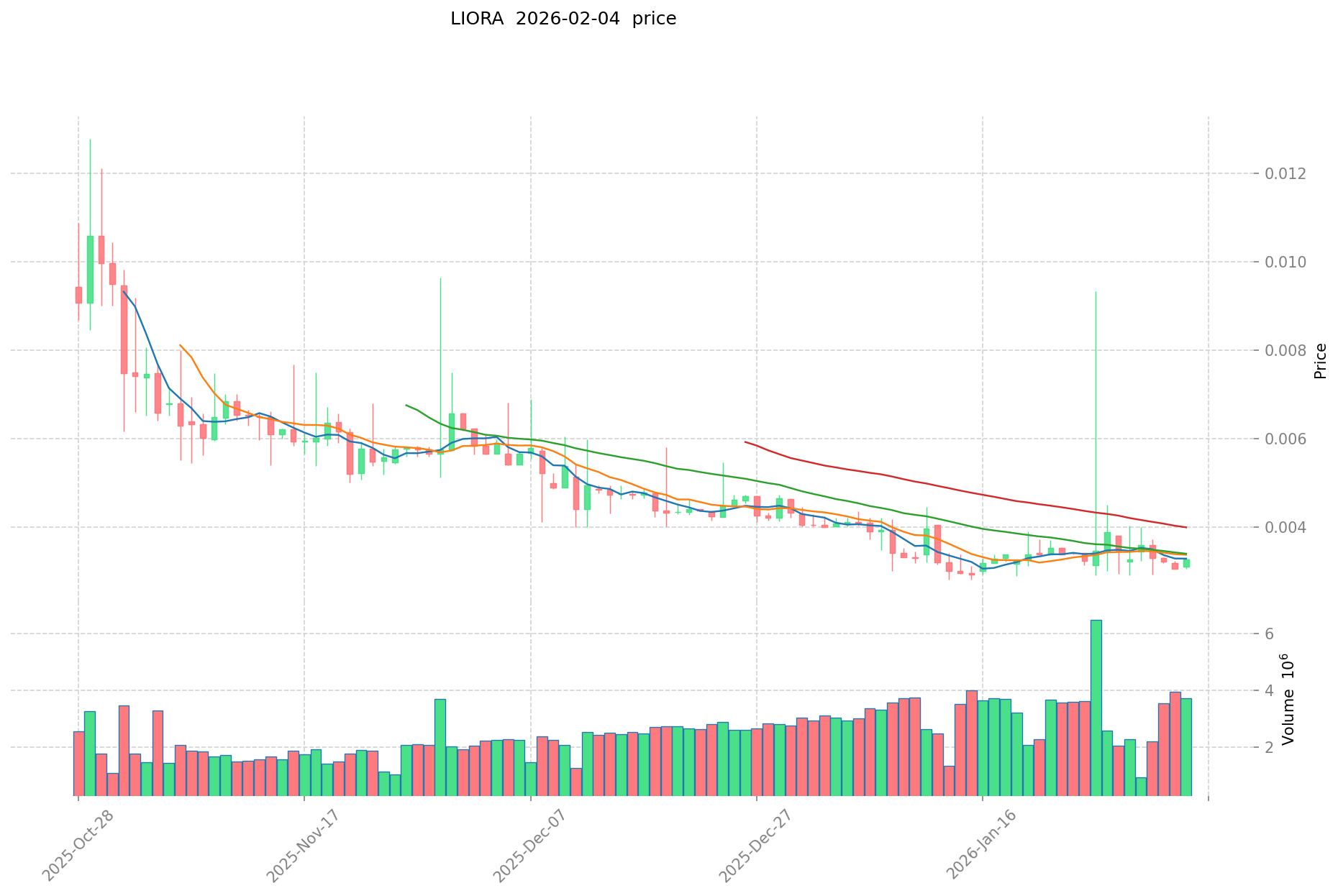
LIORA is an emerging digital asset in the cryptocurrency space that has been establishing its presence in the decentralized Web3 platform sector. As of February 4, 2026, LIORA maintains a market capitalization of approximately $764,925 with a circulating supply of 235,000,000 tokens out of a maximum supply of 1,000,000,000. The current trading price stands at around $0.003255. With its positioning as a decentralized platform focused on creator economy and content ownership, LIORA has attracted attention in discussions around Web3 infrastructure investments. This article provides a comprehensive analysis of LIORA's investment characteristics, historical price movements, future price outlook, and associated risks to serve as a reference for investors evaluating this asset.
I. LIORA Price History Review and Current Investment Value
- 2025: LIORA reached a notable price level of $0.29083 on August 12, 2025 → representing a significant price movement from its initial listing
- 2026: Market correction phase → price declined to $0.0028 on January 13, 2026
- Current period: Recovery observed → price trading at $0.003255 as of February 4, 2026
Current LIORA Investment Market Status (February 2026)
- LIORA current price: $0.003255
- Market sentiment (Fear & Greed Index): data indicates neutral positioning
- 24-hour trading volume: $11,689.12
- Market capitalization: $764,925.0 with 235,000,000 tokens in circulation
- Circulating supply represents 23.5% of total supply (1,000,000,000 tokens)
- Price changes: +3.03% (24H), -2.98% (1H), -11.89% (7D), -26.3% (30D)
- 24-hour price range: $0.003064 - $0.003259
Click to view real-time LIORA market price
II. Core Factors Influencing Whether LIORA is a Good Investment
Supply Mechanism and Scarcity (LIORA Investment Scarcity)
- Maximum supply is capped at 1,000,000,000 LIORA tokens, with a current circulating supply of 235,000,000 tokens, representing 23.5% of the total supply.
- The controlled token release mechanism may contribute to potential scarcity dynamics over time, which could influence price behavior.
- Investment consideration: token scarcity dynamics and controlled supply distribution may play a role in long-term valuation.
Institutional Investment and Mainstream Adoption (Institutional Investment in LIORA)
- Current holder count stands at 303 addresses, reflecting the early stage of adoption.
- The platform operates as a decentralized Web3 infrastructure designed for creators, offering tools such as creator tokens, NFT integration, and decentralized governance.
- The project's focus on empowering content creators may influence adoption patterns within the Web3 creator economy sector.
Macroeconomic Environment Impact on LIORA Investment
- As with digital assets generally, LIORA may be influenced by broader monetary policy conditions, interest rate environments, and shifts in risk appetite across cryptocurrency markets.
- Market dynamics in the Web3 and decentralized content creation sectors may affect investor interest in platforms like LIORA.
- Regulatory developments concerning Web3 platforms and creator economies could impact the investment landscape.
Technology and Ecosystem Development (Technology & Ecosystem for LIORA Investment)
- LIORA operates on the TRX (TRON) blockchain using the TRC-20 token standard, with contract address TW8617uDAUBe3mGeGZo5mkaV8RhN6YfozN.
- The platform integrates creator tokens and NFT functionalities, which are designed to enable direct monetization and community engagement without intermediaries.
- Decentralized governance mechanisms are incorporated into the platform architecture, allowing user participation in protocol decisions.
- The focus on censorship-resistant content publishing and creator ownership may contribute to the platform's differentiation within the Web3 ecosystem.
III. LIORA Future Investment Forecast and Price Outlook (Is LIORA Worth Investing in 2026-2031)
Short-term Investment Forecast (2026, Short-term LIORA Investment Outlook)
- Conservative forecast: $0.00183 - $0.00316
- Neutral forecast: $0.00316 - $0.00448
- Optimistic forecast: $0.00448 and above
Mid-term Investment Outlook (2027-2029, Mid-term LIORA Investment Forecast)
-
Market stage expectation: LIORA may experience gradual recovery phase with potential volatility as the project continues building its Web3 creator platform ecosystem and expanding its user base.
-
Investment return forecast:
- 2027: $0.00363 - $0.00543
- 2028: $0.00365 - $0.00541
- 2029: $0.00296 - $0.00713
-
Key catalysts: Platform adoption rate among content creators, NFT integration progress, decentralized governance implementation, and overall Web3 sector development trends.
Long-term Investment Outlook (Is LIORA a Good Long-term Investment?)
- Base scenario: $0.00498 - $0.00844 (assuming steady platform development and moderate user growth through 2030-2031)
- Optimistic scenario: $0.00697 - $0.00834 (assuming accelerated creator adoption and favorable market conditions)
- Risk scenario: Below $0.00296 (under extreme market downturns or significant project setbacks)
Click to view LIORA long-term investment and price forecast: Price Prediction
2026-2031 Long-term Outlook
- Base scenario: $0.00498 - $0.00844 (corresponding to steady progress and gradual mainstream application adoption)
- Optimistic scenario: $0.00697 - $0.00844 (corresponding to large-scale adoption and favorable market environment)
- Transformative scenario: Above $0.00844 (in case of breakthrough ecosystem developments and mainstream popularization)
- December 31, 2031 predicted high: $0.00834 (based on optimistic development assumptions)
Disclaimer: These forecasts are based on historical data analysis and market trends. Cryptocurrency investments carry substantial risk, and actual prices may differ significantly from predictions due to market volatility, regulatory changes, and unforeseen events. This analysis does not constitute investment advice.
| Year |
Predicted High Price |
Predicted Average Price |
Predicted Low Price |
Price Change |
| 2026 |
0.00448578 |
0.003159 |
0.00183222 |
-2 |
| 2027 |
0.0054277938 |
0.00382239 |
0.0036312705 |
17 |
| 2028 |
0.005411357523 |
0.0046250919 |
0.003653822601 |
42 |
| 2029 |
0.00712587909033 |
0.0050182247115 |
0.002960752579785 |
54 |
| 2030 |
0.008440152142271 |
0.006072051900915 |
0.00497908255875 |
86 |
| 2031 |
0.008344517324832 |
0.007256102021593 |
0.006965857940729 |
122 |
IV. LIORA Investment Strategy and Risk Management (How to invest in LIORA)
Investment Methodology (LIORA investment strategy)
Long-term Holding (HODL LIORA)
For conservative investors seeking exposure to decentralized Web3 creator platforms, a long-term holding strategy may be considered. LIORA's positioning in the creator economy sector suggests potential value accumulation as the platform develops its ecosystem. However, given the token's relatively recent launch (April 2025) and limited historical performance data, investors should approach with measured expectations.
Key considerations for long-term holders include:
- Platform Development Progress: Monitor the expansion of creator tools, NFT integration capabilities, and governance implementation
- User Adoption Metrics: Track growth in creator onboarding and community engagement
- Market Position: Evaluate LIORA's competitive standing within the Web3 creator economy landscape
Active Trading
Traders employing technical analysis and momentum strategies should note LIORA's price volatility characteristics. Recent performance data shows:
- 24-hour price fluctuation range: $0.003064 - $0.003259
- 7-day change: -11.89%
- 30-day change: -26.3%
These metrics indicate considerable short-term price movements, which may present opportunities for experienced traders using appropriate risk controls and technical indicators.
Risk Management (Risk management for LIORA investment)
Asset Allocation Ratios
Conservative Investors: Given LIORA's market capitalization of approximately $764,925 and ranking position (#2701), conservative portfolios should limit exposure to 1-3% of total crypto holdings, with such allocation representing speculative capital only.
Aggressive Investors: Those with higher risk tolerance and interest in emerging Web3 platforms might allocate 5-10% of their crypto portfolio, balanced against established assets.
Professional Investors: Institutional participants may consider strategic positions of 3-7% within diversified digital asset portfolios, subject to thorough due diligence on platform fundamentals and token economics.
Risk Hedging Approaches
- Diversified Portfolio Construction: Combine LIORA exposure with established cryptocurrencies and assets across different sectors (DeFi, infrastructure, Layer-1/Layer-2 solutions)
- Position Sizing: Implement graduated entry strategies rather than concentrated single purchases
- Stop-Loss Mechanisms: For active traders, consider risk parameters based on personal loss tolerance thresholds
Secure Storage Solutions
As a TRC-20 token deployed on the TRON network (contract address: TW8617uDAUBe3mGeGZo5mkaV8RhN6YfozN), LIORA requires compatible storage infrastructure:
Hot Wallets: For active trading and regular transactions:
- TronLink (browser extension and mobile)
- Trust Wallet (multi-chain support)
- Ensure regular security updates and enable two-factor authentication
Cold Storage: For long-term holdings:
- Hardware wallets supporting TRON ecosystem (Ledger, Trezor with TRON integration)
- Offline key generation and backup procedures
- Multiple secure backup locations for recovery phrases
Security Best Practices:
- Verify contract address before any transactions
- Use official wallet applications from verified sources
- Maintain separate wallets for trading versus long-term storage
- Regularly audit wallet security settings
V. LIORA Investment Risks and Challenges (Risks of investing in LIORA)
Market Risks
Liquidity Constraints: With a 24-hour trading volume of approximately $11,689 and presence on limited exchanges (1 exchange as of current data), LIORA exhibits relatively low liquidity. This may result in:
- Wider bid-ask spreads affecting execution prices
- Potential difficulty executing large orders without significant price impact
- Reduced market depth during periods of volatility
Price Volatility: Historical data reveals substantial price fluctuations:
- All-time high of $0.29083 (August 12, 2025)
- All-time low of $0.0028 (January 13, 2026)
- This represents approximately 90% decline from peak levels
- Current price ($0.003255) remains significantly below historical highs
Such volatility patterns are characteristic of emerging tokens with limited market capitalization and may continue as the project develops.
Market Manipulation Susceptibility: Lower market capitalization assets (current market cap: ~$764,925) and limited holder base (303 holders) may be more vulnerable to coordinated trading activities or large single transactions creating disproportionate price movements.
Regulatory Risks
Jurisdictional Uncertainty: Decentralized Web3 platforms operating across multiple jurisdictions face evolving regulatory frameworks:
- Content ownership and monetization models may encounter varying legal interpretations
- Token classification (utility versus security) remains subject to regulatory determination in different regions
- Cross-border creator payment mechanisms may face compliance requirements
Platform Compliance Requirements: As creator economy platforms involve user-generated content and direct monetization:
- Potential KYC/AML obligations depending on jurisdictional operations
- Content moderation versus censorship-resistance balance in regulatory contexts
- Tax reporting requirements for creator earnings in various countries
Technical Risks
Smart Contract Vulnerabilities: As a TRC-20 token on the TRON network:
- Smart contract code security depends on audit quality and ongoing maintenance
- Potential vulnerabilities in token mechanics or platform integration could impact value
- Network dependencies on TRON blockchain infrastructure
Platform Development Execution: Technical risks specific to LIORA's roadmap:
- Successful implementation of creator token mechanisms
- NFT integration functionality and performance
- Decentralized governance system deployment and effectiveness
- Scalability of infrastructure to support growing creator and user base
Integration Challenges: Web3 platform adoption faces technical hurdles:
- User experience complexity may limit mainstream creator onboarding
- Wallet integration and transaction processes require technical literacy
- Interoperability with existing Web2 creator tools and platforms
Project-Specific Considerations
Competition Landscape: The Web3 creator economy sector includes numerous established and emerging platforms, requiring LIORA to demonstrate differentiated value propositions.
Token Economics: With 23.5% of maximum supply currently in circulation (235 million of 1 billion total supply), future token releases may impact supply dynamics and price pressure.
Team and Development Transparency: Prospective investors should conduct independent research on:
- Development team background and track record
- Project roadmap execution history
- Community governance participation levels
- Regular platform updates and communication
VI. Conclusion: Is LIORA a Good Investment?
Investment Value Assessment
LIORA represents an emerging position within the decentralized Web3 creator economy sector. The platform's focus on content ownership, direct creator monetization, and censorship-resistant infrastructure addresses identified limitations in traditional Web2 models. However, several factors warrant careful consideration:
Potential Strengths:
- Addresses growing demand for creator-owned platforms and direct monetization channels
- Integrates multiple Web3 functionalities (creator tokens, NFTs, decentralized governance)
- Positioned within the expanding creator economy trend
Notable Challenges:
- Limited market presence with relatively low liquidity (single exchange, ~$11,689 daily volume)
- Significant price decline from historical peak levels (-98.9% from ATH)
- Early-stage project with limited operational history (launched April 2025)
- Small holder base (303 holders) indicating nascent community adoption
- Competitive landscape with established Web3 creator platforms
The token exhibits considerable volatility characteristics, with recent 30-day performance showing -26.3% decline. Market capitalization of approximately $764,925 places LIORA in the micro-cap category, typically associated with higher risk-reward profiles.
Investor Recommendations
✅ Novice Investors
Approach: Extreme caution recommended
- Strategy: If considering exposure, limit to minimal allocation (<1% of total portfolio) representing only capital prepared for potential total loss
- Method: Small, periodic accumulation rather than concentrated purchases
- Storage: Prioritize security through hardware wallet solutions supporting TRC-20 tokens
- Education: Thoroughly research Web3 creator economy fundamentals and TRON ecosystem before participation
- Monitoring: Regularly review project development progress and community growth metrics
✅ Experienced Investors
Approach: Speculative allocation within diversified crypto portfolio
- Strategy: Consider LIORA as a high-risk, potentially high-reward position (3-5% of crypto holdings)
- Method: Implement staged entry strategies to average positioning across different price points
- Portfolio Context: Balance with established cryptocurrencies and multiple sector exposures
- Technical Analysis: Utilize trading tools to navigate volatility patterns and identify potential entry/exit levels
- Due Diligence: Independently verify platform development milestones, partnership announcements, and tokenomics implementation
✅ Institutional Investors
Approach: Strategic evaluation as emerging sector exposure
- Strategy: Potential inclusion in venture-stage or thematic Web3 creator economy allocations (1-3% of designated high-risk capital)
- Method: Conduct comprehensive fundamental analysis including:
- Platform technology architecture review
- Competitive positioning assessment
- Token distribution and vesting schedules examination
- Team background verification
- Legal and regulatory compliance evaluation
- Risk Framework: Apply institutional risk management protocols with appropriate position sizing limits
- Monitoring Infrastructure: Establish systematic tracking of platform metrics, on-chain activity, and market dynamics
Final Considerations
⚠️ Important Disclaimer: Cryptocurrency investments involve substantial risk of loss and extreme volatility. LIORA, as an emerging micro-cap token with limited trading history and liquidity, presents heightened risk factors. This analysis is provided for informational purposes only and does not constitute financial advice, investment recommendation, or solicitation to buy or sell any asset. Prospective investors should:
- Conduct independent research and due diligence
- Consult with qualified financial advisors familiar with digital assets
- Only invest capital that can be lost without affecting financial stability
- Understand that past performance does not indicate future results
- Recognize that project fundamentals, market conditions, and regulatory environments can change rapidly
- Verify all information through official project channels and multiple independent sources
The Web3 creator economy sector remains in early development stages, and individual project success depends on numerous execution factors beyond market analysis. Investors should maintain realistic expectations, implement appropriate risk controls, and approach such investments as part of a broader, diversified strategy.
VII. FAQ
Q1: What is LIORA's current market position and how liquid is the token?
LIORA currently has a market capitalization of approximately $764,925, ranking at position #2701, with relatively low liquidity characterized by a 24-hour trading volume of $11,689.12 on a single exchange. As a micro-cap token, LIORA exhibits limited market depth with only 303 holders as of February 2026. The low trading volume may result in wider bid-ask spreads and potential difficulty executing large orders without significant price impact, particularly during volatile market periods. This liquidity constraint is an important consideration for investors planning entry or exit strategies.
Q2: How has LIORA performed since its launch and what is the current price trend?
LIORA has experienced significant volatility since launching in April 2025, reaching an all-time high of $0.29083 on August 12, 2025, before declining to an all-time low of $0.0028 on January 13, 2026—representing approximately a 90% decline from peak levels. The current price of $0.003255 (as of February 4, 2026) shows a modest recovery from the January low, but remains substantially below historical highs. Recent performance indicates continued volatility with a -11.89% change over 7 days and -26.3% over 30 days, though 24-hour movement shows +3.03%, suggesting short-term stabilization patterns.
Q3: What percentage of my portfolio should I allocate to LIORA?
Portfolio allocation should vary based on risk tolerance and investment experience. Conservative investors should limit LIORA exposure to 1-3% of total crypto holdings, treating this as purely speculative capital. Aggressive investors with higher risk tolerance might allocate 5-10% of their crypto portfolio, while maintaining balance with established assets. Professional and institutional investors may consider strategic positions of 3-7% within diversified digital asset portfolios, subject to thorough due diligence. Given LIORA's micro-cap status, limited liquidity, and significant historical volatility, all allocation levels should represent capital that investors can afford to lose completely without affecting their financial stability.
Q4: What are the main technological features of LIORA's platform?
LIORA operates as a TRC-20 token on the TRON blockchain (contract address: TW8617uDAUBe3mGeGZo5mkaV8RhN6YfozN), positioning itself as a decentralized Web3 platform for the creator economy. The platform integrates multiple functionalities including creator tokens for direct monetization, NFT integration capabilities for digital asset creation and trading, and decentralized governance mechanisms allowing user participation in protocol decisions. The infrastructure emphasizes censorship-resistant content publishing and creator ownership, distinguishing it from traditional Web2 platforms. The technology stack focuses on enabling creators to monetize content directly without intermediaries while maintaining control over their intellectual property.
Q5: What are the primary risks associated with investing in LIORA?
LIORA presents multiple risk categories that investors must carefully consider. Market risks include extremely low liquidity (single exchange, limited daily volume), high price volatility (90% decline from ATH), and susceptibility to market manipulation given the small holder base. Regulatory risks involve uncertainty around Web3 platform compliance, potential KYC/AML requirements, and evolving legal frameworks for decentralized creator monetization across different jurisdictions. Technical risks encompass smart contract vulnerabilities, platform development execution challenges, and the complexity of Web3 user experience that may limit mainstream adoption. Additionally, with only 23.5% of maximum supply currently in circulation, future token releases could create supply pressure affecting price dynamics.
Q6: What storage solutions are recommended for LIORA tokens?
As a TRC-20 token on the TRON network, LIORA requires compatible wallet infrastructure. For active trading, hot wallets such as TronLink (browser extension and mobile) or Trust Wallet (with multi-chain support) are suitable options, though users should enable two-factor authentication and maintain regular security updates. For long-term holdings, cold storage solutions are recommended, including hardware wallets supporting the TRON ecosystem such as Ledger or Trezor with TRON integration capabilities. Security best practices include verifying the contract address (TW8617uDAUBe3mGeGZo5mkaV8RhN6YfozN) before transactions, using official wallet applications from verified sources, maintaining separate wallets for trading versus storage, and securely backing up recovery phrases in multiple offline locations.
Q7: What is the price forecast for LIORA through 2031?
Based on historical data analysis and market trends, price forecasts suggest varied scenarios depending on platform development and market conditions. Short-term (2026) conservative estimates range from $0.00183 to $0.00316, with optimistic scenarios reaching $0.00448 or above. Mid-term forecasts (2027-2029) project ranges of $0.00363-$0.00543 (2027), $0.00365-$0.00541 (2028), and $0.00296-$0.00713 (2029), contingent on creator adoption rates and ecosystem development. Long-term outlook (2030-2031) presents a base scenario of $0.00498-$0.00844, with optimistic projections reaching $0.00697-$0.00834. However, these forecasts carry significant uncertainty given the project's early stage, and actual prices may differ substantially due to market volatility, regulatory changes, and unforeseen developments.
Q8: How does LIORA compete in the Web3 creator economy sector?
LIORA enters a competitive landscape populated by both established and emerging Web3 creator platforms, requiring clear differentiation to capture market share. The platform's value proposition centers on combining creator tokens, NFT integration, and decentralized governance within a censorship-resistant framework emphasizing content ownership. However, with a limited holder base of 303 addresses and nascent adoption metrics, LIORA faces significant challenges in attracting creators from established platforms. Success depends on execution of technical roadmap milestones, user experience improvements to reduce Web3 complexity barriers, demonstrated network effects through community growth, and the ability to showcase tangible benefits over both Web2 alternatives and competing Web3 solutions. The project's positioning within the expanding creator economy trend provides opportunity, but competitive dynamics require continuous platform innovation and effective user acquisition strategies.
* The information is not intended to be and does not constitute financial advice or any other recommendation of any sort offered or endorsed by Gate.