This comprehensive analysis examines whether NERO Chain (NERO) represents a viable investment opportunity for crypto investors. NERO operates as a modular, EVM-compatible Layer 1 blockchain featuring native account abstraction (ERC-4337) and flexible Paymaster systems enabling gasless transactions. As of February 2026, NERO trades at $0.002022 with a $539,874 market cap across two Gate-listed exchanges. The article evaluates historical price performance from July 2025's $0.02391 peak to current levels, analyzes core investment factors including institutional backing from NTT Digital and CoinTrade, assesses technological differentiation through Blockspace 2.0 architecture, and provides price forecasts through 2031. Key sections address investment strategies for different investor profiles, comprehensive risk management approaches covering market, regulatory, and technical risks, and practical guidance for portfolio allocation. Whether you're a beginner exploring entry points or an institutional investor evalua
Introduction: NERO Chain (NERO)'s Investment Position and Market Outlook
NERO Chain (NERO) represents a notable asset within the cryptocurrency ecosystem. As of February 2026, NERO maintains a market capitalization of approximately $539,874, with a circulating supply of 267,000,000 tokens and a current price around $0.002022. Positioned as a modular, app-centric Layer 1 blockchain with EVM compatibility, NERO has gained attention from institutional players including NTT Digital and CoinTrade since its testnet launch. With its native account abstraction (ERC-4337) and flexible Paymaster system enabling gasless transactions, NERO has gradually become a focal point for investors considering "Is NERO Chain (NERO) a good investment?" This article will comprehensively analyze NERO's investment value, historical trends, future price projections, and associated investment risks to provide reference for potential investors.
I. NERO Chain (NERO) Price History Review and Current Investment Value Status
NERO Chain launched its mainnet in July 2025 (July 28, 2025, based on ATH date reference), entering the market during a period of heightened interest in EVM-compatible Layer 1 solutions. The token experienced notable price discovery phases:
-
2025: Following testnet deployment and institutional backing from NTT Digital and CoinTrade, NERO reached a peak price level of $0.02391 in late July 2025. Early participants in the ecosystem observed initial price appreciation as the native account abstraction (ERC-4337) features attracted developer attention.
-
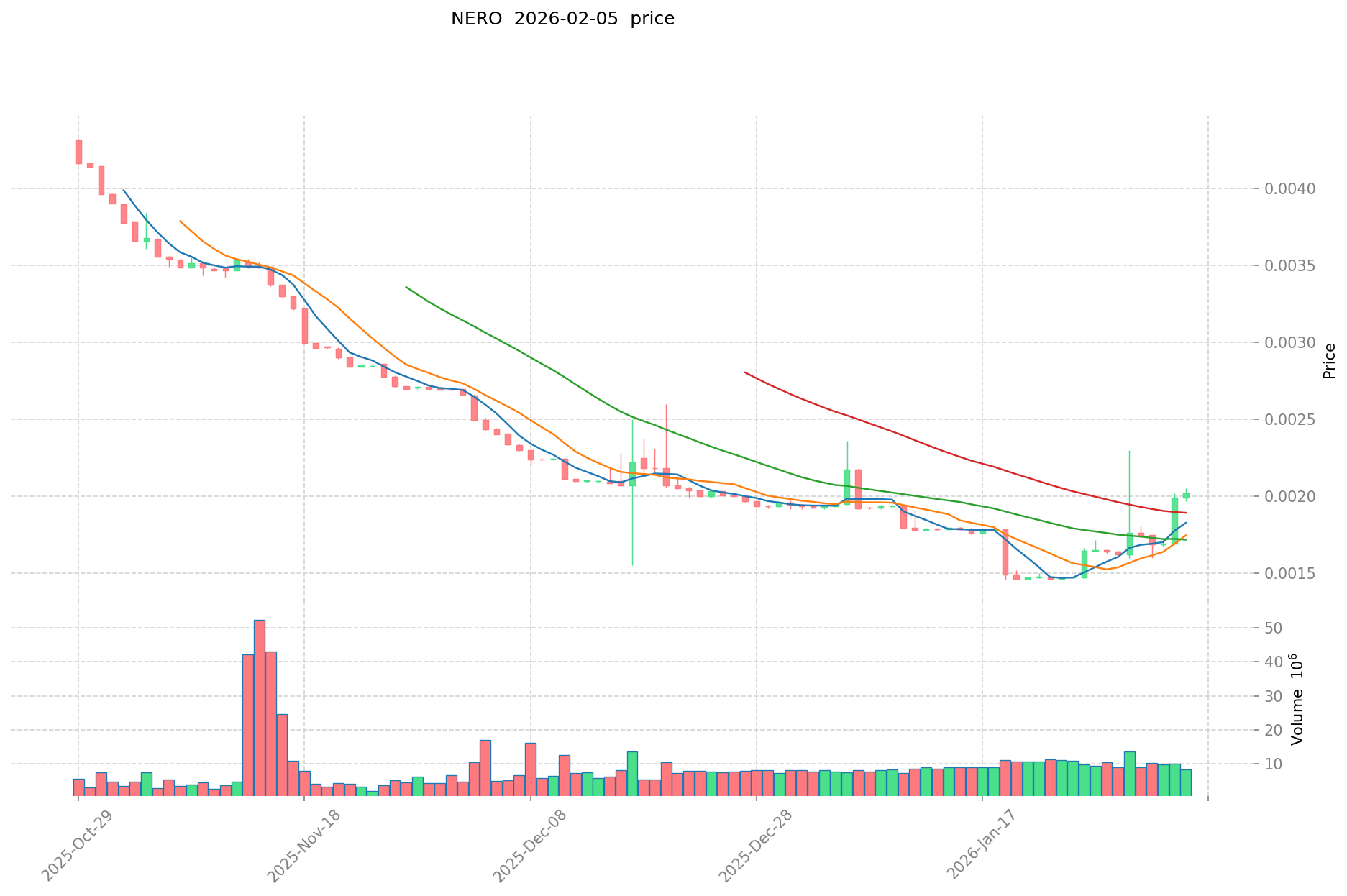
Late 2025 - Early 2026: NERO underwent a significant price correction phase. From the July 2025 reference point, the token price declined to $0.001456 by January 19, 2026, representing a substantial downward movement typical of early-stage blockchain projects during market consolidation periods.
-
February 2026: As of February 5, 2026, NERO trades at $0.002022, showing a modest recovery from the January low point. The token has posted a 7-day gain of 23.38% and a 30-day increase of 5.37%, suggesting emerging stabilization in price action.
Current NERO Investment Market Status (February 2026)
- Current NERO Price: $0.002022 (as of February 5, 2026)
- 24-Hour Trading Volume: $16,666.87, reflecting relatively limited liquidity across 2 active exchange listings
- Market Capitalization: $539,874 with a circulating supply of 267,000,000 NERO tokens (2.67% of the 10,000,000,000 maximum supply)
- Fully Diluted Valuation: $20,220,000
- Price Movements: 1-hour change +0.35%, 24-hour change +1.5%, 7-day change +23.38%, 30-day change +5.37%
- Market Share: 0.00079% of the total cryptocurrency market
Click to view real-time NERO market price
The token currently ranks #2982 in market capitalization among cryptocurrency assets. With a market cap to FDV ratio of 2.67%, NERO maintains substantial token supply yet to enter circulation, a factor that may influence future price dynamics as the ecosystem develops and additional tokens become available through vesting schedules or network rewards. The project's infrastructure support from institutional players like NTT Digital and CoinTrade provides foundational backing, though the token's trading presence remains concentrated across a limited number of exchange platforms as of early 2026.
II. Core Factors Influencing Whether NERO is a Good Investment
Supply Mechanism and Scarcity (NERO Investment Scarcity)
- Supply mechanism: NERO has a maximum supply of 10,000,000,000 tokens, with a current circulating supply of 267,000,000 tokens, representing approximately 2.67% of the total supply. This controlled release may contribute to potential scarcity dynamics.
- Market cap to fully diluted valuation ratio stands at 2.67%, indicating significant room for supply expansion, which may impact long-term scarcity considerations.
- Investment significance: The gradual token release schedule and relatively low circulating supply ratio may support price stability as ecosystem adoption develops, though future supply increases should be monitored.
Institutional Investment and Mainstream Adoption (Institutional Investment in NERO)
- Institutional backing: NERO has received support from institutions including NTT Digital and CoinTrade since its testnet launch, which may provide credibility and development resources.
- Enterprise focus: The platform is designed for developers and businesses, with features enabling dApps to capture fees and customize gas logic, potentially facilitating commercial adoption.
- Market presence: Currently traded on 2 exchanges with a 24-hour trading volume of $16,666.87, indicating early-stage market establishment.
Technology and Ecosystem Development (Technology & Ecosystem for NERO Investment)
- EVM compatibility: NERO operates as an EVM-compatible, modular Layer 1 blockchain, which may facilitate developer migration and application deployment from existing Ethereum-based ecosystems.
- Native account abstraction: Implementation of ERC-4337 and a flexible Paymaster system enables gas payments in any token, sponsored transactions, or gasless transactions, potentially improving user experience and reducing friction for mainstream adoption.
- Blockspace 2.0 architecture: The platform's separation of execution, settlement, and data availability layers is optimized for performance, developer control, and sustainable token economics, which may support long-term ecosystem scalability.
- Application-centric design: Features that allow dApps to customize gas logic and create Web2-style user experiences may lower barriers to entry for traditional businesses exploring blockchain integration.
III. NERO Future Investment Forecast and Price Outlook (Is NERO Chain(NERO) worth investing in 2026-2031)
Short-term Investment Forecast (2026, short-term NERO investment outlook)
- Conservative Forecast: $0.00187116 - $0.002012
- Neutral Forecast: $0.002012 - $0.00224
- Optimistic Forecast: $0.00224 - $0.00249488
Mid-term Investment Outlook (2027-2029, mid-term NERO Chain(NERO) investment forecast)
-
Market Stage Expectations: The mid-term period may see gradual price adjustments as NERO Chain continues to develop its modular Layer 1 infrastructure and account abstraction features. Market conditions and ecosystem adoption will likely influence price movements during this phase.
-
Investment Return Forecast:
- 2027: $0.001577408 - $0.0023886464
- 2028: $0.001415836352 - $0.002506726656
- 2029: $0.00188283024384 - $0.00251044032512
-
Key Catalysts: Native account abstraction (ERC-4337) implementation, Paymaster system adoption, institutional backing from partners like NTT Digital and CoinTrade, developer ecosystem growth, and Blockspace 2.0 architecture optimization.
Long-term Investment Outlook (Is NERO a good long-term investment?)
- Base Scenario: $0.001822615884311 - $0.003323919545856 (assuming steady ecosystem development and moderate market conditions through 2030-2031)
- Optimistic Scenario: $0.002893041086208 - $0.003847644644656 (assuming enhanced dApp adoption, expanded institutional partnerships, and favorable market environment)
- Risk Scenario: Below $0.001822615884311 (under adverse market conditions or slower-than-expected adoption)
View NERO long-term investment and price prediction: Price Prediction
2026-02-05 - 2031 Long-term Outlook
- Base Scenario: $0.002012 - $0.003323919545856 (corresponding to steady progress and gradual mainstream application improvement)
- Optimistic Scenario: $0.002893041086208 - $0.003847644644656 (corresponding to large-scale adoption and favorable market environment)
- Transformative Scenario: Above $0.003847644644656 (if the ecosystem achieves breakthrough progress and mainstream adoption)
- 2031-12-31 Predicted High: $0.003847644644656 (based on optimistic development assumptions)
Disclaimer: Price predictions are based on historical data and market analysis models. Actual results may vary significantly due to market volatility, regulatory changes, technological developments, and other unforeseen factors. This analysis does not constitute investment advice.
| Year |
Predicted High Price |
Predicted Average Price |
Predicted Low Price |
Price Change |
| 2026 |
0.00249488 |
0.002012 |
0.00187116 |
0 |
| 2027 |
0.0023886464 |
0.00225344 |
0.001577408 |
11 |
| 2028 |
0.002506726656 |
0.0023210432 |
0.001415836352 |
14 |
| 2029 |
0.00251044032512 |
0.002413884928 |
0.00188283024384 |
19 |
| 2030 |
0.003323919545856 |
0.00246216262656 |
0.002092838232576 |
21 |
| 2031 |
0.003847744644656 |
0.002893041086208 |
0.001822615884311 |
43 |
IV. NERO Investment Strategy and Risk Management (How to invest in Layer 1 blockchain)
Investment Methodology (NERO investment strategy)
-
Long-term Holding (HODL NERO): Suitable for conservative investors who believe in the fundamental value proposition of modular blockchain architecture and account abstraction technology. This approach involves acquiring NERO tokens and maintaining positions through market cycles, focusing on the long-term development of the ecosystem and institutional adoption.
-
Active Trading: Relies on technical analysis and swing trading strategies. Given NERO's price movements (1.5% in 24H, 23.38% in 7D as of February 05, 2026), traders may identify short-term opportunities based on momentum indicators, support and resistance levels, and trading volume patterns. This approach requires continuous market monitoring and risk assessment.
Risk Management (Risk management for NERO investment)
-
Asset Allocation Ratios:
- Conservative Investors: Allocate 1-3% of crypto portfolio to NERO, maintaining majority holdings in established digital assets
- Aggressive Investors: May allocate 5-10% of crypto portfolio to NERO, accepting higher volatility for potential returns
- Professional Investors: Can consider strategic allocations of 10-15% based on comprehensive research and risk tolerance
-
Risk Hedging Solutions: Implement multi-asset portfolio strategies combining NERO with established cryptocurrencies and stablecoins. Consider diversification across different blockchain ecosystems and market sectors to reduce concentration risk.
-
Secure Storage: Utilize cold wallet solutions for long-term holdings and hot wallets for active trading needs. Hardware wallet options provide enhanced security for significant NERO positions. Always verify contract addresses and use official channels for transactions.
V. NERO Investment Risks and Challenges (Risks of investing in Layer 1 blockchain)
-
Market Risk: NERO exhibits notable price volatility, with movements ranging from a low of $0.001456 to positions around $0.002022. The relatively low market capitalization of approximately $539,874 and limited exchange availability (2 exchanges) may contribute to price fluctuations. Trading volume of $16,666.87 indicates developing liquidity conditions.
-
Regulatory Risk: As a Layer 1 blockchain with EVM compatibility, NERO operates in an evolving regulatory environment. Different jurisdictions maintain varying approaches to blockchain technology and digital assets, creating uncertainty around compliance requirements, operational frameworks, and potential policy changes that could impact project development and token utility.
-
Technical Risk: Network security considerations include smart contract vulnerabilities, consensus mechanism reliability, and the execution of planned upgrades. The Blockspace 2.0 architecture's separation of execution, settlement, and data availability layers introduces technical complexity that requires ongoing maintenance and development. Protocol upgrades and system modifications carry inherent implementation risks.
VI. Conclusion: Is Layer 1 blockchain a Good Investment?
-
Investment Value Summary: NERO presents characteristics of an emerging modular blockchain project with distinctive technical features including native account abstraction (ERC-4337) and flexible Paymaster system. The project has institutional backing from entities such as NTT Digital and CoinTrade. However, the current market position shows a relatively small circulating supply (2.67% of total supply) and developing trading infrastructure.
-
Investor Recommendations:
✅ Beginners: Consider dollar-cost averaging strategies combined with secure wallet storage solutions. Focus on understanding the underlying technology and ecosystem development before making investment decisions.
✅ Experienced Investors: May explore swing trading opportunities while maintaining diversified portfolio allocations. Monitor technical developments, partnership announcements, and market sentiment indicators.
✅ Institutional Investors: Evaluate strategic long-term positioning based on comprehensive due diligence, technical assessment, and alignment with broader blockchain infrastructure investment themes.
⚠️ Notice: Cryptocurrency investment involves substantial risk and market volatility. This content is provided for informational purposes only and does not constitute investment advice. Conduct thorough research and consider your financial situation and risk tolerance before making investment decisions.
VII. FAQ
Q1: Is NERO Chain (NERO) a good investment for beginners in 2026?
NERO may be suitable for beginners with high risk tolerance, but requires careful consideration due to its early-stage market position. The token currently has a small market capitalization of $539,874 and limited liquidity ($16,666.87 in 24-hour trading volume across only 2 exchanges). Beginners should start with small allocations (1-3% of crypto portfolio) and employ dollar-cost averaging strategies. The project's institutional backing from NTT Digital and CoinTrade provides foundational credibility, while its native account abstraction features offer technical differentiation. However, the substantial price volatility and concentrated supply (only 2.67% circulating) present notable risks for inexperienced investors.
Q2: What makes NERO Chain technologically different from other Layer 1 blockchains?
NERO distinguishes itself through native account abstraction (ERC-4337) and its flexible Paymaster system, enabling gasless transactions and gas payments in any token. The platform's Blockspace 2.0 architecture separates execution, settlement, and data availability layers, optimizing for performance and developer control. Unlike traditional Layer 1 blockchains, NERO is designed as app-centric, allowing dApps to customize gas logic, capture fees, and create Web2-style user experiences. This modular approach combined with EVM compatibility facilitates developer migration from Ethereum-based ecosystems while providing enhanced user experience features that may lower barriers for mainstream adoption.
Q3: What are the key price predictions for NERO through 2031?
Based on current market analysis and historical data, NERO's price forecasts show gradual development potential. Short-term (2026) conservative estimates range from $0.00187116 to $0.00249488. Mid-term projections for 2027-2029 anticipate fluctuations between $0.001415836352 and $0.00251044032512 as the ecosystem matures. Long-term outlook for 2030-2031 suggests a base scenario of $0.002092838232576 to $0.003323919545856, with an optimistic scenario reaching $0.003847644644656 by end of 2031. These predictions assume continued ecosystem development, institutional partnership expansion, and favorable market conditions. However, actual results may vary significantly due to market volatility and unforeseen factors.
Q4: What are the main investment risks associated with NERO Chain?
NERO presents three primary investment risk categories. Market risk includes notable price volatility, low market capitalization ($539,874), and limited exchange availability creating potential liquidity challenges. Regulatory risk stems from evolving global blockchain regulations that could impact operations and token utility across different jurisdictions. Technical risk involves smart contract vulnerabilities, consensus mechanism reliability, and the complexity of the Blockspace 2.0 architecture requiring ongoing maintenance. Additionally, the token's low circulating supply ratio (2.67% of maximum supply) means future supply releases could create downward price pressure. Investors should carefully assess these risks against their risk tolerance before investing.
Q5: How does NERO's institutional backing affect its investment potential?
NERO's institutional support from NTT Digital and CoinTrade provides credibility and development resources that may enhance long-term investment potential. Institutional backing typically signals professional due diligence, access to enterprise networks, and potential pathway to commercial adoption. These partnerships may facilitate integration opportunities, provide technical resources, and improve market visibility. However, institutional involvement alone does not guarantee investment success. The project still requires successful ecosystem development, developer adoption, and dApp deployment to translate institutional support into tangible value. Investors should view institutional backing as a positive indicator while conducting comprehensive independent research on technology implementation and market traction.
Q6: What investment strategy is most suitable for NERO in current market conditions?
Current market conditions (February 2026) suggest a cautious, diversified approach. Conservative investors should allocate 1-3% of crypto portfolios to NERO using dollar-cost averaging to mitigate entry risk. Active traders may capitalize on recent momentum (23.38% 7-day gain) through swing trading strategies based on technical indicators and volume patterns. Long-term holders should focus on monitoring ecosystem development milestones including dApp launches, partnership announcements, and account abstraction feature adoption. Given the limited liquidity and exchange availability, investors should implement secure storage solutions using hardware wallets for significant holdings. All strategies should incorporate regular portfolio rebalancing and risk management protocols appropriate to individual risk tolerance levels.
Q7: How does NERO's supply mechanism impact long-term investment value?
NERO's supply structure presents both opportunities and considerations for long-term investors. With only 2.67% of the 10,000,000,000 maximum supply currently circulating (267,000,000 tokens), the project maintains significant unreleased supply. This controlled release schedule may support price stability during early ecosystem development phases by limiting available supply. The market cap to fully diluted valuation ratio of 2.67% indicates substantial future supply expansion potential, which could create downward price pressure if ecosystem demand doesn't keep pace with token releases. Long-term investment value depends on whether adoption rates and utility expansion can absorb future supply increases. Investors should monitor vesting schedules, network reward distributions, and ecosystem growth metrics to assess supply-demand dynamics over time.
Q8: What catalysts could drive NERO's price appreciation in 2026-2027?
Several potential catalysts could influence NERO's price trajectory in the near to mid-term. Technical catalysts include successful deployment of native account abstraction features, Paymaster system adoption by major dApps, and Blockspace 2.0 architecture optimizations demonstrating performance improvements. Ecosystem catalysts involve developer community growth, high-profile dApp launches utilizing NERO's unique features, and integration partnerships with established blockchain projects. Institutional catalysts encompass expansion of backing beyond NTT Digital and CoinTrade, exchange listing announcements on major platforms to improve liquidity, and enterprise adoption cases showcasing commercial applications. Market catalysts include favorable Layer 1 blockchain sector sentiment and broader cryptocurrency market recovery. Monitoring these catalyst categories provides insight into potential price movement triggers for investment timing decisions.
* The information is not intended to be and does not constitute financial advice or any other recommendation of any sort offered or endorsed by Gate.