This comprehensive guide evaluates whether Nibiru Chain (NIBI) represents a viable investment opportunity in 2026 and beyond. NIBI, launched in March 2024 as a Layer-1 blockchain native token, currently trades at $0.005044 with a market cap of approximately $941,689. The article examines NIBI's historical performance, noting an 80.45% annual decline from its $1.032 peak, while analyzing core investment factors including supply mechanics, ecosystem development, and macroeconomic influences. Price forecasts range from conservative estimates of $0.00383344 to optimistic projections reaching $0.009270265226408 by 2031. The analysis presents diversified investment strategies—long-term holding for conservative investors versus active trading for experienced traders—alongside comprehensive risk management protocols. Key risk categories include market volatility, regulatory uncertainty, and technical vulnerabilities. Detailed recommendations address investor profiles from beginners through institutional participants,
Introduction: Nibiru Chain (NIBI) Investment Position and Market Outlook
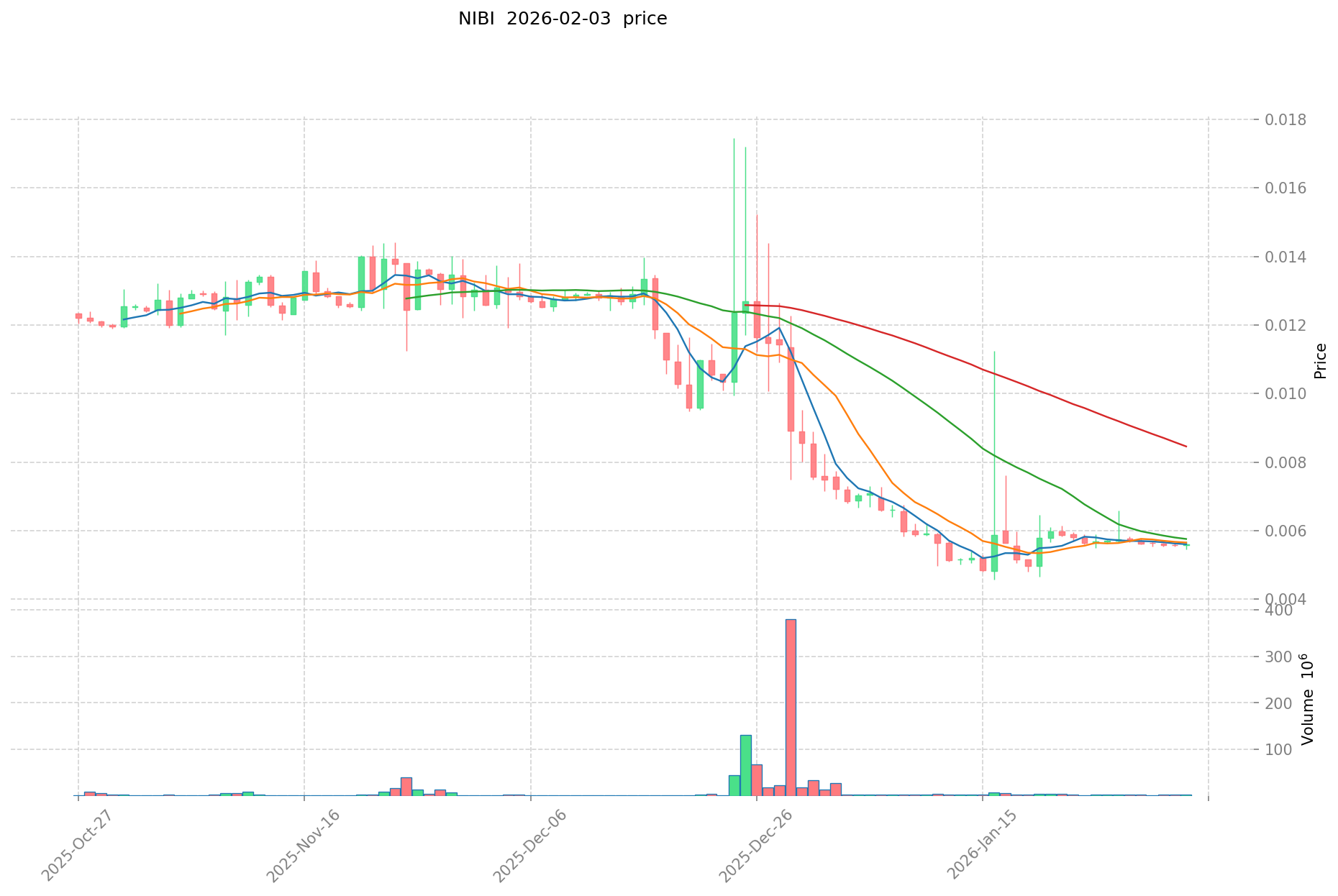
NIBI is a notable asset in the cryptocurrency sector, having been launched in March 2024 as the native token of Nibiru Chain. As of February 2026, NIBI holds a market capitalization of approximately $941,689, with a circulating supply of around 186.69 million tokens, and a current price hovering near $0.005044. Positioned as a Layer-1 blockchain ecosystem emphasizing superior throughput and security, NIBI has garnered attention from investors examining the question "Is Nibiru Chain (NIBI) a good investment?" This article provides a comprehensive analysis of NIBI's investment characteristics, historical price movements, future price projections, and associated risks to serve as a reference for potential investors.
I. Coin (NIBI) Price History Review and Investment Value Status
- 2024: NIBI launched on March 12, 2024, with an initial offering price of $0.1, and the token price experienced significant volatility during its early trading period
- 2024: The token reached a notable price level of $1.032 on March 12, 2024, representing a substantial gain from its launch price
- 2026: From early 2024 through January 2026, NIBI experienced a downward trend, with the price declining to $0.004569 on January 16, 2026
Current NIBI Investment Market Status (February 2026)
- NIBI current price: $0.005044
- Market sentiment (Fear & Greed Index): Data not available in provided materials
- 24-hour trading volume: $120,788.67
- Institutional investor holdings: Data not available in provided materials
Click to view real-time NIBI market price
II. Core Factors Influencing Whether NIBI is a Good Investment
Supply Mechanism and Scarcity (NIBI Investment Scarcity)
- Total supply capped at 1,500,000,000 NIBI with a circulating supply of approximately 186,694,846 tokens, representing a circulation ratio of about 12.45% → influences price dynamics and investment considerations
- Current supply distribution shows a significant portion of tokens remain unvested or locked, which may affect future market liquidity and price movements
- Investment consideration: The relationship between circulating supply and total supply represents a key metric for evaluating potential dilution risks and long-term scarcity dynamics
Institutional Investment and Mainstream Adoption (Institutional Investment in NIBI)
- NIBI is currently listed on 4 exchanges, indicating limited but growing market accessibility
- As a Layer 1 blockchain positioned as a developer-friendly and user-friendly smart contract platform, broader enterprise adoption could enhance its investment profile
- The project's focus on superior throughput and security aims to attract developers and users within the Web3 ecosystem, though institutional adoption data remains limited in available materials
Macroeconomic Environment's Impact on NIBI Investment
- Broader cryptocurrency market conditions and risk sentiment affect NIBI's investment attractiveness, as evidenced by its price performance showing a decline of approximately 80.45% over the past year
- Global monetary policy shifts and interest rate environments may influence capital flows into alternative blockchain platforms and smart contract ecosystems
- Market volatility and macroeconomic uncertainty can impact investor appetite for emerging Layer 1 blockchain projects
Technology and Ecosystem Development (Technology & Ecosystem for NIBI Investment)
- Nibiru Chain positions itself as a breakthrough L1 blockchain offering enhanced throughput and security features, which could support long-term value proposition
- The platform's focus on being developer-friendly and user-friendly within the Web3 space aims to drive ecosystem growth and application development
- Potential expansion of DeFi applications, smart contract use cases, and ecosystem partnerships may contribute to investment value considerations, though specific technical upgrades and adoption metrics require further monitoring
III. NIBI Future Investment Forecast and Price Outlook (Is Nibiru Chain(NIBI) worth investing in 2026-2031)
Short-term Investment Forecast (2026, short-term NIBI investment outlook)
- Conservative forecast: $0.00383344 - $0.005044
- Neutral forecast: $0.005044 - $0.00612846
- Optimistic forecast: $0.005044 - $0.00721292
Mid-term Investment Outlook (2027-2029, mid-term Nibiru Chain(NIBI) investment forecast)
- Market stage expectation: The token may experience gradual growth driven by ecosystem development and broader blockchain adoption patterns.
- Investment return forecast:
- 2027: $0.0032480838 - $0.0066187368
- 2028: $0.005290086672 - $0.006819750288
- 2029: $0.0056071731924 - $0.0075861754956
- Key catalysts: Platform development progress, smart contract ecosystem expansion, developer and user adoption metrics, and overall Web3 market conditions.
Long-term Investment Outlook (Is NIBI a good long-term investment?)
- Base scenario: $0.00425485495188 - $0.010566223130502 (assuming steady platform development and moderate market conditions through 2030)
- Optimistic scenario: $0.008828824025151 - $0.009270265226408 (assuming accelerated ecosystem growth and favorable blockchain adoption trends by 2031)
- Risk scenario: Below $0.00383344 (under conditions of significantly reduced adoption or adverse market environments)
Click to view NIBI long-term investment and price forecast: Price Prediction
2026-02-03 - 2031 Long-term Outlook
- Base scenario: $0.00425485495188 - $0.010566223130502 (corresponding to steady progress and gradual mainstream application growth)
- Optimistic scenario: $0.008828824025151 - $0.009270265226408 (corresponding to large-scale adoption and favorable market environment)
- Transformational scenario: Above $0.009270265226408 (if the ecosystem achieves breakthrough progress and mainstream adoption)
- 2031-12-31 forecast high: $0.009270265226408 (based on optimistic development assumptions)
Disclaimer: Price forecasts are based on historical data and market trends analysis. Cryptocurrency markets are highly volatile and subject to numerous unpredictable factors. These projections should not be considered as investment advice, and actual outcomes may differ significantly from forecasts.
| Year |
Predicted High Price |
Predicted Average Price |
Predicted Low Price |
Price Change |
| 2026 |
0.00721292 |
0.005044 |
0.00383344 |
0 |
| 2027 |
0.0066187368 |
0.00612846 |
0.0032480838 |
21 |
| 2028 |
0.006819750288 |
0.0063735984 |
0.005290086672 |
26 |
| 2029 |
0.0075861754956 |
0.006596674344 |
0.0056071731924 |
30 |
| 2030 |
0.010566223130502 |
0.0070914249198 |
0.00425485495188 |
40 |
| 2031 |
0.009270265226408 |
0.008828824025151 |
0.00467927673333 |
75 |
IV. NIBI Investment Strategy and Risk Management (How to invest in Nibiru Chain)
Investment Methodology (NIBI investment strategy)
Long-term Holding (HODL NIBI): Suitable for conservative investors
Long-term holding strategy focuses on the fundamental value of Nibiru Chain as a Layer 1 blockchain ecosystem. Investors adopting this approach typically believe in the project's long-term development potential and choose to hold tokens through market fluctuations. This strategy requires patience and tolerance for short-term price volatility.
Active Trading: Relying on technical analysis and swing trading
Active trading strategies involve capitalizing on NIBI's price movements through technical analysis tools and market timing. Given the token's historical volatility, with a 24-hour price range between $0.004942 and $0.006501, traders may identify short-term opportunities. However, this approach demands continuous market monitoring and risk management discipline.
Risk Management (Risk management for NIBI investment)
Asset Allocation Ratios: Conservative / Aggressive / Professional investors
- Conservative investors: May allocate 1-3% of their cryptocurrency portfolio to NIBI, focusing on capital preservation
- Aggressive investors: Could consider 5-10% allocation, accepting higher volatility for potential returns
- Professional investors: May implement dynamic allocation strategies based on market conditions and technical indicators
Risk Hedging Solutions: Multi-asset portfolio + hedging instruments
Diversification across different blockchain ecosystems and asset classes can help mitigate NIBI-specific risks. Investors may consider balancing Layer 1 blockchain exposure with established cryptocurrencies and stablecoins. Portfolio rebalancing at regular intervals helps maintain desired risk levels.
Secure Storage: Hot/cold wallets + hardware wallet recommendations
Secure storage practices are essential for protecting NIBI holdings. Cold storage solutions, including hardware wallets, provide enhanced security for long-term holdings. Hot wallets may be used for active trading positions, though they carry higher security risks. Implementing multi-signature solutions and maintaining backup recovery phrases are fundamental security practices.
V. NIBI Investment Risks and Challenges (Risks of investing in Nibiru Chain)
Market Risk: High volatility and price manipulation
NIBI has demonstrated significant price volatility, with a 24-hour change of -9.65% and a 7-day decline of -10.75%. The token's annual performance shows a -80.45% decline, indicating substantial price fluctuations. With a current price of $0.005044 compared to its historical high of $1.032, the token has experienced considerable value erosion. Market manipulation risks may be present in tokens with relatively lower market capitalization and trading volume.
Regulatory Risk: Policy uncertainty across different jurisdictions
Blockchain and cryptocurrency regulations continue to evolve globally, creating uncertainty for Layer 1 projects like Nibiru Chain. Changes in regulatory frameworks across various jurisdictions could impact the project's operations, token utility, and market accessibility. Investors should monitor regulatory developments that may affect smart contract platforms and blockchain ecosystems.
Technical Risk: Network security vulnerabilities and upgrade failures
As a blockchain infrastructure project, Nibiru Chain faces inherent technical risks including potential security vulnerabilities, network congestion, and smart contract exploits. Successful implementation of protocol upgrades and maintenance of network security are critical for the ecosystem's long-term viability. With a circulating supply of 186,694,846 NIBI (approximately 12.45% of the maximum supply of 1,500,000,000), tokenomics and future supply releases represent additional considerations.
VI. Conclusion: Is Nibiru Chain a Good Investment?
Investment Value Summary: NIBI represents a Layer 1 blockchain project with smart contract capabilities, though it faces substantial price volatility and market challenges.
The token's current market position reflects significant headwinds, with year-over-year price decline of -80.45% and a market capitalization of approximately $941,689. The fully diluted valuation stands at $7,566,000, with only 12.45% of tokens currently in circulation. The project's market share of 0.00027% indicates a relatively small presence in the overall cryptocurrency market.
Investor Recommendations:
✅ Beginners: Consider dollar-cost averaging strategies combined with secure wallet storage solutions. Start with minimal allocation to understand market dynamics before increasing exposure.
✅ Experienced Investors: May explore swing trading opportunities while maintaining diversified portfolio positions. Technical analysis and risk management protocols should guide trading decisions.
✅ Institutional Investors: Conduct thorough due diligence on project fundamentals, team capabilities, and ecosystem development before considering strategic allocation.
⚠️ Disclaimer: Cryptocurrency investment carries high risk. This content is for informational purposes only and does not constitute investment advice. Investors should conduct independent research and assess their risk tolerance before making investment decisions.
VII. FAQ
Q1: Is Nibiru Chain (NIBI) a good investment for beginners in 2026?
For beginners, NIBI presents significant risks and requires cautious consideration. The token has experienced an 80.45% decline over the past year, declining from a historical high of $1.032 to approximately $0.005044 as of February 2026. Beginners should only allocate 1-3% of their cryptocurrency portfolio to NIBI and implement dollar-cost averaging strategies to mitigate timing risks. The project's limited market accessibility (listed on only 4 exchanges) and low circulation ratio (12.45% of total supply) indicate potential liquidity constraints. New investors should prioritize secure storage solutions and avoid investing more than they can afford to lose given the asset's high volatility.
Q2: What is the long-term price prediction for NIBI through 2031?
Long-term price forecasts for NIBI vary significantly based on market conditions and ecosystem development. Under the base scenario, NIBI is projected to reach $0.00425485495188 to $0.010566223130502 by 2030, representing gradual growth from current levels. The optimistic scenario projects $0.008828824025151 to $0.009270265226408 by 2031, assuming accelerated ecosystem adoption and favorable blockchain market trends. However, these forecasts are subject to substantial uncertainty given the token's historical volatility and the unpredictable nature of cryptocurrency markets. Investors should treat these projections as rough estimates rather than guaranteed outcomes.
Q3: What are the main risks of investing in Nibiru Chain?
NIBI faces three primary risk categories: market risk, regulatory risk, and technical risk. Market risk is evidenced by extreme volatility, with a 24-hour decline of -9.65%, 7-day decline of -10.75%, and annual decline of -80.45%. The relatively low trading volume of $120,788.67 and small market capitalization of approximately $941,689 increase vulnerability to price manipulation. Regulatory risk stems from evolving global cryptocurrency regulations that could impact Layer 1 blockchain operations. Technical risk includes potential network security vulnerabilities, smart contract exploits, and protocol upgrade failures. Additionally, with only 12.45% of tokens currently circulating, future token unlocks could create significant selling pressure.
Q4: How does NIBI compare to other Layer 1 blockchain investments?
NIBI occupies a relatively modest position within the Layer 1 blockchain ecosystem, with a market share of just 0.00027% and availability on only 4 exchanges. This contrasts with more established Layer 1 platforms that typically enjoy broader market acceptance, higher liquidity, and more extensive institutional support. While Nibiru Chain positions itself as a developer-friendly platform emphasizing superior throughput and security, concrete adoption metrics and ecosystem development indicators remain limited compared to major competitors. The significant supply lock-up (87.55% of tokens not yet in circulation) represents both a potential dilution risk and possible future growth catalyst depending on release schedules and market absorption capacity.
Q5: What investment strategy works best for NIBI in the current market environment?
The optimal strategy depends on investor risk tolerance and experience level. Conservative investors should implement a long-term holding (HODL) approach with minimal allocation (1-3% of portfolio), focusing on dollar-cost averaging to smooth entry points during volatile periods. Experienced traders may capitalize on NIBI's price volatility through active trading strategies, utilizing technical analysis to identify support levels around $0.00383344 and resistance near $0.00721292. All strategies should incorporate strict risk management protocols, including diversification across multiple blockchain ecosystems, secure cold storage for long-term holdings, and regular portfolio rebalancing. Given the token's current bearish trend, waiting for clear reversal signals or fundamental catalysts before increasing exposure may be prudent.
Q6: What factors could drive NIBI price recovery in 2026-2027?
Several catalysts could potentially support NIBI price recovery over the mid-term horizon. Ecosystem development progress, including expansion of DeFi applications and smart contract use cases, represents a fundamental driver for value appreciation. Increased exchange listings beyond the current 4 platforms would enhance liquidity and market accessibility. Developer adoption metrics and growth in active user base would validate the platform's utility proposition. Broader Web3 market conditions and positive sentiment shifts toward Layer 1 blockchain projects could provide sector-wide support. However, given the substantial price decline from historical highs, recovery would likely require sustained positive developments rather than isolated events, with mid-term forecasts suggesting modest gains to $0.0032480838 - $0.0066187368 by 2027 under neutral scenarios.
Q7: Should institutional investors consider NIBI for portfolio allocation?
Institutional investors should approach NIBI with significant caution and comprehensive due diligence. The token's small market capitalization ($941,689), limited exchange presence, and substantial price volatility present liquidity constraints that may be incompatible with institutional position sizing requirements. The lack of detailed institutional holding data and limited transparency regarding major stakeholders adds uncertainty to investment evaluation. Before considering strategic allocation, institutions should thoroughly assess the project team's capabilities, technical roadmap execution, competitive positioning within the Layer 1 ecosystem, and regulatory compliance framework. The significant portion of locked tokens (87.55% of total supply) necessitates careful analysis of vesting schedules and potential dilution impacts. Given these factors, NIBI currently appears more suitable for specialized venture allocation rather than core blockchain infrastructure positions.
Q8: How should investors evaluate NIBI's tokenomics and supply dynamics?
NIBI's tokenomics present both opportunities and concerns for potential investors. The total supply is capped at 1,500,000,000 tokens, with only 186,694,846 (12.45%) currently in circulation, indicating substantial future supply releases. This low circulation ratio creates potential dilution risk as locked tokens vest, which could exert downward price pressure if market demand does not keep pace with increasing supply. However, the controlled release mechanism may also support price stability by preventing sudden supply shocks. The fully diluted valuation of $7,566,000 represents the theoretical market value if all tokens were circulating, significantly higher than the current market capitalization of $941,689. Investors should monitor token unlock schedules, vesting timelines, and team/investor allocation details to assess potential selling pressure. The relationship between circulating supply growth and ecosystem adoption will be crucial for long-term value maintenance.
* The information is not intended to be and does not constitute financial advice or any other recommendation of any sort offered or endorsed by Gate.