OpenLeverage (OLE) is a permissionless DeFi margin trading token with institutional backing from Binance Labs and audits from PeckShield, Code4rena, and Certik. This analysis examines OLE's investment fundamentals across risk, potential returns, and current market position, providing insights for investors seeking exposure to decentralized lending and margin trading. The article reviews historical price performance from its $0.155627 peak in July 2022 to current levels of $0.001548 as of February 2026, alongside price forecasts spanning short-term, medium-term, and long-term horizons. Key factors evaluated include supply mechanisms, institutional adoption metrics, multi-chain deployment on Ethereum and BNB Chain, and substantial risks including market volatility, regulatory uncertainty, and technical vulnerabilities. Practical investment strategies tailored to conservative, experienced, and institutional investors complement comprehensive risk management recommendations, enabling readers to make informed deci
Introduction: OpenLeverage (OLE)'s Investment Position and Market Outlook
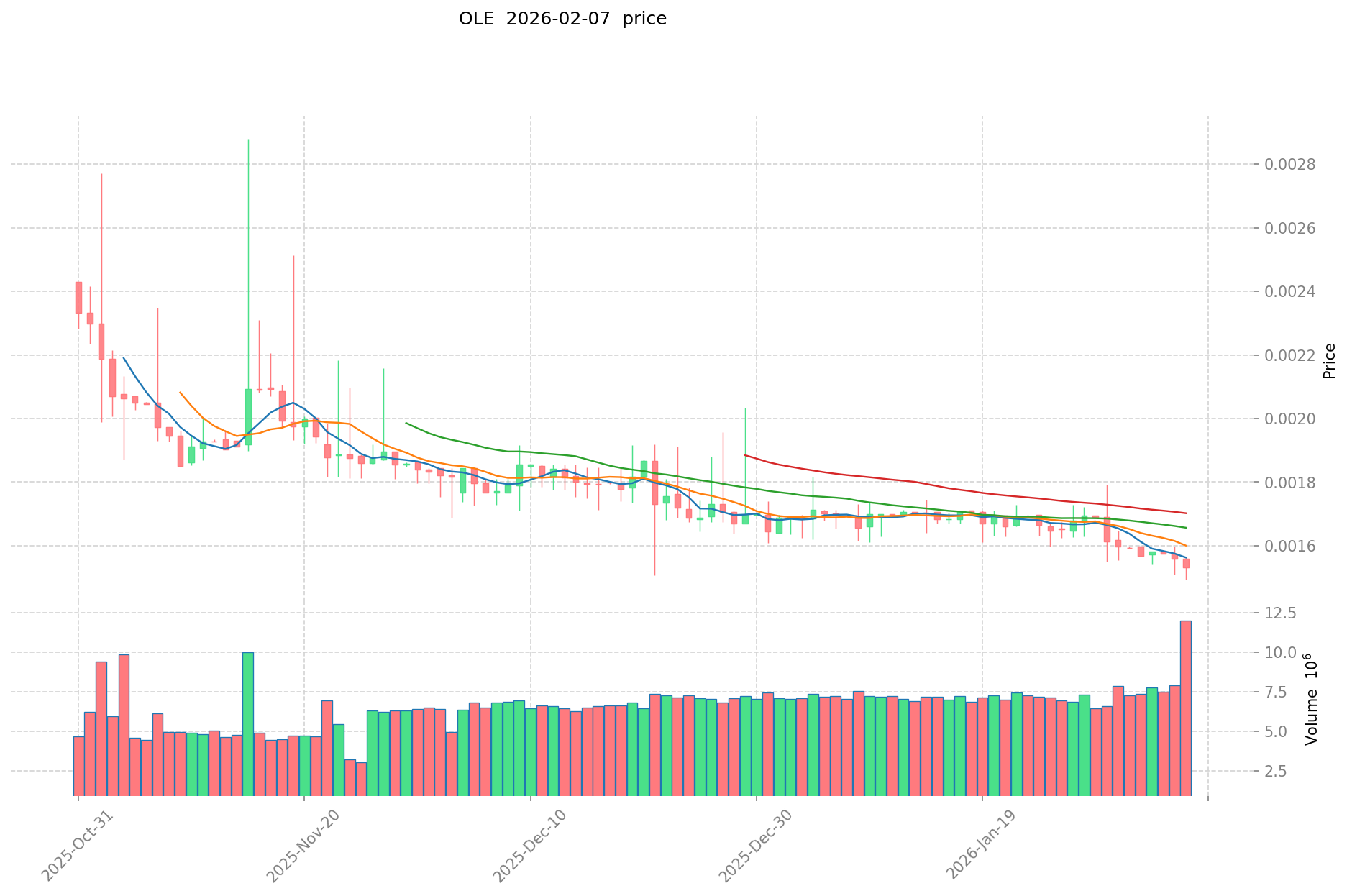
OLE is a notable asset in the cryptocurrency space, serving as the native token of OpenLeverage, a permissionless lending and margin trading protocol that enables traders and applications to efficiently and securely long or short any trading pair on decentralized exchanges. As of February 07, 2026, OLE has a market capitalization of approximately $292,000, with a circulating supply of about 188,630,573 tokens, and its current price stands around $0.001548. With its positioning in the DeFi margin trading sector, OLE has gradually become a focal point when investors discuss "Is OpenLeverage (OLE) a good investment?" The protocol has been deployed on Ethereum and BNB Chain, and has been incubated by Binance Labs and Creative Destruction Lab, receiving security audits from PeckShield, Code4rena, and Certik. This article will comprehensively analyze OLE's investment value, historical trends, future price predictions, and investment risks to provide reference for investors.
I. Price History Review and Investment Value Status of OLE
- 2022: OLE reached a notable price level of $0.155627 in July 2022 → early investors experienced significant gains
- 2025-2026: Market adjustment phase → price declined from previous levels to the current range
- 2026: As of February 7, 2026, the token traded at approximately $0.001548 → reflecting substantial retracement from prior peaks
Current OLE Investment Market Status (February 2026)
- OLE current price: $0.001548
- 24-hour trading volume: $20,791.41
- Market capitalization: $292,000.13
- Circulating supply: 188,630,573 OLE (18.86% of total supply)
Click to view real-time OLE market price
II. Core Factors Affecting Whether OLE is a Good Investment
Supply Mechanism and Scarcity (OLE Investment Scarcity)
- Total supply of 1,000,000,000 OLE tokens with a maximum supply cap → impacts price dynamics and investment value assessment
- Current circulating supply represents approximately 18.86% of total supply (188,630,573 tokens) → suggests substantial future supply potential
- Historical price movements show significant volatility, with prices having fluctuated within a wide range → reflects market response to supply-demand dynamics
- Investment consideration: The relatively low circulating supply ratio may influence long-term value as additional tokens enter circulation
Institutional Investment and Mainstream Adoption (Institutional Investment in OLE)
- OpenLeverage was incubated by Binance Labs and Creative Destruction Lab → indicates institutional backing during development phase
- Security audits conducted by PeckShield, Code4rena, and Certik → demonstrates institutional-grade security validation
- Protocol has achieved over $700 million in trading volume and $14.5 million in TVL → reflects operational adoption metrics
- Deployment across multiple blockchain networks (Ethereum, BNB Chain, and KCC) → indicates multi-chain ecosystem presence
Macroeconomic Environment Impact on OLE Investment
- As a DeFi protocol token, OLE's value may be influenced by broader cryptocurrency market conditions and regulatory developments
- Market capitalization of approximately $292,000 with 0.000062% market dominance → reflects its position within the broader crypto ecosystem
- Trading availability on limited exchanges (1 exchange listed) → may affect liquidity and accessibility for investors
Technology and Ecosystem Development (Technology & Ecosystem for OLE Investment)
- Core protocol functionality: Permissionless lending and margin trading with aggregated DEX liquidity → enables long and short positions on various trading pairs
- Community ownership model through native token distribution → rewards trading, lending, referrals, and participation in Clans Clash activities
- Multi-chain deployment strategy → expands potential user base and interoperability within DeFi ecosystem
- Protocol enables creation of lending pools for specific token pairs → provides infrastructure for decentralized margin trading
III. OLE Future Investment Forecast and Price Outlook (Is OpenLeverage(OLE) worth investing in 2026-2031)
Short-term Investment Forecast (2026, short-term OLE investment outlook)
- Conservative forecast: $0.00114256 - $0.001544
- Neutral forecast: $0.001544 - $0.001672
- Optimistic forecast: $0.001672 - $0.0020072
Based on the provided data, OLE's short-term price movement in 2026 suggests limited upside potential with relatively modest volatility anticipated.
Mid-term Investment Outlook (2027-2028, mid-term OpenLeverage(OLE) investment forecast)
- Market stage expectation: OLE is projected to experience gradual growth during the 2027-2028 period, with anticipated average prices ranging from $0.0017756 in 2027 to $0.002095208 in 2028.
- Investment return forecast:
- 2027: $0.001438236 - $0.002414816 (approximately 14% increase from 2026 baseline)
- 2028: $0.00140378936 - $0.0021999684 (approximately 35% cumulative increase from 2026 baseline)
- Key catalysts: Market adoption trends and the protocol's ability to maintain its position in the decentralized lending and margin trading sector may influence mid-term performance.
Long-term Investment Outlook (Is OLE a good long-term investment?)
- Base scenario: $0.001868401734 - $0.002663009368 (assuming steady protocol development and moderate market conditions through 2029)
- Optimistic scenario: $0.00293446451648 - $0.003022498451974 (assuming enhanced adoption and favorable DeFi market dynamics by 2031)
- Risk scenario: Below $0.00153939122176 (under adverse market conditions or decreased protocol usage)
For detailed OLE long-term investment and price predictions: Price Prediction
2026-2031 Long-term Outlook
- Base scenario: $0.001868401734 - $0.002663009368 (corresponding to steady progress and gradual mainstream application growth)
- Optimistic scenario: $0.00293446451648 - $0.003022498451974 (corresponding to large-scale adoption and favorable market environment)
- Transformative scenario: Above $0.00346363024896 (if the ecosystem achieves breakthrough developments and mainstream adoption)
- 2031-12-31 projected high: $0.003022498451974 (based on optimistic development assumptions)
Disclaimer: These forecasts are derived from historical data patterns and statistical projections. Cryptocurrency markets remain highly volatile, and actual results may differ materially from predictions. This analysis does not constitute investment advice.
| Year |
Predicted High Price |
Predicted Average Price |
Predicted Low Price |
Price Change |
| 2026 |
0.0020072 |
0.001544 |
0.00114256 |
0 |
| 2027 |
0.002414816 |
0.0017756 |
0.001438236 |
14 |
| 2028 |
0.0021999684 |
0.002095208 |
0.00140378936 |
35 |
| 2029 |
0.002663009368 |
0.0021475882 |
0.001868401734 |
38 |
| 2030 |
0.00346363024896 |
0.002405298784 |
0.00153939122176 |
55 |
| 2031 |
0.003022498451974 |
0.00293446451648 |
0.002641018064832 |
89 |
IV. OLE Investment Strategy and Risk Management (How to invest in OLE)
Investment Strategy (OLE investment strategy)
Long-term Holding (HODL OLE): Suitable for conservative investors
Long-term holding represents a passive investment approach where investors acquire OLE tokens and maintain positions over extended periods, typically measured in years rather than months. This strategy may appeal to those who believe in OpenLeverage's fundamental value proposition as a permissionless lending and margin trading protocol. Given OLE's role as a native token enabling community ownership and protocol usage incentives, long-term holders may benefit from potential protocol growth and ecosystem development. However, investors should note that OLE has experienced significant price fluctuations, with historical data showing a 74.52% decline over a one-year period as of February 7, 2026.
Active Trading: Relies on technical analysis and swing operations
Active trading involves frequent position adjustments based on technical indicators, chart patterns, and short-term price movements. For OLE, this strategy requires monitoring multiple timeframes and market conditions. Recent data shows OLE's 24-hour price range between $0.001465 and $0.001563, indicating relatively modest intraday volatility. Active traders may utilize support and resistance levels, moving averages, and volume analysis to identify entry and exit points. The token's limited exchange availability (listed on 1 exchange according to available data) may impact liquidity considerations for active trading strategies.
Risk Management (Risk management for OLE investment)
Asset Allocation Ratios: Conservative / Aggressive / Professional investors
- Conservative investors: Consider allocating 1-3% of cryptocurrency portfolio to OLE, given its lower market capitalization rank (3545) and limited trading history
- Aggressive investors: May allocate 5-10% of cryptocurrency holdings, accepting higher volatility for potential growth opportunities
- Professional investors: Should conduct thorough due diligence and consider position sizing based on risk-adjusted return expectations and portfolio correlation analysis
Risk Hedging Solutions: Multi-asset portfolio + hedging tools
Diversification across multiple cryptocurrency assets and traditional financial instruments can help mitigate OLE-specific risks. Investors may consider:
- Maintaining positions in established cryptocurrencies alongside OLE exposure
- Utilizing stablecoin allocations to manage volatility
- Monitoring correlation patterns between OLE and broader DeFi protocol tokens
- Setting predetermined stop-loss levels to limit downside exposure
Secure Storage: Hot and cold wallets + hardware wallet recommendations
Proper token custody represents a critical component of risk management. OLE holders should consider:
- Cold storage solutions (hardware wallets) for long-term holdings not actively traded
- Hot wallets only for amounts intended for immediate trading or protocol interaction
- Multi-signature wallets for institutional-sized holdings
- Regular security audits of wallet software and backup procedures
- Verification of contract addresses (0x1b6e9c73bee68102d9dd4a2627f97bff4183ab0a on Ethereum, 0xB7E2713CF55cf4b469B5a8421Ae6Fc0ED18F1467 on BSC) before any transactions
V. OLE Investment Risks and Challenges (Risks of investing in OLE)
Market Risk: High volatility and price manipulation
OLE exhibits characteristics common to lower market cap cryptocurrencies, including pronounced price volatility. The token's 24-hour trading volume of approximately $20,791 suggests relatively limited liquidity compared to major cryptocurrencies. This lower liquidity environment may increase susceptibility to significant price swings from relatively modest trading volumes. The token's price has declined 0.95% over 24 hours, 4.56% over 7 days, and 8.1% over 30 days as of February 7, 2026. With only 529 holders recorded, the token concentration among a limited number of addresses may present additional volatility considerations.
Regulatory Risk: Policy uncertainty across different jurisdictions
As a DeFi protocol offering leveraged trading functionality, OpenLeverage and its native OLE token operate in an evolving regulatory landscape. Different jurisdictions maintain varying approaches to decentralized margin trading protocols, lending platforms, and associated governance tokens. Regulatory developments in major markets could impact protocol operations, token utility, or exchange availability. The protocol's deployment across multiple chains (Ethereum, BNB Chain, and KCC) introduces additional jurisdictional complexity. Investors should monitor regulatory developments in their respective jurisdictions and consider how potential policy changes might affect their OLE holdings.
Technical Risk: Network security vulnerabilities and upgrade failures
OpenLeverage has undergone security audits from PeckShield, Code4rena, and Certik, which represents positive technical due diligence. However, DeFi protocols inherently carry smart contract risk, including potential vulnerabilities in protocol code, dependencies on external price oracles, and risks associated with cross-chain bridge implementations. The protocol's multi-chain deployment introduces additional technical complexity and potential attack surfaces. Protocol upgrades, while potentially beneficial for functionality and security, also carry implementation risks. The permissionless nature of the protocol means users bear responsibility for understanding technical risks before interacting with smart contracts or holding OLE tokens.
VI. Conclusion: Is OLE a Good Investment?
Investment Value Summary: OLE presents characteristics of an emerging DeFi governance token with associated opportunities and risks. The protocol's value proposition centers on permissionless margin trading capabilities across DEX trading pairs, supported by its deployment on multiple blockchain networks. Historical performance data shows significant price decline from its peak, with the current price of $0.001548 representing substantial distance from its historical high of $0.155627 recorded on July 7, 2022. The token's circulating supply of 188,630,573 represents 18.86% of the maximum supply of 1,000,000,000 tokens.
Investor Recommendations:
✅ New investors: Consider dollar-cost averaging (DCA) combined with secure wallet storage practices. Begin with small allocations to understand protocol mechanics and token dynamics before increasing position sizes. Prioritize security fundamentals including hardware wallet usage and careful verification of contract addresses.
✅ Experienced investors: May explore swing trading strategies based on technical analysis while maintaining core long-term positions. Consider portfolio diversification across multiple DeFi protocol tokens to manage sector-specific risks. Monitor protocol metrics including trading volume, TVL trends, and governance developments.
✅ Institutional investors: Should conduct comprehensive due diligence including smart contract audits review, legal and regulatory analysis, and liquidity assessment before any strategic allocation. Consider custody solutions appropriate for institutional requirements and implement rigorous risk management frameworks.
⚠️ Disclaimer: Cryptocurrency investments carry substantial risk and may not be suitable for all investors. Price volatility, regulatory uncertainty, and technical risks represent significant considerations. This content provides educational information only and does not constitute investment advice, financial advice, trading advice, or recommendations. Investors should conduct independent research and consider consulting qualified financial professionals before making investment decisions.
VII. FAQ
Q1: What is OpenLeverage (OLE) and what makes it unique in the DeFi space?
OpenLeverage (OLE) is the native governance token of a permissionless lending and margin trading protocol that enables users to long or short any trading pair on decentralized exchanges. What distinguishes OLE from other DeFi tokens is its focus on democratizing margin trading by aggregating DEX liquidity while allowing users to create lending pools for specific token pairs. The protocol has been incubated by Binance Labs and Creative Destruction Lab, and has undergone security audits from PeckShield, Code4rena, and Certik. It operates across multiple blockchain networks including Ethereum, BNB Chain, and KCC, offering community ownership through token distribution that rewards trading, lending, and participation in protocol activities.
Q2: What has been OLE's historical price performance and current market position?
OLE experienced significant price volatility since its launch, reaching a notable peak of $0.155627 in July 2022. As of February 7, 2026, the token trades at approximately $0.001548, representing a substantial retracement of approximately 99% from its all-time high. The token currently has a market capitalization of around $292,000 with a circulating supply of 188,630,573 tokens (18.86% of the 1 billion maximum supply). Recent performance shows a 4.56% decline over 7 days and 8.1% over 30 days, with 24-hour trading volume of approximately $20,791. The token ranks 3545 by market capitalization with only 529 recorded holders.
Q3: What are the projected price forecasts for OLE in the short, medium, and long term?
Short-term forecasts for 2026 suggest OLE may trade between $0.00114256 (conservative low) and $0.0020072 (optimistic high), with a neutral average around $0.001544. Medium-term projections for 2027-2028 anticipate gradual growth, with average prices potentially reaching $0.0017756 in 2027 (14% increase) and $0.002095208 in 2028 (35% cumulative increase from 2026). Long-term outlooks through 2031 vary significantly based on adoption scenarios: base case projections suggest a range of $0.001868401734 to $0.002663009368 by 2029, while optimistic scenarios project prices between $0.00293446451648 and $0.003022498451974 by 2031. These forecasts assume continued protocol development and varying degrees of market adoption, though actual results may differ materially given cryptocurrency market volatility.
Q4: What are the primary risks associated with investing in OLE?
OLE investment carries multiple significant risks. Market risk includes high volatility due to relatively low liquidity (24-hour volume of ~$20,791) and limited holder base (529 holders), making the token susceptible to substantial price swings from modest trading activity. Regulatory risk stems from the evolving legal landscape surrounding DeFi leveraged trading protocols, with different jurisdictions maintaining varying approaches that could impact protocol operations or token utility. Technical risk encompasses smart contract vulnerabilities despite security audits, complexities from multi-chain deployment, and potential oracle or bridge risks inherent in DeFi protocols. Additionally, the token's availability on only one exchange limits liquidity options, and the low circulating supply ratio (18.86%) suggests substantial future dilution potential as more tokens enter circulation.
Q5: What investment strategies are recommended for different types of OLE investors?
For conservative investors, a long-term holding (HODL) strategy with 1-3% portfolio allocation is recommended, utilizing dollar-cost averaging and secure cold storage solutions. Experienced investors might consider active trading strategies based on technical analysis while maintaining core positions, with 5-10% allocation and diversification across multiple DeFi tokens to manage sector-specific risks. Professional and institutional investors should conduct comprehensive due diligence including smart contract review, regulatory analysis, and liquidity assessment before strategic allocation, implementing rigorous risk management frameworks and institutional-grade custody solutions. All investors should prioritize security through hardware wallets for long-term holdings, verify contract addresses before transactions (0x1b6e9c73bee68102d9dd4a2627f97bff4183ab0a on Ethereum), and implement predetermined stop-loss levels to limit downside exposure.
Q6: How does OLE's supply mechanism affect its investment potential?
OLE has a maximum supply of 1,000,000,000 tokens with approximately 188,630,573 currently in circulation (18.86%), indicating substantial future supply potential that could impact long-term value dynamics. This relatively low circulating supply ratio means that approximately 811 million tokens have yet to enter circulation, which could create downward price pressure as additional tokens are released through protocol rewards, governance distributions, or other mechanisms. The supply mechanism includes community ownership incentives through token distribution for trading, lending, referrals, and participation in Clans Clash activities. Investors should consider that the token's scarcity profile may evolve significantly as circulation increases, potentially affecting supply-demand dynamics and price trajectories over time. Understanding the token release schedule and vesting mechanisms becomes critical for assessing long-term investment value.
Q7: What role does institutional backing play in OLE's investment thesis?
OpenLeverage benefits from institutional validation through incubation by Binance Labs and Creative Destruction Lab, which provided early-stage support and credibility during the protocol's development phase. The protocol has undergone security audits from three reputable firms (PeckShield, Code4rena, and Certik), demonstrating institutional-grade security validation that reduces technical risk concerns. The protocol has achieved operational metrics including over $700 million in cumulative trading volume and $14.5 million in TVL, reflecting meaningful adoption within the DeFi ecosystem. However, investors should note that institutional backing during development phases does not guarantee future success or token price appreciation. The protocol's current market position, with limited exchange listings and modest market capitalization, suggests that broader institutional adoption remains an area for potential growth rather than a currently established strength.
Q8: Is OLE suitable as a long-term investment for building wealth?
OLE's suitability as a long-term wealth-building investment depends significantly on individual risk tolerance and investment objectives. The protocol addresses a genuine market need for permissionless margin trading with multi-chain deployment and institutional-grade security audits, which represents a solid foundation. However, substantial challenges exist: the token has declined approximately 99% from its all-time high, maintains limited liquidity with only one exchange listing, and faces competition from established DeFi lending and trading protocols. Long-term projections suggest potential growth scenarios, with optimistic 2031 forecasts indicating possible 89% cumulative returns from 2026 levels, but these remain speculative and dependent on successful protocol adoption and favorable market conditions. Conservative investors should limit exposure to 1-3% of crypto portfolios, while even aggressive allocations should not exceed 10%. The investment is better characterized as a high-risk, speculative position rather than a core wealth-building holding, suitable only for investors who can afford complete capital loss and understand DeFi protocol dynamics.
* The information is not intended to be and does not constitute financial advice or any other recommendation of any sort offered or endorsed by Gate.