Is PUSH (PUSH) a good investment?: A Comprehensive Analysis of Price Potential, Risk Factors, and Market Outlook for 2024

Introduction: PUSH Protocol's Investment Position and Market Outlook
PUSH is a notable asset in the cryptocurrency sector, originally launched as EPNS (Ethereum Push Notification Service) in April 2021. As a decentralized notification protocol, it has established its presence in the Web3 communication infrastructure space. As of February 3, 2026, PUSH maintains a market capitalization of approximately $1.23 million, with a circulating supply of around 90.24 million tokens, and the current price hovering near $0.0136. With its positioning as a decentralized notification service enabling platform-agnostic communication for dApps and smart contracts, PUSH has gradually become a subject of discussion among investors examining "Is PUSH a good investment?" This article provides a comprehensive analysis of PUSH's investment characteristics, historical performance, future price projections, and associated risks to serve as a reference for investors.
PUSH functions as the native governance token for the Push Protocol, offering holders governance rights and reward mechanisms. The protocol enables users with wallet addresses to receive notifications from various decentralized applications, services, and smart contracts across multiple platforms including mobile devices, tablets, web browsers, and user wallets. Token holders can participate in protocol development decisions and receive rewards from network fees, with the fee pool distributing 70% to PUSH holders and 30% to the ecosystem development fund. The token has a maximum supply of 100 million units, with over 90% currently in circulation, ranking at position 2380 in the market and representing a market dominance of 0.000049%.
I. PUSH Price History Review and Current Investment Value
PUSH Historical Price Performance and Investment Returns
- 2021: Token generation event and initial exchange listings → Early investors experienced significant price appreciation as PUSH reached notable valuation levels during the market cycle
- 2021-2023: Market correction period → PUSH price declined alongside broader crypto market trends, testing support levels across multiple exchanges
- 2024-2025: Market stabilization phase → Price consolidated within a range as the protocol continued development of its decentralized notification infrastructure
Current PUSH Investment Market Status (February 2026)
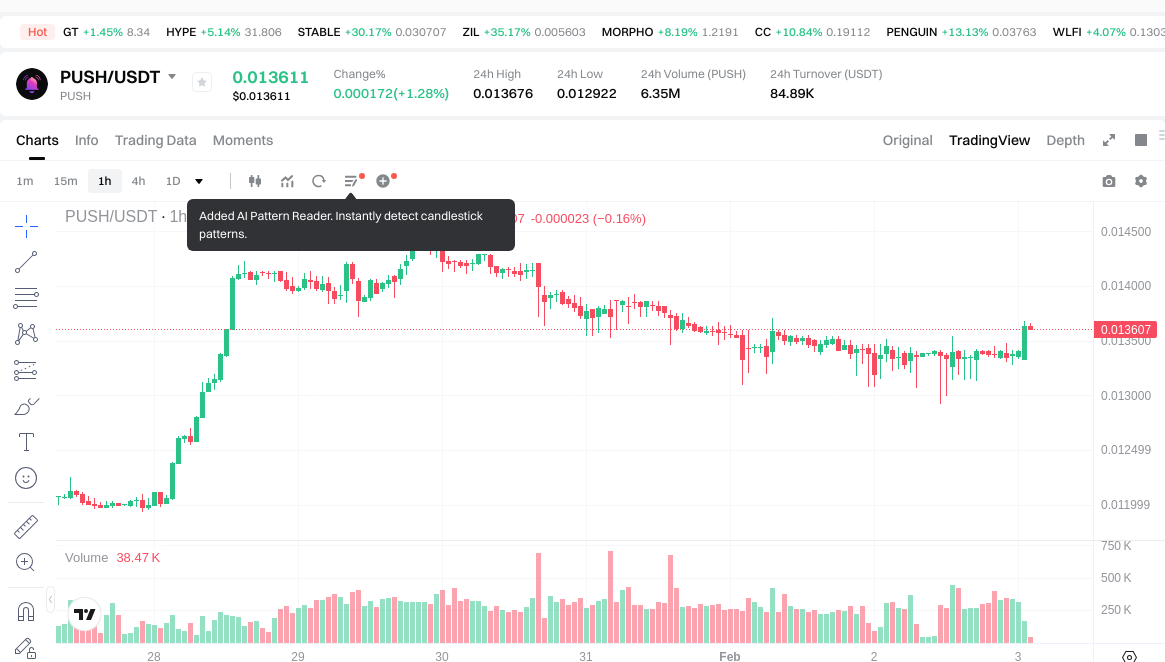
- Current PUSH price: $0.013638
- 24-hour trading volume: $85,335.63
- Market capitalization: $1,230,645.14
- Circulating supply: 90,236,482 PUSH (90.24% of total supply)
- Price changes: +1.72% (24h), +18.39% (7d), +10.32% (30d)
Click to view real-time PUSH market price
II. Core Factors Affecting Whether PUSH is a Good Investment
Supply Mechanism and Scarcity
- Fixed supply cap: PUSH has a maximum supply of 100,000,000 tokens, with approximately 90,236,482 tokens currently in circulation (90.24% circulating ratio)
- Supply dynamics: The capped supply model may contribute to scarcity characteristics over time as demand evolves
- Investment consideration: Token supply structure represents one factor among many that investors may consider when evaluating long-term positioning
Institutional Investment and Mainstream Adoption
- Holder distribution: As of current data, PUSH has approximately 5,561 token holders
- Exchange presence: The token is available on 8 cryptocurrency exchanges, indicating a level of market accessibility
- Governance participation: PUSH token holders have governance rights to participate in protocol development decisions, with potential fee pool rewards (70% allocated to PUSH holders, 30% to ecosystem development fund, though fee pool activation occurred approximately one year post-protocol launch)
Macroeconomic Environment Impact on PUSH Investment
- Market volatility context: PUSH has experienced notable price fluctuations, with current price at $0.013638 representing a significant decline from earlier periods
- Performance metrics: Recent price movements show +1.83% (1H), +1.72% (24H), +18.39% (7D), +10.32% (30D), but -81.52% (1Y)
- Broader market correlation: As with many digital assets, PUSH's investment profile may be influenced by general cryptocurrency market conditions and regulatory developments
Technology and Ecosystem Development
- Core protocol function: PUSH operates as a decentralized notification protocol (formerly EPNS - Ethereum Push Notification Service) enabling wallet addresses to receive notifications across platforms
- Technical infrastructure: The protocol allows dApps, services, and smart contracts to send platform-agnostic notifications (mobile devices, tablets, web, user wallets)
- Ecosystem utility: The notification infrastructure serves DeFi protocols and other blockchain applications, with protocol development guided by token holder governance decisions
III. PUSH Future Investment Predictions and Price Outlook (Is PUSH(PUSH) worth investing in 2026-2031)
Short-term Investment Prediction (2026, short-term PUSH investment outlook)
- Conservative Forecast: $0.0128 - $0.0136
- Neutral Forecast: $0.0136 - $0.0170
- Optimistic Forecast: $0.0170 - $0.0199
Mid-term Investment Outlook (2027-2028, mid-term PUSH(PUSH) investment forecast)
-
Market Phase Expectation: During this period, PUSH may experience gradual recovery and development phases as the decentralized notification protocol ecosystem continues to mature. Market participants may focus on protocol adoption rates and ecosystem expansion progress.
-
Investment Return Prediction:
- 2027: $0.0146 - $0.0249
- 2028: $0.0133 - $0.0263
-
Key Catalysts: Protocol development milestones, expansion of the notification service ecosystem, partnerships with DeFi protocols, and broader adoption of decentralized communication infrastructure.
Long-term Investment Outlook (Is PUSH a good long-term investment?)
- Base Scenario: $0.0137 - $0.0260 (assuming steady progress in protocol development and moderate adoption growth)
- Optimistic Scenario: $0.0210 - $0.0351 (assuming accelerated adoption of decentralized notification services and favorable market conditions)
- Risk Scenario: Below $0.0137 (considering potential competitive pressures or adverse market conditions)
Click to view PUSH long-term investment and price prediction: Price Prediction
2026-02-03 to 2031 Long-term Outlook
- Base Scenario: $0.0137 - $0.0260 (corresponding to steady progress and gradual mainstream application enhancement)
- Optimistic Scenario: $0.0210 - $0.0391 (corresponding to large-scale adoption and favorable market environment)
- Transformative Scenario: Above $0.0391 (if ecosystem achieves breakthrough progress and mainstream adoption)
- 2031-12-31 Predicted High: $0.0391 (based on optimistic development assumptions)
Disclaimer: These predictions are based on historical data and market analysis models. Cryptocurrency markets are highly volatile and subject to numerous unpredictable factors. This information does not constitute investment advice, and investors should conduct their own research and risk assessment before making any investment decisions.
| Year | Predicted High Price | Predicted Average Price | Predicted Low Price | Price Change |
|---|---|---|---|---|
| 2026 | 0.0198706 | 0.01361 | 0.0127934 | 0 |
| 2027 | 0.024943047 | 0.0167403 | 0.014564061 | 22 |
| 2028 | 0.02626050861 | 0.0208416735 | 0.01333867104 | 52 |
| 2029 | 0.02849682017655 | 0.023551091055 | 0.0136596328119 | 72 |
| 2030 | 0.035132340081296 | 0.026023955615775 | 0.021599883161093 | 90 |
| 2031 | 0.039140029246125 | 0.030578147848535 | 0.025074081235799 | 124 |
IV. PUSH Investment Strategy and Risk Management (How to invest in PUSH)
Investment Strategy (PUSH investment strategy)
Long-term Holding (HODL PUSH)
For conservative investors who believe in the long-term potential of decentralized notification protocols, a buy-and-hold strategy may be appropriate. PUSH token holders can participate in protocol governance and potentially receive rewards from network fees (with 70% allocated to PUSH holders and 30% to the ecosystem development fund, though the fee pool mechanism was designed to activate approximately one year after protocol launch). This approach requires patience and tolerance for price volatility, as PUSH has experienced significant price fluctuations since its launch in April 2021.
Active Trading
More experienced traders may choose to engage in active trading strategies based on technical analysis and market momentum. With a 24-hour trading volume of approximately $85,335 and price movements showing recent gains (1.83% in 1 hour, 1.72% in 24 hours, and 18.39% over 7 days as of February 3, 2026), there may be opportunities for swing trading. However, traders should note the token's historical volatility, with prices ranging from an all-time high of $8.73 (April 14, 2021) to an all-time low of $0.00961203 (January 21, 2026).
Risk Management (Risk management for PUSH investment)
Asset Allocation Ratios
- Conservative investors: Allocate no more than 1-3% of total crypto portfolio to PUSH, given its relatively low market capitalization of approximately $1.23 million and ranking of #2380 among cryptocurrencies.
- Aggressive investors: May allocate 5-10% of crypto portfolio, accepting higher risk for potential returns from protocol adoption growth.
- Professional investors: Should conduct thorough due diligence on protocol adoption metrics, partnership developments, and competitive positioning within the Web3 notification infrastructure space.
Risk Hedging Solutions
Diversification across multiple asset classes is recommended. Investors might consider:
- Combining PUSH with established cryptocurrencies like Bitcoin or Ethereum
- Balancing crypto exposure with traditional assets
- Using stablecoin positions for quick rebalancing opportunities
Secure Storage
- Cold wallets: For long-term holdings, hardware wallets such as Ledger or Trezor provide enhanced security
- Hot wallets: For active trading, reputable software wallets with strong security features
- Best practices: Never store all tokens in one location; use multi-signature wallets for larger holdings
- Contract verification: PUSH operates as an ERC-20 token on Ethereum (contract address: 0xf418588522d5dd018b425e472991e52ebbeeeeee), so ensure wallet compatibility
V. PUSH Investment Risks and Challenges (Risks of investing in PUSH)
Market Risk
High volatility: PUSH has demonstrated extreme price volatility, with a decline of approximately 81.52% over the past year (as of February 3, 2026). The token's current price of $0.013638 represents a significant decrease from its all-time high of $8.73, indicating substantial downside risk potential.
Liquidity concerns: With a relatively modest 24-hour trading volume of approximately $85,335 and availability on only 8 exchanges, PUSH may experience liquidity challenges during periods of market stress, potentially leading to larger price slippage during trades.
Market manipulation potential: Lower liquidity and market capitalization can make smaller tokens more susceptible to price manipulation by large holders or coordinated trading groups.
Regulatory Risk
Jurisdictional uncertainty: Cryptocurrency regulations vary significantly across different countries and continue to evolve. Changes in regulatory frameworks could impact PUSH's utility, trading availability, or legal status in certain jurisdictions.
Classification ambiguity: Tokens that provide governance rights and fee-sharing mechanisms may face regulatory scrutiny regarding their classification as securities in some jurisdictions, which could affect their trading and distribution.
Technical Risk
Smart contract vulnerabilities: As an Ethereum-based protocol, PUSH is subject to potential smart contract bugs or exploits that could compromise user funds or protocol functionality.
Protocol development risk: The success of PUSH depends on continued protocol development, adoption by dApps and services, and the ability to compete with alternative notification solutions. Any delays or failures in achieving development milestones could negatively impact token value.
Network dependency: Being built on Ethereum, PUSH's performance and user experience are tied to Ethereum network conditions, including gas fees and network congestion.
Adoption challenges: The protocol's value proposition depends on widespread adoption by decentralized applications, services, and users. Limited adoption could restrict the token's utility and long-term value.
VI. Conclusion: Is PUSH a Good Investment?
Investment Value Summary
PUSH presents a specialized use case within the Web3 infrastructure sector, focusing on decentralized notifications. The token offers governance participation and potential fee-sharing benefits to holders. However, the investment faces significant challenges, including substantial price decline (down 81.52% over one year), limited liquidity (24-hour volume around $85,335), and a relatively low market position (ranked #2380). The circulating supply represents approximately 90.24% of the maximum supply of 100 million tokens, with 5,561 holders. While the protocol addresses a real need in the decentralized ecosystem, the token's long-term investment potential remains uncertain and should be approached with considerable caution due to demonstrated high volatility.
Investor Recommendations
✅ Beginners: Consider a small allocation (1-2% of crypto portfolio maximum) through dollar-cost averaging to reduce timing risk. Prioritize secure storage using hardware wallets and only invest amounts you can afford to lose entirely. Thoroughly research the protocol's utility and competitive landscape before investing.
✅ Experienced investors: May explore swing trading opportunities based on technical analysis, given recent short-term price movements. Consider portfolio allocation of 3-5% maximum, combined with diversified holdings across multiple crypto sectors. Monitor protocol adoption metrics, partnership announcements, and competitive developments.
✅ Institutional investors: Should conduct comprehensive due diligence on protocol fundamentals, team credentials, technological differentiation, and market positioning before considering any strategic allocation. Given the token's current market dynamics, institutional involvement should be approached with enhanced risk assessment.
⚠️ Disclaimer: Cryptocurrency investments carry high risk, including potential total loss of capital. This content is for informational purposes only and does not constitute investment advice. Market conditions can change rapidly, and past performance does not indicate future results. Always conduct your own research and consider consulting with qualified financial advisors before making investment decisions.
VII. FAQ
Q1: What is PUSH Protocol and what is its primary use case?
PUSH Protocol (formerly known as EPNS - Ethereum Push Notification Service) is a decentralized notification protocol that enables wallet addresses to receive notifications from various decentralized applications, services, and smart contracts across multiple platforms including mobile devices, tablets, web browsers, and user wallets. The PUSH token serves as the native governance token, allowing holders to participate in protocol development decisions and potentially receive rewards from network fees (with 70% allocated to PUSH holders and 30% to the ecosystem development fund). The protocol addresses the critical need for platform-agnostic communication infrastructure in the Web3 ecosystem, enabling dApps and smart contracts to send notifications without relying on centralized services.
Q2: What are the current market conditions for PUSH as of February 2026?
As of February 3, 2026, PUSH trades at approximately $0.013638 with a market capitalization of $1,230,645. The token has shown mixed performance with short-term gains of +1.72% (24 hours) and +18.39% (7 days), but has experienced a significant decline of -81.52% over the past year from its all-time high of $8.73 (April 14, 2021). With a 24-hour trading volume of approximately $85,335 and availability on 8 exchanges, PUSH faces liquidity challenges compared to more established cryptocurrencies. The circulating supply stands at approximately 90.24 million tokens (90.24% of the 100 million maximum supply), with 5,561 token holders and a market ranking of #2380.
Q3: What are the key risks associated with investing in PUSH?
PUSH investment carries several significant risks. Market risk includes extreme price volatility, demonstrated by the 81.52% decline over the past year and substantial distance from all-time highs. Liquidity concerns arise from modest trading volume ($85,335 daily) and limited exchange availability, potentially leading to price slippage during trades. Technical risks include smart contract vulnerabilities inherent to Ethereum-based protocols, dependency on Ethereum network performance, and challenges in achieving widespread adoption by dApps and services. Regulatory uncertainty regarding token classification (given its governance rights and fee-sharing mechanisms) could impact trading availability in certain jurisdictions. The protocol's success depends heavily on adoption rates within the competitive Web3 communication infrastructure space.
Q4: What investment strategy is appropriate for different types of investors interested in PUSH?
For conservative investors, a long-term holding (HODL) strategy with allocation of 1-3% of crypto portfolio maximum is recommended, utilizing hardware wallets for secure storage. This approach requires high tolerance for volatility while potentially benefiting from governance participation and fee-sharing mechanisms. Experienced investors may consider swing trading opportunities based on technical analysis, with portfolio allocation of 3-5% maximum, monitoring protocol adoption metrics and competitive developments. Institutional investors should conduct comprehensive due diligence on protocol fundamentals, technological differentiation, and market positioning before considering any strategic allocation. Dollar-cost averaging is recommended for all investor types to mitigate timing risk, and diversification across multiple asset classes remains essential given PUSH's demonstrated volatility.
Q5: What is the long-term price prediction outlook for PUSH through 2031?
Price predictions for PUSH through 2031 present multiple scenarios based on adoption trajectories and market conditions. The base scenario projects a range of $0.0137 - $0.0260, assuming steady protocol development and moderate adoption growth. An optimistic scenario forecasts $0.0210 - $0.0391, contingent on accelerated adoption of decentralized notification services and favorable market conditions. For 2026, conservative estimates suggest $0.0128 - $0.0136, while optimistic projections reach $0.0170 - $0.0199. By 2031, predicted high reaches $0.0391 under optimistic development assumptions. However, these predictions carry substantial uncertainty given the token's high volatility, limited market presence, and dependency on ecosystem adoption. These forecasts should not be interpreted as guaranteed outcomes but rather as potential scenarios based on historical data and market analysis models.
Q6: How does PUSH's tokenomics and governance structure work?
PUSH operates with a fixed maximum supply of 100 million tokens, with approximately 90.24 million currently in circulation (90.24% circulating ratio). Token holders possess governance rights to participate in protocol development decisions through voting mechanisms. The protocol incorporates a fee-sharing model designed to distribute 70% of network fees to PUSH holders and 30% to the ecosystem development fund, though this fee pool mechanism was scheduled to activate approximately one year after protocol launch. The token functions as an ERC-20 token on the Ethereum blockchain (contract address: 0xf418588522d5dd018b425e472991e52ebbeeeeee). This tokenomics structure aims to align incentives between protocol users, token holders, and ecosystem development, though the actual value accrual depends on protocol adoption rates and fee generation from notification services.
Q7: What factors should be monitored when evaluating PUSH as an ongoing investment?
Key monitoring factors include protocol adoption metrics such as the number of integrated dApps and active notification channels, which directly impact utility and fee generation potential. Exchange availability and trading volume trends indicate market liquidity conditions that affect trade execution. Partnership announcements with DeFi protocols and blockchain platforms signal ecosystem expansion potential. Development milestones and GitHub activity reflect the team's progress on technical roadmap objectives. Competitive landscape analysis should track alternative Web3 communication solutions and their adoption rates. Token holder distribution changes may indicate accumulation or distribution patterns by large holders. Regulatory developments affecting utility tokens with governance features require attention, particularly in major jurisdictions. Market capitalization ranking and dominance percentage provide context for relative market positioning within the broader cryptocurrency ecosystem.
Share
Content
Introduction: PUSH Protocol's Investment Position and Market Outlook
I. PUSH Price History Review and Current Investment Value
II. Core Factors Affecting Whether PUSH is a Good Investment
III. PUSH Future Investment Predictions and Price Outlook (Is PUSH(PUSH) worth investing in 2026-2031)
IV. PUSH Investment Strategy and Risk Management (How to invest in PUSH)
V. PUSH Investment Risks and Challenges (Risks of investing in PUSH)
VI. Conclusion: Is PUSH a Good Investment?
VII. FAQ
How to Buy Cryptocurrency


Trending Cryptocurrencies



2025 SUI coin: price, buying guide, and Staking rewards

How to Buy Crypto: A Step-by-Step Guide with Gate.com
HNT Price in 2025: Helium Network Token Value and Market Analysis
What is SwissCheese (SWCH) and How Does It Democratize Investment?

Cardano (ADA) Price Analysis and Outlook for 2025

How to Invest in Metaverse Crypto

Is Router Protocol (ROUTE) a good investment?: A Comprehensive Analysis of Features, Market Performance, and Future Prospects

Is EQTY (EQTY) a good investment?: A Comprehensive Analysis of Performance, Risk, and Market Potential

Is My DeFi Pet (DPET) a good investment?: A Comprehensive Analysis of Token Fundamentals, Market Performance, and Risk Factors in 2024

What is a Non-Custodial Wallet vs Custodial Wallet?
Cloud Mining: Leading Platform Overview