This comprehensive analysis examines whether Terrace (TRC) represents a viable investment opportunity in the cryptocurrency market. As an emerging self-custodial trading terminal aggregating liquidity from centralized exchanges, decentralized exchanges, market makers, and OTC desks, TRC launched January 2025 at $0.004 and currently trades at $0.0076 with a market cap of $1.37 million. The article evaluates TRC's investment potential through multiple dimensions: historical price performance showing 89.84% 30-day gains alongside 12.06% daily volatility, tokenomics featuring 180 million circulating tokens from a 1 billion total supply, institutional adoption metrics revealing 708 holders across 2 Gate-listed exchanges, and technology fundamentals built on Base network ERC-20 infrastructure. Investment strategies span conservative dollar-cost averaging (1-3% allocation), active trading capitalizing on volatility patterns, and institutional positioning based on platform adoption metrics. The analysis presents pric
Introduction: Terrace (TRC) Investment Position and Market Outlook
TRC is an emerging asset in the cryptocurrency space, representing Terrace, a next-generation self-custodial crypto trading terminal and broker. As of February 2026, Terrace holds a market position ranked at 2302, with a market capitalization of approximately $1,368,000 and a circulating supply of 180,000,000 tokens. The current price stands at around $0.0076, reflecting recent market dynamics. With its positioning as a platform aggregating liquidity from centralized exchanges, decentralized exchanges, market makers, and OTC desks, TRC has drawn attention from investors exploring "Is Terrace (TRC) a good investment?" This article provides a comprehensive analysis of TRC's investment value, historical price movements, future price projections, and associated risks to serve as a reference for potential investors.
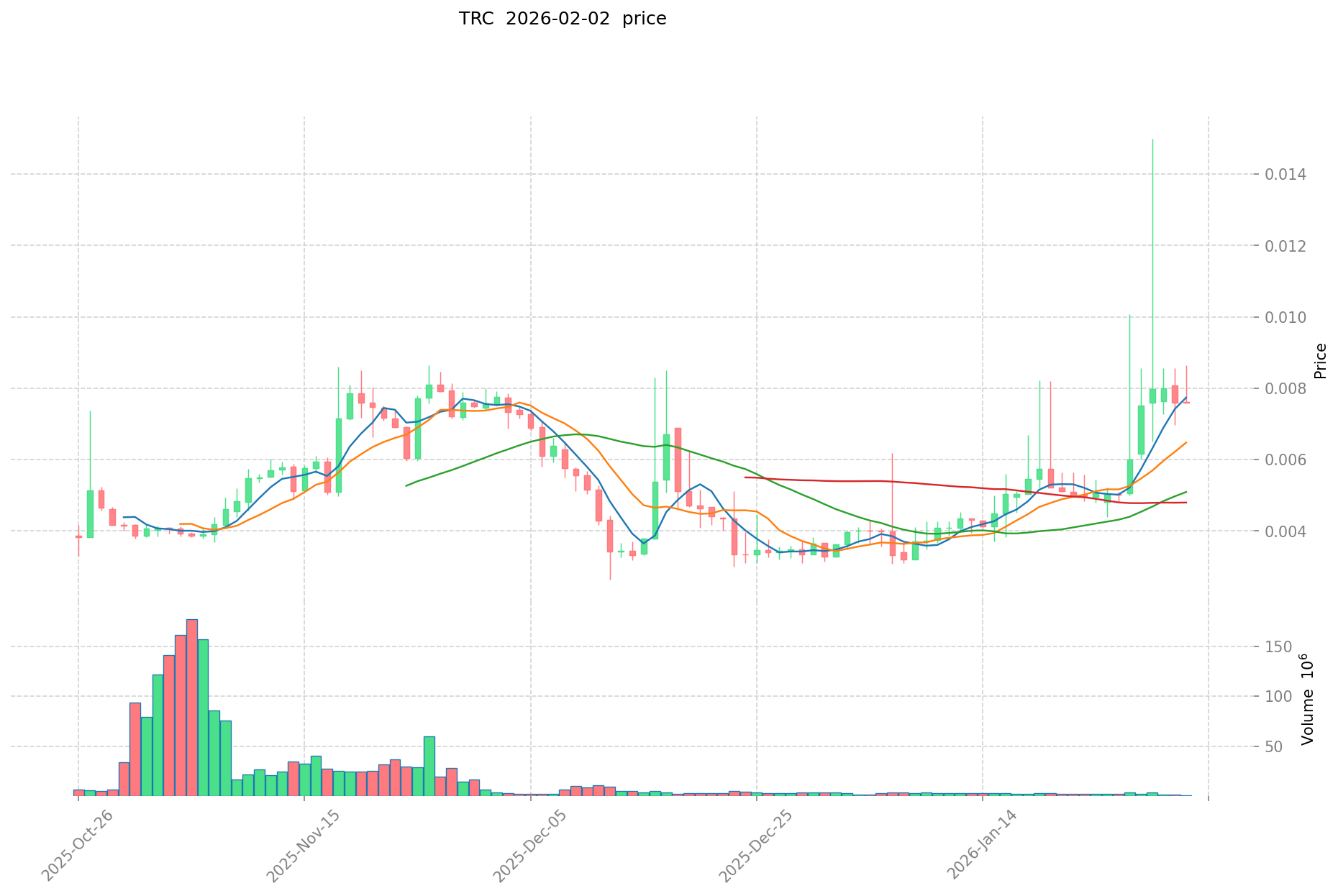
I. Terrace (TRC) Price History Review and Current Investment Value
- 2025: TRC launched on January 9, 2025, with an initial price around $0.004
- March 2025: Price rose to $0.03089, representing a nearly 7x increase from launch
- April 2025: Market correction brought the price down to $0.001399, reflecting significant volatility
- Late 2025-Early 2026: Recovery phase with price stabilizing around $0.0076 as of February 2026
Current TRC Investment Market Status (February 2026)
- Current TRC Price: $0.0076 (as of February 2, 2026)
- Market Performance: -12.06% (24H), +50.47% (7D), +89.84% (30D)
- 24-Hour Trading Volume: Approximately $4,971
- Market Capitalization: $1.368 million
- Circulating Supply: 180 million TRC (18% of total supply)
- Total Supply: 1 billion TRC
Click to view real-time TRC market price
II. Core Factors Influencing Whether TRC is a Good Investment
Supply Mechanism and Scarcity (TRC Investment Scarcity)
- Total supply capped at 1,000,000,000 TRC with current circulating supply of 180,000,000 TRC (18% circulation ratio) → affects price dynamics and investment positioning
- Historical price range spanning from $0.001399 to $0.03089 demonstrates significant volatility patterns in market valuation
- Investment significance: the fixed maximum supply framework provides a structural foundation for potential long-term value considerations, though scarcity alone does not guarantee price appreciation
Institutional Investment and Mainstream Adoption (Institutional Investment in TRC)
- Current holder base stands at 708 addresses, reflecting early-stage adoption characteristics
- Available on 2 exchanges with 24-hour trading volume of $4,971.41, indicating limited liquidity conditions
- Market capitalization of $1,368,000 represents 0.00027% market dominance, suggesting minimal institutional presence at current levels
Macroeconomic Environment's Impact on TRC Investment
- Trading terminal and broker positioning may correlate with broader crypto market sentiment and regulatory developments affecting trading infrastructure
- 30-day price change of 89.84% reflects heightened volatility characteristics typical of lower-capitalization assets during market fluctuations
- Project's focus on liquidity aggregation from CEX, DEX, market makers, and OTC desks positions it within evolving trading infrastructure landscape
Technology and Ecosystem Development (Technology & Ecosystem for TRC Investment)
- Deployed on Base network using ERC-20 standard, leveraging Ethereum Layer-2 infrastructure for operational functionality
- Core value proposition centers on aggregating liquidity sources with proprietary analytics, portfolio management, and execution tools
- Self-custodial trading terminal model addresses user control preferences while integration across multiple liquidity venues aims to provide enhanced pricing and asset coverage
III. TRC Future Investment Forecast and Price Outlook (Is Terrace(TRC) worth investing in 2026-2031)
Short-term Investment Forecast (2026, short-term TRC investment outlook)
- Conservative estimate: $0.005016 - $0.0076
- Neutral estimate: $0.0076 - $0.007904
- Optimistic estimate: $0.007904 - $0.008208
Mid-term Investment Outlook (2027-2028, mid-term Terrace(TRC) investment forecast)
- Market stage expectation: Based on reference data, TRC may experience gradual price appreciation during the mid-term period, with projected average prices ranging from $0.007904 in 2027 to $0.00976144 in 2028.
- Investment return forecast:
- 2027: $0.00703456 - $0.01161888
- 2028: $0.0051735632 - $0.012689872
- Key catalysts: Platform adoption, liquidity aggregation capabilities, and broader market sentiment towards DeFi infrastructure solutions.
Long-term Investment Outlook (Is Terrace a good long-term investment?)
- Base scenario: $0.007602575526 - $0.0120675802 (assuming steady platform development and moderate market conditions)
- Optimistic scenario: $0.0120675802 - $0.01568785426 (assuming enhanced user adoption and favorable market environment)
- Risk scenario: Below $0.007602575526 (in case of adverse market conditions or competitive pressures)
Check TRC long-term investment and price prediction: Price Prediction
2026-02-02 - 2031 Long-term Outlook
- Base scenario: $0.007602575526 - $0.0120675802 (corresponding to stable progress and steady mainstream application growth)
- Optimistic scenario: $0.0120675802 - $0.01568785426 (corresponding to large-scale adoption and favorable market conditions)
- Transformative scenario: Above $0.0172083693652 (if ecosystem achieves breakthrough developments and mainstream popularization)
- 2031-12-31 projected high: $0.0172083693652 (based on optimistic development assumptions)
Disclaimer: The above predictions are based on historical data and market analysis. Cryptocurrency investments carry significant risks, and actual prices may differ substantially from forecasts. This content does not constitute investment advice.
| Year |
Predicted High Price |
Predicted Average Price |
Predicted Low Price |
Price Change |
| 2026 |
0.008208 |
0.0076 |
0.005016 |
0 |
| 2027 |
0.01161888 |
0.007904 |
0.00703456 |
4 |
| 2028 |
0.012689872 |
0.00976144 |
0.0051735632 |
28 |
| 2029 |
0.0129095044 |
0.011225656 |
0.00999083384 |
47 |
| 2030 |
0.01568785426 |
0.0120675802 |
0.007602575526 |
58 |
| 2031 |
0.0172083693652 |
0.01387771723 |
0.0109633966117 |
82 |
IV. Terrace Investment Strategy and Risk Management (How to invest in Terrace)
Investment Methodology (Terrace investment strategy)
Long-term Holding (HODL Terrace): This approach may be suitable for conservative investors who believe in the platform's long-term value proposition as a self-custodial trading terminal aggregating liquidity from multiple sources. Given Terrace's focus on integrating CEX, DEX, market makers, and OTC desk liquidity with analytics and portfolio management tools, investors adopting this strategy would typically monitor the platform's user adoption, trading volume growth, and ecosystem development over extended periods.
Active Trading: This strategy relies on technical analysis and swing trading opportunities. With Terrace showing significant price volatility (24-hour change of -12.06%, 7-day change of +50.47%, and 30-day change of +89.84%), active traders may identify entry and exit points based on price momentum, volume patterns, and market sentiment indicators. This approach requires constant market monitoring and understanding of short-term price movements.
Risk Management (Risk management for Terrace investment)
Asset Allocation Ratios:
- Conservative investors: May consider allocating 1-3% of their crypto portfolio to Terrace, given its relatively early stage and market cap of approximately $1.37 million
- Aggressive investors: Could allocate 5-10% depending on risk tolerance and conviction in the platform's growth potential
- Professional investors: May employ dynamic allocation strategies based on market conditions, technical indicators, and fundamental developments
Risk Hedging Solutions: Investors may consider diversifying across multiple trading infrastructure projects, established cryptocurrencies, and maintaining positions in stablecoins to manage exposure. Portfolio rebalancing strategies and setting stop-loss orders can help limit downside risk during volatile periods.
Secure Storage: For TRC token holders, utilizing hardware wallets that support Base network and ERC-20 tokens is recommended for long-term storage. Hot wallets may be appropriate for active trading but should only hold amounts intended for immediate transactions. The contract address on Base (0xc23e4352cdba6fc951398bf274619c4529eac867) should be verified before any transactions.
V. Terrace Investment Risks and Challenges (Risks of investing in Terrace)
Market Risks: Terrace exhibits considerable price volatility, with 24-hour price fluctuations ranging from $0.0076 to $0.009468. The token's relatively low market cap of approximately $1.37 million and limited exchange listings (available on 2 exchanges) may contribute to heightened volatility and potential liquidity constraints during periods of high trading activity. Price movements can be influenced by broader crypto market trends, trading platform developments, and changes in user adoption rates.
Regulatory Risks: As a crypto trading terminal and broker aggregating liquidity from various sources, Terrace operates in a regulatory environment that varies significantly across jurisdictions. Changes in regulations governing crypto trading platforms, liquidity aggregation services, or self-custodial solutions could impact the platform's operational model. Different countries maintain varying approaches to crypto asset regulation, creating uncertainty for both the platform and token holders.
Technical Risks: The platform's functionality depends on successfully integrating and maintaining connections with multiple liquidity sources including CEX, DEX, market makers, and OTC desks. Technical vulnerabilities in smart contracts, integration points, or the underlying Base network infrastructure could pose security risks. The token holder count of 708 suggests a relatively concentrated ownership structure. Additionally, any technical issues affecting the platform's analytics, portfolio management, or execution systems could impact user confidence and token value.
VI. Conclusion: Is Terrace a Good Investment?
Investment Value Summary: Terrace presents a unique value proposition as a liquidity aggregation platform combining multiple trading venues with portfolio management tools. The token has shown significant short-term price movements, with a 30-day increase of 89.84% and 7-day increase of 50.47%, though it also experienced a 24-hour decline of 12.06%. With 18% of total supply in circulation and a fully diluted valuation of $7.6 million, the project is in its early stages of market development.
Investor Recommendations:
✅ Beginners: Consider dollar-cost averaging (DCA) strategy with small, regular investments rather than lump-sum purchases. Store tokens in secure wallets supporting Base network and verify all contract addresses before transactions. Focus on understanding the platform's functionality and value proposition before making investment decisions.
✅ Experienced Investors: May explore swing trading opportunities given the token's volatility patterns. Combine TRC holdings with other trading infrastructure and DeFi tokens for portfolio diversification. Monitor platform metrics such as trading volume, user growth, and ecosystem partnerships to inform trading decisions.
✅ Institutional Investors: Could consider strategic positioning based on thorough due diligence of the platform's technology, team, competitive positioning, and market opportunity. Assess liquidity aggregation market trends and evaluate Terrace's execution capabilities relative to existing solutions.
⚠️ Disclaimer: Cryptocurrency investments carry substantial risk due to price volatility, market uncertainty, and technological factors. This content is for informational purposes only and does not constitute investment advice. Investors should conduct independent research and consider their financial situation and risk tolerance before making investment decisions.
VII. FAQ
Q1: What is Terrace (TRC) and how does it work as an investment?
Terrace (TRC) is the native token of a self-custodial crypto trading terminal that aggregates liquidity from centralized exchanges, decentralized exchanges, market makers, and OTC desks. As an investment, TRC represents ownership in an emerging trading infrastructure platform that launched in January 2025, currently trading at approximately $0.0076 with a market capitalization of $1.37 million. The token operates on the Base network using the ERC-20 standard and has shown significant volatility, with a 30-day price increase of 89.84%, though it remains in early development stages with only 18% of its total supply in circulation.
Q2: What are the main risks associated with investing in Terrace (TRC)?
The primary investment risks include extreme price volatility (24-hour fluctuations ranging from -12.06% to +50.47%), limited liquidity with availability on only 2 exchanges and $4,971 in 24-hour trading volume, and a concentrated ownership structure with just 708 token holders. Additional risks encompass regulatory uncertainties affecting crypto trading platforms across different jurisdictions, technical vulnerabilities in smart contract integration with multiple liquidity sources, and the project's early-stage market position with only 0.00027% market dominance. The low market cap and limited institutional presence also contribute to heightened investment risk.
Q3: What investment strategies are recommended for different types of Terrace investors?
For beginners, a dollar-cost averaging (DCA) approach with allocations of 1-3% of crypto portfolio is recommended, focusing on secure storage using hardware wallets supporting the Base network. Experienced investors may pursue active trading strategies capitalizing on TRC's volatility patterns while maintaining 5-10% portfolio allocation, combining technical analysis with monitoring of platform metrics like trading volume and user growth. Institutional investors should conduct comprehensive due diligence on technology, competitive positioning, and market opportunity, potentially employing dynamic allocation strategies based on fundamental developments in the liquidity aggregation space.
Q4: What is the price prediction outlook for Terrace (TRC) through 2031?
Based on historical data and market analysis, short-term forecasts for 2026 range from $0.005016 (conservative) to $0.008208 (optimistic). Mid-term projections suggest gradual appreciation with 2027 estimates between $0.00703456 and $0.01161888, and 2028 projections ranging from $0.0051735632 to $0.012689872. Long-term outlook through 2031 presents a base scenario of $0.007602575526 to $0.0120675802, with optimistic projections reaching $0.01568785426, and a transformative scenario potentially exceeding $0.0172083693652. However, these forecasts carry substantial uncertainty due to cryptocurrency market volatility and the project's early development stage.
Q5: How does Terrace's tokenomics affect its investment potential?
Terrace has a fixed total supply of 1 billion TRC tokens, with currently 180 million tokens (18%) in circulation, providing a structural foundation for potential scarcity-based value appreciation. The relatively low circulation ratio suggests significant future token releases could impact price dynamics. The current fully diluted valuation stands at $7.6 million, indicating substantial room for market cap expansion if adoption grows. However, the low holder count of 708 addresses and limited exchange presence create concentration risk and liquidity constraints that may amplify price volatility during market movements.
Q6: What factors distinguish Terrace from other crypto trading platforms?
Terrace differentiates itself through its self-custodial model that gives users complete control over their assets while aggregating liquidity from multiple sources including centralized exchanges, decentralized exchanges, market makers, and OTC desks. The platform integrates proprietary analytics, portfolio management, and execution tools within a single interface. Built on the Base network, it leverages Ethereum Layer-2 infrastructure for operational efficiency. This combination of self-custody, multi-source liquidity aggregation, and comprehensive trading tools positions Terrace as a solution addressing both user control preferences and execution optimization needs in the evolving crypto trading infrastructure landscape.
Q7: What are the key milestones and performance metrics to monitor for TRC investment decisions?
Critical metrics include platform user adoption rates, total trading volume processed through the aggregation system, and the number of integrated liquidity sources. Price performance indicators such as the token's historical range ($0.001399 to $0.03089), current volatility patterns, and correlation with broader crypto market trends provide insight into market sentiment. Exchange listing expansions beyond the current 2 platforms, growth in the holder base beyond 708 addresses, and increases in 24-hour trading volume above the current $4,971 level signal improving liquidity conditions. Additionally, monitoring the token unlock schedule relative to the 82% remaining supply and ecosystem partnership announcements can inform investment timing decisions.
* The information is not intended to be and does not constitute financial advice or any other recommendation of any sort offered or endorsed by Gate.