LVVA vs BNB: A Comprehensive Comparison of Two Leading Blockchain Tokens in the Cryptocurrency Market


Introduction: LVVA vs BNB Investment Comparison
In the cryptocurrency market, the comparison between LVVA and BNB has been a topic of interest for investors. The two assets differ significantly in market capitalization ranking, application scenarios, and price performance, representing distinct positioning within the crypto asset landscape.
LVVA (Levva Protocol Token): Launched in January 2025, this token operates within the Open Custody Protocol (OCP) ecosystem, focusing on keychain aggregation and modular permissionless custody solutions. As an ERC-20 token on Ethereum, LVVA aims to simplify key management protocols for developers and end-users.
BNB (Binance Coin): Since its launch in July 2017, BNB has been recognized as the native utility token of the Binance ecosystem. With a market capitalization ranking of 4th globally, it serves multiple functions including transaction fee discounts, payment applications, and ecosystem fuel across Binance's platforms.
This article will comprehensively analyze the investment value comparison between LVVA and BNB, covering historical price trends, supply mechanisms, institutional adoption, technical ecosystems, and future outlooks. We aim to address the question most investors are concerned about:
"Which is the better buy right now?"
I. Historical Price Comparison and Current Market Status
Historical Price Trends of LVVA (Coin A) and BNB (Coin B)
- 2025: LVVA reached an all-time high of $0.016799 on March 14, 2025, following its token launch, but subsequently experienced significant volatility in the cryptocurrency market.
- 2017-2025: BNB demonstrated sustained growth from its initial coin offering (ICO) price of $0.15 in July 2017, achieving an all-time high of $1,369.99 on October 13, 2025, driven by ecosystem expansion and quarterly token burn mechanisms.
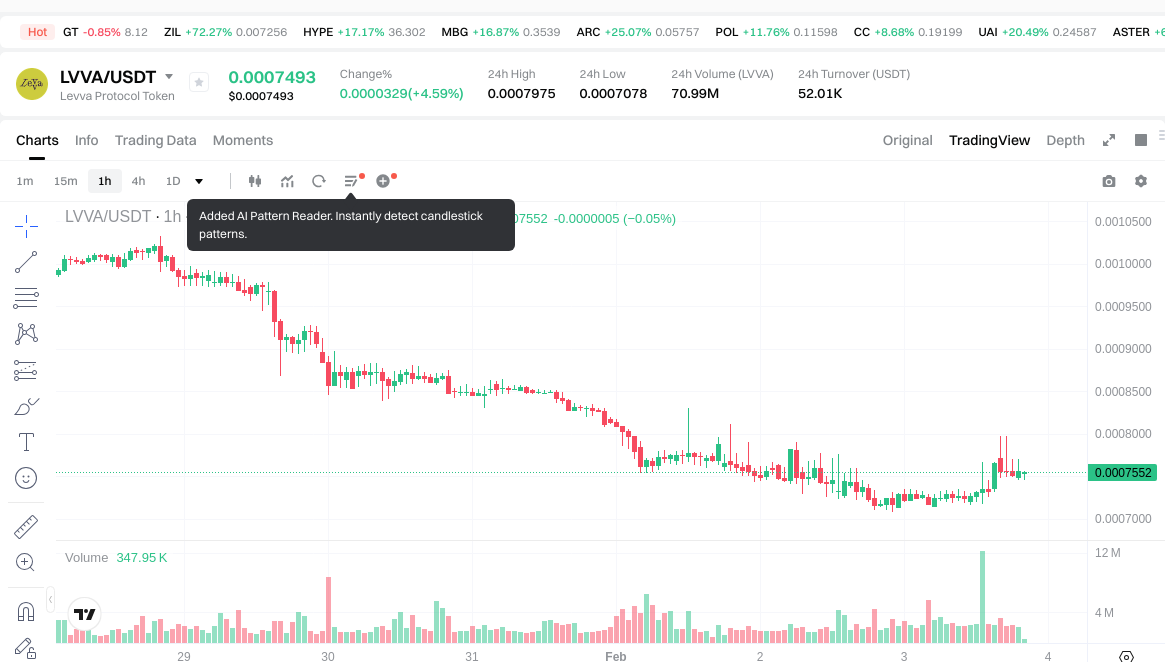
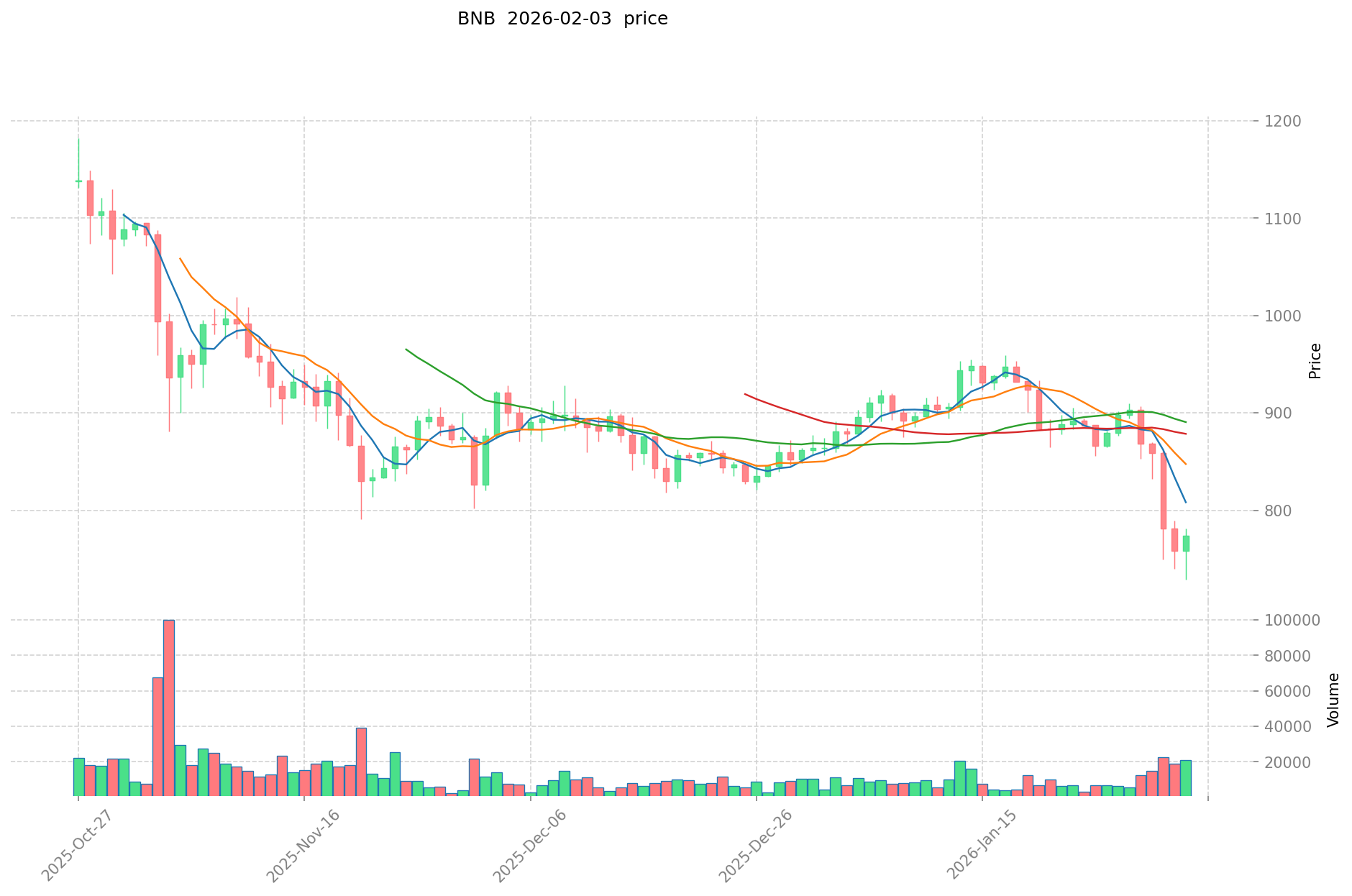
- Comparative Analysis: During the recent market correction phase, LVVA declined from its peak of $0.016799 to a low of $0.0007078 on February 2, 2026, representing a substantial decrease, while BNB adjusted from $1,369.99 to approximately $770.2, showing relatively stronger price resilience.
Current Market Conditions (February 3, 2026)
- LVVA current price: $0.0007544
- BNB current price: $770.2
- 24-hour trading volume: LVVA $51,892.16 vs BNB $8,924,704.78
- Market Sentiment Index (Fear & Greed Index): 17 (Extreme Fear)
View real-time prices:
- Check LVVA current price Market Price
- Check BNB current price Market Price
II. Core Factors Influencing LVVA vs BNB Investment Value
Supply Mechanism Comparison (Tokenomics)
- LVVA: The reference materials mention LVVA operates as a DeFi optimizer with automated lending strategies, though specific supply mechanism details are not elaborated in the available sources.
- BNB: The materials reference BNB's role in maintaining liquidity expectations within MEME markets, where LP holders are willing to maintain main token positions when BNB price shows positive expectations.
- 📌 Historical Pattern: Supply mechanisms play a role in driving price cycle variations, though the specific dynamics between these two assets require consideration of multiple market factors.
Institutional Adoption and Market Application
- Institutional Holdings: The materials indicate that investor sentiment and confidence directly impact price movements for both assets.
- Market Application: LVVA functions as a DeFi optimizer automating lending strategies, while BNB serves as a key element in maintaining market liquidity and preventing single-project fund concentration.
- Regulatory Environment: The regulatory landscape in major cryptocurrency markets influences both assets, with policy clarity playing a crucial role in their adoption trajectories.
Technical Development and Ecosystem Building
- LVVA Technical Features: Described as an ultimate DeFi optimizer that automates and refines lending strategies.
- BNB Ecosystem Role: Functions within the broader liquidity framework, where price expectations influence LP holder behavior and overall market stability.
- Ecosystem Comparison: Both assets operate within distinct niches, with LVVA focusing on DeFi optimization and BNB maintaining broader ecosystem liquidity support.
Macroeconomic Factors and Market Cycles
- Market Sentiment Impact: Both assets demonstrate sensitivity to market sentiment and news developments, with investor confidence serving as a direct influence on price trends.
- Regulatory Clarity: Government regulations and legal frameworks in major markets affect both assets' performance and adoption rates.
- Market Dynamics: The introduction of new liquidity and avoidance of fund concentration in single projects represents important considerations for market participants evaluating both assets.
III. 2026-2031 Price Prediction: LVVA vs BNB
Short-term Forecast (2026)
- LVVA: Conservative $0.000704 - $0.000749 | Optimistic $0.000749 - $0.000846
- BNB: Conservative $492.74 - $769.90 | Optimistic $769.90 - $923.88
Mid-term Forecast (2028-2029)
- LVVA may enter a gradual growth phase, with estimated price range of $0.000603 - $0.001049
- BNB may enter a consolidation and expansion phase, with estimated price range of $535.57 - $1,107.86
- Key drivers: institutional capital flows, ETF developments, ecosystem expansion
Long-term Forecast (2030-2031)
- LVVA: Baseline scenario $0.000702 - $0.001125 | Optimistic scenario $0.001091 - $0.001289
- BNB: Baseline scenario $894.26 - $1,258.20 | Optimistic scenario $1,006.56 - $1,476.56
Disclaimer
LVVA:
| Year | Predicted High Price | Predicted Average Price | Predicted Low Price | Price Change |
|---|---|---|---|---|
| 2026 | 0.000845918 | 0.0007486 | 0.000703684 | 0 |
| 2027 | 0.00083712195 | 0.000797259 | 0.00064577979 | 5 |
| 2028 | 0.0009315971415 | 0.000817190475 | 0.00069461190375 | 8 |
| 2029 | 0.0010492725699 | 0.00087439380825 | 0.000603331727692 | 15 |
| 2030 | 0.00128885647336 | 0.000961833189075 | 0.000702138228024 | 27 |
| 2031 | 0.001282893107588 | 0.001125344831217 | 0.001091584486281 | 49 |
BNB:
| Year | Predicted High Price | Predicted Average Price | Predicted Low Price | Price Change |
|---|---|---|---|---|
| 2026 | 923.88 | 769.9 | 492.736 | 0 |
| 2027 | 880.7656 | 846.89 | 813.0144 | 9 |
| 2028 | 1079.78475 | 863.8278 | 535.573236 | 12 |
| 2029 | 1107.8591535 | 971.806275 | 544.211514 | 26 |
| 2030 | 1476.562454235 | 1039.83271425 | 894.256134255 | 35 |
| 2031 | 1421.763270194025 | 1258.1975842425 | 1006.558067394 | 63 |
IV. Investment Strategy Comparison: LVVA vs BNB
Long-term vs Short-term Investment Strategies
-
LVVA: May appeal to investors seeking exposure to emerging DeFi optimization protocols with higher risk tolerance. The asset's focus on automated lending strategies positions it within the specialized DeFi infrastructure segment, though its significant price volatility requires careful consideration of investment timeframes.
-
BNB: May suit investors looking for established ecosystem exposure with relatively more stability. BNB's role in maintaining market liquidity and its integration across multiple platform functions provides broader utility applications, potentially offering diversified value drivers across various market conditions.
Risk Management and Asset Allocation
-
Conservative Investors: LVVA 5-10% vs BNB 90-95%
- This allocation reflects the substantial difference in market maturity and price volatility between the two assets
- Emphasis on BNB provides exposure to established infrastructure while limiting risk from emerging protocols
-
Aggressive Investors: LVVA 20-30% vs BNB 70-80%
- Higher LVVA allocation captures potential growth in DeFi optimization sector
- Maintains significant BNB position for portfolio stability and ecosystem exposure
-
Hedging Tools: Stablecoin allocation, options strategies, cross-asset diversification
- Stablecoin reserves (10-20% of portfolio) provide liquidity cushion during extreme market conditions
- Options instruments may offer downside protection while maintaining upside exposure
- Cross-cryptocurrency combinations help manage correlation risks and sector-specific volatility
V. Potential Risk Comparison
Market Risks
-
LVVA: Exhibits substantial price volatility, with historical data showing significant drawdowns from peak levels. The asset's relatively low trading volume ($51,892.16 in 24-hour period) may contribute to liquidity constraints and wider bid-ask spreads during market stress periods. The extreme fear sentiment (Fear & Greed Index: 17) reflects broader market caution that may disproportionately impact smaller-cap assets.
-
BNB: Demonstrates relatively higher price resilience during market corrections, though remains subject to ecosystem-specific risks and broader cryptocurrency market dynamics. The substantially higher trading volume ($8,924,704.78 in 24-hour period) provides better liquidity conditions, though significant price movements remain possible during extreme market events.
Technical Risks
-
LVVA: Network scalability considerations and protocol development risks associated with emerging DeFi infrastructure. The automated lending optimization mechanism requires ongoing technical maintenance and adaptation to evolving market conditions. Smart contract vulnerabilities and integration challenges with multiple lending protocols represent additional technical considerations.
-
BNB: Infrastructure stability considerations related to ecosystem expansion and cross-platform integration. Network congestion during high-activity periods and potential security considerations require ongoing monitoring. The complexity of multiple use cases across various platforms introduces operational risk factors.
Regulatory Risks
-
Global Regulatory Impact: Both assets face evolving regulatory frameworks across major cryptocurrency markets. Policy developments in key jurisdictions may affect adoption trajectories differently based on asset classification and primary use cases.
-
Compliance Considerations: DeFi protocols like LVVA may encounter specific regulatory scrutiny regarding automated financial services, while established ecosystem tokens like BNB face ongoing evaluation regarding utility token classification and exchange-related regulations.
-
Jurisdictional Variance: Regional regulatory approaches create asymmetric risk profiles, with policy clarity in major markets playing significant roles in both assets' operational frameworks and market accessibility.
VI. Conclusion: Which Is the Better Buy?
📌 Investment Value Summary:
-
LVVA Advantages: Exposure to specialized DeFi optimization sector with potential growth opportunities in automated lending strategies. The asset's focus on infrastructure solutions addresses specific pain points in decentralized finance protocols. Early-stage positioning may offer higher growth potential for risk-tolerant investors willing to navigate substantial volatility.
-
BNB Advantages: Established market presence with broader ecosystem integration across multiple use cases. Higher liquidity conditions and relatively stronger price resilience during market corrections. Diversified utility functions provide multiple value drivers beyond single-use applications. Historical performance demonstrates sustained ecosystem expansion over extended timeframes.
✅ Investment Considerations:
-
New Investors: May consider starting with established assets like BNB to gain cryptocurrency market exposure while managing volatility risks. Understanding ecosystem fundamentals and market dynamics should precede allocation decisions. Beginning with smaller position sizes allows for learning curve management.
-
Experienced Investors: May evaluate portfolio diversification benefits of including both established ecosystem tokens and emerging protocol assets. Risk-adjusted position sizing based on individual risk tolerance and investment objectives remains essential. Technical analysis and fundamental research should inform entry and exit strategies.
-
Institutional Investors: May assess liquidity requirements, regulatory compliance frameworks, and portfolio construction guidelines when evaluating both assets. Due diligence on protocol security, ecosystem sustainability, and market infrastructure represents critical evaluation components. Strategic allocation decisions should align with broader investment mandates and risk management frameworks.
⚠️ Risk Warning: The cryptocurrency market exhibits extreme volatility. This article does not constitute investment advice. Investors should conduct independent research and consult qualified financial advisors before making investment decisions. Past performance does not guarantee future results.
VII. FAQ
Q1: What is the primary difference between LVVA and BNB in terms of their core functionality?
LVVA functions as a DeFi optimizer focusing on automated lending strategies within the Open Custody Protocol ecosystem, while BNB serves as the native utility token for the entire Binance ecosystem with multiple use cases including transaction fee discounts and cross-platform applications. LVVA represents specialized infrastructure for decentralized finance protocol optimization, launched in January 2025 as an ERC-20 token on Ethereum. In contrast, BNB has operated since July 2017 as a multi-functional ecosystem token with established market presence and broader utility integration across various platforms and services.
Q2: How do the current trading volumes compare between LVVA and BNB, and what does this indicate?
BNB's 24-hour trading volume of $8,924,704.78 significantly exceeds LVVA's $51,892.16, indicating substantially different liquidity conditions between the two assets. This volume disparity reflects BNB's established market position and broader investor participation, which typically translates to tighter bid-ask spreads and reduced price slippage during transactions. LVVA's lower trading volume suggests limited liquidity that may result in higher price volatility and potential execution challenges during larger trades, particularly during periods of market stress or extreme fear sentiment (current Fear & Greed Index: 17).
Q3: What are the recommended portfolio allocation ratios for conservative versus aggressive investors?
Conservative investors may consider allocating 5-10% to LVVA and 90-95% to BNB, emphasizing established infrastructure exposure while limiting risk from emerging protocols. Aggressive investors may increase LVVA allocation to 20-30% while maintaining 70-80% in BNB to capture potential growth in the DeFi optimization sector. Both allocation strategies reflect the substantial difference in market maturity, price volatility, and liquidity conditions between the assets. Additionally, maintaining stablecoin reserves of 10-20% provides a liquidity cushion during extreme market conditions, while options strategies and cross-asset diversification help manage correlation risks and sector-specific volatility.
Q4: What are the projected price ranges for LVVA and BNB by 2031?
By 2031, LVVA's baseline scenario projects a price range of $0.000702 - $0.001125, with an optimistic scenario reaching $0.001091 - $0.001289, representing a 49% price change from current levels. BNB's baseline scenario forecasts $894.26 - $1,258.20, with an optimistic scenario of $1,006.56 - $1,476.56, indicating a 63% price change. These projections reflect different growth trajectories, with LVVA's estimates accounting for emerging protocol adoption challenges and market validation requirements, while BNB's forecasts incorporate continued ecosystem expansion and institutional capital flows. However, these predictions remain speculative and subject to substantial uncertainty given cryptocurrency market volatility and evolving regulatory frameworks.
Q5: What specific technical risks should investors evaluate for each asset?
For LVVA, investors should assess network scalability considerations, protocol development risks, smart contract vulnerabilities, and integration challenges with multiple lending protocols that require ongoing technical maintenance. The automated lending optimization mechanism necessitates continuous adaptation to evolving market conditions, creating operational complexity. For BNB, technical considerations include infrastructure stability related to ecosystem expansion, network congestion during high-activity periods, security considerations across cross-platform integration, and operational risks from multiple use cases spanning various platforms. Both assets require monitoring of technical development progress and security audit results as part of comprehensive risk assessment frameworks.
Q6: How does the regulatory environment differently impact LVVA versus BNB?
LVVA may encounter specific regulatory scrutiny regarding automated financial services and DeFi protocol classifications, as regulatory frameworks continue evolving around decentralized finance applications. The asset's focus on lending optimization may face jurisdiction-specific interpretations of financial service regulations. BNB faces ongoing evaluation regarding utility token classification, exchange-related regulations, and compliance requirements tied to its ecosystem functions across multiple platforms. Both assets experience global regulatory impact with policy developments in key jurisdictions affecting adoption trajectories differently based on asset classification and primary use cases. Jurisdictional variance creates asymmetric risk profiles, making policy clarity in major markets a significant factor in operational frameworks and market accessibility for both assets.
Q7: What market conditions favor LVVA investment versus BNB investment?
LVVA may demonstrate stronger relative performance during periods of DeFi sector expansion, increased demand for automated yield optimization solutions, and when risk-on sentiment drives capital toward emerging protocol infrastructure. The asset benefits from technical innovation cycles and growing institutional interest in specialized DeFi tools. BNB typically shows resilience during broader market corrections due to established liquidity conditions and diversified utility functions across the Binance ecosystem. BNB may outperform during risk-off environments when investors seek exposure to proven infrastructure with multiple value drivers. Market cycle positioning, investor risk tolerance, and sector rotation dynamics significantly influence relative performance between these assets with substantially different market capitalizations and ecosystem maturity levels.
Share
Content
Introduction: LVVA vs BNB Investment Comparison
I. Historical Price Comparison and Current Market Status
II. Core Factors Influencing LVVA vs BNB Investment Value
III. 2026-2031 Price Prediction: LVVA vs BNB
IV. Investment Strategy Comparison: LVVA vs BNB
V. Potential Risk Comparison
VI. Conclusion: Which Is the Better Buy?
VII. FAQ
How to Buy Cryptocurrency


Trending Cryptocurrencies



What will be the market capitalization of USDC in 2025? Analysis of the stablecoin market landscape.

How is DeFi different from Bitcoin?

What is DeFi: Understanding Decentralized Finance in 2025

USDC stablecoin 2025 Latest Analysis: Principles, Advantages, and Web3 Eco-Applications

Development of Decentralized Finance Ecosystem in 2025: Integration of Decentralized Finance Applications with Web3

2025 USDT USD Complete Guide: A Must-Read for Newbie Investors

Is ETHS (ETHS) a good investment?: A Comprehensive Analysis of Returns, Risks, and Future Prospects

Is Telos (TLOS) a good investment?: A Comprehensive Analysis of Performance, Use Cases, and Future Prospects

Is Router Protocol (ROUTE) a good investment?: A Comprehensive Analysis of Features, Market Performance, and Future Potential

Is DexCheck (DCK) a good investment?: A Comprehensive Analysis of Tokenomics, Market Performance, and Future Potential in the DeFi Security Landscape

Comprehensive Guide to Moving Averages for Trading