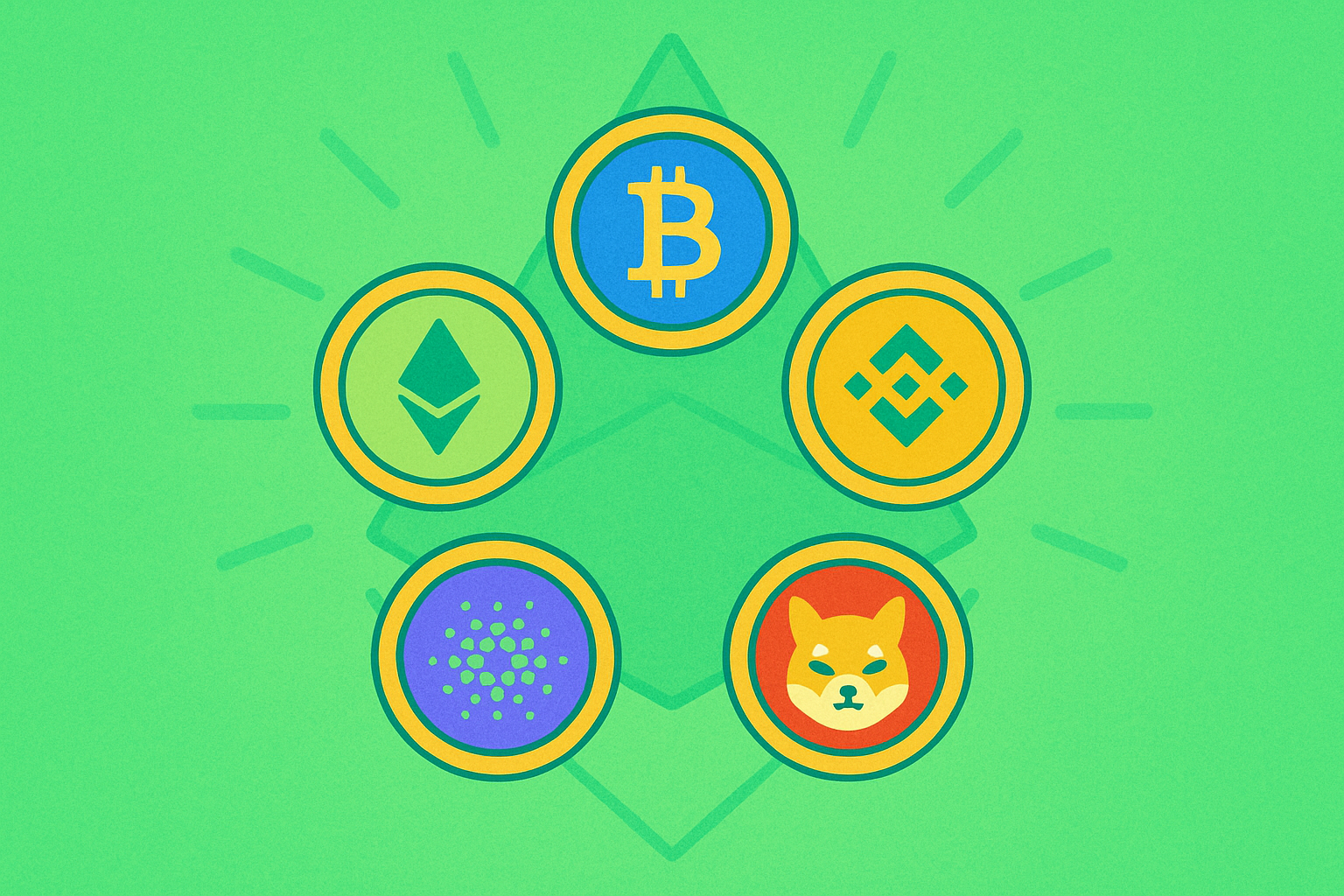
A complete guide to choosing cryptocurrencies with 1000x profit potential. Discover the success factors and selection strategies for coins that have achieved over 1000x growth, such as Bitcoin, Ethereum, BNB, and Cardano. Includes investment strategies for beginners and intermediate users on platforms like Gate.
Introduction: The Astonishing Rise of the Cryptocurrency Market
Over the past decade, the cryptocurrency market has seen extraordinary growth, with numerous tokens surging hundreds or even thousands of times from their initial prices. Bitcoin, in particular, has skyrocketed by at least a million-fold to its peak, and by some estimates, tens of millions-fold. This explosive ascent was driven by a convergence of technological innovation, institutional participation, and global shifts in the financial environment.
Beyond Bitcoin, several other tokens have achieved exponential growth through unique technologies, robust communities, or by capitalizing on market trends. These assets are more than mere speculative instruments—they each offer distinctive value propositions and use cases, helping advance the broader crypto ecosystem.
This article highlights six leading cryptocurrencies that have grown over 1,000-fold in price between 2009 and 2025. We provide detailed analysis of each, including initial and peak prices and key growth drivers, to shed light on the dynamism of the crypto market and the essence of its investment opportunities.
Growth Summary of Six Leading Tokens (Initial Price, All-Time High, Multiples)
The following table outlines the growth profiles of the six major tokens covered in this article. These figures offer concrete proof of the tremendous potential within the cryptocurrency sector.
| Token (Ticker) |
Year Launched |
Initial Price |
All-Time High (Date) |
Multiplier (vs. Initial Price) |
| Bitcoin (BTC) |
2009 |
$0.0008 (assumed for 2010) |
$109,350 (January 20, 2025) |
Approx. 136,687,500x |
| Ethereum (ETH) |
2015 |
$0.31 (2014 ICO price) |
$4,878 (November 2021) |
Approx. 15,736x |
| Major Exchange Token (BNB) |
2017 |
$0.15 (2017 ICO price) |
$690 (May 2021) |
Approx. 4,600x |
| Cardano (ADA) |
2017 |
$0.0024 (2015–17 ICO price) |
$3.10 (September 2021) |
Approx. 1,291x |
| Dogecoin (DOGE) |
2013 |
$0.0004 (December 2013 launch) |
$0.74 (May 2021) |
Approx. 1,850x |
| Shiba Inu Coin (SHIB) |
2020 |
$0.00000000051 (August 2020 launch) |
$0.0000885 (October 2021) |
Approx. 173,529x |
Each token has a unique background and features, yet all have ridden major market waves to deliver exceptional returns for investors. Below, we explore the growth stories and success factors behind each.
Bitcoin (BTC): Securing Its Role as Digital Gold
Bitcoin, launched by Satoshi Nakamoto in January 2009, is the world’s first cryptocurrency. It serves as the market’s anchor and is often called "digital gold." With a capped supply of 21 million BTC, its scarcity and secure, decentralized network have made it a prominent long-term store of value.
Bitcoin introduced the possibility of a currency system independent of central banks and governments. Anchored by blockchain technology, it combines transparency and immutability, embodying the ideals of financial democratization.
Price Evolution (Initial Price, All-Time High) and Multiples
At launch, Bitcoin had virtually no monetary value, and exchanges did not exist in 2009. The first USD exchange rate was set in October 2009 when 5,050 BTC sold for about $5, pricing each BTC around $0.0009.
In July 2010, exchanges began trading Bitcoin at prices between roughly $0.0008 and $0.08. By year-end, the price reached about $0.5, exceeded $1 in 2011 for the first time, and spiked to around $29.6 in June amid sharp volatility.
Bitcoin continued its four-year cycle, breaking $1,000 in late 2013 and reaching approximately $19,000 in December 2017. Its most recent all-time high was $109,350 on January 20, 2025. From the initial trading price ($0.0008–$0.08), Bitcoin has climbed at least a million-fold—and potentially tens of millions-fold at peak.
This extraordinary growth is not merely speculative but reflects Bitcoin’s intrinsic value and the impact of global financial changes.
Key Drivers of Bitcoin’s Growth
Market Maturity and Anchor Currency Status
As the first cryptocurrency, Bitcoin has consistently held the central position in the market. It is widely regarded as the "first-choice asset" among institutional investors and corporations, accounting for more than half of the total crypto market capitalization for years.
Bitcoin’s anchor status is further reinforced by its use as the primary trading pair for other cryptocurrencies. Many investors see Bitcoin as the gateway to the crypto market, supporting its stability and liquidity.
Scarcity Strengthened by Supply Constraints and Halving
Bitcoin’s built-in "halving" mechanism reduces new issuance by half every four years. These events in 2012, 2016, and 2020 have helped curb inflation. After the third halving in 2020, Bitcoin’s appeal as an "inflation hedge" soared amid global monetary easing.
This supply restriction gives Bitcoin gold-like scarcity, enhancing its attractiveness as a long-term store of value. The clear supply cap offers investors predictability and reassurance.
Macroeconomic Factors and Safe Haven Re-Evaluation
Following the COVID-19 crisis, fiscal stimulus and quantitative easing accelerated capital flows into Bitcoin. In early 2021, Bitcoin gained attention alongside stocks and real estate as a risk asset, surging from $29,000 at the end of 2020 to over $64,000 in just months.
This movement reflects inflation concerns in traditional markets and skepticism toward central bank policies. Bitcoin’s immunity to government intervention is establishing it as a new asset class.
Institutional and Corporate Adoption
Since 2020, major corporations have started accumulating large BTC reserves. Tesla announced a $1.5 billion BTC purchase in 2021. PayPal and major US banks have launched crypto services, with traditional financial institutions joining the market.
These developments mark Bitcoin’s shift from speculation to an official asset class in corporate treasury strategies. Institutional adoption increases market maturity and price stability.
Legal Tender Adoption by Nation-States
In 2021, El Salvador made Bitcoin legal tender, distributing wallets to all citizens in an unprecedented move. This expanded Bitcoin’s practical use as a payment method and marked a historical milestone.
This initiative has influenced other countries, with some in Central America and Africa considering legal tender status or official adoption for Bitcoin.
Global Recognition as Digital Gold
Bitcoin’s reputation as "digital gold" is now globally entrenched. In 2021, the market cap briefly topped $1 trillion, approaching the size of the gold market. Its limited supply and decentralized nature make it increasingly attractive for long-term holders, establishing it as the "store of value for the 21st century."
Trump Administration’s Bitcoin Reserve Proposal (April 2025)
The Trump administration indicated possible inclusion of BTC in US foreign reserves, citing the need to "preserve dollar dominance" and counter other countries’ digital asset policies. The announcement triggered new all-time highs for Bitcoin, underscoring the connection between policy and price.
This proposal signals Bitcoin’s growing recognition as a strategic national asset.
Ethereum (ETH): The Foundation for a Decentralized Internet
Ethereum, launched in July 2015, is a blockchain platform and the second-largest cryptocurrency after Bitcoin. While Bitcoin is "digital gold," Ethereum is described as the "protocol for a decentralized internet," and serves as the foundation for smart contracts and DApps.
Ethereum’s breakthrough lies in enabling programmable blockchain functions beyond simple payments. This flexibility positions it at the center of DeFi and NFT trends, with countless projects and tokens built on its platform.
Price Evolution (Initial Price, All-Time High) and Multiples
Ethereum’s 2014 ICO sold ETH at about $0.31 per token, raising about $18 million. After the mainnet debuted in July 2015, ETH began trading in the low-dollar range.
Demand exploded during the 2017 ICO boom, with ETH reaching around $1,400 in January 2018. The price fell to the $80s by year-end, highlighting market volatility.
Ethereum regained momentum after 2020, as DeFi and NFT activity surged and ETH hit an all-time high of $4,878.26 on November 10, 2021. From its ICO price, this equates to over 15,000x growth, delivering substantial returns to early investors.
Key Drivers of Ethereum’s Growth
Innovation in Smart Contracts and DApps
Ethereum’s defining feature is smart contracts, enabling anyone to create tokens and applications. Since 2016, thousands of projects have launched on ETH, fueling the ICO boom.
This innovation expanded blockchain’s utility across finance, gaming, art, supply chain management, and more.
From 2020, major DeFi protocols built on ETH saw rapid growth. Yield farming locked up ETH, driving prices higher. Ethereum is the backbone of DeFi’s financial infrastructure—a status expected to persist.
DeFi’s expansion offers a transparent, efficient alternative to traditional financial services.
NFT Mania and Surging Demand
In early 2021, leading NFT marketplaces grew rapidly. ETH became the currency for digital art and collectibles, attracting new users. Rising gas fees reflected heavy network usage and pushed ETH prices higher.
NFTs popularized digital ownership and proved Ethereum’s practical utility.
Technical Advancements: Transition to Ethereum 2.0
The London Upgrade in August 2021 introduced EIP-1559, automating the burning of part of transaction fees. The Merge in September 2022 shifted Ethereum from PoW to PoS, dramatically improving energy efficiency and long-term investor confidence.
These upgrades significantly enhance Ethereum’s sustainability and scalability, strengthening its long-term growth prospects.
Enterprise Adoption and Ecosystem Expansion
Ethereum is now the "second investment choice" after Bitcoin. In 2017, the Enterprise Ethereum Alliance (EEA) launched with members like Microsoft and JP Morgan. ETH futures listings and expanded custody services have bolstered institutional products since 2020.
Major Exchange Token (BNB): A Case Study in Ecosystem Growth
The Major Exchange Token (BNB) is the native token of one of the world’s largest crypto exchanges. Launched via ICO in July 2017 alongside the exchange’s debut, BNB initially operated as an ERC-20 token before migrating to its own blockchain (Binance Chain → BNB Chain). It has evolved into a utility token for trading fee discounts, gas payments, and ecosystem-wide use.
Price Evolution (Initial Price, All-Time High) and Multiples
BNB launched at $0.15 per token during the ICO, with approximately 100 million tokens sold. The price started at a few dollars and surged in early 2021, reaching a record $690.93 on May 10, 2021. From ICO price, that’s a 4,605x increase.
In 2024, expansion of the exchange ecosystem and regulatory easing pushed BNB to a new high of $705 on November 15, 2024, with a multiplier of about 7,016x. In recent years, BNB stabilized in the $500–$700 range.
Key Drivers of BNB’s Growth
Rapid Expansion and User Growth
Since 2018, the major exchange has led global trading volumes. Users benefit from fee discounts with BNB, ensuring steady real demand. Since 2019, scandals at rival exchanges have further accelerated capital inflows.
Expanded Use Cases and Trading Fee Discounts
BNB is used for spot trading fee discounts, IEOs, staking, lending, and more. Holding BNB is required for Launchpad IEO participation, boosting demand. As user numbers rise, BNB’s utility continues to grow.
Success of the Native Chain (BNB Chain)
BNB became the native token of its own chain in 2019. Launching the Ethereum-compatible BSC (Binance Smart Chain) in 2020 attracted a surge in DeFi and gaming apps thanks to low gas fees. Today, the network hosts numerous dApps and is second only to Ethereum as a smart contract platform.
Deflationary Impact from Regular Burns
BNB’s supply is set to be reduced to a final cap of 100 million tokens. The exchange buys back and burns BNB quarterly using part of its profits, shrinking supply and benefiting long-term holders.
Strong Branding and Community Support
The founder’s charisma and user-focused marketing have built global support. Frequent use of BNB for airdrops and IEOs has created a base of long-term holders. The exchange’s reliability—including hack compensation—strengthens investor trust in BNB.
Cardano (ADA): Academic Approach Delivers Results
Cardano is a third-generation blockchain platform launched in 2017. Its ticker is ADA, and it is designed for smart contracts and DApps as a platform cryptocurrency.
Led by former Ethereum co-founder Charles Hoskinson, Cardano’s development is based on academic peer review and formal methods. The PoS consensus algorithm "Ouroboros" and phased upgrades (Byron, Shelley, Goguen, etc.) have driven ongoing evolution.
Price Evolution (Initial Price, All-Time High) and Multiples
ADA’s ICO took place in January 2017, primarily in Japan and South Korea, selling at about $0.0024. With the mainnet launch in October 2017, ADA surged during the altcoin boom, briefly nearing $1.
After a prolonged downturn in 2018, Cardano rebounded in 2020–2021. Staking (Shelley) and smart contract functionality (Alonzo) drew attention, and ADA hit a record $3.1 on September 2, 2021, up more than 1,300x from its ICO price.
Key Drivers of Cardano’s Growth
Catalysts from Upgrade Milestones
Shelley enabled decentralization and staking in 2020, and Alonzo added smart contracts in 2021. Each milestone triggered price rallies.
In 2023, the "Hydra" upgrade dramatically improved scalability, enabling thousands of transactions per second. Adoption of DeFi and NFT projects has accelerated in recent years.
Reliability Through Academic Development
Cardano’s theory-driven, peer-reviewed approach has earned long-term support for its safety and stability. This process continues, integrating state-of-the-art cryptography.
The community remains cohesive, and investors show a strong tendency to hold long-term, supporting sustained value.
Expectations as an "Ethereum Killer"
Cardano’s energy efficiency, low fees, and high security made it attractive as an alternative chain during Ethereum’s gas fee spikes in early 2021. With Ethereum’s scaling challenges still debated, Cardano’s "Hydra" fast processing has reinforced its position as a viable alternative.
ADA is widely known in Japan as "Eida Coin," benefiting from domestic listings.
Emergence of Real-World Use Cases
A partnership with Ethiopia’s government provided digital IDs and academic management for over 5 million students. By 2024, this project expanded to cover the entire nation’s education system, reaching over 10 million users.
Cardano has also expanded into agricultural traceability (Tanzania), educational certification (Southeast Asia), and notary services (Europe), further supporting national-level adoption.
Staking Incentives for Long-Term Holding
ADA holders earn annual yields of several percent via staking. About 75% of ADA in circulation is currently staked (up from 70% in 2022), reducing market liquidity.
Dogecoin (DOGE): The Evolution from Meme to Mainstream
Dogecoin is a cryptocurrency born from internet meme culture, created in 2013 as a joke. Engineers Billy Markus and Jackson Palmer launched the project inspired by the Shiba Inu "Kabosu" meme, as a "joke currency with unlimited supply" and no clear technical innovations.
Dogecoin’s approachable branding and humor quickly won over the community, and by 2021, DOGE briefly ranked among the top five assets by market cap—truly evolving from meme to mainstream.
Price Evolution (Initial Price, All-Time High) and Multiples
DOGE launched in December 2013 at about $0.0004. Buzz on Reddit sent its price up 300% in days. DOGE hit a record low of $0.000086 in 2015, but rebounded during the 2017–2018 altcoin boom.
In 2021, Elon Musk’s tweets and retail investor enthusiasm drove DOGE to an all-time high of $0.74 on May 8—about 1,850x its initial price.
More recently, anticipation around Musk’s Tesla projects sent DOGE to $1.23 on December 15, 2024, setting a new record and reaching a 3,075x multiplier. DOGE is currently trading in the $0.80–$1.00 range.
Key Drivers of Dogecoin’s Growth
Meme Culture and Community Strength
The Shiba Inu logo and playful tone make DOGE accessible to newcomers. Popular on Reddit for tipping and donations, it established a unique niche as "currency for fun."
The "No highs, no lows, only Doge" philosophy has built a dedicated following. Meme popularity on X and TikTok remains strong, with community unity supporting prices.
Support from Celebrities and Influencers
Elon Musk’s impact has been immense, branding himself as the "Dogefather" and boosting DOGE through Tesla payment adoption in 2024. Other celebrities, including Snoop Dogg and Mark Cuban, have publicly backed DOGE.
Social media momentum fueled both the 2021 bubble and the late 2024 price surge. Recently, Grayscale’s DOGE ETF application (filed January 31, accepted February 13 by the SEC) has gained further attention alongside Musk’s support.
Alignment with Retail Investor Movements
The January 2021 "WallStreetBets" movement saw retail investors pile into DOGE. The rallying cry "To the Moon" drove grassroots buying, pushing DOGE to fifth place by market cap on "Doge Day," April 20.
Renewed ETF optimism has helped DOGE maintain its spot in the top ten by market cap.
Broader Platform Accessibility
DOGE’s listing on major platforms dramatically increased accessibility, especially for younger investors. Surging demand even caused platform outages at times.
Recently, Grayscale’s ETF application (via NYSE Arca) and expanded DOGE trading on leading exchanges have encouraged institutional participation.
Virality as a Unique Branding Factor
Despite limited utility or technical progress, DOGE’s appeal endures because it’s "fun to own." In 2023, Elon Musk changed Twitter’s logo to a Shiba Inu, renewing attention. DOGE remains a constant topic of discussion.
Tesla’s test adoption of DOGE payments in December 2024 drove prices to $1.23, and the SEC’s ETF approval in February 2024 added further momentum. Musk’s suggestion of "Dogecoin as Mars currency" continues to fuel speculation and meme-driven activity.
Shiba Inu Coin (SHIB): The Meme Coin That Delivered on Its Promise
Shiba Inu Coin launched in August 2020, created by the anonymous developer "Ryoshi" as a meme-based cryptocurrency inspired by Dogecoin. The coin adopted the tagline "Dogecoin Killer."
Issued as an ERC-20 token on Ethereum, SHIB is defined by its ultra-low price and massive supply, enabling anyone to amass vast amounts. The 2021 meme coin boom propelled SHIB to global recognition, producing numerous millionaires in a short time as the "coin of dreams."
Price Evolution (Initial Price, All-Time High) and Multiples
SHIB began trading on Uniswap in 2020 at an initial price of $0.00000000051. Initially obscure, SHIB gained traction after listing on major exchanges in May 2021, reaching an all-time high of $0.00008845 in October. From its launch price, SHIB soared over 500,000x.
After a correction, SHIB now trades in the $0.00001–$0.00003 range—still exponentially higher than its original level.
Key Drivers of SHIB’s Growth
Meme Appeal and "Dogecoin Killer" Marketing
SHIB leveraged the Shiba Inu breed and meme coin status, targeting "the next Dogecoin." The hope of "becoming a millionaire if SHIB hits $1" drove rapid social media growth, fueling two explosive rallies in 2021.
Active meme sharing on X and TikTok continues, with annual gains of 150% and FOMO-driven speculation persisting.
Fervent Community and Viral Hype
The SHIB Army community was instrumental in spreading hype. Elon Musk’s Shiba Inu tweets and Vitalik Buterin’s massive SHIB burn (90%) sparked major attention.
Celebrity involvement often triggers sharp price reactions. The 410 trillion SHIB token burn has further supported prices by reducing supply.
Rapid Listings on Major Exchanges
In 2021, SHIB was listed on top exchanges in quick succession. Improved trading infrastructure broadened liquidity, transforming SHIB from a "wildcard" to a "mainstream currency." Its accessibility attracted many new investors.
Today, SHIB is listed on over 100 exchanges, with additional listings expanding liquidity.
Low Entry Cost and Speculative Appeal
The ability to buy millions of SHIB for a few hundred dollars encourages speculative buying. Stories of modest investments turning into millions have spread widely on social media, accelerating FOMO.
As of April, at $0.00001252, $100 buys about 8 million tokens—keeping SHIB’s speculative allure alive.
Project Evolution and Growing Utility
ShibaSwap, a decentralized exchange, launched in 2021. Since 2022, the project has focused on Layer 2 development ("Shibarium") and announced the metaverse initiative "SHIB: The Metaverse."
Expanded utility and burn mechanisms aim to support long-term price stability.
Conclusion: Future Prospects and Guidance for Investors
Looking back at the six tokens (BTC, ETH, BNB, ADA, DOGE, SHIB) that have surged more than 1,000-fold from 2009 to recent years, it’s clear that technological innovation, macroeconomic factors, and the impact of social media have powered their growth.
What these tokens share is adaptability to market needs and trends, backed by unique value propositions. Bitcoin is "digital gold," Ethereum is the "platform for decentralized apps," and meme coins represent "community power"—each delivering value in different ways.
While similar phenomena may occur again, past success does not guarantee future results. The crypto market remains highly volatile, with regulatory changes and technical challenges posing ongoing risks.
For investors, the key is to look beyond short-term price swings and understand each project’s fundamental value and long-term vision. Evaluate technological innovation, utility, community strength, and market fit from multiple angles.
Adhering to diversification principles and practicing disciplined risk management is essential. The crypto market offers substantial upside but carries significant risks. Success requires a calm perspective, long-term focus, and strategies tailored to personal goals and risk tolerance.
FAQ
Which cryptocurrencies have grown more than 1,000-fold?
Cardano (ADA) and Dogecoin (DOGE) are prime examples. ADA surged from $0.0024 in 2017, and DOGE has increased more than 1,000-fold from $0.0004 in 2013. Both have delivered exceptional returns to early investors.
What factors enable a cryptocurrency to grow 1,000-fold?
Key factors include technological innovation, surging market demand, regulatory improvements, institutional adoption, and community-driven growth.
Is it still worthwhile to invest in tokens that have already grown 1,000-fold?
Yes, in certain cases. Even established tokens may continue to rise with new innovations or market expansion. However, thorough research into fundamentals and future potential is crucial for each asset.
What risks should be considered when evaluating cryptocurrency growth rates?
Be mindful of market manipulation, liquidity shortages, and price volatility due to regulatory shifts. Verify project fundamentals and the development team’s track record, and check the balance between market cap and trading volume. Avoid getting swept up in speculative frenzies.
How do you identify promising new cryptocurrencies with high growth potential?
Focus on technological innovation, the development team’s track record, and genuine market demand. Prioritize tokens with fast transaction speeds, robust security, and real-world use cases. Projects that address social challenges—such as RWA tokenization, digital IDs, or Layer 2 solutions—often show greater potential for growth.
* The information is not intended to be and does not constitute financial advice or any other recommendation of any sort offered or endorsed by Gate.