STABLE vs DOGE: Which Cryptocurrency Offers Better Long-term Investment Potential?

Introduction: STABLE vs DOGE Investment Comparison
In the cryptocurrency market, the comparison between STABLE and DOGE has always been a topic investors cannot avoid. The two assets differ significantly in market ranking, application scenarios, and price performance, representing different positioning within the crypto asset landscape. STABLE (STABLE): Since its launch, it has gained market recognition by positioning itself as a USDT-native Layer 1 built for stablecoin payments, with every transaction settling in USDT and featuring sub-second finality and low fees for global payment demands. DOGE (DOGE): Since December 8, 2013, it has been established as a fun and lighthearted cryptocurrency designed to appeal beyond Bitcoin's core audience through its dog meme foundation, becoming one of the largest virtual currencies by user base globally. This article will provide a comprehensive analysis of the investment value comparison between STABLE and DOGE across historical price trends, supply mechanisms, market adoption, and technical ecosystem, while attempting to answer the question investors care about most:
"Which is the better buy right now?"
Comparative Market Analysis: STABLE vs DOGE
I. Historical Price Comparison and Current Market Status
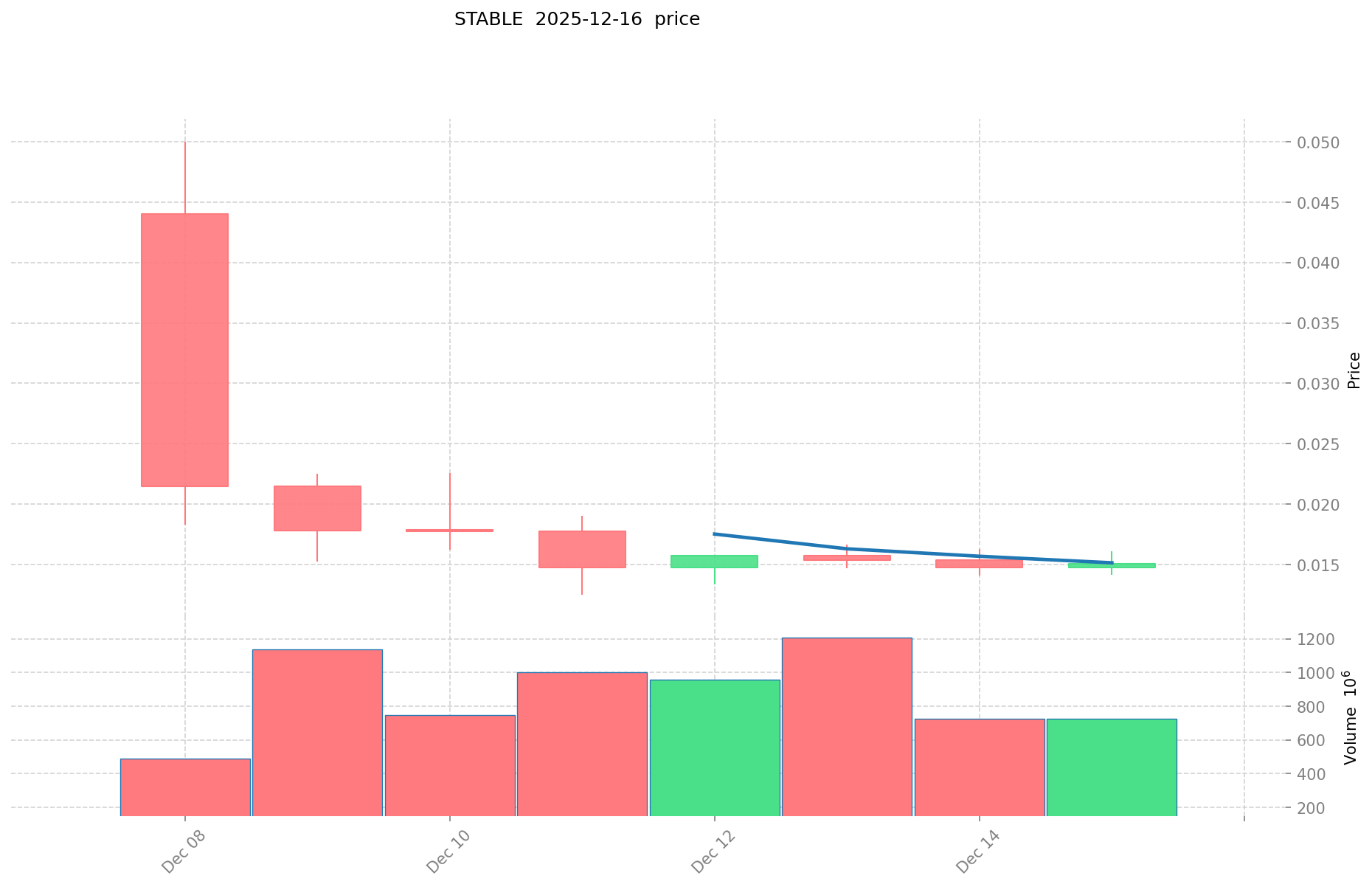
STABLE and DOGE Price Trend Overview
STABLE Historical Performance:
- Launch Date: December 8, 2025
- All-Time High (ATH): $0.05 (December 8, 2025)
- All-Time Low (ATL): $0.01252 (December 11, 2025)
- Current Trading Range: The asset has experienced a 74.96% decline from its ATH to current levels within just eight days of trading
DOGE Historical Performance:
- Launch Date: December 8, 2013
- All-Time High (ATH): $0.731578 (May 8, 2021)
- All-Time Low (ATL): $0.0000869 (May 6, 2015)
- Cumulative Return from ATL to ATH: Approximately 742,000%
- Current Status: Trading significantly below historical peaks, down 68.08% year-over-year
Comparative Analysis:
STABLE represents a newly launched Layer 1 blockchain specifically designed for USDT-denominated transactions, while DOGE is an established meme-based cryptocurrency with a 12-year trading history. The stark contrast in their lifecycles is evident: STABLE has declined 74.96% in just over one week, whereas DOGE has experienced volatile but more established market cycles over more than a decade. DOGE's 2021 bull run demonstrated community-driven price appreciation, while STABLE's early decline reflects post-launch market consolidation typical of newly issued blockchain tokens.
Current Market Status (December 16, 2025)
STABLE (STABLE)
- Current Price: $0.01448
- 24-Hour Change: -2.68%
- 1-Hour Change: -1.64%
- 7-Day Change: -15.37%
- 24-Hour Trading Volume: $11,308,397.47
- Market Capitalization: $1,448,000,000 (fully diluted)
- Circulating Supply: 18,000,000,000 STABLE
- Total Supply: 100,000,000,000 STABLE
- Market Dominance: 0.046%
DOGE (DogeCoin)
- Current Price: $0.12991
- 24-Hour Change: -4.56%
- 1-Hour Change: -1.52%
- 7-Day Change: -8.02%
- 30-Day Change: -19.17%
- 1-Year Change: -68.08%
- 24-Hour Trading Volume: $29,462,468.76
- Market Capitalization: $19,773,119,963.21 (fully diluted)
- Circulating Supply: 152,200,516,383.71 DOGE
- Market Dominance: 0.63%
- Total Holders: 7,792,465
Market Sentiment Index (Fear & Greed Index)
- Current Reading: 11 (Extreme Fear)
- Status: Extreme Fear
This indicates a highly pessimistic market sentiment across the cryptocurrency sector as of December 16, 2025.
View Real-Time Prices:

Investment Value Analysis: STABLE vs DOGE
I. Executive Summary
Based on available market research, this report analyzes the investment value drivers of DOGE (Dogecoin) and STABLE, examining their tokenomics, institutional adoption, regulatory environment, and market positioning. The analysis reveals distinct investment profiles shaped by community dynamics, institutional participation, and regulatory clarity.
II. Core Factors Influencing Investment Value of STABLE vs DOGE
Tokenomics and Supply Mechanism
DOGE (Dogecoin):
- Features an inflationary supply model with unlimited total supply, distinguishing it from fixed-supply cryptocurrencies
- Token economics are influenced by its supply volume, circulation metrics, and allocation structure across teams, investors, and communities
- The inflationary mechanism and its core economic logic directly impact market performance
STABLE:
- Success depends on rapid adoption of the USDT ecosystem, attracting developers and institutional users
- First-mover advantage in large-scale settlement domains is critical for competitive positioning
- Ecosystem attractiveness and execution capability are primary determinants of token economics viability
Market Observation: DOGE lacks core demand drivers such as major corporate treasury accumulation or sustained institutional ETF inflows, which has contributed to recent price underperformance.
Institutional Adoption and Market Application
Institutional Participation:
- Dogecoin's holder structure has undergone significant transformation, with institutional investors now dominating market dynamics
- Whales and major institutions control 75%-81% of DOGE's total supply, marking a shift from retail-driven to institution-led markets
- Recent developments include DOGE stock offerings and whale accumulation of approximately $1 billion in holdings
Cross-Platform Utility:
- DOGE investment value depends on market demand, community support, and cross-exchange/wallet interoperability
- STABLE's success hinges on leveraging the established USDT ecosystem while establishing first-mover advantages in large-scale settlement
Regulatory Transparency:
- Regulatory clarity remains a critical factor for cryptocurrency ETF adoption
- DOGE and LINK ETF launches demonstrate the importance of compliance and transparency in attracting institutional capital
- As regulators refine their frameworks, the crypto market may experience expanded institutional participation
Technical Development and Ecosystem Construction
DOGE Technical Limitations:
- White paper analysis reveals core logic centered on inflationary mechanisms
- Application scenarios beyond payments are limited
- Technological innovation remains insufficient compared to competing platforms
- Price volatility is significantly influenced by social media sentiment and community activity
STABLE Ecosystem Development:
- Execution capability and development team performance are essential for establishing ecosystem credibility
- Ability to attract developers and institutional users determines long-term viability
Macroeconomic and Market Cycle Considerations
Price Volatility Drivers:
- DOGE exhibits high price volatility driven by social media trends rather than fundamental demand catalysts
- Recent price movements show week-long gains of 20%, reflecting meme-driven market dynamics
- Absence of institutional treasury accumulation or consistent ETF capital flows limits sustained upward pressure
Risk Profile:
- Memecoin classification carries inherent risks with extreme volatility and potential for rapid value loss
- Price fluctuations can occur rapidly and dramatically within short timeframes
III. Investment Characteristics
DOGE Profile
- Community-driven asset with significant retail participation
- Increasingly dominated by institutional holders (75%-81% concentration)
- Lacks structural demand drivers beyond speculative interest
- Subject to social media sentiment and meme-culture dynamics
- Cross-platform interoperability enhances utility potential
STABLE Profile
- Ecosystem-dependent success model requiring developer and institutional adoption
- Positioning as derivative of established stablecoin infrastructure (USDT)
- First-mover advantage critical for market penetration
- Execution capability determines long-term competitive positioning
IV. Conclusion
DOGE investment value remains contingent upon sustained market demand, community engagement, and cross-platform adoption, with institutional participation now a dominant force. STABLE's viability depends on ecosystem ecosystem attractiveness and ability to establish settlement dominance. Regulatory clarity continues to serve as a foundational requirement for institutional capital deployment in both assets. Market participants should note that memecoin characteristics—including extreme volatility and speculative foundations—carry substantial inherent risks.
III. 2025-2030 Price Forecast: STABLE vs DOGE
Short-term Forecast (2025)
- STABLE: Conservative $0.00957-$0.0145 | Optimistic $0.016095
- DOGE: Conservative $0.097785-$0.13038 | Optimistic $0.1786206
Mid-term Forecast (2027-2028)
- STABLE could enter consolidation phase, with projected price range of $0.013688-$0.017748 (2027) to $0.013688-$0.025470 (2028)
- DOGE could enter recovery and growth phase, with projected price range of $0.164520-$0.210514 (2027) to $0.154967-$0.216954 (2028)
- Key drivers: institutional capital inflows, ETF approvals, ecosystem development
Long-term Forecast (2030)
- STABLE: Base case $0.013635-$0.023110 | Optimistic scenario $0.030274
- DOGE: Base case $0.145867-$0.227918 | Optimistic scenario $0.339597
Disclaimer: These forecasts are based on historical data and market analysis. Cryptocurrency markets are highly volatile and unpredictable. Past performance does not guarantee future results. This analysis should not be considered investment advice. Please conduct your own research and consult with financial professionals before making investment decisions.
STABLE:
| 年份 | 预测最高价 | 预测平均价格 | 预测最低价 | 涨跌幅 |
|---|---|---|---|---|
| 2025 | 0.016095 | 0.0145 | 0.00957 | 0 |
| 2026 | 0.018509975 | 0.0152975 | 0.0116261 | 5 |
| 2027 | 0.017748924375 | 0.0169037375 | 0.015044326375 | 16 |
| 2028 | 0.025469706478125 | 0.0173263309375 | 0.013687801440625 | 19 |
| 2029 | 0.024821701701062 | 0.021398018707812 | 0.014336672534234 | 47 |
| 2030 | 0.030273916867813 | 0.023109860204437 | 0.013634817520618 | 59 |
DOGE:
| 年份 | 预测最高价 | 预测平均价格 | 预测最低价 | 涨跌幅 |
|---|---|---|---|---|
| 2025 | 0.1786206 | 0.13038 | 0.097785 | 0 |
| 2026 | 0.199305387 | 0.1545003 | 0.128235249 | 18 |
| 2027 | 0.210514383765 | 0.1769028435 | 0.164519644455 | 35 |
| 2028 | 0.2169536472684 | 0.1937086136325 | 0.154966890906 | 48 |
| 2029 | 0.250503979149549 | 0.20533113045045 | 0.149891725228828 | 57 |
| 2030 | 0.339597156651999 | 0.227917554799999 | 0.145867235071999 | 74 |
Comparative Investment Analysis Report: STABLE vs DOGE
I. Historical Price Performance and Market Status
Price Trend Overview
STABLE Historical Performance:
- Launch Date: December 8, 2025
- All-Time High (ATH): $0.05
- All-Time Low (ATL): $0.01252 (December 11, 2025)
- Decline from ATH: 74.96% within eight days of trading
- Current Price (December 16, 2025): $0.01448
- 24-Hour Change: -2.68%
- 7-Day Change: -15.37%
- Market Capitalization: $1,448,000,000
- Circulating Supply: 18,000,000,000 STABLE
- Total Supply: 100,000,000,000 STABLE
DOGE Historical Performance:
- Launch Date: December 8, 2013
- All-Time High (ATH): $0.731578 (May 8, 2021)
- All-Time Low (ATL): $0.0000869 (May 6, 2015)
- Cumulative Return from ATL to ATH: Approximately 742,000%
- Current Price (December 16, 2025): $0.12991
- 24-Hour Change: -4.56%
- 1-Year Change: -68.08%
- Market Capitalization: $19,773,119,963.21
- Circulating Supply: 152,200,516,383.71 DOGE
- Total Holders: 7,792,465
Market Sentiment Context
The current Fear & Greed Index reads 11 (Extreme Fear), indicating highly pessimistic market sentiment across the cryptocurrency sector as of December 16, 2025.
II. Core Investment Value Drivers
Tokenomics and Supply Mechanism
DOGE (Dogecoin):
- Features an inflationary supply model with unlimited total supply
- Token economics influenced by supply volume, circulation metrics, and allocation structure
- Inflationary mechanism directly impacts long-term market performance
STABLE:
- Success dependent on rapid adoption within the USDT ecosystem
- Requires attraction of developers and institutional users
- First-mover advantage in large-scale settlement domains critical for competitive positioning
- Ecosystem attractiveness and execution capability are primary value determinants
Institutional Adoption and Market Participation
DOGE Institutional Dynamics:
- Institutional investors now dominate market dynamics with 75%-81% supply concentration
- Shift from retail-driven to institution-led market structure
- Recent institutional whale accumulation of approximately $1 billion in holdings
- Cross-platform utility and wallet interoperability enhance adoption potential
STABLE Market Application:
- Positioning as derivative of established USDT stablecoin infrastructure
- Leveraging established payment settlement ecosystem
- Institutional adoption dependent on execution capability and ecosystem development
Regulatory and Compliance Environment
Regulatory clarity remains critical for cryptocurrency adoption. DOGE and related cryptocurrency ETF launches demonstrate the importance of compliance and transparency in attracting institutional capital.
III. Investment Characteristics and Comparative Analysis
DOGE Investment Profile
Strengths:
- Established 12-year market history with proven community resilience
- Significant institutional participation and whale accumulation
- Cross-platform interoperability enhancing utility potential
- Large holder base (7,792,465 total holders) indicating widespread adoption
Weaknesses:
- Memecoin classification carrying inherent volatility and speculative risk
- Limited structural demand drivers beyond social media sentiment
- Price movements heavily influenced by meme-culture dynamics and retail enthusiasm
- Lacks core institutional treasury accumulation catalysts
- Subject to rapid and dramatic price fluctuations
STABLE Investment Profile
Strengths:
- Positioning as purpose-built Layer 1 blockchain for USDT-denominated transactions
- Sub-second finality and low fees for global payment demands
- First-mover advantage in stablecoin settlement ecosystem
- Clear technical utility for institutional payment use cases
Weaknesses:
- Extremely early stage (launched December 8, 2025)
- Severe post-launch volatility with 74.96% decline in eight days
- Success contingent on achieving critical ecosystem adoption
- Execution risk from development team and institutional user acquisition
- Limited trading history and market cycle data
- Market dominance at only 0.046% indicates nascent adoption
IV. Investment Strategy Comparison: STABLE vs DOGE
Long-term vs Short-term Investment Strategies
STABLE:
- Better suited for investors focused on emerging payment infrastructure and stablecoin ecosystem adoption
- Requires conviction in Layer 1 settlement technology and institutional payment demand
- High-risk profile appropriate only for risk-tolerant investors with long-term conviction horizons
DOGE:
- Suitable for investors seeking established meme-culture community participation and institutional whale dynamics
- Can serve as portfolio diversifier given 12-year market history and broader holder distribution
- Better-suited for investors comfortable with memecoin volatility and speculative dynamics
Risk Management and Asset Allocation
Conservative Investor Portfolio:
- STABLE: 0-5% (if included, position size minimal given extreme launch volatility)
- DOGE: 2-8% (established history but memecoin risk profile warrants limited allocation)
- Recommended hedge: 85-90% stablecoin/fiat allocation, 5-10% diversified altcoin exposure
Aggressive Investor Portfolio:
- STABLE: 5-15% (higher conviction in Layer 1 settlement thesis with risk tolerance)
- DOGE: 8-20% (institutional dynamics and community support justify elevated allocation)
- Tactical deployment: 5-10% reserved for market opportunities during extreme fear periods
Risk Mitigation Tools:
- Stablecoin allocation for dry powder and volatility hedging
- Dollar-cost averaging entry strategy given current extreme fear sentiment
- Cross-portfolio diversification beyond these two assets
- Position sizing appropriate to risk tolerance and portfolio objectives
V. Comparative Risk Analysis
Market Risk
STABLE:
- Extreme post-launch volatility with 74.96% decline in eight days exposes investors to severe drawdown risk
- Nascent market with minimal established price discovery mechanisms
- High probability of continued volatility as market establishes equilibrium pricing
- Liquidity concentration in early trading stages may amplify price movements
DOGE:
- Subject to social media sentiment swings and meme-culture momentum shifts
- 68.08% year-over-year decline demonstrates sustained bearish pressure despite community support
- Memecoin classification creates permanent speculative risk profile
- However, 12-year market history provides established volatility benchmarks
Technical Risk
STABLE:
- Network stability and security untested beyond eight days of operation
- Execution capability of development team unproven in extended market operations
- First-mover Layer 1 blockchain risk includes potential technical failures or security vulnerabilities
- Ecosystem development risk if developer adoption lags expectations
DOGE:
- Limited technological innovation constrains application scenarios beyond payments
- White paper analysis reveals core logic centered on inflationary mechanisms without advanced feature development
- Insufficient technological advancement compared to competing platforms
- However, network security has been established over 12-year operational history
Regulatory Risk
- Both assets subject to evolving global cryptocurrency regulatory frameworks
- DOGE established compliance history and institutional ETF infrastructure development demonstrate improving regulatory clarity
- STABLE regulatory status uncertain given recent launch and novel Layer 1 positioning
- Regulatory clarity improvements may accelerate institutional capital deployment into both assets, though timing remains unpredictable
VI. Price Forecast Analysis (2025-2030)
Short-term Outlook (2025)
STABLE:
- Conservative Range: $0.00957-$0.0145
- Optimistic Scenario: $0.016095
DOGE:
- Conservative Range: $0.097785-$0.13038
- Optimistic Scenario: $0.1786206
Medium-term Outlook (2027-2028)
STABLE:
- 2027: $0.013688-$0.017748
- 2028: $0.013688-$0.025470
DOGE:
- 2027: $0.164520-$0.210514
- 2028: $0.154967-$0.216954
Long-term Outlook (2030)
STABLE:
- Base Case: $0.013635-$0.023110
- Optimistic Scenario: $0.030274
- Projected Gain: 59% from 2025 levels
DOGE:
- Base Case: $0.145867-$0.227918
- Optimistic Scenario: $0.339597
- Projected Gain: 74% from 2025 levels
Forecast Disclaimer: These projections are based on historical data and market analysis. Cryptocurrency markets are highly volatile and unpredictable. Past performance does not guarantee future results.
VII. Conclusion: Which Is the Better Buy?
Investment Value Summary
STABLE Advantages:
- Purpose-built Layer 1 infrastructure for institutional payment settlement
- Emerging stablecoin ecosystem positioning with potential first-mover advantage
- Addresses specific technical demand for USDT-denominated transactions
- Higher asymmetric upside potential given extreme early-stage discount from ATH
DOGE Advantages:
- Established 12-year market history with proven community resilience and network security
- Significant institutional participation (75%-81% supply concentration) providing market stability
- Broader holder distribution (7.79 million total holders) indicating mainstream adoption
- More predictable volatility and established price discovery mechanisms
- Cross-platform utility and widespread exchange/wallet support
Investment Recommendations
Beginner Investors:
- Consider DOGE as primary exposure given established market history, predictable volatility patterns, and institutional adoption infrastructure
- Avoid STABLE exposure until post-launch stabilization period completes and ecosystem viability demonstrates measurable progress
- Recommended allocation: 3-5% of portfolio maximum, with 70%+ in stablecoins/fiat for risk preservation
Experienced Investors:
- DOGE allocation (8-15%) for core memecoin exposure with institutional dynamics as moderating influence
- STABLE allocation (5-10%) only if demonstrating conviction in Layer 1 settlement thesis with risk capital
- Tactical opportunistic deployment during extreme fear periods
- Recommended strategy: dollar-cost averaging over 3-6 month periods given current extreme fear sentiment
Institutional Investors:
- DOGE: Suitable for institutional portfolio diversification given 75%-81% institutional supply concentration, established market infrastructure, and regulatory clarity trajectory
- STABLE: Monitor ecosystem development and institutional adoption metrics before considering meaningful allocation
- Recommended approach: selective participation in DOGE given institutional dominance; maintain observation-only stance on STABLE until ecosystem proves viability
Risk Warnings
⚠️ Critical Risk Disclosure: Cryptocurrency markets exhibit extreme volatility and unpredictability. STABLE has declined 74.96% in eight days, demonstrating catastrophic drawdown potential for nascent assets. DOGE memecoin classification carries permanent speculative risk with potential for rapid and substantial value loss. This analysis does not constitute investment advice. Conduct independent research and consult qualified financial professionals before making investment decisions. Allocation to either asset should represent only capital you can afford to lose completely. None
FAQ: STABLE vs DOGE Cryptocurrency Investment Comparison
I. What are the key differences between STABLE and DOGE in terms of market positioning?
Answer: STABLE is a newly launched Layer 1 blockchain specifically designed for USDT-denominated transactions with sub-second finality and low fees for global payments. DOGE is an established meme-based cryptocurrency with a 12-year trading history (since December 8, 2013) that has evolved from a community-driven asset to one increasingly dominated by institutional investors. STABLE represents emerging payment infrastructure, while DOGE represents an established speculative asset with significant institutional participation (75%-81% supply concentration).
II. How have STABLE and DOGE performed historically, and what are their current price levels?
Answer: STABLE launched on December 8, 2025, with an all-time high of $0.05, declining 74.96% to $0.01448 by December 16, 2025. DOGE launched in 2013, peaked at $0.731578 in May 2021 (a 742,000% cumulative return from its all-time low), and currently trades at $0.12991—down 68.08% year-over-year. STABLE's extreme early volatility reflects post-launch market consolidation, while DOGE demonstrates more established market cycles over its 12-year history. Current market sentiment is at extreme fear levels (Fear & Greed Index: 11), affecting both assets negatively.
III. Which asset carries higher investment risk, and what risk factors should investors consider?
Answer: STABLE carries higher short-term risk due to its nascent stage (8 days old), extreme volatility, unproven network security, and execution-dependent development team. DOGE carries different but also substantial risks including memecoin speculation dynamics, social media sentiment dependency, and limited technological innovation. STABLE risks include ecosystem adoption failure and potential technical vulnerabilities; DOGE risks include rapid speculative reversals and absence of core institutional treasury accumulation catalysts. Both assets are subject to evolving regulatory frameworks. Current market conditions (extreme fear sentiment) amplify risk profiles for both assets.
IV. What are the price forecasts for STABLE and DOGE through 2030?
Answer: STABLE forecasts project 2030 base-case pricing of $0.013635-$0.023110 (59% gain from 2025) with optimistic scenario of $0.030274. DOGE forecasts project 2030 base-case pricing of $0.145867-$0.227918 (74% gain from 2025) with optimistic scenario of $0.339597. Mid-term (2027-2028) projections show STABLE in consolidation phase while DOGE enters recovery and growth phase. These forecasts are based on historical data and market analysis; cryptocurrency markets remain highly volatile and unpredictable. Past performance does not guarantee future results.
V. Should conservative investors consider allocating to either STABLE or DOGE?
Answer: Conservative investors should limit exposure to both assets significantly. Recommended allocation for STABLE is 0-5% maximum (or avoided entirely until post-launch stabilization occurs), while DOGE allocation should remain 2-8% maximum given its memecoin risk profile. Conservative portfolios should maintain 85-90% allocation in stablecoins/fiat for risk preservation. The current extreme fear market sentiment creates both risk and opportunity; however, STABLE's 74.96% eight-day decline and DOGE's 68.08% year-over-year decline demonstrate the substantial drawdown potential of both assets. Conservative investors should conduct independent research and consult qualified financial professionals before any allocation.
VI. What institutional participation characteristics differentiate DOGE from STABLE?
Answer: DOGE demonstrates established institutional dominance with 75%-81% of total supply controlled by institutional investors and whales, representing approximately $1 billion in recent accumulation. This institutional concentration provides market stability and infrastructure development but also reduces retail upside potential. STABLE lacks meaningful institutional participation history given its eight-day operational window, creating both uncertainty and potential opportunity as institutional adoption develops. DOGE's institutional participation has driven cross-platform interoperability enhancements and ETF infrastructure development, while STABLE's success depends on attracting developers and institutional users to its Layer 1 ecosystem. Current institutional dynamics suggest DOGE offers more predictable market behavior through established participant structures.
VII. How do tokenomics and supply mechanisms differ between these assets?
Answer: DOGE features an inflationary supply model with unlimited total supply, creating permanent supply expansion pressure. STABLE's tokenomics depend on rapid USDT ecosystem adoption, with circulating supply of 18 billion STABLE against total supply of 100 billion STABLE (18% circulating). DOGE's inflationary mechanism directly impacts long-term price performance, while STABLE's value is contingent on ecosystem attractiveness and first-mover advantages in large-scale USDT settlement. STABLE's ecosystem-dependent model creates execution risk but potentially higher asymmetric upside if adoption accelerates. DOGE's unlimited supply creates ongoing deflationary pressure but is partially offset by institutional accumulation and cross-platform utility expansion.
VIII. Which asset represents a better investment opportunity at current market conditions?
Answer: Neither asset represents an objectively superior investment—the choice depends on investor risk tolerance and conviction thesis. DOGE is more suitable for investors seeking established memecoin community participation with institutional stability through 75%-81% supply concentration, proven 12-year market history, and cross-platform utility. STABLE is appropriate only for risk-tolerant investors with conviction in Layer 1 payment infrastructure and USDT ecosystem adoption, accepting extreme early-stage volatility and execution risk. Current extreme fear sentiment (Fear & Greed Index: 11) creates tactical opportunities through dollar-cost averaging strategies over 3-6 month periods for experienced investors. Beginner investors should avoid STABLE until post-launch stabilization completes and prioritize DOGE with maximum 3-5% portfolio allocation. All investors should recognize that cryptocurrency markets exhibit extreme unpredictability; this analysis does not constitute investment advice. Allocation to either asset should represent only capital you can afford to lose completely.
Disclaimer: This analysis is based on historical data and market research. Cryptocurrency markets are highly volatile and unpredictable. Past performance does not guarantee future results. This content does not constitute investment advice. Please conduct independent research and consult qualified financial professionals before making investment decisions.
Share
How to Buy Cryptocurrency


Trending Cryptocurrencies



XZXX: A Comprehensive Guide to the BRC-20 Meme Token in 2025
Bitcoin Fear and Greed Index: Market Sentiment Analysis for 2025

Top Crypto ETFs to Watch in 2025: Navigating the Digital Asset Boom

5 ways to get Bitcoin for free in 2025: Newbie Guide

Bitcoin Market Cap in 2025: Analysis and Trends for Investors
2025 Bitcoin Price Prediction: Trump's Tariffs' Impact on BTC

Is cheems (CHEEMS) a good investment?: A Comprehensive Guide to Understanding Risks, Potential Returns, and Market Dynamics

Is Kamino (KMNO) a good investment?: A Comprehensive Analysis of Price Performance, Market Potential, and Risk Factors for 2024

Is Loaded Lions (LION) a good investment?: A Comprehensive Analysis of Performance, Tokenomics, and Market Potential

Is Golem (GLM) a good investment? A Comprehensive Analysis of the Distributed Computing Platform's Potential and Risks in 2024

BEAT vs GMX: Comparing Two Leading Decentralized Perpetual Futures Trading Protocols