UNIBOT vs APT: A Comprehensive Comparison of Two Leading Automated Trading Bots in the Cryptocurrency Market

Introduction: Investment Comparison Between UNIBOT and APT
In the cryptocurrency market, the comparison between UNIBOT vs APT has been a topic of continuous interest among investors. These two assets show notable differences in market capitalization ranking, application scenarios, and price performance, representing distinct positioning within the crypto asset landscape.
Unibot (UNIBOT): Launched in 2023, this project has gained market attention through its positioning as a Telegram-based Uniswap trading bot, offering advanced algorithmic trading infrastructure with features including private nodes, private transaction options, and wallet monitoring capabilities.
Aptos (APT): Since its introduction in 2022, Aptos has established itself as a high-performance Layer 1 blockchain, utilizing the Move programming language and focusing on secure, scalable blockchain infrastructure for decentralized application development.
This article will provide a comprehensive analysis of the UNIBOT vs APT investment value comparison, examining historical price trends, supply mechanisms, institutional adoption, technological ecosystems, and future projections, while addressing the question that concerns investors:
"Which is the better buy right now?"
I. Historical Price Comparison and Market Status
Price Trends of UNIBOT (Coin A) and APT (Coin B)
- 2023: UNIBOT reached a peak price of $243.36 on August 16, 2023, during a period of growth in Telegram-based trading bot platforms.
- 2022: APT launched its mainnet in October 2022, with initial price discovery phase followed by a high of $19.92 on January 26, 2023, driven by institutional backing and innovative Layer-1 blockchain technology.
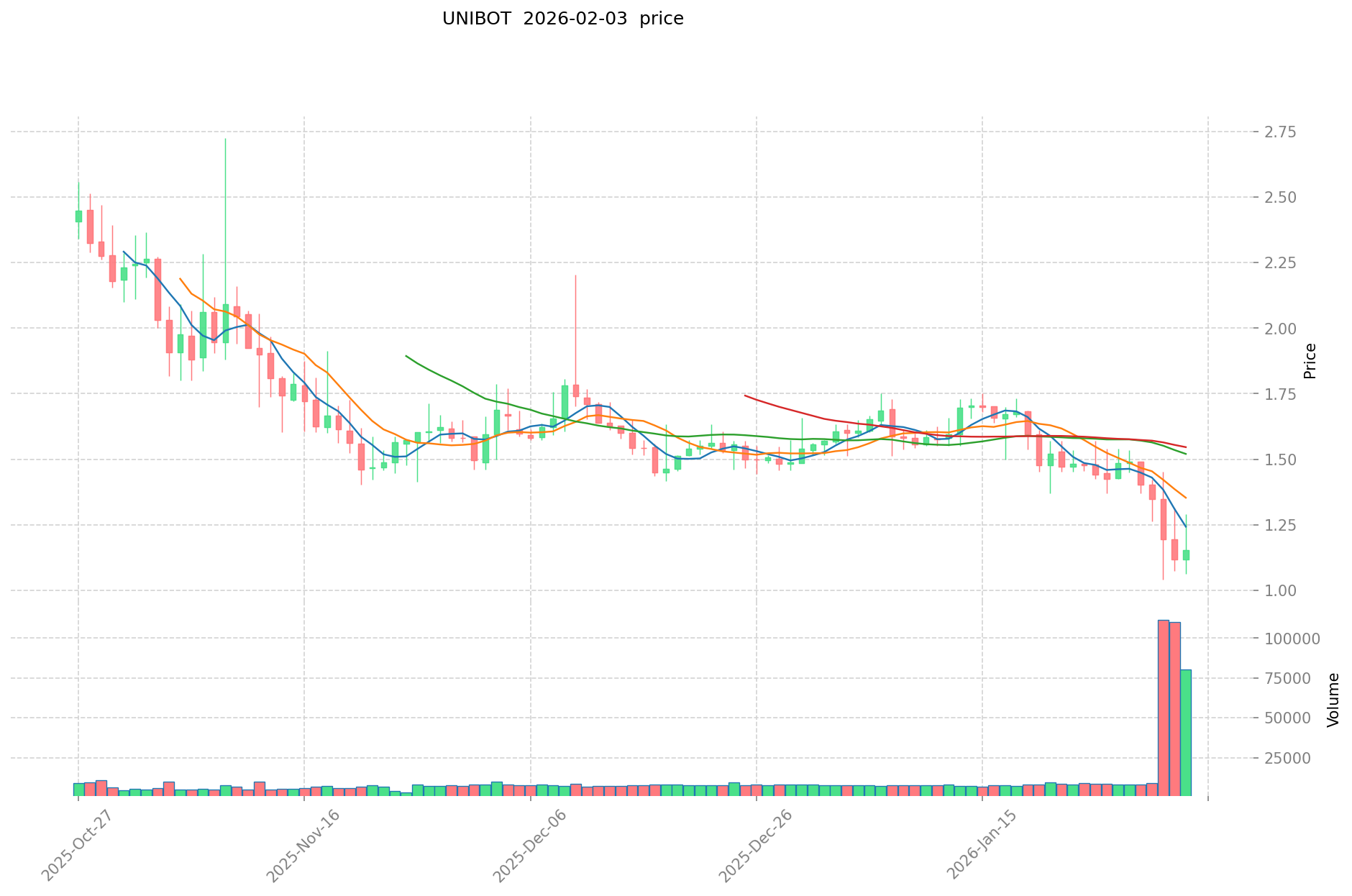
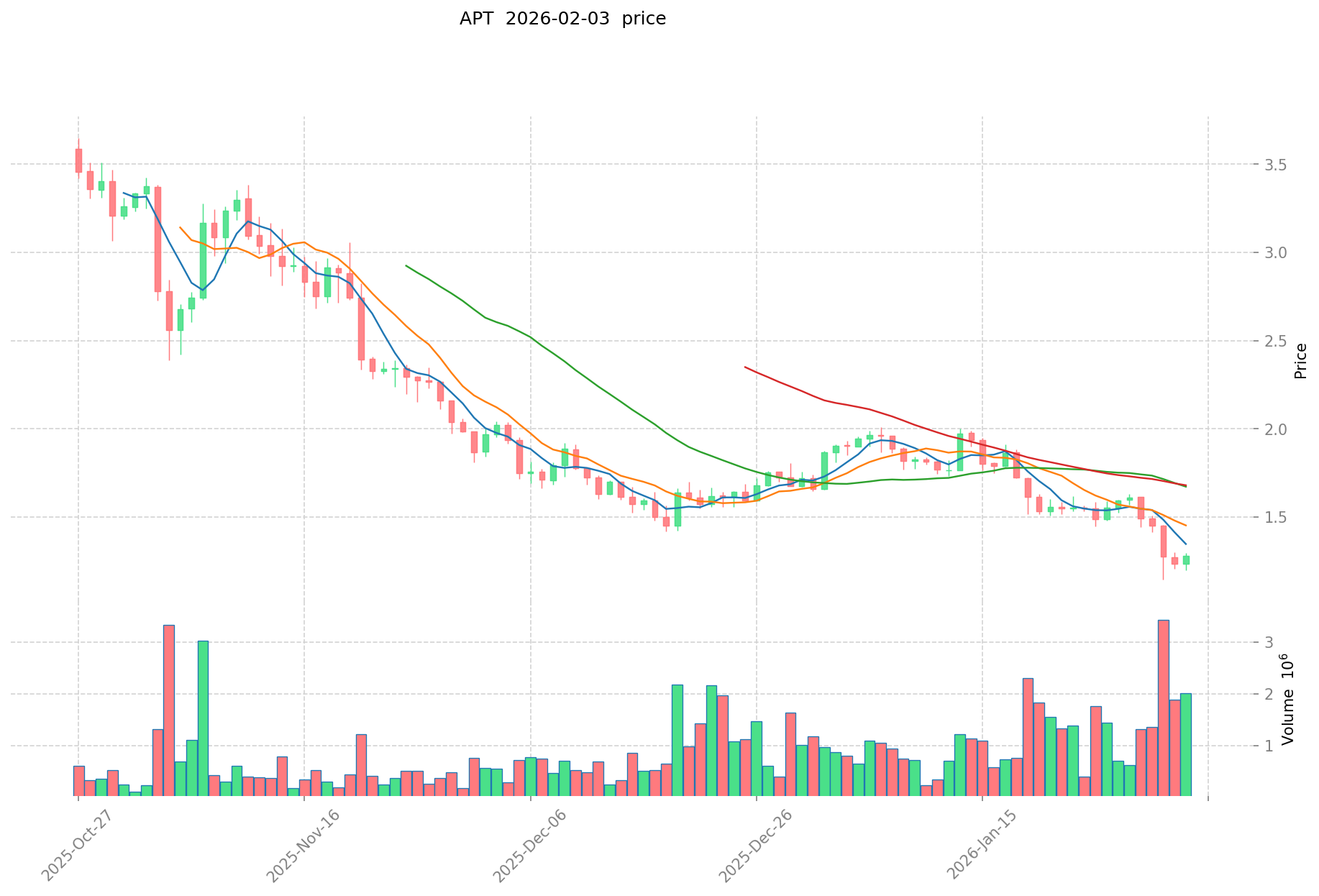
- Comparative Analysis: During the 2023-2026 market cycle, UNIBOT declined from $243.36 to approximately $1.14, representing a decline of over 99%, while APT declined from $19.92 to approximately $1.27, showing a decline of around 93%.
Current Market Status (2026-02-03)
- UNIBOT Current Price: $1.14
- APT Current Price: $1.27
- 24-Hour Trading Volume: UNIBOT $90,703.37 vs APT $2,292,471.30
- Market Sentiment Index (Fear & Greed Index): 17 (Extreme Fear)
View Real-Time Prices:
- View UNIBOT Current Price Market Price
- View APT Current Price Market Price
II. Core Factors Affecting UNIBOT vs APT Investment Value
Supply Mechanism Comparison (Tokenomics)
- UNIBOT: The percentage of each UNIBOT holder relative to the nominal supply may vary due to structural factors in token distribution.
- APT: Aptos experienced a token unlock event involving 24.8 million APT tokens, representing approximately 10% of circulating supply, valued at around 172.9 million USD. The majority of unlocked funds (approximately 82.7 million USD) were allocated to core contributors, with 58.6 million USD directed to investors.
- 📌 Historical Pattern: Token unlock events and distribution structures can influence price volatility cycles, as supply-side changes may create selling pressure or liquidity shifts in the market.
Institutional Adoption and Market Application
- Market Positioning: APT has been referenced alongside projects in the MOVE ecosystem category, alongside SUI, indicating recognition within specific technical frameworks.
- Adoption Factors: The investment value of both assets appears linked to broader market trends, adoption rates, and ecosystem development momentum.
- Monitoring Requirement: Participants are advised to closely monitor market dynamics, as both assets may experience volatility related to supply events and adoption trends.
Technical Development and Ecosystem Building
- UNIBOT Technical Context: The asset's valuation potential depends on factors including market trends, adoption rates, and global economic conditions.
- APT Ecosystem Activity: The token unlock pattern suggests active development phases with scheduled distributions to contributors and investors, which may indicate ongoing ecosystem development activities.
- Application Comparison: Specific technical features, upgrade schedules, or ecosystem expansion details for either asset were not detailed in available materials.
Macroeconomic and Market Cycles
- Market Trend Dependency: Both UNIBOT and APT investment values appear sensitive to overall cryptocurrency market trends and adoption momentum.
- Economic Condition Factors: Global economic conditions may influence price movements for both assets, requiring continuous market assessment.
- Investment Consideration: Market participants should evaluate real-time pricing and market conditions before making allocation decisions, as both assets demonstrate sensitivity to broader market dynamics and ecosystem-specific developments.
III. 2026-2031 Price Forecast: UNIBOT vs APT
Short-term Forecast (2026)
- UNIBOT: Conservative $0.78-$1.14 | Optimistic $1.14-$1.21
- APT: Conservative $0.82-$1.27 | Optimistic $1.27-$1.65
Mid-term Forecast (2028-2029)
- UNIBOT may enter a consolidation phase with projected prices ranging from $1.24 to $1.58
- APT may enter a growth phase with projected prices ranging from $1.17 to $2.40
- Key drivers: institutional capital inflows, ETF developments, ecosystem expansion
Long-term Forecast (2030-2031)
- UNIBOT: Base scenario $1.45-$1.86 | Optimistic scenario $1.86-$2.46
- APT: Base scenario $1.94-$2.50 | Optimistic scenario $2.50-$3.08
Disclaimer
UNIBOT:
| Year | Predicted High Price | Predicted Average Price | Predicted Low Price | Price Change |
|---|---|---|---|---|
| 2026 | 1.20522 | 1.137 | 0.78453 | 0 |
| 2027 | 1.4755986 | 1.17111 | 0.8783325 | 2 |
| 2028 | 1.548324531 | 1.3233543 | 1.243953042 | 16 |
| 2029 | 1.57942335705 | 1.4358394155 | 1.364047444725 | 25 |
| 2030 | 2.21621813782425 | 1.507631386275 | 1.447326130824 | 32 |
| 2031 | 2.457740685905505 | 1.861924762049625 | 1.675732285844662 | 63 |
APT:
| Year | Predicted High Price | Predicted Average Price | Predicted Low Price | Price Change |
|---|---|---|---|---|
| 2026 | 1.64736 | 1.2672 | 0.82368 | 0 |
| 2027 | 1.894464 | 1.45728 | 1.3698432 | 14 |
| 2028 | 1.87697664 | 1.675872 | 1.1731104 | 31 |
| 2029 | 2.398172832 | 1.77642432 | 1.4033752128 | 39 |
| 2030 | 2.9222180064 | 2.087298576 | 1.94118767568 | 64 |
| 2031 | 3.080852698176 | 2.5047582912 | 2.154092130432 | 96 |
IV. Investment Strategy Comparison: UNIBOT vs APT
Long-term vs Short-term Investment Strategies
- UNIBOT: May appeal to investors focusing on trading infrastructure tools and specialized bot utility within the Telegram ecosystem, with consideration for higher volatility patterns.
- APT: May appeal to investors interested in Layer 1 blockchain infrastructure with institutional backing and Move programming language ecosystem development potential.
Risk Management and Asset Allocation
- Conservative Investors: UNIBOT 20-30% vs APT 70-80%
- Aggressive Investors: UNIBOT 40-50% vs APT 50-60%
- Hedging Tools: Stablecoin allocation, derivatives positioning, cross-asset portfolio diversification
V. Comparative Risk Analysis
Market Risk
- UNIBOT: Demonstrates high sensitivity to trading bot adoption trends, with historical price volatility exceeding 99% from peak levels, influenced by niche market positioning.
- APT: Exhibits correlation with Layer 1 blockchain sector performance, with token unlock events creating periodic supply-side pressure, as evidenced by the 24.8 million token unlock event.
Technical Risk
- UNIBOT: Infrastructure dependency on Telegram platform stability, bot functionality maintenance, and competitive landscape within trading tool sector.
- APT: Network scalability considerations, Move programming language adoption rates, validator network decentralization factors.
Regulatory Risk
- Global regulatory developments may affect both assets differently, with trading bot infrastructure facing potential scrutiny on automated trading mechanisms, while Layer 1 blockchain platforms encountering varying jurisdictional approaches to smart contract platforms and token distribution models.
VI. Conclusion: Which Is the Better Buy?
📌 Investment Value Summary:
- UNIBOT Strengths: Specialized utility in algorithmic trading infrastructure, features including private nodes and transaction privacy options, positioning within Telegram-based trading ecosystem.
- APT Strengths: Institutional backing since 2022 launch, innovative Move programming language framework, Layer 1 infrastructure with focus on scalability and security, established ecosystem development patterns.
✅ Investment Considerations:
- New Investors: Consider APT for exposure to established Layer 1 infrastructure with institutional participation, while maintaining awareness of token unlock schedules and broader market conditions.
- Experienced Investors: Evaluate portfolio allocation based on risk tolerance, with APT offering blockchain infrastructure exposure and UNIBOT providing specialized trading tool utility, requiring assessment of ecosystem development momentum.
- Institutional Investors: APT may align with infrastructure investment strategies given Layer 1 positioning and Move ecosystem development, while UNIBOT represents specialized trading infrastructure with niche market focus.
⚠️ Risk Disclosure: Cryptocurrency markets demonstrate extreme volatility. This analysis does not constitute investment advice. Market participants should conduct independent research and assess current market conditions before making allocation decisions.
VII. FAQ
Q1: What are the main differences in supply mechanisms between UNIBOT and APT that investors should consider?
APT has a structured token unlock schedule with significant distribution events, while UNIBOT's supply dynamics are less transparent. APT experienced a major unlock of 24.8 million tokens (approximately 10% of circulating supply) valued at around $172.9 million USD, with 82.7 million USD allocated to core contributors and 58.6 million USD to investors. These scheduled unlocks create predictable supply-side pressure periods that investors should monitor. UNIBOT's supply structure shows variations in holder percentages relative to nominal supply due to distribution factors, though specific unlock schedules are less documented. For investment planning, APT's transparent unlock calendar allows investors to anticipate potential price volatility periods, while UNIBOT requires closer monitoring of holder distribution patterns.
Q2: How do the historical price declines of UNIBOT and APT compare, and what does this indicate about risk profiles?
UNIBOT declined over 99% from its peak, while APT declined approximately 93%, indicating higher volatility risk for UNIBOT. UNIBOT reached $243.36 on August 16, 2023, before falling to approximately $1.14 by February 2026, representing extreme downside volatility exceeding 99%. APT peaked at $19.92 on January 26, 2023, declining to approximately $1.27, showing a 93% correction. This comparative analysis suggests UNIBOT carries higher volatility risk due to its niche market positioning in Telegram-based trading tools, while APT's decline, though substantial, reflects broader Layer 1 blockchain sector performance. The severity of UNIBOT's decline indicates greater sensitivity to adoption trends and market sentiment within specialized trading infrastructure, making it suitable primarily for high-risk tolerance investors.
Q3: What role does institutional adoption play in differentiating UNIBOT from APT as investment options?
APT demonstrates significantly stronger institutional backing compared to UNIBOT, which focuses on retail trading tool utility. APT launched in October 2022 with institutional investor participation and has been recognized within the MOVE ecosystem category alongside projects like SUI, indicating technical framework credibility. The structured token distribution to investors ($58.6 million in unlocks) and core contributors ($82.7 million) reflects organized institutional involvement. UNIBOT, as a Telegram-based trading bot launched in 2023, primarily serves retail traders seeking algorithmic trading features like private nodes and wallet monitoring. This institutional adoption gap suggests APT may offer more stable long-term value proposition through established partnerships and development funding, while UNIBOT's value depends heavily on grassroots adoption within the trading bot user community.
Q4: How do the 24-hour trading volumes of UNIBOT and APT reflect their market liquidity differences?
APT shows substantially higher liquidity with 25x greater trading volume than UNIBOT, indicating easier entry and exit for investors. As of February 3, 2026, APT recorded 24-hour trading volume of $2,292,471.30 compared to UNIBOT's $90,703.37. This 25-fold difference in trading activity indicates APT offers significantly better market depth and liquidity for position management. Higher liquidity typically results in tighter bid-ask spreads, reduced slippage on larger orders, and more efficient price discovery. For institutional investors or those managing larger positions, APT's superior liquidity profile reduces execution risk and provides more reliable exit strategies during market volatility. UNIBOT's lower volume suggests limited market depth, potentially creating challenges for investors seeking to establish or exit significant positions without substantial price impact.
Q5: What are the key technical development differences between UNIBOT and APT ecosystems?
APT focuses on Layer 1 blockchain infrastructure development with the Move programming language, while UNIBOT specializes in trading automation tools within Telegram. APT's technical foundation centers on building a scalable, secure blockchain platform using the Move programming language, originally developed by Facebook's Diem project, emphasizing safety and formal verification. This positions APT within the broader smart contract platform category with focus on decentralized application development. UNIBOT's technical scope is narrower, providing algorithmic trading infrastructure features including private nodes, private transaction options, and wallet monitoring capabilities specifically for Uniswap trading via Telegram interface. The ecosystem building approaches differ fundamentally: APT cultivates developer communities, validator networks, and dApp ecosystems, while UNIBOT focuses on enhancing trading bot functionality and user experience for cryptocurrency traders. This technical divergence means APT's value proposition ties to blockchain infrastructure adoption, whereas UNIBOT's depends on trading tool utility and bot feature competitiveness.
Q6: How do the price forecasts for 2030-2031 compare between UNIBOT and APT?
APT's long-term forecasts show stronger growth potential, with 2031 optimistic scenarios reaching $3.08 versus UNIBOT's $2.46. For 2030, APT projects a base scenario range of $1.94-$2.50 with optimistic potential up to $2.92, representing potential 96% growth from current levels by 2031. UNIBOT forecasts show 2030 base scenario of $1.45-$1.86 with optimistic potential reaching $2.46 by 2031, indicating 63% potential growth. The forecast divergence reflects differing growth drivers: APT's projections assume institutional capital inflows, ecosystem expansion, and Layer 1 blockchain adoption trends, while UNIBOT's forecasts depend on trading bot market penetration and feature competitiveness. These projections suggest APT may offer higher absolute growth potential over the 5-year horizon, though both forecasts remain speculative and dependent on broader cryptocurrency market recovery and adoption trends beyond current extreme fear market conditions (Fear & Greed Index: 17).
Q7: What portfolio allocation strategies are recommended for different investor types considering UNIBOT vs APT?
Conservative investors should favor APT with 70-80% allocation versus 20-30% UNIBOT, while aggressive investors may balance 50-60% APT with 40-50% UNIBOT. Conservative portfolio construction prioritizes APT's institutional backing, established Layer 1 infrastructure, and relatively lower historical volatility (93% decline vs 99% for UNIBOT), allocating 70-80% to APT and limiting UNIBOT exposure to 20-30% for diversification. Aggressive investors with higher risk tolerance may increase UNIBOT allocation to 40-50% while maintaining 50-60% in APT, accepting greater volatility for potential upside in specialized trading tool adoption. Risk management should incorporate stablecoin allocations for portfolio stability, derivatives positioning for downside protection, and cross-asset diversification beyond these two assets. New investors are advised to favor APT for foundational blockchain infrastructure exposure, while experienced investors may evaluate UNIBOT for tactical exposure to trading infrastructure trends, always maintaining awareness of extreme market volatility and conducting independent research before allocation decisions.
Q8: What specific regulatory risks differentiate UNIBOT from APT as investment considerations?
UNIBOT faces potential scrutiny on automated trading mechanisms, while APT encounters jurisdictional variations in smart contract platform regulation. Trading bot infrastructure like UNIBOT may face regulatory attention regarding automated trading systems, market manipulation prevention measures, and user fund custody arrangements, particularly as regulators globally develop frameworks for algorithmic trading in cryptocurrency markets. APT as a Layer 1 blockchain platform encounters different regulatory considerations including token distribution model compliance, smart contract platform classification across jurisdictions, and securities law implications for ecosystem tokens. Global regulatory developments may affect both assets differently: trading automation tools may face specific requirements around transparency and user protection, while blockchain infrastructure platforms navigate varying approaches to decentralized networks and validator operations. Investors should monitor regulatory developments in key jurisdictions including the United States, European Union, and Asia-Pacific regions, as policy changes could materially impact both projects' operational models and market accessibility, with UNIBOT potentially more vulnerable to trading-specific regulations and APT exposed to broader blockchain platform regulatory frameworks.
Share
Content
Introduction: Investment Comparison Between UNIBOT and APT
I. Historical Price Comparison and Market Status
II. Core Factors Affecting UNIBOT vs APT Investment Value
III. 2026-2031 Price Forecast: UNIBOT vs APT
IV. Investment Strategy Comparison: UNIBOT vs APT
V. Comparative Risk Analysis
VI. Conclusion: Which Is the Better Buy?
VII. FAQ
How to Buy Cryptocurrency


Trending Cryptocurrencies



2025 SUI coin: price, buying guide, and Staking rewards

How to Buy Crypto: A Step-by-Step Guide with Gate.com
HNT Price in 2025: Helium Network Token Value and Market Analysis

What is SwissCheese (SWCH) and How Does It Democratize Investment?

Cardano (ADA) Price Analysis and Outlook for 2025
How to Invest in Metaverse Crypto

What Are Nodes? Types of Nodes and How They Work in Blockchain

Comprehensive Guide to NFT Minting on Popular Platforms

What is NBLU: A Comprehensive Guide to Understanding Next-Generation Business Logic Units

What is MTRG: A Comprehensive Guide to Multi-Token Retrieval Generation in Modern AI Systems

What is KYO: A Comprehensive Guide to Understanding the Kyoto Protocol and Its Global Impact on Climate Change