Crepe Project is a Web3.0 asset management platform built on Polygon and BSC networks, addressing accessibility barriers in crypto portfolio management for ordinary users. Launched in 2023 and listed on Gate.com, the platform enables crypto experts to construct investment strategies that retail investors can easily purchase and manage, democratizing professional-grade portfolio access. Operating on decentralized blockchain infrastructure with public-private key security, Crepe Project leverages smart contracts to facilitate transparent, intermediary-free transactions across multiple chains. With 6,650 token holders and fixed supply of 1 billion CRE tokens, the platform offers multi-chain support and cross-chain asset management capabilities. Despite facing market volatility and competitive pressures from established DeFi platforms, Crepe Project continues optimizing its technology and expanding ecosystem applications. The platform bridges the gap between expert financial strategies and retail crypto investors
Crepe Project's Positioning and Significance
In 2023, the Crepe Project team launched Crepe Project (CRE), aiming to address the complexity and accessibility barriers in crypto asset management for ordinary users.
As a Web3.0 asset management system on Polygon and BSC, Crepe Project plays a key role in democratizing crypto investment portfolio management.
As of 2026, Crepe Project has developed into a specialized asset management platform with 6,650 holders and an active development community.
This article will provide an in-depth analysis of its technical architecture, market performance, and future potential.
Origin and Development History
Birth Background
Crepe Project was created in 2023, aiming to solve the challenge of ordinary users accessing professional-grade crypto investment strategies and portfolio management.
It emerged during the expansion of Web3.0 infrastructure and growing demand for accessible DeFi tools, with the goal of enabling experts to build investment portfolios that regular users can easily purchase and manage to transform the status quo.
The launch of Crepe Project brought new possibilities to retail crypto investors seeking expert-curated investment solutions.
Important Milestones
- October 2023: Official launch on Gate.com, establishing initial market presence with a listing price of $0.04389.
- October 2024: Platform reached peak engagement, with token price reaching $0.49 on October 31, 2024.
- 2025: Expansion of holder base, growing to 6,650 holders across BSC ecosystem.
- 2026: Continued development of asset management features and platform optimization.
Under the support of its development team and growing community, Crepe Project continues to optimize its technology, security, and real-world applications.
How Crepe Project Works?
No Central Control
Crepe Project operates on decentralized blockchain networks (Polygon and BSC), freeing itself from centralized financial institution control.
These networks collaboratively validate transactions, ensuring system transparency and attack resistance, granting users greater autonomy and enhancing network resilience.
Blockchain Foundation
Crepe Project's infrastructure is built on public, immutable digital ledgers recording every transaction.
Transactions are grouped into blocks and linked through cryptographic hashes to form a secure chain.
Anyone can view records, establishing trust without intermediaries.
The platform leverages BSC's BEP-20 standard to ensure compatibility and efficient transaction processing.
Crepe Project implements a Web3.0 asset management framework where expert portfolio managers can create investment strategies.
Ordinary users can access these professionally constructed portfolios, enabling participation in sophisticated investment approaches without requiring deep technical knowledge.
The system operates across Polygon and BSC networks, providing users with flexibility in chain selection and transaction cost optimization.
Secure Transactions
Crepe Project uses public-private key cryptography to protect transactions:
- Private keys (similar to secret passwords) are used to sign transactions
- Public keys (similar to account numbers) are used to verify ownership
This mechanism ensures fund security, with transactions maintaining pseudonymous privacy through blockchain addresses.
The platform's deployment on established blockchain networks provides additional security layers through proven consensus mechanisms.
Circulation Overview
As of February 7, 2026, Crepe Project has a circulating supply of 1,000,000,000 CRE tokens, with a total supply of 1,000,000,000 tokens and a maximum supply of 1,000,000,000 tokens, indicating a fixed supply model.
The token operates on the BSC (BEP-20) standard, with its contract address verifiable on BscScan. The complete circulation of tokens suggests that all planned tokens have been released into the market, which may influence its supply-demand dynamics.
Price Volatility
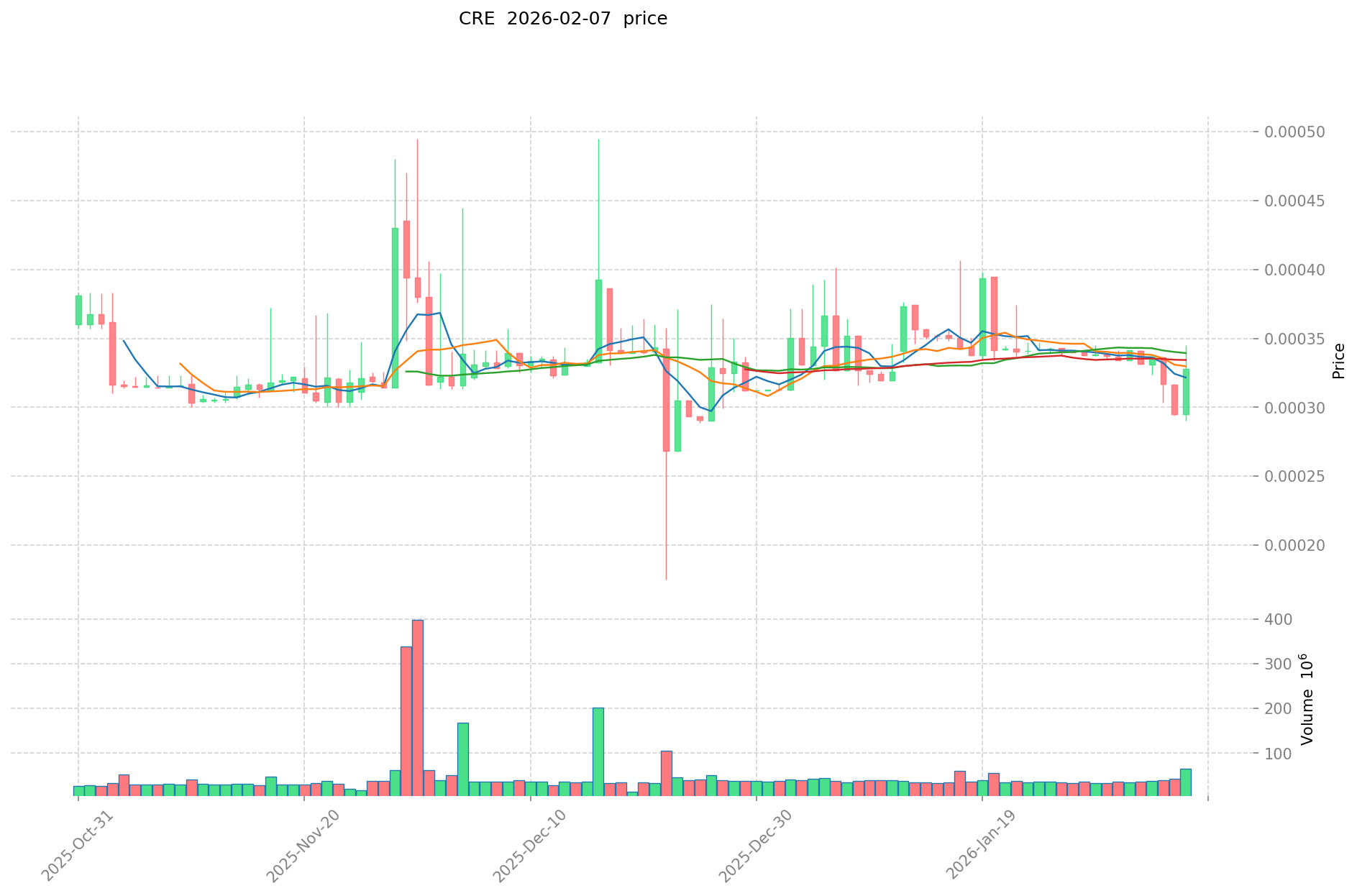
Crepe Project reached its peak price of $0.49 on October 31, 2024. The lowest recorded price was $0.0000999 on March 2, 2025, representing significant price fluctuation within the period.
As of the latest update, CRE is trading at $0.0003285, showing a 24-hour increase of 11.55% and a 1-year increase of 50.07%. However, the token has experienced a 7-day decline of 2.42% and a 30-day decline of 6.67%, reflecting mixed short-term and long-term performance trends.
The 24-hour trading range spans from $0.00029017 to $0.000345, with a total 24-hour trading volume of approximately $20,347.61.
Click to view the current CRE market price
On-Chain Metrics
- Market Capitalization: The current market cap stands at $328,500, representing 0.000013% market dominance in the cryptocurrency space
- Fully Diluted Valuation: With 100% of tokens in circulation, the FDV equals the market cap at $328,500
- Token Holders: Approximately 6,650 addresses hold CRE tokens, indicating community distribution
- Exchange Listings: CRE is currently listed on 1 exchange platform
Crepe Project Ecosystem Applications and Partners
Core Use Cases
Crepe Project's ecosystem supports multiple applications:
- Asset Management: CREPE provides a Web3.0 asset management system that enables crypto experts to construct investment portfolios for ordinary users to purchase, offering decentralized portfolio management services.
- Multi-Chain Support: Operating on both Polygon and BSC networks, CREPE facilitates cross-chain asset management and diversified investment strategies.
Strategic Partnerships
Based on available information, Crepe Project operates as a Web3.0 asset management platform on Polygon and BSC networks.
These partnerships provide a solid foundation for CREPE's ecosystem expansion.
Controversies and Challenges
Crepe Project faces the following challenges:
- Market Volatility: Price fluctuations with a 24-hour change of 11.55% and monthly decline of 6.67%
- Competitive Pressure: Competition from other DeFi platforms and asset management protocols in the evolving Web3.0 space
- Adoption Hurdles: Building user trust and expanding from 6,650 holders to mainstream adoption
These issues have sparked discussions within the community and market, driving CREPE's continuous innovation.
Fan Enthusiasm
Crepe Project's community shows engagement with 6,650 holders participating in the ecosystem.
On X platform, related posts and hashtags (such as #CREPE) attract community attention.
Platform launches and portfolio management features have generated community interest.
Sentiment on X shows mixed perspectives:
- Supporters praise CREPE's Web3.0 asset management capabilities and accessibility for ordinary users, viewing it as a bridge between expert strategies and retail investors.
- Critics focus on price volatility, limited exchange listings, and market competition from established DeFi platforms.
Recent trends indicate ongoing community engagement despite market fluctuations.
Hot Topics
X users discuss CREPE's asset management model, multi-chain deployment strategy, and portfolio construction mechanisms,
showcasing both its innovative potential and the challenges in achieving widespread adoption.
- Official Website: Visit Crepe Project Official Site for features, use cases, and latest updates.
- Whitepaper: Crepe Project Whitepaper details its technical architecture, goals, and vision.
- X Updates: On X platform, Crepe Project maintains an active presence at @CREPENEWS,
with posts covering platform updates, asset management features, and community developments.
Crepe Project Future Roadmap
Based on available information, Crepe Project continues to develop its Web3.0 asset management platform on Polygon and BSC networks, focusing on expanding portfolio management capabilities and user accessibility.
How to Participate in Crepe Project?
- Purchase Channels: Buy CRE on Gate.com
- Storage Solutions: Use compatible BSC wallets to securely store CRE tokens
- Participate in Ecosystem: Engage with the platform's asset management services and portfolio investment features
- Build Ecosystem: Visit the official documentation to explore development opportunities
Summary
Crepe Project leverages blockchain technology to redefine crypto asset management, providing accessible portfolio investment, expert-driven strategies, and multi-chain deployment.
Its Web3.0 approach, cross-chain capabilities, and focus on bridging expert knowledge with retail investors distinguish it in the crypto space.
Despite facing market volatility and competitive pressures, CREPE's innovative model and clear positioning in decentralized asset management give it relevance in the evolving DeFi landscape.
Whether you are a newcomer or experienced crypto participant, Crepe Project offers an interesting approach to portfolio management worth exploring.
FAQ
What is CRE crypto and what does it stand for?
CRE stands for Commercial Real Estate. CRE crypto is a tokenized digital asset representing fractional ownership in commercial real estate properties. It enables investors to participate in real estate markets through blockchain technology and decentralized finance (DeFi) platforms.
What is the purpose and use case of CRE token?
CRE token represents fractionalized commercial real estate loans, enabling digital trading on a marketplace to increase liquidity and accessibility for investors in real estate assets.
How can I buy and store CRE cryptocurrency?
Purchase CRE on a centralized exchange using fiat currency or crypto. Transfer your CRE to a secure personal wallet for storage. Choose a reputable wallet with strong security features for optimal asset protection.
What is the difference between CRE and other cryptocurrencies?
CRE focuses on real estate investment backed by blockchain technology, utilizing smart contracts for transparency and property management. Unlike general cryptocurrencies, CRE tokens represent tangible real estate assets, offering investors direct exposure to property markets with enhanced security and liquidity.
Is CRE a safe investment and what are the risks involved?
CRE offers moderate safety through debt-based structures with prioritized payments. Key risks include market volatility, tenant defaults, and interest rate fluctuations. Conduct thorough due diligence before investing.
* The information is not intended to be and does not constitute financial advice or any other recommendation of any sort offered or endorsed by Gate.