Crepe Project (CRE) is a Web3.0 asset management platform launched in 2023 on Polygon and BSC networks, designed to democratize crypto investment by bridging expert portfolio builders with ordinary investors. The platform addresses key barriers including portfolio construction complexity and lack of professional guidance in decentralized finance. CRE operates as a BEP-20 token on BSC with approximately 6,650 holders and offers transparent, blockchain-based portfolio tracking where users maintain custody while accessing professionally managed strategies. Trading on Gate.com, CRE has demonstrated market activity with notable price history reaching $0.49 in October 2024, currently trading with positive momentum. The ecosystem enables decentralized portfolio management, reducing intermediaries while maintaining security through cryptographic mechanisms. Whether you seek expert-driven investment strategies or decentralized asset management solutions, Crepe Project presents an innovative Web3.0 alternative worth ex
Crepe Project's Position and Significance
In 2023, the Crepe Project team launched Crepe Project (CRE), aiming to address barriers to crypto investment faced by ordinary users, including complexity in portfolio construction and lack of professional guidance.
As a Web3.0 asset management system on Polygon and BSC, Crepe Project plays a key role in decentralized finance and portfolio management.
As of 2026, Crepe Project has developed into a growing platform in the Web3 asset management space, with 6,650 holders and an active development community.
This article will provide an in-depth analysis of its technical architecture, market performance, and future potential.
Origin and Development History
Birth Background
Crepe Project was created in 2023, aiming to solve the challenges ordinary users face in accessing professional-grade crypto investment portfolios and asset management expertise.
It emerged during the expansion of blockchain infrastructure and growing demand for accessible DeFi solutions, with the goal of democratizing crypto asset management by connecting expert portfolio builders with everyday investors to transform the current landscape.
Crepe Project's launch brought new possibilities to retail crypto investors seeking diversified exposure without deep technical knowledge.
Important Milestones
- 2023: Platform launched on Gate.com, enabling users to access expert-built portfolios.
- 2024: Reached peak valuation with price touching $0.49 in October.
- 2025-2026: Continued ecosystem development with holder base expanding to over 6,600 participants.
With the support of its community and development team, Crepe Project continues to optimize its technology, security, and real-world applications.
How Crepe Project Works
Decentralized Control
Crepe Project operates on decentralized blockchain networks including Polygon and BSC, removing dependence on traditional financial intermediaries.
These networks enable transparent, permissionless access to investment portfolios, giving users greater autonomy while maintaining system resilience through distributed validation.
Blockchain Foundation
Crepe Project's infrastructure leverages established blockchains - specifically Polygon and BSC - which serve as public, immutable digital ledgers recording all transactions.
Transactions are grouped into blocks and cryptographically linked to form a secure chain.
Anyone can verify records without intermediaries, establishing trust through transparency.
The multi-chain approach across Polygon and BSC provides users with flexibility in network selection based on transaction costs and speed preferences.
Portfolio Management Model
Crepe Project implements a system where expert portfolio builders create diversified crypto investment strategies that ordinary users can access and purchase.
This model bridges the expertise gap by enabling experienced traders and analysts to construct portfolios while retail investors gain exposure to professionally managed strategies.
The platform facilitates transparent, blockchain-based portfolio tracking where users maintain custody while benefiting from expert strategy design.
Secure Transactions
Crepe Project utilizes standard blockchain cryptographic security:
- Private keys (similar to secret passwords) are used to authorize transactions
- Public keys (similar to account numbers) are used to verify ownership
This mechanism ensures fund security while transactions maintain pseudonymous privacy typical of blockchain networks.
As a BEP-20 token on BSC, CRE benefits from the established security infrastructure of the Binance Smart Chain ecosystem.
Circulation Overview
As of February 07, 2026, CRE has a circulating supply of 1,000,000,000 tokens, with a total supply of 1,000,000,000 tokens, representing a 100% circulation ratio with a fixed supply model.
The token operates on the BSC (BNB Smart Chain) network using the BEP-20 standard, with the contract address 0xeec027f0d9a1de829f430b5dfafe9f7ca5be9c88.
Price Fluctuations
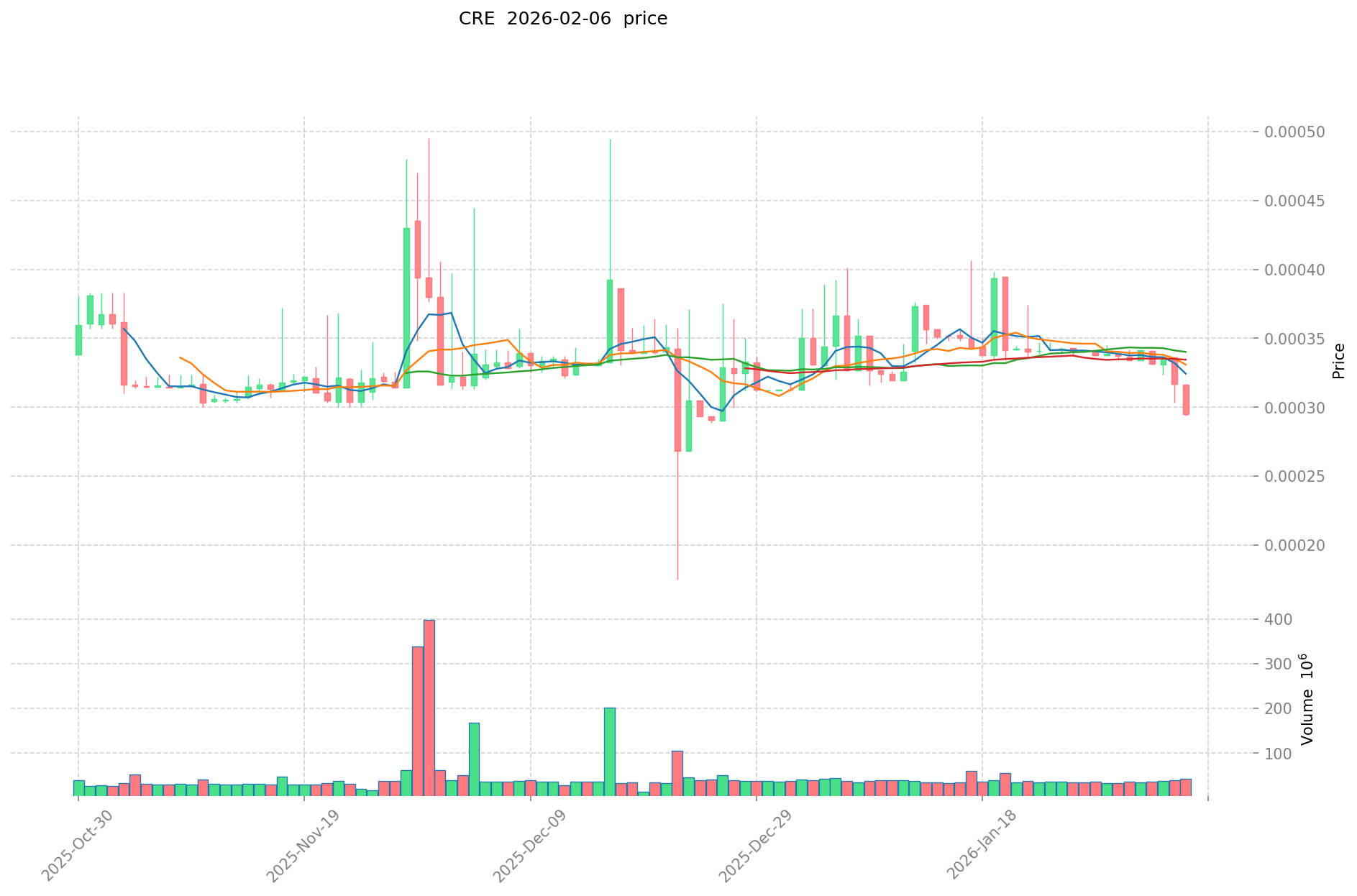
CRE reached a notable price level of $0.49 on October 31, 2024, driven by initial market enthusiasm and trading activity following its launch in late October 2023.
The token experienced its lowest price of $0.0000999 on March 02, 2025, reflecting broader market corrections and volatility in the cryptocurrency sector.
These price movements demonstrate the token's sensitivity to market sentiment, adoption trends, and external market conditions. As of the latest data, CRE is trading at $0.0003285, showing a 24-hour increase of 10.64% and a one-year gain of 77.66%.
Click to view current CRE market price
On-Chain Metrics
- Holder Count: Approximately 6,650 addresses (indicating user distribution and community participation)
- 24-Hour Trading Volume: $19,728.13 (reflecting current market activity levels)
- Market Capitalization: $328,500 (representing the token's current market valuation)
Crepe Project Ecosystem Applications and Partners
Core Use Cases
Crepe Project's ecosystem supports multiple applications:
- Asset Management: The platform enables crypto experts to create professionally curated investment portfolios, providing decentralized portfolio management services.
- Web3.0 Investment: Users can access expert-built crypto portfolios through a Web3.0 interface, promoting democratized access to professional crypto investment strategies.
Strategic Collaborations
Based on available information, Crepe Project operates on Polygon and BSC networks, leveraging these blockchain infrastructures to enhance its technical capabilities.
These partnerships provide a solid foundation for Crepe Project's ecosystem expansion.
Challenges and Discussions
Crepe Project faces several challenges:
- Market Volatility: Price fluctuations with a 24-hour change of 10.64% and 30-day decline of 6.47%
- Competitive Landscape: Operating in the competitive Web3.0 asset management sector
- Adoption Barriers: Building trust and user base in the decentralized portfolio management space
These issues have sparked discussions within the community and market, while driving Crepe Project's continuous innovation.
Crepe Project's community shows growing interest, with approximately 6,650 token holders.
On X platform, related posts and hashtags (such as #CRE or #CrepeProject) engage users interested in Web3.0 asset management.
New feature releases and portfolio performance updates have generated community enthusiasm.
Sentiment on X presents mixed perspectives:
- Supporters praise Crepe Project's democratization of crypto investment expertise and Web3.0 integration, viewing it as an innovative approach to asset management.
- Critics focus on price volatility and market cap considerations.
Recent trends show interest in decentralized portfolio management solutions.
Hot Topics
X users discuss Crepe Project's accessibility for ordinary users, expert-driven portfolio strategies, and Web3.0 implementation,
showcasing both its transformative potential and the challenges in achieving mainstream adoption.
- Official Website: Visit Crepe Project Official Site for features, use cases, and latest updates.
- White Paper: Crepe Project White Paper details its technical architecture, goals, and vision.
- X Updates: On X platform, Crepe Project maintains an active presence through @CREPENEWS,
sharing posts covering platform updates, portfolio strategies, and community activities.
Crepe Project Future Roadmap
- Development Focus: Enhancing the Web3.0 asset management system with improved portfolio creation tools and user experience
- Ecosystem Goals: Expanding the network of expert portfolio creators and attracting more users to the platform
- Long-term Vision: Becoming a leading decentralized asset management platform in the Web3.0 space
How to Participate in Crepe Project?
- Purchase Options: Buy CRE on Gate.com and other supporting exchanges
- Storage Solutions: Securely store CRE using compatible BEP-20 wallets
- Platform Engagement: Explore expert-built portfolios and participate in the Web3.0 asset management ecosystem
- Contract Information: BSC Contract Address: 0xeec027f0d9a1de829f430b5dfafe9f7ca5be9c88
Summary
Crepe Project redefines crypto asset management through Web3.0 technology, providing democratized access to expert investment strategies, transparency, and decentralized portfolio management.
Its innovative approach and clear positioning in the Web3.0 space make it noteworthy in the cryptocurrency sector.
Despite facing market volatility and adoption challenges, Crepe Project's focus on bridging expert knowledge with ordinary users positions it as an interesting participant in decentralized finance's evolution.
Whether you're a newcomer or experienced investor, Crepe Project offers an alternative approach to crypto portfolio management worth exploring.
FAQ
What is CRE cryptocurrency and what is its main purpose?
CRE cryptocurrency bridges real estate and digital assets. It enables seamless transactions and investments in real estate using blockchain technology, tokenizing property assets for global accessibility and liquidity.
How do I buy and store CRE tokens?
Purchase CRE by trading stablecoins like USDT in the spot market. After buying, transfer your tokens to a secure wallet and consider storing them offline for enhanced security and protection.
What is the total supply and current market cap of CRE?
CRE has a total supply of 10 billion tokens, with a circulating supply of approximately 9.8 billion. The current market cap fluctuates based on real-time price movements in the market.
What blockchain does CRE operate on?
CRE operates on the Chainlink blockchain, leveraging Chainlink's decentralized oracle network. It provides interoperability across multiple blockchains as an orchestration layer for onchain finance.
What are the main risks and security considerations for CRE?
CRE faces market volatility, regulatory changes, property damage risks, and environmental hazards. Security priorities include physical safety measures and cybersecurity protection against digital threats and unauthorized access.
How does CRE compare to other similar cryptocurrencies?
CRE offers faster transaction speeds and lower fees than major cryptocurrencies like Bitcoin and Ethereum. While it has a smaller market cap, its efficiency and growing adoption make it competitive in specific use cases within the blockchain ecosystem.
* The information is not intended to be and does not constitute financial advice or any other recommendation of any sort offered or endorsed by Gate.