Decentralized Finance (DeFi): Fundamentals, Benefits, and Drawbacks Explained
What Is Decentralized Finance (DeFi)?
Decentralized Finance (DeFi) is an innovative financial system that enables transactions without the need for intermediaries or central authorities. Built on blockchain technology—specifically, distributed ledgers—DeFi most commonly operates on the Ethereum blockchain.
At the heart of DeFi are smart contracts: self-executing programs that deliver financial services automatically when pre-set conditions are met, requiring no human intervention. This empowers users to maintain complete control over their assets at all times.
Compared to traditional, centralized finance, DeFi offers several distinct advantages. These include advanced transparency—since all transactions are publicly recorded on the blockchain—elimination of geographic restrictions, censorship resistance, user privacy protection, 24/7 accessibility, and composability, which lets users create new financial products by combining multiple services. With these features, DeFi is widely regarded as a foundational technology shaping the future of finance.
Key Features of Decentralized Finance (DeFi)
DeFi possesses three defining features that set it fundamentally apart from traditional financial systems. Together, these features open new possibilities beyond the conventional financial paradigm.
Feature 1: Decentralized—No Central Authority
DeFi’s most basic feature is the lack of central administrators such as banks or financial institutions. In traditional finance, banks or similar entities approve transactions and manage funds. With DeFi, autonomous programs operating on blockchain infrastructure fulfill these roles instead.
This model enables open financial services accessible equally to anyone worldwide. Individuals without bank accounts or those excluded from traditional finance can access DeFi services as long as they have an internet connection.
However, this feature comes with caveats. The absence of central oversight may mean user protections are insufficient. Identifying responsibility when problems occur can be difficult, and regulatory supervision is limited. Users must select services carefully and act with personal responsibility.
Feature 2: Composability
One of DeFi’s most transformative features is composability: the ability to freely combine different DeFi services—like financial building blocks—to create new products and strategies.
For instance, users can borrow crypto from a lending platform, swap it for another asset on a decentralized exchange (DEX), and stake the new asset on a third protocol to earn yield—all in a seamless sequence. Decentralized insurance services can also be layered in for risk management.
This composability enables developers to build advanced and complex financial services efficiently using existing protocols—a concept often called “money Legos.” This has fueled DeFi’s rapid ecosystem growth and innovation. For users, composability means complex strategies are achievable by combining protocols that single services alone could not deliver.
Feature 3: Instant Access with Wallet Connection
Another groundbreaking DeFi feature is that anyone can start using services immediately with just a crypto wallet. A wallet is a software application or hardware device that securely stores and manages crypto assets.
Traditionally, financial services required cumbersome identity verification—ID submission, address checks, credit investigations—that could take days or weeks. In DeFi, users simply connect their wallet to the blockchain network for instant access.
No KYC (Know Your Customer) or screening is required. As a result, individuals without identification or those in regions lacking banking access can use DeFi services equally. Privacy-focused users can also access financial services without disclosing personal information.
However, this anonymity and convenience entail risks of illicit use, such as money laundering, posing challenges for regulators.
Advantages of Decentralized Finance (DeFi)
DeFi provides several clear advantages over traditional financial systems. These benefits contribute substantially to financial democratization and operational efficiency.
Advantage 1: Low Fees
One of DeFi’s most compelling benefits is drastically reduced transaction fees. Traditional finance involves multiple intermediaries—banks, payment processors—each charging fees. For international transfers, multiple correspondent banks may be involved, with cumulative fees reaching several percent or even over 10% of the transfer amount.
DeFi transactions are executed directly on the blockchain, eliminating intermediary fees. Users primarily pay blockchain network fees—known as gas fees—which fluctuate with network congestion but are generally much lower than traditional financial fees.
Competition among DeFi protocols further drives down costs, giving users more economical choices. Low fees particularly benefit those making small or frequent transactions.
Advantage 2: Open and Transparent System
DeFi leverages blockchain’s inherent transparency. All transaction records and smart contract code are published on the blockchain, allowing anyone to freely inspect and verify them.
This transparency lets users track their funds and understand their usage in real time. In traditional finance, processes and fund management are typically opaque, requiring users to trust financial institutions. DeFi, by contrast, is built on verifiability, not trust.
Transparency also deters fraud and manipulation. Since all transactions are public, suspicious activities are quickly detected and flagged by the community. Public smart contract code enables audits by security experts and the community, facilitating early vulnerability detection.
This openness also improves market efficiency. Real-time data on prices and trading volumes empowers participants to make better decisions, supporting fairness across the market.
Advantage 3: Universal, Equitable Access
DeFi’s most revolutionary advantage is universal access to financial services. Traditional financial services require credit history, stable income, and identification, resulting in an estimated 1.7 billion adults worldwide who remain unbanked.
DeFi removes these barriers. With just internet access and a wallet, anyone—regardless of age, location, income, or credit history—can access the same financial services. This is especially transformative in developing countries and regions with limited financial infrastructure.
For example, rural residents without local bank branches can access savings, investments, and loans through DeFi on their smartphones. People in politically or economically unstable countries can use DeFi to move assets into stable cryptocurrencies, safeguarding their wealth from local currency devaluation.
This equal access drives financial democratization and could help reduce economic inequality. Universal access—once an elusive goal in traditional finance—is a core social contribution of DeFi.
Disadvantages of Decentralized Finance (DeFi)
Despite its many benefits, DeFi also carries important risks and drawbacks that users must recognize and address appropriately.
Disadvantage 1: Security Risks
Security remains a serious concern in DeFi. While it operates on blockchains and relies on smart contracts, these technologies are not infallible and can contain vulnerabilities.
Major DeFi projects have been hacked in recent years, with attackers exploiting smart contract bugs, flash loan attacks, and reentrancy vulnerabilities to steal assets worth billions. Once deployed, smart contracts are generally immutable, so vulnerabilities persist until discovered and exploited. The composability of DeFi means a flaw in one protocol can cascade across others.
User-side security is equally vital. Losing a private key or seed phrase—or falling for phishing scams—can result in total asset loss. Insurance and compensation measures common in traditional finance are limited, so most losses are the user’s responsibility.
Disadvantage 2: Regulatory Uncertainty
DeFi’s goal of eliminating centralized control creates significant uncertainty over regulatory compliance. Regulators worldwide have yet to establish clear frameworks for DeFi oversight.
This uncertainty poses challenges for developers and operators, who cannot predict future regulatory requirements, making business and development planning difficult. Sudden regulatory shifts could force projects to shut down or undergo major changes.
Anti-money laundering and counter-terrorism regulations often conflict with DeFi’s anonymity. Authorities may demand KYC and transaction monitoring, contradicting DeFi’s principle of universal access.
Users also face risks: DeFi services could become suddenly regulated, leading to restricted access or frozen funds. Tax treatment of DeFi varies globally, often requiring complex reporting.
This regulatory ambiguity hinders DeFi’s adoption and growth, highlighting the need for constructive dialogue among regulators, industry leaders, and the community.
Disadvantage 3: Operational and Human Errors
DeFi requires users to possess technical literacy and operate services carefully. Unlike traditional finance with staff support, DeFi users manage everything independently.
Interacting with smart contracts means executing code directly. Mistyped addresses, incorrect gas settings, or parameter errors can result in lost funds or failed transactions. Due to blockchain’s irreversible nature, mistakes are often permanent.
DeFi platform interfaces can be daunting for non-technical users, filled with specialized terminology. Lack of understanding can lead to unintended outcomes—such as incurring unexpected losses from impermanent loss or slippage when providing liquidity.
Even when users act correctly, bugs or design flaws in smart contracts can cause unexpected losses. As protocols become more complex, these risks increase.
These hurdles limit mainstream DeFi adoption. Improving user interfaces, offering educational resources, and building error-prevention features are critical for future usability.
Leading Examples of Decentralized Finance (DeFi)
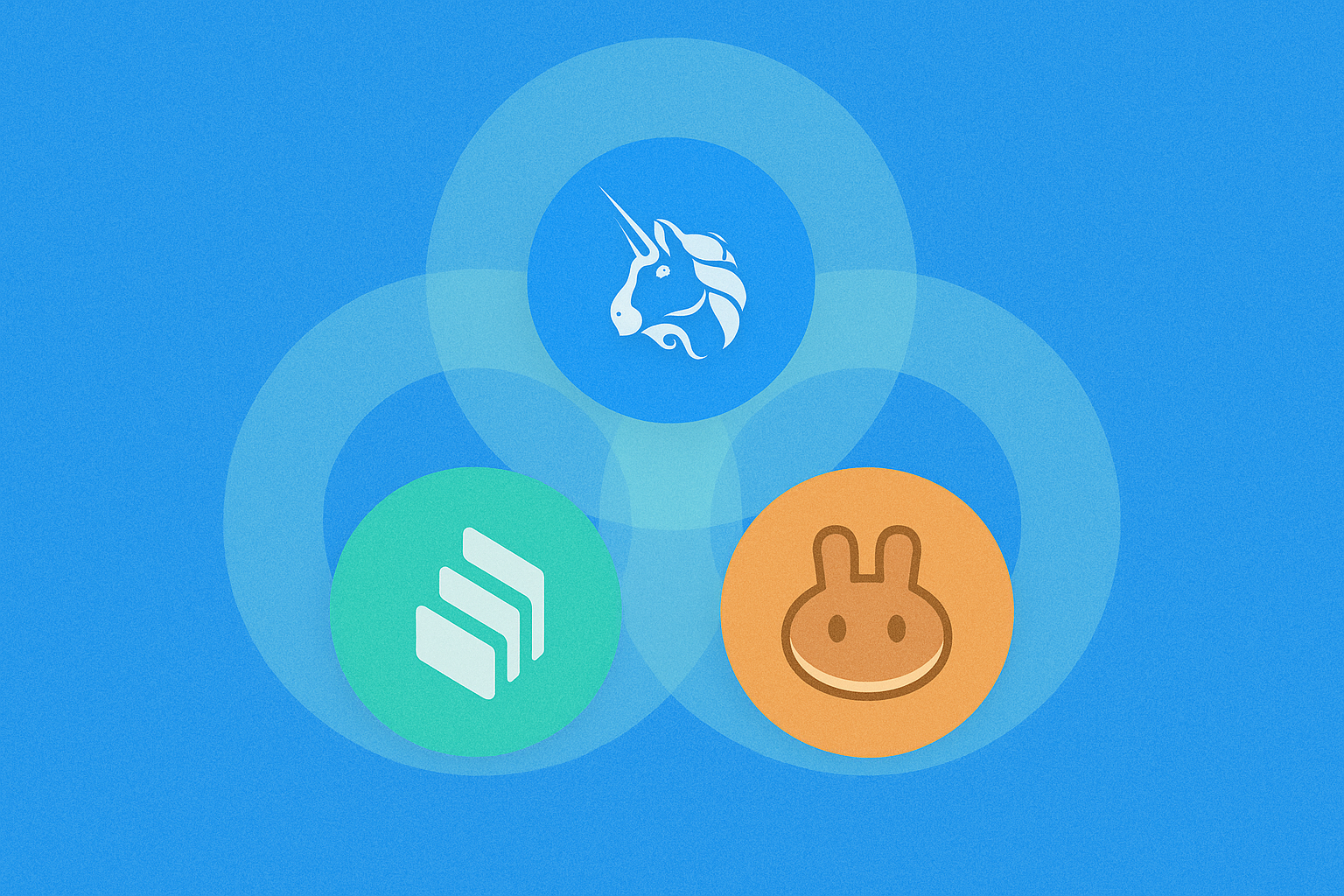
The DeFi ecosystem features a range of protocols with unique strengths. Below are three of the most influential projects.
1: Uniswap
Uniswap is a trailblazing decentralized exchange (DEX) on Ethereum, central to the DeFi revolution. Unlike order book-based exchanges, Uniswap introduced the Automated Market Maker (AMM) model.
AMMs do not match buyers and sellers directly. Instead, users trade against token pairs in liquidity pools. Anyone can swap crypto assets or provide tokens to liquidity pools to earn a share of transaction fees—enabling passive income for liquidity providers.
Uniswap’s pricing uses the constant product formula (x * y = k), ensuring prices adjust automatically in response to supply and demand. This transparent and fair mechanism exemplifies DeFi principles.
Uniswap’s open-source code has spawned many derivatives. Its simplicity and efficiency have established Uniswap as the industry standard for decentralized exchanges.
Native Token: UNI (governance token granting holders voting rights in protocol decisions)
2: Compound
Compound is a decentralized lending protocol on Ethereum and a leader in the DeFi lending sector. It enables crypto asset holders to earn interest on their assets.
Compound’s system is similar to traditional banking, but all operations are automated with smart contracts. Users deposit assets to Compound pools to earn interest, which is paid by other users who borrow those assets.
Borrowers can use deposited assets as collateral to borrow other cryptocurrencies, unlocking liquidity without selling their holdings. For example, a user can keep Ethereum as collateral and borrow stablecoins for other investments.
Compound features algorithmic, dynamic interest rates, automatically adjusting rates based on supply and demand. Rising demand increases rates to attract more supply, while falling demand lowers rates to encourage borrowing.
Compound introduced “cTokens” (e.g., cETH, cDAI), which serve as deposit receipts and can be used across DeFi protocols, improving capital efficiency.
Native Token: COMP (governance token granting holders voting rights on protocol parameters and proposals)
3: PancakeSwap
PancakeSwap is a decentralized exchange (DEX) operating on a major blockchain network, bringing Uniswap’s successful model to a different ecosystem. Compared to Ethereum, this network offers much lower transaction fees and faster processing.
PancakeSwap uses the AMM model like Uniswap, but its lower fees and faster trades have attracted a broad user base—especially those conducting small or frequent transactions.
Users provide tokens to liquidity pools to earn transaction fees. Through “yield farming,” liquidity providers can earn extra rewards in the form of the platform’s native token.
PancakeSwap has built a diverse ecosystem, integrating lotteries, NFT marketplaces, prediction markets, and more. This multifunctionality increases user engagement by offering various activities on a single platform.
It also prioritizes community-driven governance, allowing token holders to steer the platform’s development through proposals and voting. This democratic approach reflects DeFi’s core philosophy.
Native Token: CAKE (a utility token used for governance, staking rewards, fee discounts, and more)
FAQ
What Is Decentralized Finance (DeFi)?
Decentralized Finance (DeFi) is a financial system that removes intermediaries such as banks using blockchain technology. It automates lending, trading, and yield operations, making these services accessible to anyone worldwide.
What Are the Main Benefits of DeFi?
DeFi offers fast, low-cost financial services. It requires no central institutions, ensures high transparency and accessibility, and allows anyone to participate in the financial system.
What Are the Main Risks or Drawbacks of DeFi?
Key risks include high gas fees, vulnerabilities in smart contracts leading to fraud, and the potential for stricter regulation in the future. High market volatility also means users must exercise caution.
How Does DeFi Differ from Traditional Financial Services?
DeFi is powered by smart contracts on the blockchain, eliminating intermediaries. Traditional finance relies on centralized banks, resulting in higher fees and slower processing. DeFi is accessible 24/7, highly transparent, and open to anyone with internet access.
What Financial Services Can I Use with DeFi?
DeFi enables services like lending, borrowing, swaps on decentralized exchanges, staking, yield farming, stablecoins, and insurance. With a wallet and crypto assets, users can directly access these services through blockchain-based smart contracts—without intermediaries.
How Do I Get Started with DeFi?
To start with DeFi, acquire crypto assets and set up a MetaMask wallet. Then connect to a DEX (decentralized exchange) to begin trading. Beginners should first build foundational knowledge before participating.
What Are the Security and Regulatory Challenges for DeFi?
DeFi’s decentralized structure exposes users to smart contract bugs and cyberattacks. Regulatory frameworks are still in development, and compliance challenges remain. While DeFi provides transparency, users should stay alert to the risks of fraud and asset loss.
Share
Content
How to Buy Cryptocurrency


Trending Cryptocurrencies



XZXX: A Comprehensive Guide to the BRC-20 Meme Token in 2025

Survey Note: Detailed Analysis of the Best AI in 2025

Detailed Analysis of the Best 10 GameFi Projects to Play and Earn in 2025

Kaspa’s Journey: From BlockDAG Innovation to Market Buzz

Best Crypto Wallets 2025: How to Choose and Secure Your Digital Assets

Popular GameFi Games in 2025

What is MLP: A Comprehensive Guide to Multilayer Perceptrons and Their Applications in Deep Learning
What is BMON: A Comprehensive Guide to Business Performance Monitoring and Optimization

Best Crypto Leverage Trading Platforms: A Comprehensive Guide
What is TCT: A Comprehensive Guide to Thin-layer Chromatography Testing and Its Clinical Applications
2026 TCT Price Prediction: Expert Analysis and Future Outlook for Tron's Native Token