What is FOR: A Comprehensive Guide to Understanding Its Purpose and Applications

FOR's Position and Significance
In 2019, the team behind The Force Protocol launched FOR (ForTube), aiming to address challenges in decentralized finance accessibility, cross-platform asset circulation inefficiency, and fragmented liquidity across blockchain ecosystems.
As a distributed encrypted digital financial service protocol, FOR plays a key role in decentralized finance (DeFi) and cross-chain infrastructure.
As of 2026, FOR has established itself as a solution provider for decentralized financial applications, with an active development community and partnerships across multiple blockchain ecosystems.
This article will explore its technical architecture, market performance, and future potential.
Origin and Development History
Birth Background
FOR was created by the Force Protocol team in 2019, aiming to solve barriers in decentralized financial service development, lack of interoperability between blockchain platforms, and inefficient cross-chain asset management.
It emerged during the rapid expansion of DeFi and growing demand for cross-chain solutions, with the goal of empowering developers to build decentralized financial applications through standardized SDK and API tools.
FOR's launch brought new possibilities for blockchain developers and DeFi protocols seeking streamlined integration.
Key Milestones
- 2019: FOR token launched, establishing the foundation for the Force Protocol ecosystem.
- 2020: ForTube platform launched, providing lending and borrowing services.
- 2021: Price reached significant levels during the broader DeFi market expansion.
- 2022-2026: Continued ecosystem development with focus on cross-chain solutions and DeFi infrastructure.
With support from the development team and community, FOR continues to refine its technical capabilities, security measures, and real-world applications.
How FOR Works
Decentralized Control
FOR operates within a decentralized network built on mainstream public blockchain systems, removing dependence on centralized financial intermediaries.
The protocol leverages distributed nodes across various blockchain networks to process transactions and maintain system integrity, providing users with greater autonomy while enhancing network resilience.
Blockchain Foundation
FOR's infrastructure is built on established blockchain networks, maintaining transparent and immutable transaction records.
The protocol abstracts and encapsulates distributed financial business processes, enabling developers to integrate DeFi functionalities through SDK and API interfaces.
This architecture supports cross-platform asset circulation, transaction depth sharing, and on-chain payment settlement.
Ensuring Fairness
FOR relies on the underlying consensus mechanisms of its host blockchains to validate transactions and prevent fraudulent activities.
Network participants maintain system security through validation processes inherent to the respective blockchain platforms.
The protocol's innovation lies in providing standardized interfaces that simplify DeFi application development across multiple chains.
Secure Transactions
FOR utilizes the cryptographic security of its underlying blockchain infrastructure:
- Private keys enable users to authorize transactions securely
- Public keys allow verification of ownership and transaction validity
This mechanism ensures fund security while maintaining transaction integrity.
The protocol supports various DeFi operations including lending, borrowing, and cross-chain asset management through its secure framework.
FOR's Market Performance
Circulation Overview
As of February 08, 2026, FOR's circulating supply is 563,718,021.23 tokens, with a total supply of 1,000,000,000 tokens. The circulating supply represents approximately 56.37% of the total supply, indicating a fixed supply model with no additional token inflation.
Price Volatility
FOR reached its all-time high of $0.167203 on April 12, 2021, driven by favorable market conditions during the broader cryptocurrency bull market cycle. Its all-time low of $0.00016742 occurred on January 28, 2026, reflecting broader market corrections and reduced trading activity. These price fluctuations demonstrate the token's sensitivity to market sentiment and adoption trends.
Click to view the current FOR market price
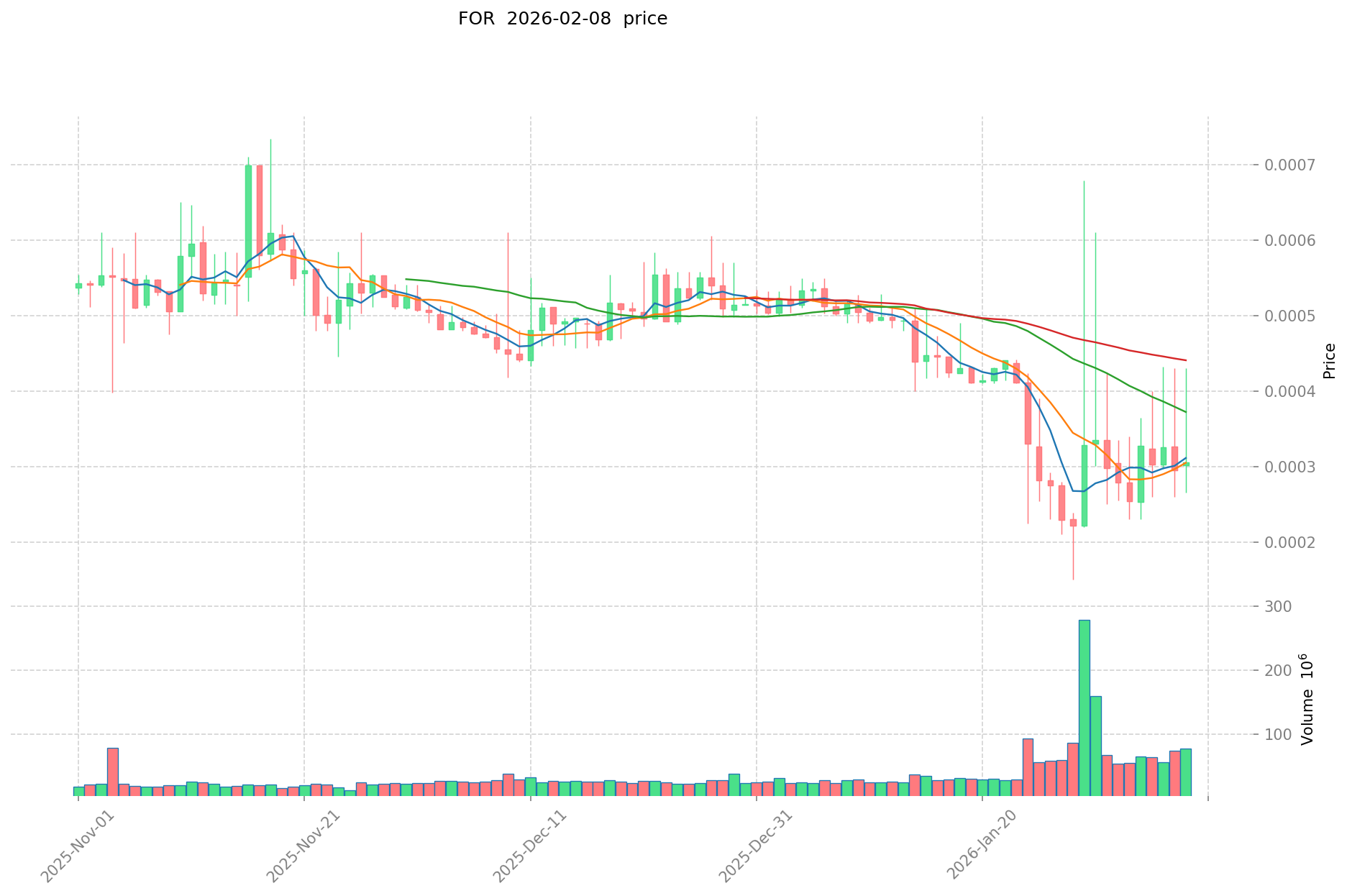
On-Chain Metrics
- Holder Count: 22,696 addresses (indicating community participation level)
- 24-Hour Trading Volume: $15,339.92 (reflecting current market activity)
- Market Capitalization: $177,007.46 (representing the token's current market valuation)
ForTube (FOR) Ecosystem Applications and Partners
Core Use Cases
ForTube's ecosystem supports multiple applications:
- DeFi Services: ForTube provides decentralized lending and borrowing solutions, enabling cross-platform asset circulation and transaction depth sharing.
- Cross-chain Finance: The protocol facilitates stablecoin issuance backed by cross-chain encrypted assets, supporting token bond issuance and on-chain payment solutions.
Strategic Cooperation
ForTube has established its position through distributed encrypted digital financial service protocols, building upon mainstream public chain systems and underlying cross-chain protocols. The protocol empowers decentralized financial application development through SDK and API solutions, providing a foundation for ecosystem expansion.
Challenges and Considerations
ForTube faces certain challenges:
- Market Volatility: Price fluctuations have been significant, with movements ranging from recent increases to longer-term declines
- Market Position: With a relatively modest market cap and trading volume, the project faces competitive dynamics in the DeFi space
- Adoption Scale: The number of holders and exchange listings indicate room for broader market penetration
These factors continue to shape community discussions and drive ongoing development efforts.
ForTube Community and Social Media Presence
Community Engagement
ForTube maintains an active presence with 22,696 holders participating in its ecosystem. The project's circulating supply represents approximately 56.37% of the total supply, indicating distribution across the community.
Social Media Activity
The ForTube community engages through official channels including X platform presence. The project maintains active communication regarding:
- Protocol updates and technical developments
- DeFi ecosystem innovations
- Cross-chain integration progress
Discussion Topics
Community members discuss ForTube's distributed financial services, cross-chain capabilities, and DeFi application development, reflecting both the protocol's innovative approach and considerations about market dynamics in the broader cryptocurrency landscape.
More Information Sources for ForTube
- Official Website: Visit ForTube Official Site for features, use cases, and latest updates.
- Blockchain Explorer: ForTube on Etherscan provides transaction and contract information.
- Social Media: Follow ForTube on X platform at @ForTubeFi for protocol updates, community activities, and partnership announcements.
ForTube Development Vision
- Technical Enhancement: Continue developing distributed financial service protocols with improved cross-chain functionality
- Ecosystem Goals: Expand DeFi application development support and cross-platform integration capabilities
- Long-term Vision: Establish comprehensive solutions for decentralized financial services, including lending, stablecoin issuance, and on-chain payment systems
How to Participate in ForTube?
- Purchase Options: FOR tokens are available on Gate.com and select cryptocurrency platforms
- Storage Solutions: Securely store FOR tokens using compatible wallets that support the protocol's infrastructure
- Ecosystem Engagement: Explore ForTube's DeFi services and cross-chain financial solutions through the official platform
- Development Participation: Access development resources to build applications leveraging ForTube's SDK and API solutions
Summary
ForTube (FOR) represents a distributed encrypted digital financial service protocol that provides solutions for cross-platform asset circulation, decentralized lending, and cross-chain financial operations. Through its SDK and API framework, the protocol enables DeFi application development with features including stablecoin issuance, token bonds, and on-chain payment systems.
With an active community and technical infrastructure built on mainstream public chains, ForTube continues to develop its position in the decentralized finance sector. While facing market dynamics and competitive considerations, the protocol's focus on distributed financial services and cross-chain capabilities positions it within the evolving DeFi landscape.
Whether exploring DeFi opportunities or researching cross-chain financial protocols, ForTube offers a technical framework worth examining for those interested in decentralized financial services.
FAQ
What is cryptocurrency? What are its main uses?
Cryptocurrency is a decentralized digital currency built on blockchain technology. Its main uses include peer-to-peer transactions, investment, decentralized finance services, and cross-border payments without traditional intermediaries.
What are the advantages of cryptocurrencies compared to traditional currencies and payment methods?
Cryptocurrencies offer lower transaction fees, no intermediaries, faster settlement, and global accessibility 24/7. They enable peer-to-peer transactions with greater transparency and financial inclusion for unbanked populations worldwide.
What are the practical applications of cryptocurrencies in real life?
Cryptocurrencies enable cross-border payments, decentralized services like ridesharing, smart contracts for investments, insurance solutions, and transparent charitable giving. They also facilitate micropayments and financial inclusion for unbanked populations globally.
Why do some people believe cryptocurrency is the future financial tool?
Cryptocurrency is viewed as the future of finance because blockchain technology offers decentralization, transparency, and security beyond traditional systems. It enables faster transactions, financial inclusion, and eliminates intermediaries, making it more efficient and accessible globally.
What are the main risks and limitations of cryptocurrency?
Cryptocurrency faces high market volatility, regulatory uncertainty, and security risks. Limitations include low adoption rates, technological barriers, and legal restrictions in some jurisdictions.
How is cryptocurrency used for cross-border transfers and payments?
Cryptocurrency enables fast, low-cost cross-border transfers through blockchain networks. Assets like ALGO and XLM offer near-zero fees for international payments, settling transactions in minutes rather than days, making it an efficient alternative to traditional banking systems.
What role does blockchain technology play in cryptocurrency?
Blockchain technology enables decentralized, secure, and transparent transactions for cryptocurrency. It maintains an immutable distributed ledger, ensuring data integrity and preventing fraud. Cryptocurrency relies on blockchain to guarantee security, verify transactions, and maintain network consensus without central authority.
Share
Content
FOR's Position and Significance
Origin and Development History
How FOR Works
FOR's Market Performance
ForTube (FOR) Ecosystem Applications and Partners
Challenges and Considerations
ForTube Community and Social Media Presence
More Information Sources for ForTube
ForTube Development Vision
How to Participate in ForTube?
Summary
FAQ
How to Buy Cryptocurrency


Trending Cryptocurrencies



XZXX: A Comprehensive Guide to the BRC-20 Meme Token in 2025
Survey Note: Detailed Analysis of the Best AI in 2025

Detailed Analysis of the Best 10 GameFi Projects to Play and Earn in 2025

Kaspa’s Journey: From BlockDAG Innovation to Market Buzz

Best Crypto Wallets 2025: How to Choose and Secure Your Digital Assets
Popular GameFi Games in 2025

Unstoppable Domains: Your Gateway to Owning a Blockchain Domain

Trading Patterns: A Beginner's Guide

What is Brave, the Web3 browser that allows you to watch YouTube without ads?
Top cryptocurrencies with the highest potential: investment opportunities

What is an NFT game?