What is GAI: A Comprehensive Guide to Generative AI and Its Transformative Impact on Modern Technology
GraphAI's Positioning and Significance
In 2025, GraphAI launched GraphAI (GAI), aiming to address the fragmentation of blockchain data and the difficulty of accessing actionable insights from decentralized networks. As the AI-native data layer for Web3, GraphAI plays a critical role in AI-driven blockchain intelligence and decentralized data querying.
As of 2026, GraphAI has positioned itself as a key infrastructure bridging blockchain and AI ecosystems, with integrations across Base, Ethereum, and the Artificial Superintelligence Alliance. This article will provide an in-depth analysis of its technical architecture, market performance, and future potential.
Origin and Development History
Birth Background
GraphAI was created by its development team in 2025, aiming to solve the challenge of transforming raw blockchain events into structured, AI-accessible knowledge graphs. It emerged during the convergence of Web3 infrastructure growth and AI-driven data analysis demand, with the goal of enabling natural language access to on-chain intelligence and empowering applications, agents, and enterprises with contextual blockchain insights. The launch of GraphAI brought new possibilities for developers, enterprises, and AI-powered decentralized applications.
Important Milestones
- January 2025: Token launched, establishing the foundation for its AI-native data infrastructure.
- 2025: Integration with Base, Ethereum, and the Artificial Superintelligence Alliance, expanding ecosystem reach.
- 2025: Launch of GraphEngine, the flagship product enabling subgraph creation, querying, and analysis at scale.
- 2026: Growing adoption with over 7,300 token holders, demonstrating increasing community engagement.
With support from its development team and ecosystem partners, GraphAI continues to optimize its technology, security, and real-world applications.
How GraphAI Works
No Central Control
GraphAI operates on a decentralized infrastructure where data indexing and querying are distributed across nodes, eliminating reliance on centralized entities. These nodes collaborate to process blockchain events and transform them into structured knowledge graphs, ensuring transparency and resilience while granting users greater autonomy.
Blockchain Core
GraphAI's infrastructure leverages blockchain technology to process real-time on-chain data and combine it with off-chain intelligence. The platform transforms raw blockchain events into structured, queryable formats that can be accessed through natural language interfaces. This approach bridges decentralized infrastructure with AI reasoning, enabling contextual insights for applications and enterprises. Its flagship product, GraphEngine, supports subgraph creation and analysis at scale, enhancing data accessibility.
Ensuring Fairness
GraphAI implements a token-based economic model where $GAI tokens facilitate indexing, querying, curation, and staking within the network. Participants maintain network operations through data indexing, query processing, and network governance, earning rewards in GAI tokens. The system is designed to incentivize quality data provision and efficient query processing.
Secure Transactions
GraphAI utilizes cryptographic techniques to secure data access and token transactions:
- Private keys authorize data queries and token transfers
- Public keys verify ownership and access permissions
This mechanism ensures data integrity while transactions maintain transparency within the decentralized network. The platform's integration with established blockchain ecosystems adds additional layers of security verification.
GraphAI (GAI) Market Performance
Circulating Supply Overview
As of February 03, 2026, GraphAI (GAI) has a circulating supply of 70,000,000 tokens, with a total supply of 100,000,000 tokens and a maximum supply capped at 100,000,000 tokens. The circulating supply represents 70% of the total supply, indicating a significant portion of tokens are currently in circulation. The token economics demonstrate a fixed supply model with no inflationary mechanism.
Price Fluctuation
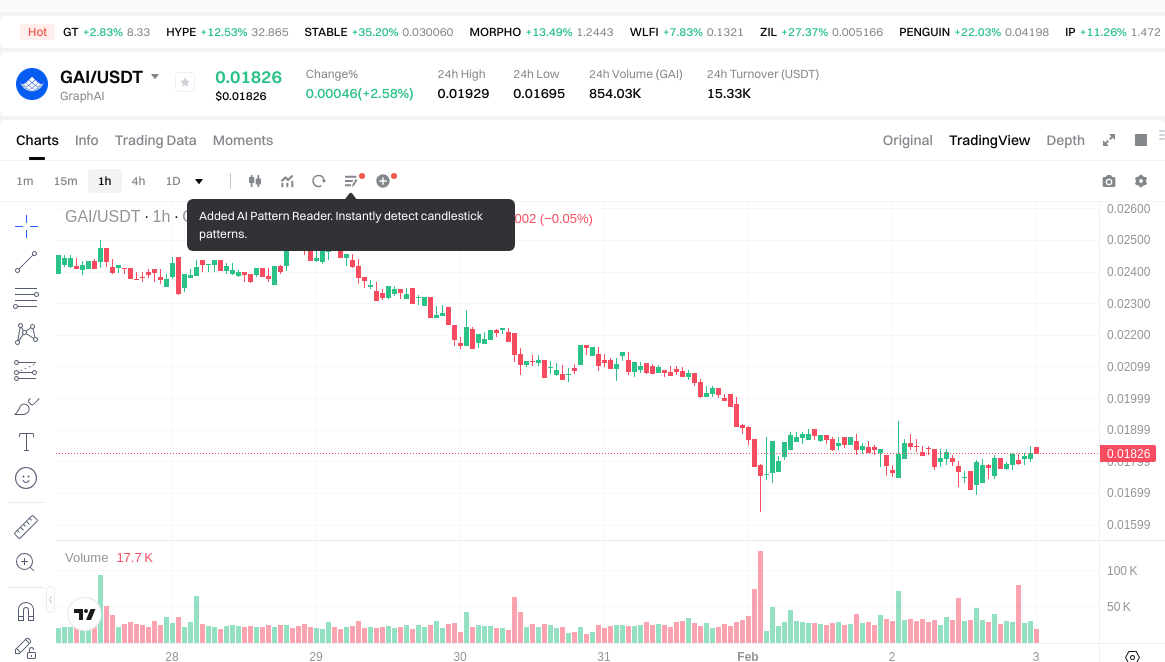
GraphAI (GAI) reached a notable price level of $0.5078 on September 16, 2025, driven by market dynamics during its initial trading period. The token's lowest recorded price was $0.0164 on January 31, 2026, reflecting market volatility and adjustment phases. As of the latest data, GAI is trading at $0.01844, showing a 24-hour change of +2.46% with a trading range between $0.01695 and $0.01929. Over different time periods, the token has experienced a 7-day decline of -24.14% and a 30-day decline of -48.55%, while demonstrating significant growth over a longer timeframe. These fluctuations reflect evolving market sentiment, adoption patterns, and the broader cryptocurrency market conditions.
Click to view the current GAI market price
On-Chain Metrics
- Market Capitalization: $1,290,800 (reflecting current circulating supply valuation)
- Fully Diluted Valuation: $1,844,000 (based on maximum supply)
- 24-Hour Trading Volume: $15,370.42 (indicating trading activity levels)
- Number of Holders: 7,301 addresses (demonstrating community distribution)
- Market Dominance: 0.000066% (representing GAI's position in the overall crypto market)
GraphAI Ecosystem Applications and Partners
Core Use Cases
GraphAI's ecosystem supports multiple applications:
- Data Infrastructure: GraphEngine, providing subgraph creation, querying, and analysis at scale.
- AI Integration: Natural language query interfaces, driving contextual insights accessible through conversational AI.
Strategic Partnerships
GraphAI has established partnerships with Base, Ethereum, and the Artificial Superintelligence Alliance, enhancing its technical capabilities and market influence. These partnerships provide a solid foundation for GraphAI's ecosystem expansion.
Controversies and Challenges
GraphAI faces the following challenges:
- Technical Challenges: Scaling data indexing infrastructure to meet growing demand
- Competitive Pressure: Competition from established blockchain data platforms and emerging AI-native solutions
These issues have sparked discussions within the community and market, while also driving GraphAI's continuous innovation.
GraphAI Community and Social Media Atmosphere
Community Engagement
GraphAI's community demonstrates growing activity, with 7,301 token holders.
On X platform, related posts and hashtags (such as #GraphAI) generate engagement within the Web3 and AI communities.
New product launches and ecosystem integrations have energized community enthusiasm.
Social Media Sentiment
Sentiment on X presents diverse perspectives:
- Supporters praise GraphAI's AI-native data layer architecture and cross-chain integration capabilities, viewing it as "the connective tissue between blockchain and AI".
- Observers focus on market volatility and long-term adoption challenges.
Recent trends show growing interest in AI and blockchain convergence applications.
Trending Topics
X users actively discuss GraphAI's data indexing technology, AI agent integration, and ecosystem development, showcasing both its transformative potential and the path toward mainstream adoption.
GraphAI Additional Information Sources
- Official Website: Visit GraphAI Official Website for features, use cases, and latest updates.
- Documentation: GraphAI Documentation details its technical architecture, objectives, and vision.
- X Presence: On X platform, GraphAI actively engages using @GraphAIOfficial, with posts covering technical updates, community activities, and partnership announcements, generating engagement from the Web3 and AI developer communities.
GraphAI Future Roadmap
- Ecosystem Goals: Expand subgraph coverage and enhance AI reasoning capabilities
- Long-term Vision: Become the standard data infrastructure layer for AI-powered Web3 applications
How to Participate in GraphAI?
- Purchase Options: Acquire GAI on Gate.com
- Storage Solutions: Use compatible Web3 wallets to securely store GAI tokens
- Ecosystem Contribution: Visit GraphAI Documentation to explore integration opportunities
Summary
GraphAI is redefining blockchain data infrastructure through its AI-native approach, offering structured knowledge graphs, natural language querying, and contextual insights. Its growing community, technical resources, and market presence position it distinctively in the crypto space. Despite facing scaling and adoption challenges, GraphAI's innovative vision and clear development direction establish its relevance in the future of decentralized intelligence networks. Whether you are a newcomer or experienced participant, GraphAI merits attention and engagement.
FAQ
What is Crypto GAI? What are its core functions and features?
Crypto GAI is a token within the Gate Alpha points system designed to reward Web3 participation. Its core functions include incentivizing user engagement, enabling participation rewards, and distributing tokens through a points-based mechanism for platform interactions and contributions.
What is the purpose of GAI token and what can it be used for?
GAI token is used to exchange computing time, democratize access to AI technology, and reward token holders who verify computational tasks on the network.
How to buy and hold Crypto GAI? On which exchanges can it be traded?
You can purchase Crypto GAI by registering an account, completing identity verification, and depositing funds via bank transfer or payment methods. GAI is available for trading on major cryptocurrency exchanges where you can securely hold your tokens in your wallet.
What is the difference between Crypto GAI and other AI-related crypto projects?
Crypto GAI integrates generative AI with blockchain technology, focusing on creating decentralized AI solutions. Unlike other AI crypto projects, GAI emphasizes practical blockchain applications, superior scalability, and transparent on-chain governance, delivering unique value in the crypto ecosystem.
What are the risks of investing in Crypto GAI? What should I pay attention to?
Crypto GAI investment carries market volatility, regulatory, and technology risks. Monitor market performance closely, stay informed on project developments, and only invest what you can afford to lose.
What is the team background and development roadmap of the Crypto GAI project?
Crypto GAI's team comprises leading blockchain and AI experts focused on developing AI-native Web3 data layers. The roadmap emphasizes decentralized data processing, knowledge graph construction, and ecosystem intelligence enhancement to advance blockchain technology adoption.
Share
Content
GraphAI's Positioning and Significance
Origin and Development History
How GraphAI Works
GraphAI (GAI) Market Performance
GraphAI Ecosystem Applications and Partners
Controversies and Challenges
GraphAI Community and Social Media Atmosphere
GraphAI Additional Information Sources
GraphAI Future Roadmap
How to Participate in GraphAI?
Summary
FAQ
How to Buy Cryptocurrency


Trending Cryptocurrencies



Survey Note: Detailed Analysis of the Best AI in 2025

What Is the Best AI Crypto in 2025?

What is the Best AI Now?

Why ChatGPT is Likely the Best AI Now?

How Does Solidus Ai Tech's Market Cap Compare to Other AI Cryptocurrencies?
MomoAI: AI-Powered Social Gaming Revolution on Solana
Top 4 Most Profitable Cryptocurrencies for Mining
FLT vs BTC: Which Digital Asset Offers Better Long-Term Investment Potential in 2024?
GTAI vs FLOW: Which AI-Powered Platform Delivers Superior Performance and User Experience?

SBR vs MANA: A Comprehensive Comparison of Two Leading Decentralized Metaverse Tokens

Free Cryptocurrency Registration Bonuses Without Deposit