OpenOcean (OOE) is a comprehensive blockchain-based aggregation platform launched in 2021 to solve fragmented liquidity across decentralized and centralized exchanges. This guide explores how OpenOcean optimizes crypto trading through intelligent routing algorithms that minimize slippage and provide optimal execution prices. Discover the platform's decentralized architecture, security mechanisms powered by public-private key cryptography, and multi-chain deployment across major blockchains. Learn about OOE's market performance, utility token functions including governance and liquidity mining rewards, and its active ecosystem with over 8,000 token holders. The article covers practical applications in DeFi trading, strategic partnerships, participation methods on Gate, and OpenOcean's roadmap for becoming a leading aggregation platform. Whether you're a trader seeking efficient execution or a developer exploring integration opportunities, this comprehensive guide demonstrates why OpenOcean represents a valuabl
OpenOcean's Positioning and Significance
In 2021, the OpenOcean team launched OpenOcean (OOE), aiming to address fragmented liquidity across decentralized and centralized exchanges, leading to suboptimal trading prices and high slippage.
As a comprehensive aggregation platform for crypto trading, OpenOcean plays a key role in DeFi trading and liquidity optimization.
As of 2026, OpenOcean has established itself as a multi-chain aggregator serving traders across various blockchains, with over 8,000 token holders and an active developer community.
This article will provide an in-depth analysis of its technical architecture, market performance, and future potential.
Origin and Development History
Background
OpenOcean was created by the OpenOcean team in 2021, aiming to solve the problem of fragmented liquidity and inefficient price discovery across multiple exchanges.
It emerged during the rapid expansion of DeFi protocols and trading platforms, with the goal of providing traders with optimal execution prices through intelligent routing algorithms.
The launch of OpenOcean brought new possibilities for DeFi traders and liquidity seekers.
Key Milestones
- 2021: Platform launch on July 13, 2021, with an initial price of $0.335, implementing smart routing across multiple DEXs and CEXs.
- 2021: On September 3, 2021, OOE reached its peak price of $1.034, marking significant market recognition.
- 2026: As of February 4, 2026, the circulating supply reached approximately 504.5 million tokens, representing about 50.45% of the total supply.
With support from the community and development team, OpenOcean continues to optimize its technology, security, and real-world applications.
How OpenOcean Works
No Central Control
OpenOcean operates as a decentralized aggregation protocol that connects to various exchanges without central authority control.
The platform aggregates liquidity sources across the ecosystem, ensuring transparent price discovery and enabling users to maintain control over their trading decisions while improving market efficiency.
Blockchain Foundation
OpenOcean is deployed on BSC (BNance Smart Chain), utilizing blockchain's transparent and immutable ledger to record trading activities.
Transactions are grouped into blocks and linked through cryptographic hashes to form a secure chain.
Anyone can verify the protocol's operations, establishing trust without intermediaries.
The platform's smart routing algorithm optimizes trade execution across multiple liquidity sources.
Ensuring Fairness
OpenOcean leverages the underlying blockchain's consensus mechanism to validate transactions and prevent fraudulent activities.
Network participants maintain security through standard blockchain validation processes.
Its innovation includes intelligent routing algorithms that optimize trading paths and minimize slippage across aggregated exchanges.
Secure Transactions
OpenOcean uses public-private key cryptography to protect transactions:
- Private keys (similar to secret passwords) are used to authorize trades
- Public keys (similar to account numbers) are used to verify ownership
This mechanism ensures fund security while maintaining transaction pseudonymity.
The OOE token serves multiple purposes including protocol governance, gas fee subsidies, liquidity mining rewards, CEX VIP membership benefits, derivative margin, and collateral for lending.
Circulation Overview
As of February 04, 2026, the circulating supply of OpenOcean (OOE) is 504,525,932 tokens, with a total supply of 1,000,000,000 tokens and a maximum supply capped at 1,000,000,000 tokens, indicating a fixed supply model.
The circulating supply represents approximately 50.45% of the total supply. The token distribution and issuance mechanism influence the supply-demand dynamics within the market.
Price Volatility
OpenOcean (OOE) reached a notable price level of $1.034 on September 03, 2021, during a period characterized by significant market activity in the decentralized exchange aggregator sector.
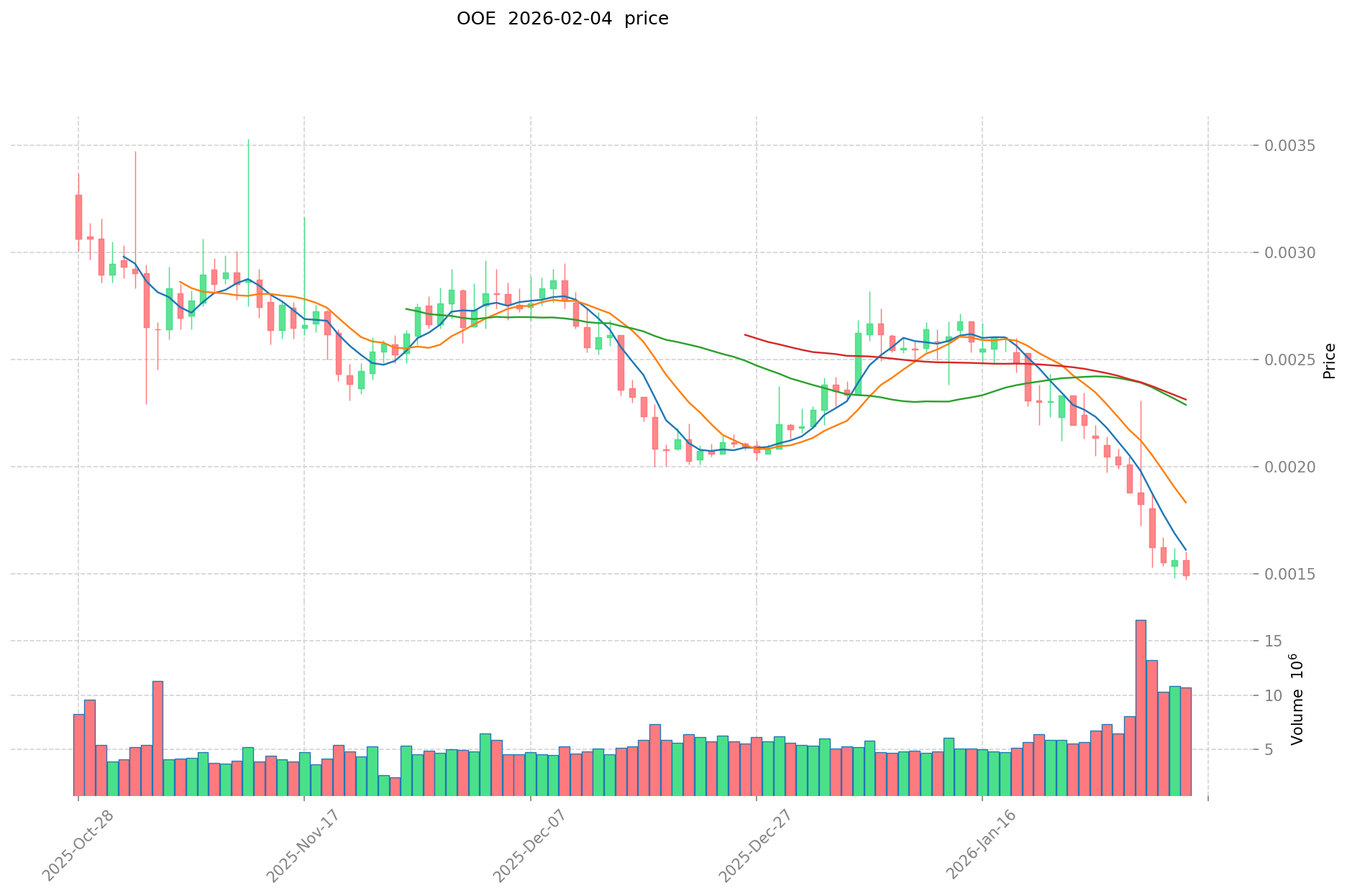
The lowest recorded price was $0.00146913, observed on February 04, 2026, reflecting periods of market fluctuation and changing sentiment toward DEX aggregation platforms.
Recent price movements show varied performance across different timeframes: a 0.13% increase over 1 hour, a -1.79% change over 24 hours, a -26.38% decline over 7 days, a -34.96% decrease over 30 days, and a -76.89% decline over the past year. The 24-hour trading range spans from $0.001473 to $0.001603, with the current price at $0.001535.
These fluctuations reflect market sentiment, adoption trends, and various external factors affecting the cryptocurrency ecosystem.
Click to view the current OOE market price
On-Chain Metrics
- Holder Count: 8,093 addresses (indicating the level of token distribution among users)
- 24-Hour Trading Volume: $17,952.55 (reflecting current market activity)
- Market Capitalization: $774,447.31 (representing the total market value of circulating tokens)
- Fully Diluted Valuation: $1,535,000 (indicating potential market cap if all tokens were in circulation)
OpenOcean Ecosystem Applications and Partners
Core Use Cases
OpenOcean's ecosystem supports multiple applications:
- DeFi Aggregation: OpenOcean provides decentralized and centralized exchange aggregation, enabling traders to find optimal prices and minimal slippage through intelligent routing algorithms.
- Trading Optimization: The platform offers comprehensive liquidity aggregation services, integrating multiple exchanges to enhance trading efficiency.
Strategic Partnerships
OpenOcean has established collaborations to enhance its technical capabilities and market influence.
These partnerships provide a solid foundation for OpenOcean's ecosystem expansion.
Challenges and Controversies
OpenOcean faces the following challenges:
- Market Competition: Competition from other aggregation platforms and decentralized exchanges
- Technical Optimization: Continuous improvement of routing algorithms and liquidity sources
- Market Volatility: Price fluctuations influenced by overall crypto market conditions
These issues have sparked discussions within the community and market, while driving OpenOcean's continuous innovation.
OpenOcean's community demonstrates active participation, with over 8,000 token holders.
On X platform, related posts and hashtags (such as #OpenOcean) generate regular engagement.
Product updates and feature releases continue to energize community interest.
Sentiment on X shows diverse perspectives:
- Supporters praise OpenOcean's aggregation capabilities and optimized trading experience, viewing it as a valuable tool for efficient crypto trading.
- Critics focus on price volatility and market conditions.
Recent trends reflect market dynamics and broader crypto sentiment.
Popular Topics
X users discuss OpenOcean's aggregation technology, liquidity optimization, and token utility,
showcasing both its innovation potential and considerations for mainstream adoption.
- Official Website: Visit OpenOcean Official Site for features, use cases, and latest updates.
- Application Platform: Access OpenOcean App for trading services.
- X Updates: On X platform, OpenOcean actively engages users with @OpenOceanGlobal,
sharing content about technical updates, community activities, and partnership news.
OpenOcean Future Roadmap
- Ecosystem Development: Expansion of supported chains and liquidity sources
- Technical Enhancement: Continuous optimization of routing algorithms and user experience
- Long-term Vision: Becoming a leading aggregation platform for crypto trading
How to Participate in OpenOcean?
- Purchase Channels: Buy OOE on Gate.com and other supported exchanges
- Storage Solutions: Store OOE securely using compatible wallets such as MetaMask
- Participate in Governance: Engage in community decisions through OOE token-based governance mechanisms
- Ecosystem Building: Explore development opportunities and integration possibilities with OpenOcean's platform
Summary
OpenOcean redefines crypto trading through blockchain-based aggregation technology, providing transparency, optimized pricing, and efficient execution.
Its active community, comprehensive resources, and market presence position it distinctively in the cryptocurrency space.
Despite facing market competition and volatility challenges, OpenOcean's innovative approach and development roadmap establish its relevance in decentralized trading technology.
Whether you are a newcomer or experienced trader, OpenOcean offers valuable services worth exploring and utilizing.
FAQ
What does OOE stand for in the cryptocurrency context?
OOE stands for OpenOcean, a decentralized finance protocol that serves as a comprehensive aggregator for cryptocurrency trading, enabling users to access multiple liquidity sources and optimize their trading efficiency.
How does crypto OOE work and what is its main purpose?
OOE is a governance and utility token designed to incentivize holders and enable decentralized governance within the OpenOcean ecosystem. Token holders can participate in protocol decisions and receive rewards for participation.
What are the practical use cases and applications of OOE in blockchain?
OOE enhances transaction processing efficiency by executing transactions non-sequentially, optimizing resource utilization. Key applications include accelerating high-throughput smart contract execution, improving transaction settlement speed, and enabling parallel processing for decentralized applications and DeFi protocols.
What are the potential risks and security considerations associated with OOE?
OOE faces risks including smart contract vulnerabilities, wallet security threats, and regulatory uncertainties. Users should employ secure wallets, verify smart contract audits, and stay informed on compliance changes to protect assets effectively.
How does OOE compare to other similar cryptocurrency technologies or protocols?
OOE is a public, permissionless blockchain focusing on scalability and efficiency. Compared to Ethereum and Binance Smart Chain, OOE offers faster transaction speed and lower fees while using similar cryptographic techniques with higher throughput capabilities.
* The information is not intended to be and does not constitute financial advice or any other recommendation of any sort offered or endorsed by Gate.