What is SHM: A Comprehensive Guide to Simple Harmonic Motion and Its Real-World Applications

Shardeum's Positioning and Significance
In 2025, the Shardeum team launched Shardeum (SHM), aiming to address the blockchain scalability trilemma while maintaining true decentralization. As the world's first auto-scaling Layer 1 blockchain, Shardeum plays a critical role in decentralized applications and smart contract execution.
As of 2026, Shardeum has established itself as an emerging blockchain platform with an active development community and growing ecosystem. This article will provide an in-depth analysis of its technical architecture, market performance, and future potential.
Origin and Development History
Background
Shardeum was created by its founding team in 2025, designed to solve blockchain scalability challenges without sacrificing decentralization or security. It emerged during the ongoing evolution of blockchain technology, with the goal of enabling low gas fees and high throughput regardless of network size to transform the current landscape. Shardeum's launch brought new possibilities for developers and users seeking scalable blockchain solutions.
Major Milestones
- 2025: Mainnet launch, achieving dynamic state sharding and transaction-level consensus.
- January 2026: Token price reached approximately 0.0000961, establishing a support level.
- May 2025: Price peaked at 0.65, demonstrating early market interest.
- February 2026: Listed on multiple exchanges including Gate.com, expanding accessibility.
With support from its community and foundation, Shardeum continues to optimize its technology, security, and real-world applications.
How Shardeum Works
Decentralized Control
Shardeum operates on a globally distributed network of decentralized computers (nodes), eliminating control by banks or governments. These nodes collaborate to validate transactions, ensuring system transparency and attack resistance, granting users greater autonomy and enhancing network resilience.
Blockchain Foundation
Shardeum's blockchain is a public, immutable digital ledger recording every transaction. Transactions are grouped into blocks and linked through cryptographic hashing to form a secure chain. Anyone can view the records, establishing trust without intermediaries. Dynamic state sharding technology further enhances performance by allowing the network to scale as more nodes join.
Ensuring Fairness
Shardeum employs transaction-level consensus to validate transactions and prevent fraud such as double-spending. Validators maintain network security by running nodes with reduced computational requirements, earning SHM rewards. Its innovation includes enabling anyone to operate a node while maintaining decentralization and keeping gas fees consistently low.
Secure Transactions
Shardeum uses public-private key cryptography to protect transactions:
- Private keys (like secret passwords) are used to sign transactions
- Public keys (like account numbers) are used to verify ownership
This mechanism ensures fund security while maintaining pseudonymous transactions. The network's architecture provides additional security through its distributed consensus model and sharding mechanism.
Shardeum's Market Performance
Circulation Overview
As of February 05, 2026, Shardeum's circulating supply stands at 6,348,549,754 SHM tokens, with a total supply of 59,760,000,000 tokens, representing a circulation ratio of approximately 10.62%. The maximum supply is capped at 59,760,000,000 tokens, establishing a fixed supply model. New tokens enter the market according to the project's predetermined distribution schedule, influencing the supply-demand dynamics of the ecosystem.
Price Volatility
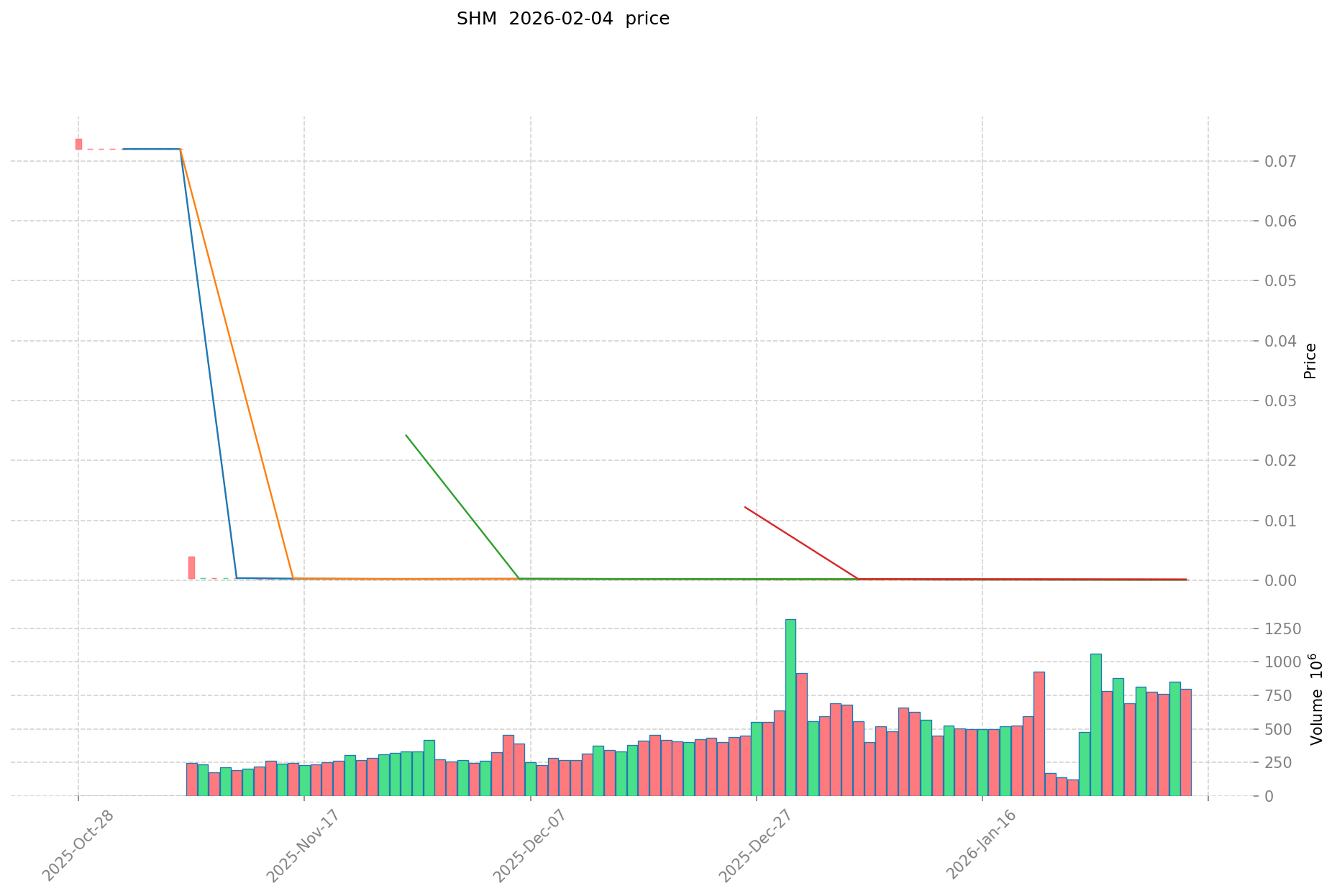
Shardeum reached its peak price of $0.65 on May 08, 2025, driven by market dynamics during the period following its initial listing. The token experienced its lowest recorded price of $0.0000961 on January 31, 2026, reflecting broader market corrections and adjustments in the cryptocurrency sector. These price fluctuations demonstrate the token's sensitivity to market sentiment, adoption trends, and external factors affecting the broader blockchain ecosystem. Currently trading at $0.0000992, the token has shown a 0.01% increase over the past 24 hours, with a 0.06% gain in the last hour, while experiencing a -6.09% decline over the past 7 days and a -36.82% decrease over the past 30 days.
Click to view current SHM market price
On-Chain Metrics
- 24-Hour Trading Volume: Approximately $86,673.96 (indicating network activity levels)
- Market Capitalization: $629,776.14 in circulating market cap, with a fully diluted valuation of $5,928,192
- Market Dominance: 0.00022% of the total cryptocurrency market
Shardeum Ecosystem Applications and Partners
Core Use Cases
Shardeum's ecosystem supports multiple application scenarios:
- DeFi: The platform enables decentralized financial services with its low gas fees and high transaction throughput, supporting efficient decentralized exchanges and lending protocols.
- Smart Contracts: Shardeum's EVM compatibility allows developers to deploy various decentralized applications, facilitating innovation in areas such as automated trading and yield farming.
Strategic Collaborations
As Shardeum continues to develop its ecosystem, strategic partnerships play a vital role in expanding its technical capabilities and market reach. These collaborations provide a solid foundation for Shardeum's ecosystem expansion.
Controversies and Challenges
Shardeum faces the following challenges:
- Technical Hurdles: As a relatively new layer-1 blockchain, maintaining network stability while scaling and implementing dynamic state sharding presents ongoing technical complexity.
- Competition Pressure: The blockchain space is highly competitive, with established platforms like Ethereum and emerging solutions like Solana offering alternative scaling approaches.
- Market Adoption: Building developer and user adoption for a new blockchain requires significant ecosystem development and community engagement.
These issues have sparked discussions within the community and market, driving Shardeum's continuous innovation.
Shardeum Community and Social Media Atmosphere
Community Engagement
Shardeum's community demonstrates growing interest, with the project maintaining active communication channels on social platforms.
On X platform, related posts and hashtags (such as #Shardeum) appear regularly, engaging with discussions about blockchain scalability and decentralization.
Factors such as mainnet development updates and node participation opportunities have energized the community.
Social Media Sentiment
Sentiment on X shows diverse perspectives:
- Supporters praise Shardeum's innovative approach to dynamic state sharding and its commitment to maintaining low transaction fees while increasing throughput, viewing it as a promising solution to blockchain scalability challenges.
- Critics focus on concerns about the project's early stage development, market cap volatility, and the challenges of building a competitive ecosystem in a crowded blockchain landscape.
Recent trends reflect cautious optimism as the project progresses through its development phases.
Popular Topics
X users actively discuss Shardeum's approach to achieving scalability through auto-scaling technology, node accessibility for decentralization, and its position in the competitive layer-1 blockchain market, showcasing both its transformative potential and the obstacles it faces in achieving mainstream adoption.
More Information Sources on Shardeum
- Official Website: Visit Shardeum Official Website for features, use cases, and latest developments.
- Whitepaper: Shardeum Whitepaper details its technical architecture, objectives, and vision for auto-scaling blockchain technology.
- X Platform: On X platform, Shardeum maintains an active presence through @shardeum, sharing content about technical upgrades, community activities, and ecosystem developments.
Shardeum Future Roadmap
- Ongoing Development: Continued implementation of dynamic state sharding technology to enhance transaction throughput and maintain decentralization
- Ecosystem Goals: Expanding developer tools and resources to support a growing number of decentralized applications on the platform
- Long-term Vision: Establishing itself as a scalable infrastructure for decentralized applications while maintaining low transaction costs and high accessibility
How to Participate in Shardeum?
- Purchase Channels: Buy SHM on Gate.com and other supporting exchanges
- Storage Solutions: Securely store tokens using compatible EVM wallets
- Community Participation: Engage with the Shardeum community through official channels and stay updated on node participation opportunities
- Ecosystem Building: Visit developer documentation to explore building decentralized applications on Shardeum's platform
Summary
Shardeum reimagines blockchain scalability through its innovative auto-scaling layer-1 architecture, offering benefits such as low gas fees, high transaction throughput, and genuine decentralization. Its growing community, technical resources, and unique approach to dynamic state sharding position it distinctively in the cryptocurrency space. Despite facing challenges such as market competition and the complexity of early-stage blockchain development, Shardeum's innovative approach to scalability and clear development direction give it a noteworthy position in the future of decentralized technology. Whether you are a newcomer or an experienced participant, Shardeum presents an interesting project to follow and engage with.
FAQ
What is SHM crypto and what is its main purpose?
SHM is a cryptocurrency on the Shardeum blockchain, designed to enhance scalability and decentralization through dynamic state sharding. Its main purpose is to provide a scalable and decentralized Layer 1 blockchain solution.
How can I buy or acquire SHM tokens?
Transfer funds to your trading account and trade on the SHM/USDT pair on a reliable exchange platform to acquire SHM tokens.
What are the risks and security considerations when dealing with SHM crypto?
SHM carries market volatility risks, potential price manipulation, and regulatory uncertainties. Technical security concerns include network vulnerabilities and smart contract risks. Always use secure wallets and enable multi-factor authentication for account protection.
How does SHM compare to other similar cryptocurrencies or projects?
SHM differentiates itself through unique tokenomics and community-driven development. While Bitcoin dominates as digital gold and Ethereum leads in smart contracts, SHM offers specialized use cases with faster transaction speeds and lower fees, positioning itself as a competitive alternative in its niche market segment.
What is the current market performance and future outlook for SHM?
SHM demonstrates strong market momentum with consistent growth driven by increased adoption across DeFi and institutional sectors. Future outlook remains bullish, with expanding use cases and ecosystem development expected to drive sustained value appreciation through 2026-2027.
Share
Content
Shardeum's Positioning and Significance
Origin and Development History
How Shardeum Works
Shardeum's Market Performance
Shardeum Ecosystem Applications and Partners
Controversies and Challenges
Shardeum Community and Social Media Atmosphere
More Information Sources on Shardeum
Shardeum Future Roadmap
How to Participate in Shardeum?
Summary
FAQ
How to Buy Cryptocurrency


Trending Cryptocurrencies



Top Layer 2 projects worth following in 2025: From Arbitrum to zkSync

Pepe Unchained: Pepe Meme Coin evolves into a Layer-2 ecosystem

2025 Layer-2 Solution: Ethereum Scalability and Web3 Performance Optimization Guide

What is Layer 2 in crypto assets? Understand the scaling solution for Ethereum

How Layer 2 Changes the Crypto Assets Experience: Speed, Cost, and Mass Adoption
Pepe Unchained (PEPU): Building the New Era of Meme Coins on Layer 2
Top 5 Tokens to Consider for DeFi Investment
Tax Planning for Bitcoin Investors Who Have Achieved Millionaire Status

FUD and FOMO in Crypto: Key Concepts Explained with Practical Examples
OpenSea NFT Exchange: Reviews, Advantages and Disadvantages

Top 10 Metaverse Platforms: An In-Depth Overview