This comprehensive analysis compares ZERC and BAT as emerging investment opportunities in the digital economy. ZERC, a 2024-launched GameFi infrastructure token built on zk-rollup technology, contrasts sharply with BAT, an established 2017-originated digital advertising token. The article examines historical price trends, tokenomics, institutional adoption, and technical ecosystems, revealing BAT's superior market capitalization ($184.3M vs $1.1M) and liquidity. Detailed price forecasts span 2026-2031, with conservative and optimistic scenarios for both assets. Investment allocation strategies are tailored for conservative, aggressive, and beginner investors, while risk assessments address liquidity, technical, and regulatory challenges. The analysis concludes that BAT suits established market exposure, while ZERC appeals to emerging sector investors, providing actionable insights for informed decision-making across investor profiles and risk tolerances.
Introduction: Investment Comparison Between ZERC and BAT
In the cryptocurrency market, the comparison between ZERC vs BAT has consistently been a topic investors cannot overlook. The two differ notably in market cap ranking, application scenarios, and price performance, representing distinct positioning within the crypto asset landscape.
ZERC (zkRace): Launched in 2024, it has gained market recognition through its dual positioning as both a leading Web3 horse racing game and the world's first zk-rollup-based infrastructure tailored for GameFi.
BAT (Basic Attention Token): Since its inception in 2017, it has been positioned as a digital asset focused on decentralized digital advertising, addressing ad display and user incentive challenges within browsers through the Brave ecosystem.
This article will comprehensively analyze the investment value comparison of ZERC vs BAT, focusing on historical price trends, supply mechanisms, technical ecosystems, and future outlook, while attempting to answer the question investors care about most:
"Which is the better buy right now?"
I. Historical Price Comparison and Current Market Status
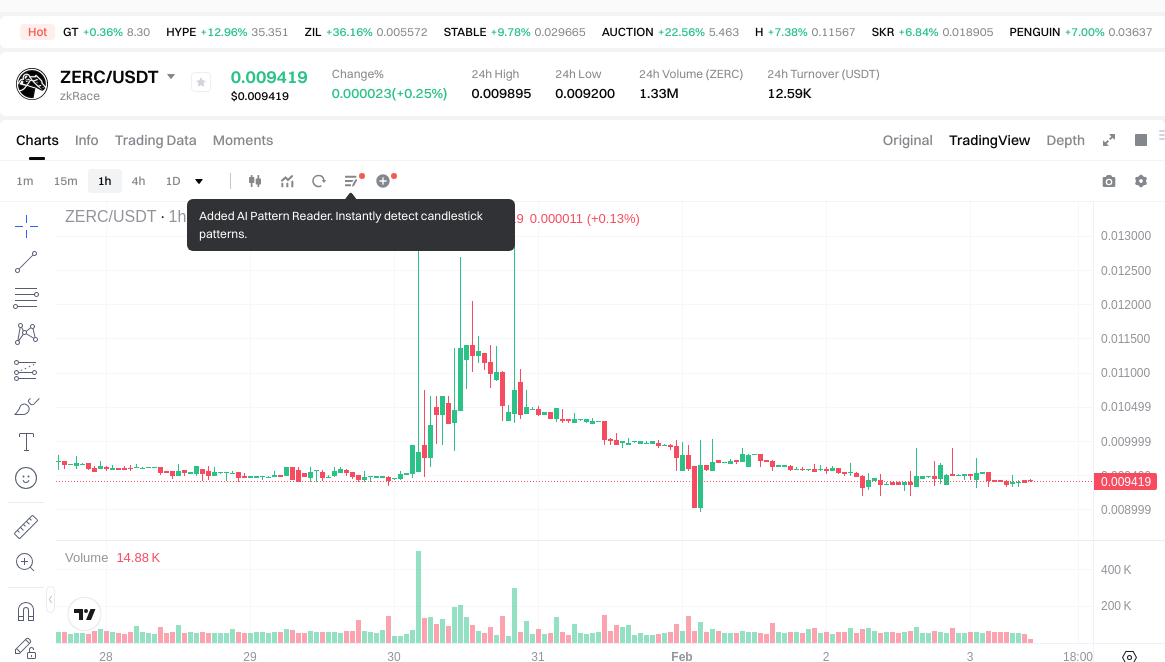
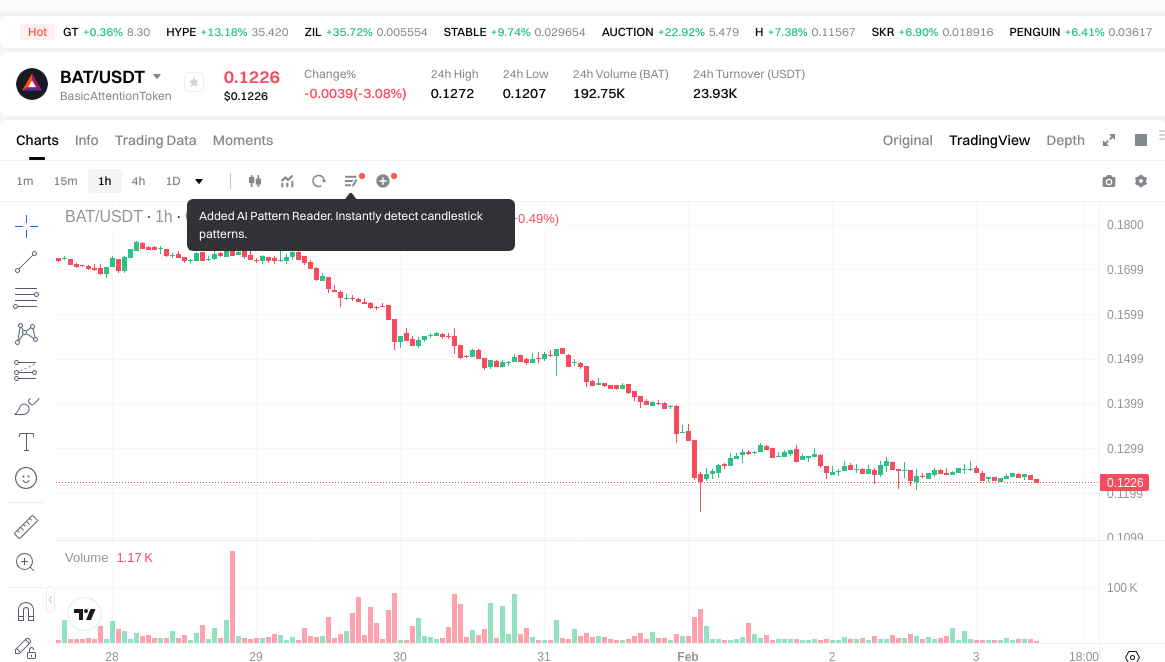
Historical Price Trends of ZERC (Coin A) and BAT (Coin B)
- 2024: ZERC reached its all-time high of $0.51359 on May 22, 2024, following the project's rebranding from DeRace and the launch of its zk-rollup-based infrastructure for GameFi.
- 2021: BAT reached its all-time high of $1.9 on November 28, 2021, during the broader crypto market rally that year.
- 2017: BAT launched at an initial price of $0.035998 on July 16, 2017, establishing its position in the digital advertising sector.
- Comparative Analysis: During recent market cycles, ZERC has declined from its peak of $0.51359 to a low of $0.00881 recorded on November 24, 2025, representing a substantial decrease. In comparison, BAT has decreased from its high of $1.9 to a low of $0.072394 recorded on July 16, 2017.
Current Market Status (2026-02-03)
- ZERC current price: $0.009407
- BAT current price: $0.1232
- 24-hour trading volume: ZERC $12,555.71 vs BAT $23,916.73
- Market capitalization: ZERC $1,128,840 vs BAT $184,271,897.90
- Market sentiment index (Fear & Greed Index): 17 (Extreme Fear)
View real-time prices:
- Check ZERC current price Market Price
- Check BAT current price Market Price
II. Core Factors Influencing ZERC vs BAT Investment Value
Tokenomics Comparison
- ZERC: The token demonstrates stability characteristics and transparency in its supply mechanism, which appeals to investors seeking predictable tokenomics models.
- BAT: The token operates within a defined supply framework that supports its ecosystem growth and user adoption initiatives.
- 📌 Historical Pattern: Supply mechanisms play a role in shaping price dynamics over different market cycles, though specific patterns vary based on market conditions and adoption rates.
Institutional Adoption and Market Applications
- Institutional Holdings: BAT has shown notable traction in decentralized finance (DeFi) applications and demonstrates growing user adoption metrics.
- Enterprise Adoption: Both tokens have varying levels of integration in digital payment systems and blockchain-based applications, with adoption patterns influenced by market demand and technical innovation.
- Regulatory Environment: Policy frameworks across different jurisdictions continue to evolve, affecting both tokens' operational landscapes and compliance requirements.
Technical Development and Ecosystem Building
- ZERC Technical Features: The project emphasizes transparency and stability mechanisms in its technical architecture.
- BAT Technical Development: The token benefits from significant developments in DeFi integration and user growth initiatives, supported by technical innovation and community engagement.
- Ecosystem Comparison: BAT demonstrates activity in DeFi applications and digital advertising sectors, while both tokens continue developing their respective ecosystem use cases.
Macroeconomic Factors and Market Cycles
- Inflation Environment Performance: Both tokens respond to macroeconomic conditions differently based on their use cases and market positioning.
- Macroeconomic Monetary Policy: Interest rate changes, monetary policy adjustments, and broader financial market conditions influence investor sentiment toward digital assets.
- Geopolitical Factors: Cross-border transaction demand and international developments affect the adoption and utility of both tokens in different market contexts.
III. 2026-2031 Price Forecast: ZERC vs BAT
Short-term Forecast (2026)
- ZERC: Conservative $0.0051 - $0.0094 | Optimistic $0.0094 - $0.0116
- BAT: Conservative $0.104 - $0.123 | Optimistic $0.123 - $0.175
Medium-term Forecast (2028-2029)
- ZERC may enter a consolidation phase, with estimated prices ranging from $0.0096 to $0.0148
- BAT may enter a growth phase, with estimated prices ranging from $0.109 to $0.264
- Key drivers: institutional capital inflows, ETF developments, ecosystem expansion
Long-term Forecast (2030-2031)
- ZERC: Baseline scenario $0.0119 - $0.0159 | Optimistic scenario $0.0159 - $0.0193
- BAT: Baseline scenario $0.155 - $0.254 | Optimistic scenario $0.254 - $0.332
View detailed price predictions for ZERC and BAT
Disclaimer
ZERC:
| Year |
Predicted High Price |
Predicted Average Price |
Predicted Low Price |
Price Change |
| 2026 |
0.01158537 |
0.009419 |
0.00508626 |
0 |
| 2027 |
0.01480808085 |
0.010502185 |
0.00892685725 |
11 |
| 2028 |
0.01430030020525 |
0.012655132925 |
0.009617901023 |
34 |
| 2029 |
0.014825488221637 |
0.013477716565125 |
0.011995167742961 |
43 |
| 2030 |
0.017689502991726 |
0.014151602393381 |
0.012877958177976 |
50 |
| 2031 |
0.01926386875799 |
0.015920552692554 |
0.011940414519415 |
69 |
BAT:
| Year |
Predicted High Price |
Predicted Average Price |
Predicted Low Price |
Price Change |
| 2026 |
0.175461 |
0.1227 |
0.104295 |
0 |
| 2027 |
0.198277065 |
0.1490805 |
0.129700035 |
21 |
| 2028 |
0.224045629425 |
0.1736787825 |
0.109417632975 |
41 |
| 2029 |
0.264486733930125 |
0.1988622059625 |
0.153123898591125 |
61 |
| 2030 |
0.275692619236111 |
0.231674469946312 |
0.203873533552755 |
88 |
| 2031 |
0.332325443414487 |
0.253683544591212 |
0.154746962200639 |
106 |
IV. Investment Strategy Comparison: ZERC vs BAT
Long-term vs Short-term Investment Strategies
- ZERC: May appeal to investors interested in emerging GameFi infrastructure and zk-rollup technology applications, with a focus on early-stage project development and ecosystem expansion potential.
- BAT: May suit investors seeking exposure to established digital advertising models and browser-based user incentive mechanisms, with relatively more mature market positioning and ecosystem integration.
Risk Management and Asset Allocation
- Conservative Investors: ZERC 20-30% vs BAT 70-80%
- Aggressive Investors: ZERC 40-50% vs BAT 50-60%
- Hedging Tools: Stablecoin allocation, options strategies, cross-asset portfolio diversification
V. Potential Risk Comparison
Market Risks
- ZERC: Lower liquidity conditions with 24-hour trading volume of $12,555.71 may present challenges during market volatility periods, alongside price fluctuation patterns observed since its 2024 launch.
- BAT: Market sentiment influences related to broader crypto market cycles, with historical price movements reflecting varying levels of correlation with overall market trends.
Technical Risks
- ZERC: Scalability considerations for zk-rollup infrastructure, network stability during ecosystem expansion phases.
- BAT: Platform dependency factors, integration challenges with evolving browser technologies and digital advertising standards.
Regulatory Risks
- Global regulatory frameworks continue evolving differently for GameFi-focused projects versus digital advertising tokens, with compliance requirements varying across jurisdictions and potentially affecting operational models for both assets.
VI. Conclusion: Which Is the Better Buy?
📌 Investment Value Summary:
- ZERC Characteristics: Represents exposure to GameFi infrastructure development and zk-rollup technology adoption, with positioning in emerging Web3 gaming sector applications.
- BAT Characteristics: Offers participation in established digital advertising innovation and browser-based user incentive models, supported by longer operational history since 2017.
✅ Investment Considerations:
- Beginner Investors: Consider starting with smaller position sizes and focus on understanding both tokens' underlying use cases, market dynamics, and risk factors before making allocation decisions.
- Experienced Investors: Evaluate portfolio diversification opportunities by assessing correlation patterns, technical development progress, and ecosystem growth metrics for both assets.
- Institutional Investors: Conduct comprehensive due diligence on liquidity conditions, regulatory compliance status, and long-term sustainability of both tokens' business models and technical architectures.
⚠️ Risk Disclosure: Cryptocurrency markets exhibit high volatility characteristics. This content does not constitute investment advice. Investors should conduct independent research and consult qualified financial professionals before making investment decisions.
VII. FAQ
Q1: What are the main differences between ZERC and BAT in terms of their core use cases?
ZERC focuses on GameFi infrastructure built on zk-rollup technology for Web3 gaming applications, while BAT targets decentralized digital advertising and user incentives within the Brave browser ecosystem. ZERC launched in 2024 as a specialized infrastructure for gaming-related blockchain applications, whereas BAT has been operating since 2017 with a focus on revolutionizing the digital advertising model through blockchain technology. The fundamental distinction lies in their target markets: ZERC serves the emerging GameFi sector, while BAT addresses challenges in online advertising and user reward mechanisms.
Q2: Which token demonstrates better liquidity and market capitalization?
BAT significantly outperforms ZERC in both metrics, with a market capitalization of $184,271,897.90 compared to ZERC's $1,128,840, and 24-hour trading volume of $23,916.73 versus $12,555.71. This substantial difference reflects BAT's longer market presence since 2017 and broader adoption within the Brave ecosystem. BAT's higher liquidity provides investors with easier entry and exit opportunities, while ZERC's lower liquidity may present challenges during periods of market volatility, potentially resulting in wider bid-ask spreads and increased price slippage.
Q3: How do the historical price performances of ZERC and BAT compare?
ZERC reached its all-time high of $0.51359 on May 22, 2024, and has since declined to current levels around $0.009407, representing a significant decrease. BAT achieved its peak of $1.9 on November 28, 2021, during the broader crypto market rally, and currently trades at $0.1232. Both tokens have experienced substantial corrections from their respective highs, though BAT's longer operational history provides more data points for analyzing price patterns across multiple market cycles. The current market sentiment index of 17 (Extreme Fear) suggests challenging conditions affecting both assets.
Q4: What are the projected price ranges for ZERC and BAT through 2031?
For ZERC, conservative estimates range from $0.0051-$0.0094 in 2026, potentially reaching $0.0119-$0.0193 by 2031 under optimistic scenarios. BAT projections show conservative estimates of $0.104-$0.123 in 2026, with potential growth to $0.155-$0.332 by 2031 in optimistic conditions. These forecasts consider factors including institutional adoption, ecosystem development, and broader market cycles. However, cryptocurrency price predictions carry substantial uncertainty, and actual performance may deviate significantly from these estimates due to market volatility, regulatory changes, and technological developments.
Q5: What investment allocation strategy should different investor types consider for ZERC vs BAT?
Conservative investors might consider a 20-30% ZERC to 70-80% BAT allocation, favoring BAT's established market presence and higher liquidity. Aggressive investors could pursue a more balanced 40-50% ZERC to 50-60% BAT split, accepting higher risk for potential upside in ZERC's emerging GameFi sector. Beginner investors should start with smaller position sizes and focus on understanding each token's fundamentals before making allocation decisions. Portfolio diversification with stablecoin allocations and risk management tools remains essential regardless of investor profile, given the high volatility characteristics of cryptocurrency markets.
Q6: What are the primary risks associated with investing in ZERC versus BAT?
ZERC faces liquidity challenges with lower trading volume, scalability considerations for its zk-rollup infrastructure, and uncertainties related to GameFi sector adoption. BAT encounters risks including platform dependency on Brave browser adoption, integration challenges with evolving digital advertising standards, and market sentiment fluctuations tied to broader crypto cycles. Both tokens face regulatory uncertainties as global frameworks for GameFi projects and digital advertising tokens continue evolving differently across jurisdictions. Additionally, technical risks related to network stability, smart contract vulnerabilities, and competition from similar projects present ongoing challenges for both assets.
Q7: How do macroeconomic factors affect ZERC and BAT differently?
Both tokens respond to macroeconomic conditions based on their distinct market positioning and use cases. Interest rate changes and monetary policy adjustments influence investor risk appetite, potentially affecting speculative assets like ZERC more significantly due to its lower market capitalization and emerging sector focus. BAT may demonstrate different sensitivity patterns given its integration within the established Brave ecosystem and digital advertising applications. Geopolitical factors and cross-border transaction demand also play varying roles, with inflation environments potentially impacting user adoption rates and utility for both tokens in different ways across international markets.
Q8: What technical developments should investors monitor for both ZERC and BAT?
For ZERC, key technical developments include zk-rollup infrastructure scaling progress, GameFi ecosystem expansion, and integration with Web3 gaming platforms. BAT investors should monitor DeFi integration advancements, Brave browser user growth metrics, and improvements to the digital advertising reward mechanism. Both projects' ecosystem building efforts, partnership announcements, and technical upgrade implementations serve as important indicators of long-term viability. Additionally, tracking developer activity, community engagement levels, and competition from similar projects provides valuable insights into each token's technical sustainability and market positioning strength.
* The information is not intended to be and does not constitute financial advice or any other recommendation of any sort offered or endorsed by Gate.