As DeFi gradually shifts from high volatility yield strategies toward more stable returns, low risk assets such as US Treasuries and money market funds are emerging as a new engine for on-chain growth. Ondo Finance has risen within this trend by introducing structured products that bring traditional financial yields onto the blockchain, offering users a more predictable source of returns.
From a broader perspective, the ONDO token is not just a governance tool, it also serves as a key bridge between on-chain capital and traditional financial systems. Its economic model reflects a hybrid approach that combines real yield from underlying assets with protocol level token incentives. This marks a transition in DeFi from liquidity driven growth toward a more sustainable model centered on yield and asset quality.
Core Functions and Use Cases of the ONDO Token
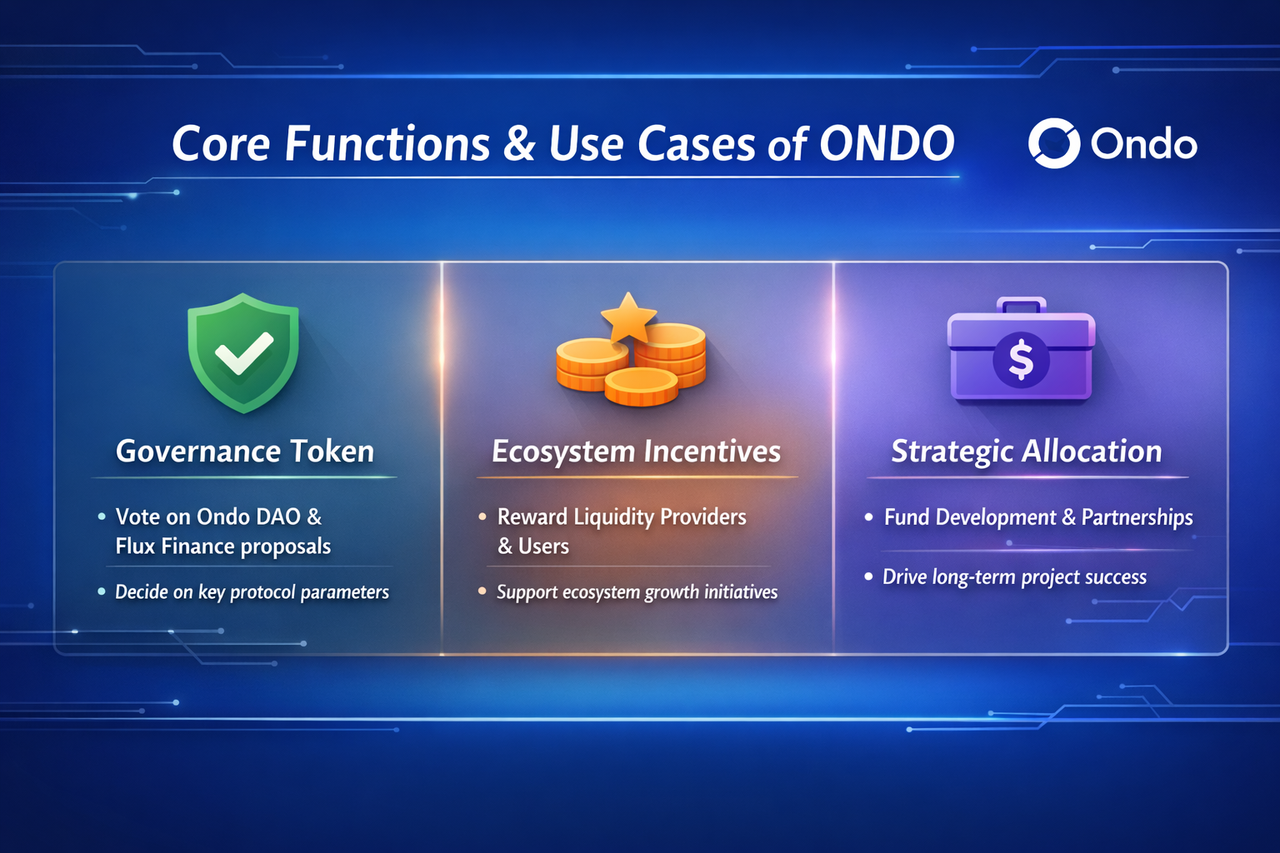
The ONDO token plays multiple roles within the Ondo Finance ecosystem. It is not designed as a simple payment or reward token, but rather as a core component spanning governance, ecosystem incentives, and value capture.
-
ONDO acts as the primary governance credential. Token holders can participate in key protocol decisions, including product launches, asset allocation strategies, fee structures, and risk parameters. This ensures that the direction of the protocol is shaped by the community and stakeholders, rather than controlled by a centralized entity.
-
ONDO plays an important role in ecosystem incentives. The protocol distributes token rewards to encourage users to provide liquidity, use products, and contribute to ecosystem development, creating a positive feedback loop. For example, early participants in RWA products such as on-chain US Treasury funds may receive additional ONDO incentives to compensate for liquidity provision and trust costs.
-
ONDO also has potential value capture mechanisms. As the protocol’s assets under management grow, generating more fee revenue, the token may be linked to this income through mechanisms such as buybacks, distributions, or staking, providing long term value support.
Token Issuance, Distribution, and Incentive Design
The ONDO tokenomics model is structured more like a long term governance resource allocation system. Its core goal is to gradually transition control of the protocol to the community while sustaining incentives for ecosystem expansion.
In terms of issuance, ONDO has a fixed total supply of 10 billion tokens, with no inflation model. This means there is no additional minting to dilute existing holders. The design emphasizes long term supply stability, making token value more dependent on ecosystem growth and governance demand rather than inflation driven incentives.
The distribution is clearly structured and paired with long term vesting schedules:
-
Ecosystem Growth accounts for approximately 52.1%, used to incentivize user participation, partnerships, and ecosystem development, making it the largest allocation
-
Protocol Development accounts for approximately 33.0%, allocated to the team, developers, and long term technical development
-
Private Sales account for approximately 12.9%, distributed to early investors and strategic backers
-
Community Access Sale accounts for approximately 2.0%, made available to a broader user base
In terms of circulating supply, about 14.3% of ONDO was initially in circulation. The remaining tokens are subject to vesting schedules that include a one-year lockup followed by multi-year linear release periods, extending up to five years. This structure helps limit short term sell pressure while aligning long term incentives.
Vesting terms vary across participants:
-
Team and core contributors may face lockups of up to five years
-
Seed and Series A investors typically have a one-year lockup followed by 48 months of linear release
-
Community sale allocations generally have shorter lockups to improve market liquidity
It is important to note that ONDO does not rely on the high inflation liquidity mining model common in early DeFi. Instead, participation is driven through ecosystem fund allocation and governance control. For example, the DAO can vote on how tokens are distributed to incentivize specific products, markets, or partners, enabling more precise and strategic resource allocation.
Overall, ONDO’s token distribution and release structure is designed around three key objectives:
-
Long term incentive alignment through extended vesting for core participants
-
Ecosystem first growth, with over half of the supply dedicated to expansion
-
Governance driven allocation, where the DAO determines how resources are used
This positions ONDO more as a governance claim on an on-chain asset management platform rather than a simple liquidity incentive token, reflecting the higher demands for stability and capital efficiency in the RWA sector.
How to Participate in Decentralized Governance with ONDO
ONDO holders can directly participate in protocol governance through on-chain mechanisms, typically involving three stages: proposal, voting, and execution.
During the proposal stage, users holding a sufficient amount of ONDO can submit governance proposals. These may include adding new asset categories, adjusting yield distribution models, or refining risk parameters. Proposals must meet minimum thresholds to prevent spam and maintain governance efficiency.
In the voting stage, token holders vote based on their holdings, with voting power weighted by token balance. While this improves capital efficiency, it may also introduce the risk of whale dominance. Some protocols address this through delegated voting or quadratic voting mechanisms.
In the execution stage, approved proposals are either automatically implemented through smart contracts or carried out by a governance execution layer. This ensures transparency and verifiability in decision making.
Notably, ONDO governance extends beyond parameter adjustments. It also involves selecting and managing real world assets. This means participants need a certain level of financial understanding, not just familiarity with on-chain operations.
Market Value and Long Term Potential of ONDO
The market value of ONDO ultimately depends on two key variables: assets under management and the protocol’s ability to generate real yield.
As the RWA sector continues to expand, capital is increasingly shifting from high risk DeFi strategies toward lower volatility, predictable yield assets. By bringing traditional assets such as US Treasuries on-chain, Ondo Finance has positioned itself as a key player in this transition.
The value of ONDO may be driven by several factors:
-
Growth in assets under management, leading to increased fee revenue
-
Entry of institutional capital, driven by demand for compliant RWA products
-
Ecosystem expansion, with more applications integrating Ondo’s asset products
-
Optimization of token mechanisms, such as staking, buybacks, or revenue sharing
Over the long term, if Ondo can establish stable asset management capabilities and continue integrating real world assets within a compliant framework, its token may take on characteristics similar to equity in an on-chain asset management platform.
Risks and Return Profile of Investing in ONDO
Despite its clear use case and growth narrative, investing in ONDO involves multiple risks.
-
Regulatory risk: The RWA sector involves traditional financial assets and is highly dependent on regulatory frameworks across different jurisdictions. Regulatory tightening could impact product issuance and user participation.
-
Asset risk: While US Treasuries are generally considered low risk, they are not risk free. Interest rate changes and liquidity conditions can affect yield performance.
-
Token model risk: Poorly designed incentive mechanisms may lead to increased price volatility or even liquidity issues.
-
Market competition: As RWA becomes a popular sector, more protocols are entering the space, requiring Ondo to maintain its product and structural advantages.
From a return perspective, ONDO’s potential upside mainly comes from two sources:
As a result, its risk return profile resembles a hybrid structure combining a high growth asset with a stable yield foundation.
Conclusion
The ONDO tokenomics model represents an important evolution in how DeFi integrates with real world assets. At its core, it combines token incentives with real yield to build a more sustainable growth framework.
Compared to early DeFi models that relied heavily on high inflation incentives, Ondo places greater emphasis on asset quality, yield stability, and long term capital efficiency. This gives it a structural advantage in the current market environment.
As the RWA sector continues to develop, whether ONDO can truly establish itself as a long term on-chain asset management platform will depend on its ability to navigate regulation, refine product design, and expand its ecosystem. This is not only a test of its token model, but also a broader experiment in the convergence of DeFi and traditional finance.







