


What Is EIP-1559? How Do ETH Burning and the Fee Mechanism Work?
As the Ethereum ecosystem expanded rapidly, the old fee model struggled to handle sharp fluctuations in network activity. EIP-1559 was introduced to improve user experience and implement a burn mechanism. Examining its definition, fee structure, ETH burning process, and impact on network behavior helps clarify its role within Ethereum’s broader economic model.
What Is EIP-1559?
An EIP, or Ethereum Improvement Proposal, is the standardized process for proposing changes to Ethereum. EIP-1559 was one of the most significant technical upgrades included in Ethereum’s London hard fork.
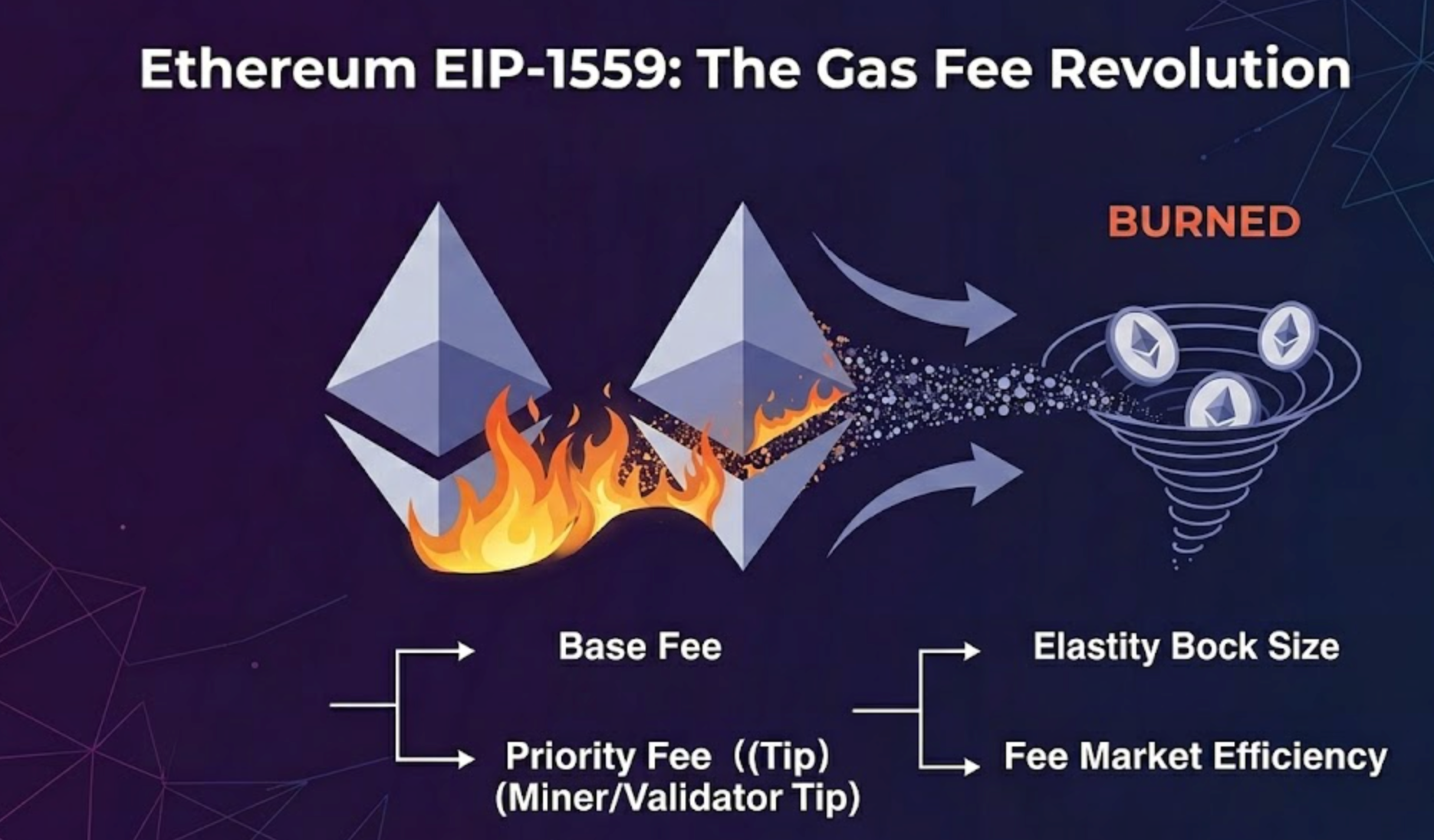
As a proposal aimed at restructuring Ethereum’s transaction fee market, its core objective was to optimize gas pricing. In doing so, it fundamentally changed how transaction fees are estimated and paid on the network.
Before EIP-1559, transaction fees were entirely market driven, which made gas prices difficult to predict. EIP-1559 introduced a system of “predictable pricing” and “automatic block size adjustments”, smoothing out fee volatility and, for the first time, directly linking ETH supply to network activity.
The Gas Auction Model Before EIP-1559
Prior to EIP-1559, Ethereum used a first price auction mechanism with the following characteristics:
- Bidding logic: Users set the gas price they were willing to pay, and miners, now validators, prioritized transactions offering the highest bids.
- Inefficiency: To ensure faster confirmation, users often overpaid, driving fees higher. All gas fees paid went directly to block producers.
- Poor user experience: During periods of congestion, it was difficult to determine an optimal gas price that would secure inclusion without overpaying, leading to widespread bidding wars.
This model worked reasonably well when network usage was low. However, during periods of heavy DeFi and NFT activity, its flaws became obvious. Users either overpaid significantly or saw their transactions stuck, reducing overall efficiency.
The Structure of Base Fee and Priority Fee
EIP-1559 divides transaction fees into two distinct components: the Base Fee and the Priority Fee. This separation distinguishes network resource pricing from validator incentives, improving both transparency and predictability.
- Base Fee: This functions as the required cost of entry into a block. It is automatically adjusted by the protocol based on congestion in the previous block. By shifting pricing authority from manual bidding to an algorithm, the system makes fees more predictable.
- Priority Fee: Also known as a tip, this portion is paid directly to validators. It compensates them for prioritizing a transaction, particularly during busy periods. This preserves a degree of market based competition while maintaining validator incentives.
- Max Fee: The maximum total amount a user is willing to pay, covering both the Base Fee and the Priority Fee.
By separating “resource pricing” from “block inclusion incentives”, Ethereum moved away from a pure “auction model” toward a more mature “dynamic pricing system”, laying a more stable economic foundation for large scale Web3 applications.
How Does the ETH Burning Mechanism Work?
The most revolutionary aspect of EIP-1559 is the introduction of Base Fee burning. Whenever a transaction is successfully included in a block, the Base Fee portion of the payment is not given to validators. Instead, it is sent to an inaccessible address and permanently removed from circulation.
This means that part of the ETH used in every transaction is effectively destroyed. When network activity is high, the amount of ETH burned increases, creating deflationary pressure.
However, this does not guarantee permanent deflation. When Ethereum usage is high, the total ETH burned through Base Fees can exceed newly issued ETH, resulting in periods of net deflation.
The Impact of EIP-1559 on Network Behavior
The implementation of EIP-1559 has had significant effects on the Ethereum ecosystem:
- Smoother user experience: Wallets can automatically suggest accurate fees based on the current Base Fee, removing the need for manual guesswork.
- Elastic block capacity: Block size is no longer strictly fixed. It can fluctuate between 15 million and 30 million Gas to absorb short term spikes in demand.
- Enhanced monetary properties: The burn mechanism gives ETH characteristics similar to “super sound money”, with value increasingly tied to network activity.
- Restructured validator revenue: Validator income now consists of Priority Fees and block rewards, reducing manipulation incentives and improving fairness.
The Limitations and Misconceptions of EIP-1559
Although EIP-1559 improves user experience, several common misunderstandings remain:
- It does not directly reduce gas fees. The primary goal of EIP-1559 is predictability, not lower costs. Fees are still determined by supply and demand for network resources.
- Bidding still occurs during congestion. In extreme cases, such as popular NFT launches, users may still need to increase their Priority Fee to compete for limited block space.
- It does not guarantee permanent ETH deflation. Whether ETH becomes net deflationary depends on transaction volume and issuance from staking rewards. If network usage declines, burned ETH may be lower than newly issued ETH.
Conclusion: The Significance of EIP-1559 in Ethereum’s Economic Model
By introducing the dual structure of Base Fee and Priority Fee, EIP-1559 reshaped Ethereum’s fee market and established an ETH burning mechanism tied directly to network activity. This improved transparency and predictability while linking ETH supply dynamics to on chain usage.
In broader terms, EIP-1559 represents more than a technical fee adjustment. It marks a turning point in Ethereum’s monetary policy. By connecting network usage with token deflation through its burn mechanism, it creates a positive feedback loop between ecosystem growth and value capture, helping users better understand cost and value within complex Web3 interactions.
FAQ
Does EIP-1559 mean ETH will definitely become deflationary?
Not necessarily. Net deflation depends on the relationship between the amount of ETH burned and newly issued ETH. Ethereum only enters a deflationary phase when daily ETH burned exceeds daily issuance.
Can the Base Fee be manually adjusted?
No. The Base Fee is automatically adjusted by the protocol based on block utilization.
Is there risk in setting a very high Max Fee?
The risk is relatively low. Under EIP-1559, users are charged only the actual Base Fee plus Priority Fee, and any excess is automatically refunded. Setting a higher Max Fee mainly protects against sudden Base Fee spikes that could otherwise cause a transaction to fail.
Do validators still earn transaction fees?
Yes, but they receive only the Priority Fee, not the full transaction fee.
Does EIP-1559 solve Ethereum’s congestion problem?
It does not directly increase capacity, but the elastic block mechanism helps buffer short term demand spikes.
Does the burn mechanism affect network security?
No. Validators continue to earn revenue through Priority Fees and block rewards. As long as network activity remains healthy, the incentive structure stays intact.
Share
Content


Related Articles

Exploring 8 Major DEX Aggregators: Engines Driving Efficiency and Liquidity in the Crypto Market

What Is Copy Trading And How To Use It?

What Is Technical Analysis?

How to Do Your Own Research (DYOR)?

What Is Fundamental Analysis?
