

Trade
Basic
Futures
Futures
Hundreds of contracts settled in USDT or BTC
TradFi
Gold
Trade global traditional assets with USDT in one place
Options
Hot
Trade European-style vanilla options
Unified Account
Maximize your capital efficiency
Demo Trading
Futures Kickoff
Get prepared for your futures trading
Futures Events
Participate in events to win generous rewards
Demo Trading
Use virtual funds to experience risk-free trading
Earn
Launch
CandyDrop
Collect candies to earn airdrops
Launchpool
Quick staking, earn potential new tokens
HODLer Airdrop
Hold GT and get massive airdrops for free
Launchpad
Be early to the next big token project
Alpha Points
Trade on-chain assets and enjoy airdrop rewards!
Futures Points
Earn futures points and claim airdrop rewards
Investment
Simple Earn
Earn interests with idle tokens
Auto-Invest
Auto-invest on a regular basis
Dual Investment
Buy low and sell high to take profits from price fluctuations
Soft Staking
Earn rewards with flexible staking
Crypto Loan
0 Fees
Pledge one crypto to borrow another
Lending Center
One-stop lending hub
VIP Wealth Hub
Customized wealth management empowers your assets growth
Private Wealth Management
Customized asset management to grow your digital assets
Quant Fund
Top asset management team helps you profit without hassle
Staking
Stake cryptos to earn in PoS products
Smart Leverage
New
No forced liquidation before maturity, worry-free leveraged gains
GUSD Minting
Use USDT/USDC to mint GUSD for treasury-level yields

More


MICA Daily|Tom Lee predicts January's new high for BTC, ETH breaks 7,000, what about now?
2h ago
Bullish "hope" shattered? Bitcoin drops below $78,000, analysts warn: weekend sell-off is just the beginning
2h ago
Trending Topics
View More374.94K Popularity
2.55K Popularity
3.16K Popularity
1.94K Popularity
1.06K Popularity
Hot Gate Fun
View More- MC:$0.1Holders:00.00%
- MC:$2.74KHolders:10.00%
- MC:$2.72KHolders:10.00%
- MC:$2.68KHolders:10.00%
- MC:$2.67KHolders:10.00%



Pin
It's already 2026. Who is still playing with NFTs?
Author: Nancy, PANews
It’s 2026, and the story of NFTs should have long been over.

Once sold for astronomical prices, most NFTs have now become unnoticed small images; many NFT projects are struggling to transition, sell, or shut down amid waves of rebranding, sales, and closures; the once-top-tier event NFT Paris recently announced its discontinuation, even falling into refund disputes.
During consecutive years of downturn, hot money has exited, narratives have failed, and “NFT is dead” seems to have become a market consensus.
However, in the week of 2026, the NFT market surprisingly shows signs of recovery, with prices rising and trading volume increasing. Has NFT really come back? What are the remaining players still doing in the space?
A New Year’s Kickoff, Price Surge “Like a Different World”
Entering 2026, the long-dormant NFT market finally stirs with a long-awaited ripple.
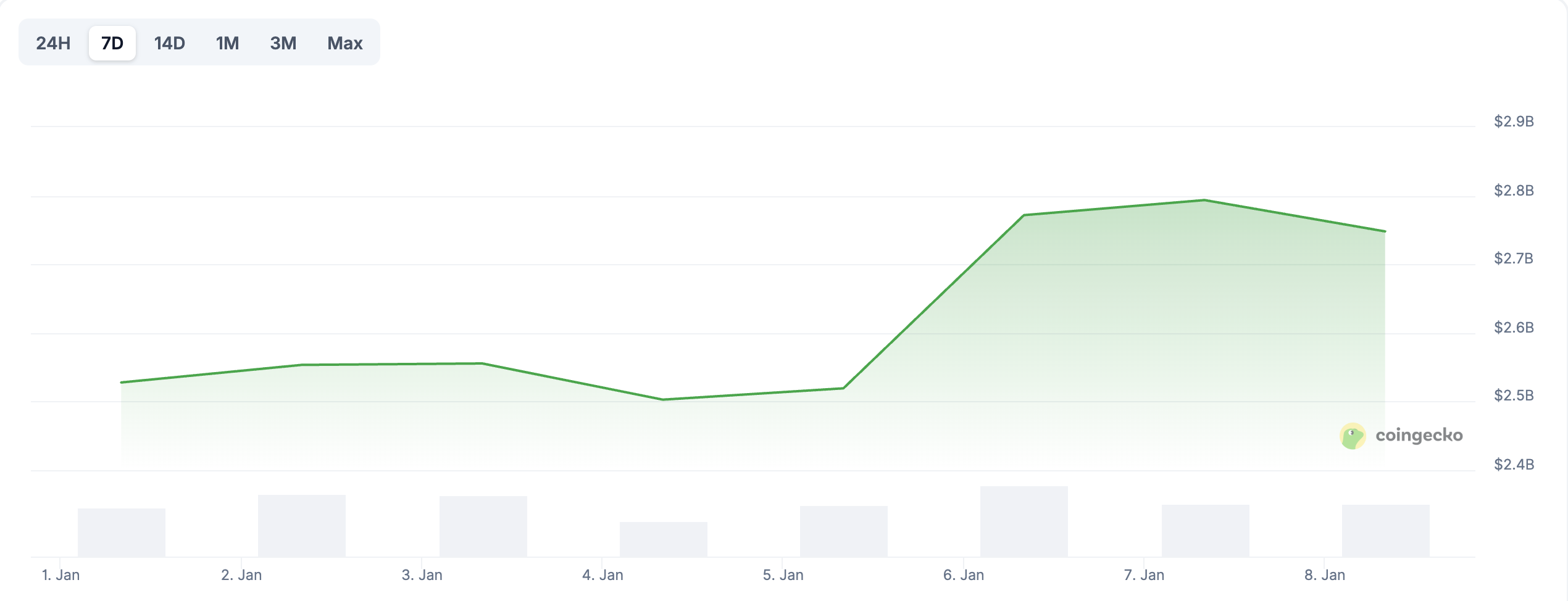
According to CoinGecko data, since the beginning of 2026, the overall market cap of NFTs has increased by over $220 million in the past week. NFT Price Floor data further shows that in the past week, hundreds of NFT projects experienced price rebounds, with some projects even recording three- to four-digit gains. For players who have endured years of decline, their hopes have been shattered, and this market movement feels like a different world.
Although this is just a drop in the bucket compared to historical highs, compared to the freezing point at the end of 2025, the long-lost green market is enough to bring some comfort to steadfast players.
However, behind the price increase, the current market warming appears more like a game of existing capital within a very small range, rather than a true recovery driven by new capital influx. The extreme lack of liquidity is a fatal flaw the market cannot ignore.
Looking at weekly trading volume, among over 1,700 NFT projects, only 6 have trading volumes reaching the million-dollar level, 14 projects have trading volumes in the hundreds of thousands of dollars, and only 72 are in the tens of thousands range. Overall, very scarce. Even top-tier projects with higher trading volumes have only a small percentage of active NFTs relative to total supply, with most NFTs trading in single digits or even zero.
In fact, The Block’s 2025 report also shows that the NFT market throughout the year did not see strong reinvestment of funds, with speculative enthusiasm cooling significantly, and the multi-chain proliferation returning to Ethereum dominance. The total trading volume for the year dropped to $5.5 billion, about 37% lower than 2024; the total market cap shrank sharply from approximately $9 billion to about $2.4 billion.
These data indicate that the so-called rebound has not changed the fact that NFTs have long been inactive. Today’s NFTs have long become “old assets,” only held by veteran players, while new capital has long ceased to buy in.
The Great Escape and Survival Stories, Capital Flows into New Battlegrounds
In this long winter cold wave, from infrastructure to blue-chip projects, various survival stories are unfolding.
For example, the trading giant OpenSea no longer insists on JPEG images but is transforming its token trading business through airdrops and incentives; the once-mainstream NFT chain Flow has begun exploring DeFi growth points; Zora abandons traditional NFT models and shifts toward a “content as token” new track; even the iconic NFT Paris event has run out of funds and has been reported to have been abandoned by investors.
Even those top-tier NFTs still holding some vitality are caught in a “praise but no audience” dilemma, where brand influence has not translated into a price moat. For example, Pudgy Penguins successfully boosted IP awareness in mainstream circles and sold physical toys hotly, but still cannot escape the downward pressure on floor and token prices.
Meanwhile, the cessation of NFT services by Reddit, Nike’s sale of its RTFKT division, and the departure of Web2 giants have further shattered the last illusions of mainstream adoption.
But the decline of NFTs does not mean the disappearance of collecting and speculative demand; capital has just shifted to a new battlefield. Compared to virtual images on-chain, off-chain markets like collectibles and trading cards are still hot, for example, Pokémon TCG trading volume exceeds $1 billion, with revenue over $100 million.
Not only ordinary collectors, but even crypto elites are starting to vote with their feet, returning to physical assets and top collectibles.
For example, crypto artist Beeple has turned to physical robot creations, with celebrity robot dogs like Elon Musk’s being sold out; Wintermute co-founder Yoann Turpin invested $5 million in buying dinosaur fossils; Animoca founder Yat Siu spent $9 million on a Stradivarius violin.
In the current market environment, ordinary investors need to seriously face the reality of NFT liquidity exhaustion.
Farewell to the Small Image Logic, These NFTs Are More Popular
After the bubble burst, the NFT market is not experiencing a complete capital drought but is flowing toward targets with high profit-loss ratios or clear value support.
· Speculation and arbitrage demand: Some players believe the market has bottomed out, engaging in short-term trading by capturing price mismatches, which offers high risk-reward ratios.
· “Golden Shovel” attribute: These are the NFTs with the highest market participation and liquidity at this stage. Essentially, these NFTs are no longer collectibles but financial certificates for future airdrops, mostly meaning access to airdrops/whitelist opportunities. However, expectations are bearish once snapshots are completed or airdrops are distributed; if project teams do not empower NFTs with new utility, floor prices often plummet rapidly or even drop to zero. Therefore, these NFTs are more suitable as short-term investments or arbitrage tools rather than long-term value storage.
· Celebrity/Top Project Endorsements: The value of these NFTs relies on attention economy. Endorsements by celebrities or top projects can significantly boost visibility and liquidity, creating short-term premiums. For example, the top DEX HyperLiquid previously airdropped the Hypurr NFT series to early users, which has been rising steadily; Ethereum founder Vitalik Buterin recently changed his avatar to Milady NFT, and its floor price has noticeably increased.
· Top IP: These NFTs have moved beyond simple hype, with investment logic leaning toward cultural recognition and collection value, making them relatively anti-dip and suitable for long-term value storage. For example, CryptoPunks, which was officially added to the permanent collection of MoMA at the end of last year.
· Acquisition narratives: When projects are acquired by stronger capital, the market re-prices, expecting their IP monetization ability and brand moat to strengthen, thus pushing prices upward. For example, Pudgy Penguins and Moonbirds saw significant price increases after being acquired.
· Real-world asset integration: By tokenizing real assets on-chain, NFTs can gain tangible value support, reduce downside risks, and enhance their outside-market appeal. For example, recently popularized Pokémon card tokenization platforms like Collector Crypt and Courtyard allow users to trade ownership of cards/items on-chain, with physical items stored by the platform.
· Practical functions: NFTs are returning to tool-like roles, serving specific application scenarios such as NFT tickets, DAO voting rights, AI on-chain identities (e.g., Ethereum ERC-8004’s NFT-based AI agent identities).
From this perspective, compared to chasing meaningless small images, NFTs with practical utility or clear upward potential are gradually becoming the focus of capital attention.