

Trade
Basic
Futures
Futures
Hundreds of contracts settled in USDT or BTC
TradFi
Gold
Trade global traditional assets with USDT in one place
Options
Hot
Trade European-style vanilla options
Unified Account
Maximize your capital efficiency
Demo Trading
Futures Kickoff
Get prepared for your futures trading
Futures Events
Participate in events to win generous rewards
Demo Trading
Use virtual funds to experience risk-free trading
Earn
Launch
CandyDrop
Collect candies to earn airdrops
Launchpool
Quick staking, earn potential new tokens
HODLer Airdrop
Hold GT and get massive airdrops for free
Launchpad
Be early to the next big token project
Alpha Points
Trade on-chain assets and enjoy airdrop rewards!
Futures Points
Earn futures points and claim airdrop rewards
Investment
Simple Earn
Earn interests with idle tokens
Auto-Invest
Auto-invest on a regular basis
Dual Investment
Buy low and sell high to take profits from price fluctuations
Soft Staking
Earn rewards with flexible staking
Crypto Loan
0 Fees
Pledge one crypto to borrow another
Lending Center
One-stop lending hub
VIP Wealth Hub
Customized wealth management empowers your assets growth
Private Wealth Management
Customized asset management to grow your digital assets
Quant Fund
Top asset management team helps you profit without hassle
Staking
Stake cryptos to earn in PoS products
Smart Leverage
New
No forced liquidation before maturity, worry-free leveraged gains
GUSD Minting
Use USDT/USDC to mint GUSD for treasury-level yields

More


Cryptocurrency exemption fails to take effect in January! US SEC urgently "puts on the brakes," Wall Street erupts
2h ago
【Madman on Trends】Bitcoin heading towards "break," consider swing trading below 80,000
5h ago
Trending Topics
View More378.64K Popularity
7.28K Popularity
7.15K Popularity
4.24K Popularity
2.83K Popularity





Pin
On-chain data hits new highs. In a sluggish market, how does the Avalanche ecosystem "build nests to attract phoenixes"?
Zen, PANews
Since Q4 2025, Avalanche has been experiencing a rapid resurgence in on-chain activity, nearly synchronized with institutional adoption. On one side, mainnet activity indicators have repeatedly hit new highs at the end of the year and in January; on the other side, a series of events focused on institutional workflows and compliance distribution have emerged intensively. Even in a challenging market, the story of assets going on-chain continues to accelerate. Institutionalization Drives Asset On-Chain In January 2026, the well-known crypto investment bank Galaxy Digital announced the successful issuance of its first tokenized loan collateral (CLO) on Avalanche, with a total scale of $75 million, of which $50 million was subscribed by the institutional credit agreement Grove. CLO is a structured credit product that packages corporate loans for sale to investors of different risk levels. Its tranches are tokenized and issued via the regulated digital asset platform INX on the Avalanche network, offering trading to qualified investors. This investment is actually Grove’s second large-scale deployment on the Avalanche platform. In July last year, Grove announced the launch on Avalanche, with an initial deployment strategy aiming to issue up to approximately $250 million in real-world assets (RWA). Grove allocated funds to JAAA, issued through the multi-chain protocol Centrifuge on its native chain, and circulated the tokenized shares on Avalanche C-Chain.
As a high-performance public chain designed specifically for institutional finance, Avalanche offers advantages such as EVM compatibility, rapid deployment, and access to compliant distribution channels. Additionally, Avalanche emphasizes quick deployment of customizable Avalanche L1 (Atomic Subnets), which better meets requirements for access, compliance, performance, and risk control, making it one of the top-tier financial institutions on-chain.
For example, Balcony, a New Jersey real estate infrastructure company, announced in May last year that it deployed a scalable, dedicated Avalanche L1 service via the AvaCloud platform, aiming to digitize and tokenize property records worth approximately $240 billion across over 370,000 land parcels. AvaCloud is a hosted blockchain service provider for Avalanche L1, assisting enterprises in building, deploying, and scaling Layer-1 networks.
Data Shows a “Double-Edged Sword”
Avalanche’s institutional route has contributed to steady growth in its on-chain assets. According to Token Terminal data, the total market cap of stablecoins and tokenized funds on Avalanche’s mainnet has increased by about 70% over two years since January 2024.
Data from RWA.xyz shows that as of January 21, Avalanche’s stablecoin assets exceeded $2.2 billion, and RWA assets totaled over $1.351 billion — including approximately $636 million in Distributed Assets (tokens that can be transferred peer-to-peer between wallets) and about $715 million in Represented Assets (assets that cannot be transferred outside the issuing platform). Distributed Assets focus on market coverage, inclusive finance, and platform interoperability; Represented Assets serve more as shared ledgers for accounting, clearing, and settlement, with blockchain networks acting as a shared record.
By December 2025, total L1 transaction volume on Avalanche surpassed 10 billion. With this milestone, the ecosystem officially entered a recovery phase at the end of the year. In that month, Avalanche’s C-Chain set new records for the highest single-day and weekly activity in 2025, with active addresses reaching 651.2 million, weekly capital inflows of $43 million, ranking second among all blockchains at one point.
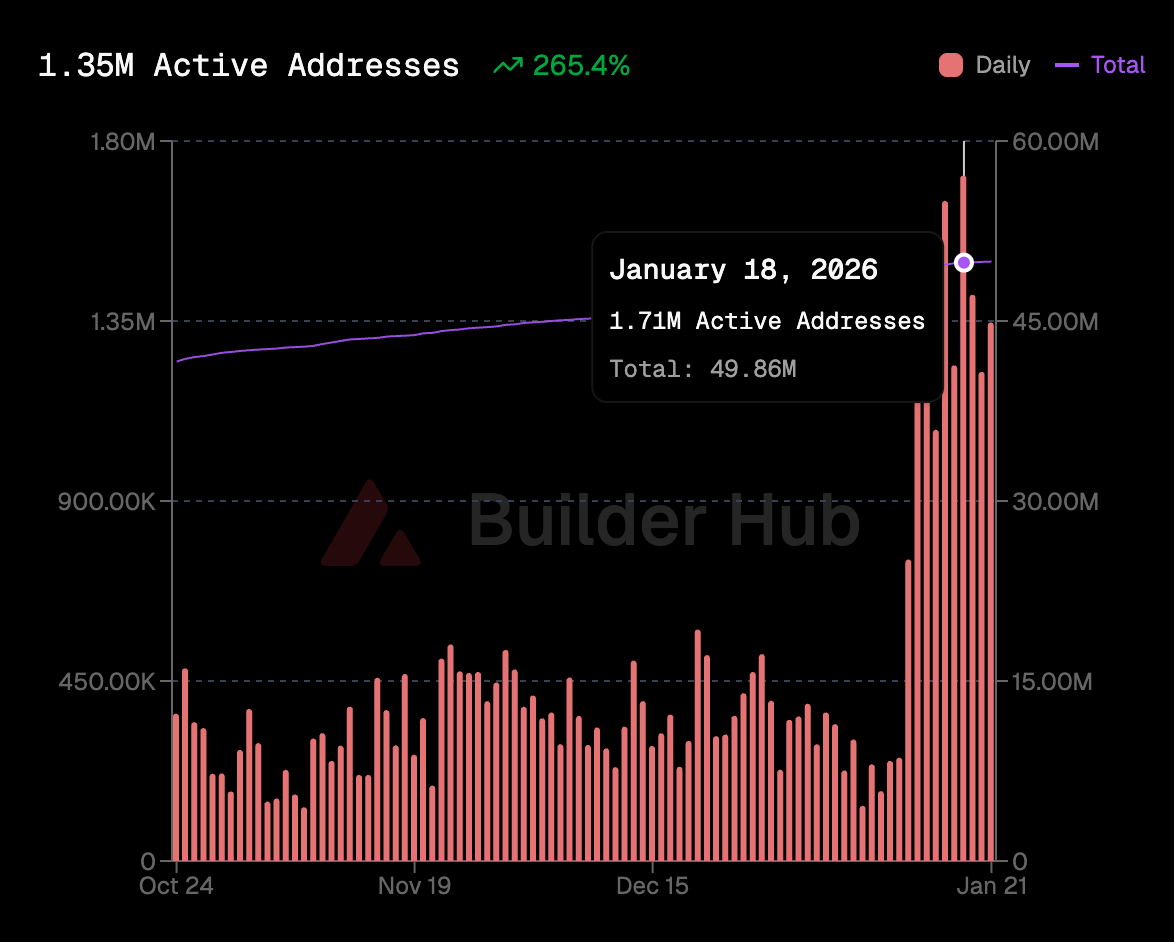
Entering the new year, Avalanche continued its growth momentum from late 2025, with its main network (primarily C-Chain, along with P-Chain and X-Chain) hitting new daily active address records, peaking at 1.71 million on January 18.
This investment is actually Grove’s second large-scale deployment on the Avalanche platform. In July last year, Grove announced the launch on Avalanche, with an initial deployment strategy aiming to issue up to approximately $250 million in real-world assets (RWA). Grove allocated funds to JAAA, issued through the multi-chain protocol Centrifuge on its native chain, and circulated the tokenized shares on Avalanche C-Chain.
As a high-performance public chain designed specifically for institutional finance, Avalanche offers advantages such as EVM compatibility, rapid deployment, and access to compliant distribution channels. Additionally, Avalanche emphasizes quick deployment of customizable Avalanche L1 (Atomic Subnets), which better meets requirements for access, compliance, performance, and risk control, making it one of the top-tier financial institutions on-chain.
For example, Balcony, a New Jersey real estate infrastructure company, announced in May last year that it deployed a scalable, dedicated Avalanche L1 service via the AvaCloud platform, aiming to digitize and tokenize property records worth approximately $240 billion across over 370,000 land parcels. AvaCloud is a hosted blockchain service provider for Avalanche L1, assisting enterprises in building, deploying, and scaling Layer-1 networks.
Data Shows a “Double-Edged Sword”
Avalanche’s institutional route has contributed to steady growth in its on-chain assets. According to Token Terminal data, the total market cap of stablecoins and tokenized funds on Avalanche’s mainnet has increased by about 70% over two years since January 2024.
Data from RWA.xyz shows that as of January 21, Avalanche’s stablecoin assets exceeded $2.2 billion, and RWA assets totaled over $1.351 billion — including approximately $636 million in Distributed Assets (tokens that can be transferred peer-to-peer between wallets) and about $715 million in Represented Assets (assets that cannot be transferred outside the issuing platform). Distributed Assets focus on market coverage, inclusive finance, and platform interoperability; Represented Assets serve more as shared ledgers for accounting, clearing, and settlement, with blockchain networks acting as a shared record.
By December 2025, total L1 transaction volume on Avalanche surpassed 10 billion. With this milestone, the ecosystem officially entered a recovery phase at the end of the year. In that month, Avalanche’s C-Chain set new records for the highest single-day and weekly activity in 2025, with active addresses reaching 651.2 million, weekly capital inflows of $43 million, ranking second among all blockchains at one point.
Entering the new year, Avalanche continued its growth momentum from late 2025, with its main network (primarily C-Chain, along with P-Chain and X-Chain) hitting new daily active address records, peaking at 1.71 million on January 18.
 However, if we shift focus from on-chain activity to asset pricing and DeFi activity, the “recovery curve” is not as evident. According to CoinGecko data, from mid-January to now, AVAX’s closing price has fluctuated roughly between $12 and $15, closing at about $12.09 on January 20 — the lowest since November 2023.
Looking at chain-level metrics from DeFiLlama, Avalanche’s native TVL is approximately $1.66 billion, with bridged TVL around $3.62 billion. Meanwhile, on-chain fees/revenue remain relatively low on a daily basis, indicating that even with increasing transaction counts and addresses, protocol-level value capture may not be proportionate.
However, considering macro factors, cryptocurrencies, especially L1 tokens, have generally been under pressure over the past year. Even with institutional collaborations or technological progress within the ecosystem, stronger market beta and the longstanding issue of lack of large-scale applications overshadow Avalanche’s valuation issues, which are not unique to it.
Building a Nest for the Phoenix: Launching a $1 Million Builder Competition
For infrastructure projects, a bear market is also a good time to accumulate strength and focus on ecosystem development.
Taking advantage of the recent rebound in on-chain activity, Avalanche has intensified its developer support initiatives. On January 21, the Avalanche Foundation announced the launch of the “BuildGames” builder competition, offering a total prize pool of $1 million. The competition is set for six weeks, with a rolling review process, and opened for registration immediately. The competition has no specific theme or track restrictions. Outstanding teams may also receive follow-up guidance and funding from Avalanche’s incubation program.
However, if we shift focus from on-chain activity to asset pricing and DeFi activity, the “recovery curve” is not as evident. According to CoinGecko data, from mid-January to now, AVAX’s closing price has fluctuated roughly between $12 and $15, closing at about $12.09 on January 20 — the lowest since November 2023.
Looking at chain-level metrics from DeFiLlama, Avalanche’s native TVL is approximately $1.66 billion, with bridged TVL around $3.62 billion. Meanwhile, on-chain fees/revenue remain relatively low on a daily basis, indicating that even with increasing transaction counts and addresses, protocol-level value capture may not be proportionate.
However, considering macro factors, cryptocurrencies, especially L1 tokens, have generally been under pressure over the past year. Even with institutional collaborations or technological progress within the ecosystem, stronger market beta and the longstanding issue of lack of large-scale applications overshadow Avalanche’s valuation issues, which are not unique to it.
Building a Nest for the Phoenix: Launching a $1 Million Builder Competition
For infrastructure projects, a bear market is also a good time to accumulate strength and focus on ecosystem development.
Taking advantage of the recent rebound in on-chain activity, Avalanche has intensified its developer support initiatives. On January 21, the Avalanche Foundation announced the launch of the “BuildGames” builder competition, offering a total prize pool of $1 million. The competition is set for six weeks, with a rolling review process, and opened for registration immediately. The competition has no specific theme or track restrictions. Outstanding teams may also receive follow-up guidance and funding from Avalanche’s incubation program.
 From the foundation’s existing support system, Avalanche’s developer support is not just a one-time event but divided into several parallel channels.
The first is the official accelerator Codebase, which focuses on rapid mentorship for early-stage teams and non-dilutive funding support. Selected teams can receive $50,000 in funding and practical support covering product development, token design, validator/infrastructure strategies, growth, and compliance.
Second is the foundation’s Grants program, mainly targeting infrastructure and AI-related projects. Lastly, Retro9000, with a maximum fund pool of $40 million, aims to reward teams that have already delivered tangible results and impact on Avalanche L1 or key toolchains, lowering the barrier of “funding before delivery” and favoring proven builders.
On the infrastructure front, Avalanche completed a network upgrade codenamed “Granite” at the end of last year, consisting of three ACPs (ACP-181/204/226). The Granite upgrade introduced dynamic block times, biometric authentication, and a more stable validator view, improving cross-chain message reliability and performance.
Overall, in the past month, Avalanche’s ecosystem has gained institutional capacity for scaling, and with infrastructure development and developer incentives, it has laid a solid foundation for growth in 2026.
From the foundation’s existing support system, Avalanche’s developer support is not just a one-time event but divided into several parallel channels.
The first is the official accelerator Codebase, which focuses on rapid mentorship for early-stage teams and non-dilutive funding support. Selected teams can receive $50,000 in funding and practical support covering product development, token design, validator/infrastructure strategies, growth, and compliance.
Second is the foundation’s Grants program, mainly targeting infrastructure and AI-related projects. Lastly, Retro9000, with a maximum fund pool of $40 million, aims to reward teams that have already delivered tangible results and impact on Avalanche L1 or key toolchains, lowering the barrier of “funding before delivery” and favoring proven builders.
On the infrastructure front, Avalanche completed a network upgrade codenamed “Granite” at the end of last year, consisting of three ACPs (ACP-181/204/226). The Granite upgrade introduced dynamic block times, biometric authentication, and a more stable validator view, improving cross-chain message reliability and performance.
Overall, in the past month, Avalanche’s ecosystem has gained institutional capacity for scaling, and with infrastructure development and developer incentives, it has laid a solid foundation for growth in 2026.