


From Olympic athlete to transnational drug lord! FBI wanted fugitive captured, involved in running drug trafficking using Bitcoin and stablecoins

Former Olympic athlete Ryan Wedding involved in transnational drug trafficking and apprehended in Mexico, authorities reveal extensive use of stablecoins and multi-chain laundering, highlighting new challenges in cryptocurrency regulation.
Former Olympian turns into transnational drug lord, US-Mexico cooperation completes arrest
U.S. law enforcement agencies recently announced that a suspect listed among the Federal Bureau of Investigation’s Top Ten Most Wanted has been captured in Mexico. 44-year-old Ryan Wedding, who represented Canada in the 2002 Salt Lake City Winter Olympics snowboarding event, is now accused of being a core member of a cocaine smuggling group spanning Colombia, Mexico, the United States, and Canada.
The U.S. Department of Justice stated that Wedding had been hiding in Mexico for a long time and was arrested with the assistance of local law enforcement. He has been extradited to the U.S. for trial. U.S. Attorney General Pamela Bondi described the case as “a fall from Olympic athlete to suspected violent drug kingpin,” emphasizing its significance for North American and global security.
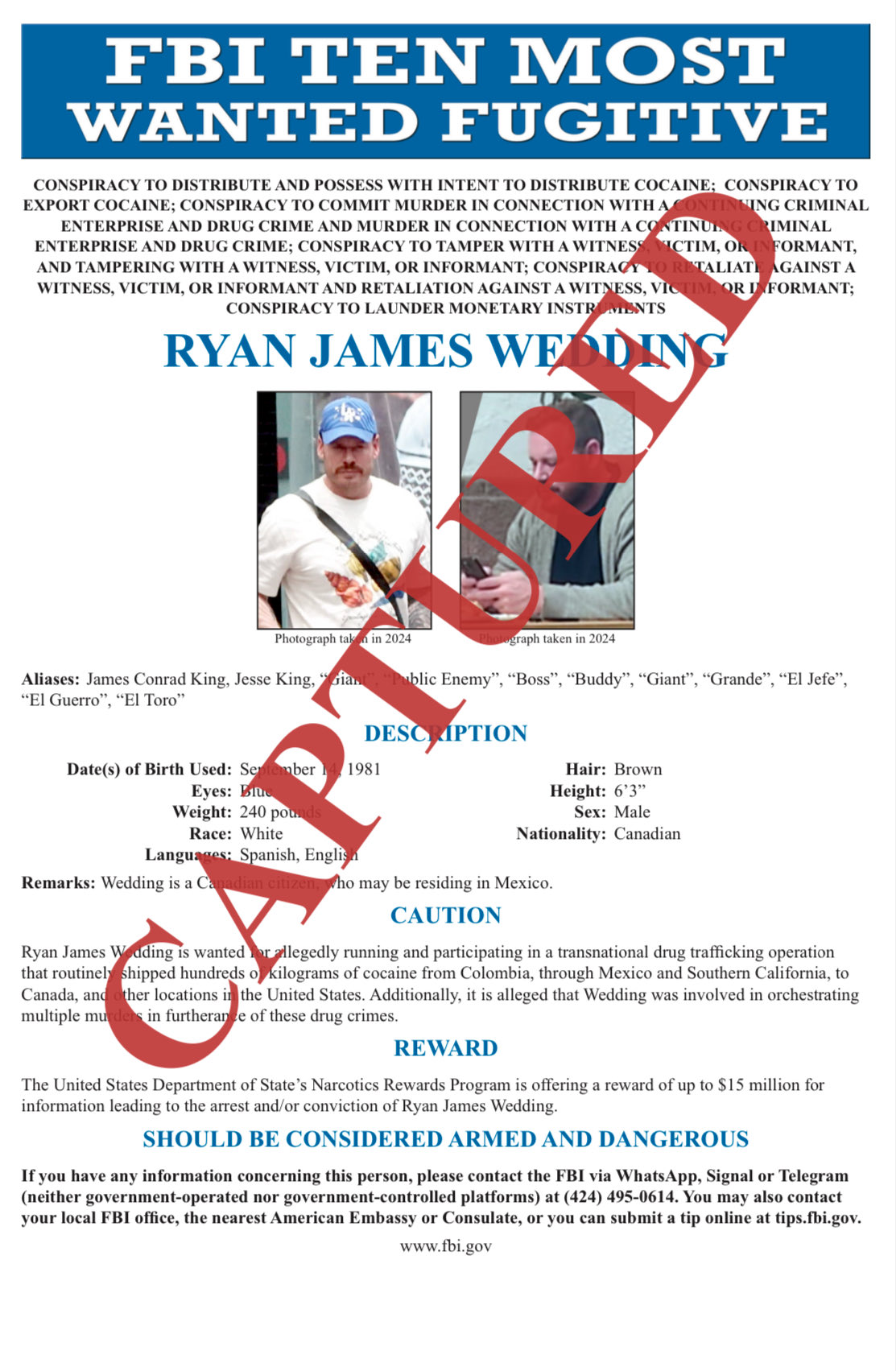
Image source: X/@FBIDirectorKash The U.S. Department of Justice announced that Ryan Wedding, one of the Top Ten Most Wanted, has been apprehended in Mexico.
Highly encrypted drug money flow, stablecoins become transaction tools
Investigations show that Wedding’s organization extensively used Bitcoin and stablecoins for drug transactions and money laundering, deliberately avoiding traditional financial regulation. The U.S. Treasury Department has placed Wedding and related individuals on sanctions lists in November 2024, directly accusing the group of “using cryptocurrency networks to transfer and conceal large amounts of illegal proceeds.”
The indictment states that members of the drug trafficking group received drug payments via QR codes using $USDT and transferred funds across multiple blockchains to obfuscate the source. The flow of funds spans major chains such as Bitcoin, Ethereum, Tron, Solana, and BNB Chain, demonstrating a highly sophisticated and large-scale money laundering architecture.
Sanctions and seizure operations underway, crypto assets as key evidence
Prior to the arrest, U.S. law enforcement had launched multiple strikes against Wedding’s criminal network. By the end of 2024, they seized approximately 1 ton of cocaine, crypto assets valued at about $3.2 million, and multiple firearms. Several front companies, including a Toronto jewelry firm accused of aiding money laundering, were also targeted.
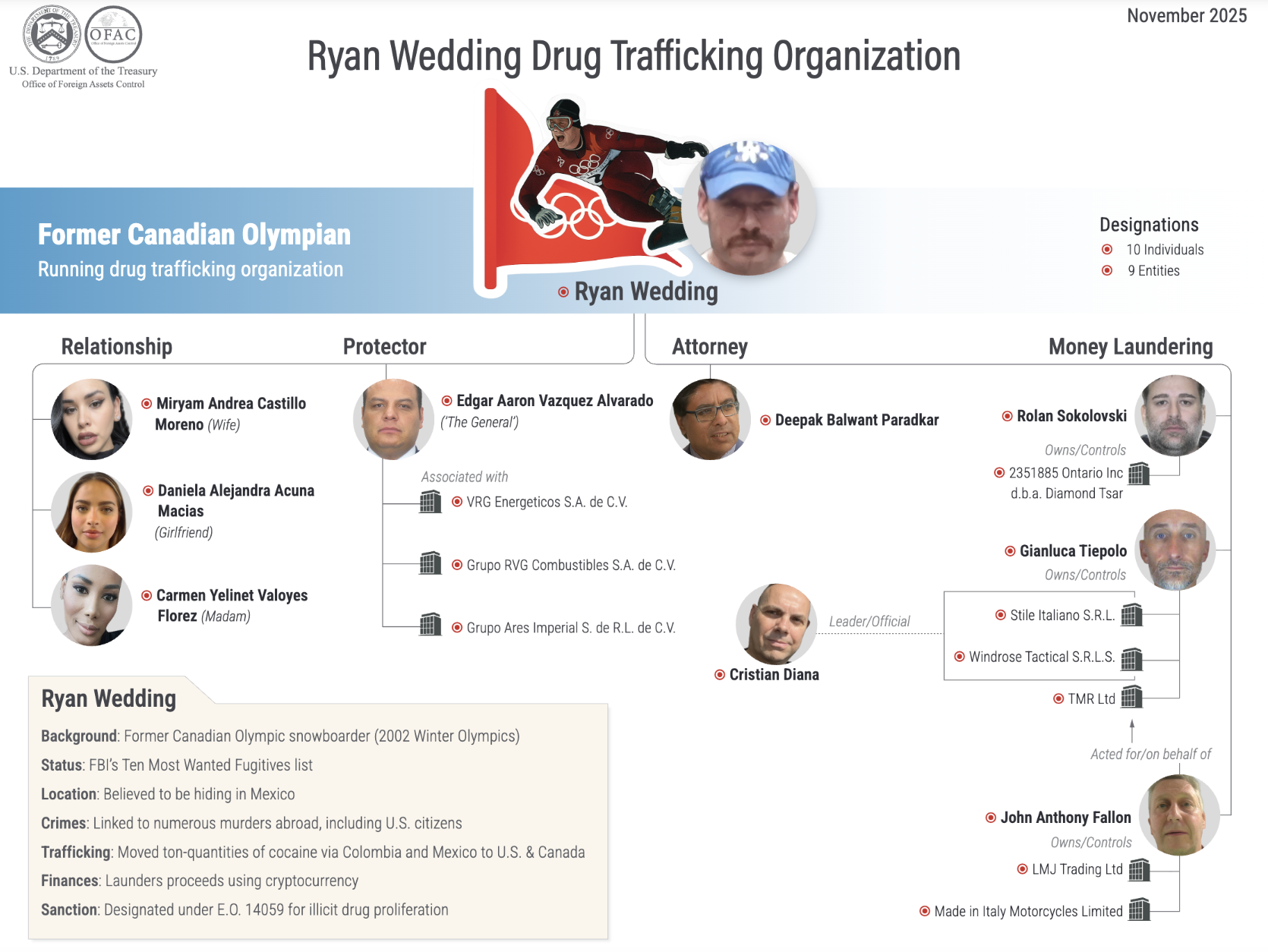
Image source: U.S. Department of the Treasury Office of Foreign Assets Control Ryan Wedding drug trafficking organization structure diagram
The U.S. Department of the Treasury also released over a dozen crypto wallet addresses associated with Wedding and his accomplices, aiming to cut off their ability to transfer funds via blockchain. Law enforcement officials pointed out that this “multi-chain money laundering model” is gradually becoming standard for large transnational criminal organizations, forcing regulators to enhance on-chain tracking and international cooperation capabilities.
Violence and political signals, case sparks crypto regulation debate
In addition to drug and money laundering charges, Wedding is also accused of inciting multiple violent crimes, including ordering the murder of a federal witness cooperating with investigations in Colombia in January 2025, and retaliatory shootings related to stolen drugs. U.S. prosecutors have filed additional charges under the “Continuing Criminal Enterprise” statute, with the maximum penalty potentially including life imprisonment.
This case has reignited discussions about the misuse of cryptocurrencies by criminal organizations. U.S. officials emphasize that the case does not discredit blockchain technology itself but highlights the regulatory challenges posed by anonymity and decentralization in cross-border crime scenarios. With Wedding’s successful capture, law enforcement signals that even with the use of crypto assets and multi-national cover-ups, transnational crime remains difficult to evade long-term investigation and judicial sanctions.
Related Articles
FTX Founder Sam Bankman-Fried Requests New Trial After Firing Attorney
SafeMoon founder Braden Karony sentenced to 100 months in prison
The United States imposes sanctions on Lebanon's gold trading company Jood SARL
YZi Labs addresses the CEA Industries Board of Directors: Requesting clarification on false news and full disclosure of a director's related-party transaction
7 Malaysian police officers threaten and extort Chinese tourists, forcing them to transfer 352,000 yuan in cryptocurrency