


XRP Double Good News! US Bank Holdings Revealed, Ripple Receives Luxembourg License
Bank of America first disclosed holding 13,000 shares of XRP ETF, a significant symbolic gesture. Ripple has obtained a license from Luxembourg’s CSSF, allowing it to provide payment services across the 27 EU countries. Ripple Prime supports Hyperliquid derivatives protocol. Technical analysis shows XRP under pressure, RSI at 30 indicating oversold conditions, and MACD negative, dominated by bears.
Bank of America’s First Disclosure of XRP ETF Holdings
Bank of America has directly linked itself to XRP for the first time, but not through the XRP token itself. In a recent report, the bank disclosed its holdings of exchange-traded products tied to XRP, which immediately drew market attention. This involves approximately 13,000 shares of Volatility Shares XRP ETF. On the surface, this is a small position, but for Bank of America, this type of investment is significant in itself.
This exposure is achieved through an ETF, not by directly holding the tokens. For large banks, this approach still appears to be the most prudent choice. The focus here is more on who is participating rather than the amount involved. When one of the largest US banks records a position in XRP within a regulated instrument, it aligns with the overall market pattern. Major players tend to participate indirectly in crypto assets through familiar legal structures rather than directly via wallets and custodians.
While 13,000 shares may seem modest, its symbolic significance far exceeds its actual monetary value. It marks the first public acknowledgment by a traditional bank of holding XRP, even if indirectly through an ETF. For XRP, long marginalized by traditional finance, this investment is a form of legitimization. It signals to the market that XRP is now sufficiently compliant and mature to be included in mainstream financial asset allocations.
There is particular interest in the long-standing relationship between Bank of America and Ripple. As early as 2019, the bank participated in cross-border payment pilot programs. Additionally, the bank’s name appeared in blockchain settlement experiments. Industry insiders regularly discuss potential collaborations in stablecoins and payment infrastructure, though no official statements have been made about specific partnership models. This long-term engagement provides context for the ETF investment, demonstrating that Bank of America’s understanding of Ripple’s technology and the XRP ecosystem is not superficial.
Overall, the market has long viewed ETFs as the simplest entry point for institutional investors. They offer exposure to asset prices without the need to handle tokens, navigate regulatory complexities, or manage operational risks. Against this backdrop, the new report further confirms that, despite cautious interest from traditional finance, XRP remains a key focus.
Ripple Secures Luxembourg License to Expand Across 27 EU Countries
In addition to its cooperation with Bank of America, Ripple continues to actively strengthen its position at the institutional and regulatory levels. Early 2026, the company took a series of steps to significantly expand its operations outside the US. On February 2, Ripple received a license from the Luxembourg Financial Supervisory Authority (Commission de Surveillance du Secteur Financier, CSSF) for electronic money institutions.
This license grants Ripple the right to provide regulated payment services across the 27 EU member states under a unified legal framework. For Ripple, this is a crucial step in consolidating its position in the European payments market. The EU’s single license system (EU Passporting) allows a company licensed in one member state to operate across all member states automatically. This greatly reduces compliance costs and market entry barriers.
Strategic Significance of Ripple’s European Expansion
Single license across 27 countries: Luxembourg CSSF license valid throughout the EU, covering a market of 450 million people
Regulatory advantage: Post-MICA regulation, licensed institutions gain a competitive edge
Countering SWIFT: Building cross-border payment infrastructure in Europe to challenge traditional banking systems
Luxembourg, as a key financial hub in Europe, issues licenses with high value. Many global financial institutions choose to establish their European headquarters there, attracted by its mature regulatory environment and access to the EU market. Ripple’s acquisition of this license indicates its compliance capabilities have passed rigorous scrutiny, including anti-money laundering, capital adequacy, and corporate governance standards.
Ripple Prime Integrates Hyperliquid for Innovative Expansion
Meanwhile, Ripple Prime announced support for Hyperliquid, a decentralized protocol for derivatives trading. This enables institutional clients to access on-chain derivatives liquidity through a single platform. This model combines traditional prime brokerage services with decentralized infrastructure. It demonstrates Ripple’s ongoing efforts to deepen collaborations with institutions beyond traditional payment solutions.
Ripple Prime is Ripple’s enterprise-grade crypto asset platform offering custody, trading execution, liquidity aggregation, and risk management solutions. Integrating Hyperliquid shows Ripple’s ambition to expand from payments into derivatives trading, a larger and more profitable market. Hyperliquid, as an emerging decentralized derivatives protocol, is known for its deep liquidity and low latency, providing a compliant on-chain derivatives trading channel for institutional clients.
This expansion strategy indicates Ripple’s desire not just to be a cross-border payments infrastructure provider but to become a comprehensive institutional crypto services provider. From payments to custody, spot to derivatives, Ripple is building a complete ecosystem for institutional crypto finance.
Technical Deterioration: RSI at 30 Oversold Without Reversal
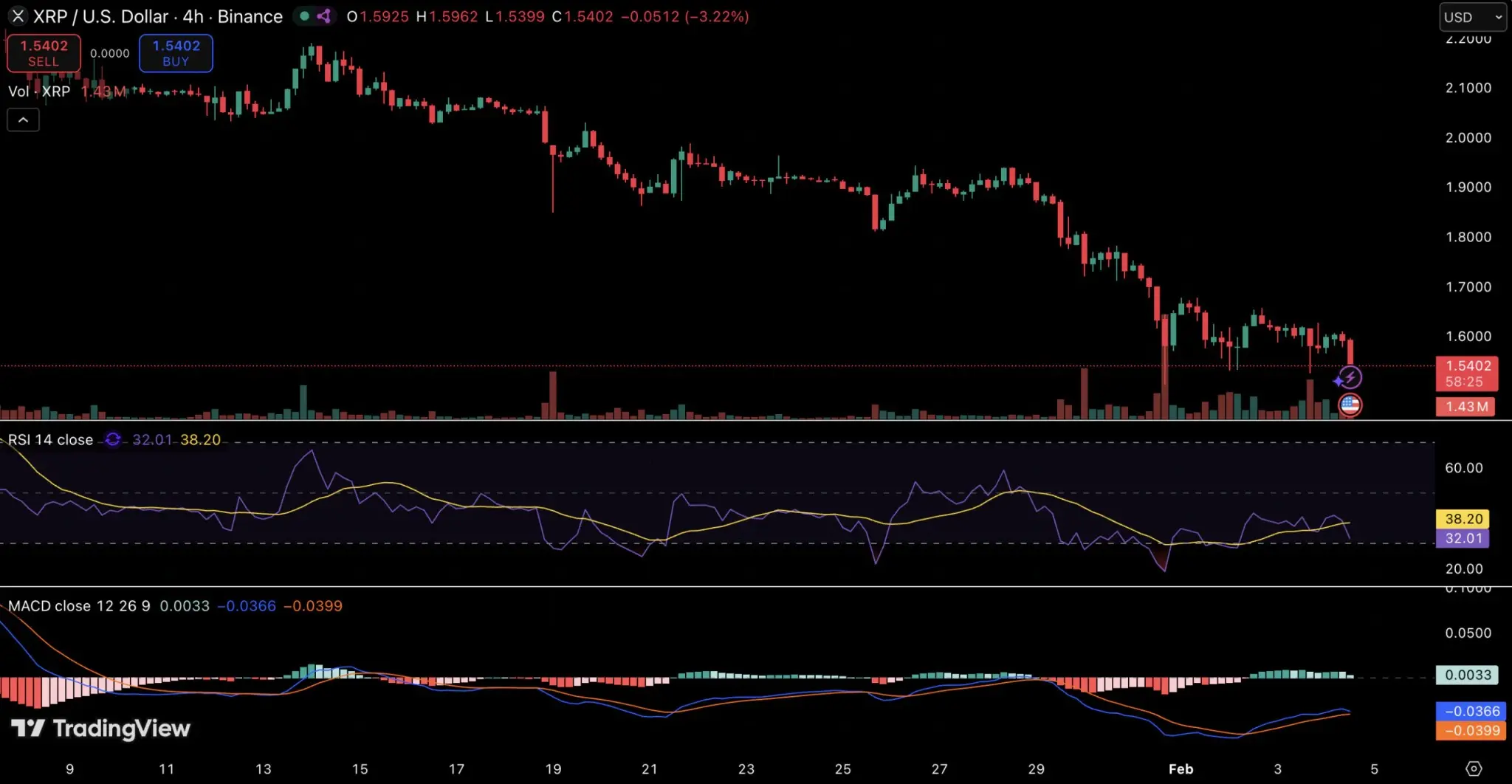
(Source: Trading View)
From a market perspective, amid widespread sell-offs in the crypto sector, XRP also faces downward pressure. On the 4-hour chart, prices show a downtrend with a series of lower highs and lower lows. This pattern indicates persistent selling pressure. Momentum indicators confirm market weakness. The Relative Strength Index has fallen to around 30, signaling oversold conditions, but no clear reversal signals have emerged.
The MACD remains below the signal line, with negative histogram bars indicating bearish momentum dominates. Although the decline has slowed, no confirmed golden cross has appeared, so the short-term outlook remains cautious. Traders are closely watching whether XRP can stabilize above recent support levels or if macroeconomic risks and the overall crypto market downturn will push prices lower until more sustainable recovery signs appear.
Fundamental positives versus technical pressures create a contradiction. The disclosure of holdings by US banks and Ripple’s European license are clear positives, yet XRP’s price has not been uplifted and continues to decline. This divergence can be explained by several factors: first, the market may have already priced in these positives; second, worsening macro conditions overshadow individual asset news; third, the actual impact of these developments may take time to reflect in prices.
For long-term investors, current conditions might present a value investment opportunity. Fundamentals are improving (institutional adoption and regulatory breakthroughs), while prices are falling (technical oversold). This combination often creates asymmetric risk-reward. However, short-term traders should be cautious; attempting to buy the dip before a clear technical reversal could lead to continued losses.
Related Articles
Ripple CEO: XRP Community Has Always Been Top Priority - U.Today